Top 7 Silicone Pet Product Manufacturers for New Product Launches in Guangdong, China
- Share
- publisher
- FromRubber
- Issue Time
- Oct 21,2026
Summary
Seven silicone pet product manufacturers with a published Guangdong base, assessed for prototype development, tooling, pilot production and scheduling. The article separates the tooling clock, the approval clock and the production clock, and explains where a launch date actually slips.
A launch date is usually set before anyone knows how long the tool will take. The date goes into the plan, the plan goes to the retailer, and the first fixable delay turns into a container that ships by air at four times the freight cost.
Guangdong is the right place to look for a silicone pet product supplier, but not for the reason most sourcing notes give. The advantage is not that factories there are faster. It is that mould shops, silicone mixers, printers, packaging suppliers and export forwarders sit within an hour of each other, so a change of plan can be absorbed locally instead of restarting the project in another province.
Seven manufacturers with a published Guangdong base are reviewed below, followed by the part of a launch that is normally underestimated: the approval loop between the first sample and the production tool.
Why Guangdong Can Be Relevant to a New Silicone Pet Product Launch
Pet spending has held up through a period when many other consumer categories contracted. The American Pet Products Association reports that 95 million US households own a pet, based on its 2025 National Pet Owners Survey cited in the 2026 State of the Industry Report. That number explains why so many new brands start with an accessory rather than a staple: the category is deep enough to support niche products.
What Guangdong offers that number cannot is a short route between the steps of a launch. A new silicone part needs a tool drawing, a cut tool, a compound, a press, a printer and a carton. In a dense manufacturing area those steps can be walked in a week. Spread across three provinces, the same steps add transit time to every revision, and a launch with two revisions becomes a launch with six weeks of freight.
The trade-off is that density also hides weak suppliers. A trading company with a desk in Dongguan can present a factory address it does not own. The check is not the address on the website but the answer to one question: which processes happen inside your building?
What a launch actually competes on: not the fastest sample, but the shortest gap between a sample and a signed approval. A factory that ships a sample in five days and then needs three weeks to correct a logo depth has not saved anybody a week.
How We Selected Manufacturers for New Product Launches
The weighting below rewards launch capability rather than catalogue breadth. A company with forty stock pet items and no tooling evidence scores lower than a company with four items and a documented prototype route.
| Evaluation criterion | Weight | Evidence accepted |
|---|---|---|
| Verifiable manufacturing presence in Guangdong | 25 | Published plant address and process description, not a sales office |
| Documented silicone pet product manufacturing | 20 | Pet products published with material and process detail |
| Prototype and mould development support | 20 | In-house tooling, drawing review, sample approval stages |
| Pilot production and customization options | 15 | Small-run capability, colour and packaging options |
| Quality control and product validation | 10 | Inspection stages, test references, dimensional reporting |
| Communication and production planning | 10 | Named process steps, stated lead-time structure |
A Guangdong office or sales address alone earns no points in the first row. Scores are editorial, from public pages reviewed on 21 October 2026, and are not an audited industry ranking.
7 Silicone Pet Product Manufacturers in Guangdong to Evaluate
| Company | Published base | Launch-relevant evidence | Score |
|---|---|---|---|
| Guangdong Yumingsheng (YMS) | Liaobu, Dongguan | In-house design, tooling and prototyping, HTV and LSR lines, ODM case work | 88 |
| Dongguan Wellfine Silicone | Shatian, Dongguan | Concept review, mould development, sampling, private label, MOQ from 200 pcs | 84 |
| SM (Dongguan Sanmao) | Dongguan | Product definition before tooling, sample-based approval route | 80 |
| Dongguan Yuankang | Dongguan | Mould development and prototyping, 17 years in silicone, private label | 76 |
| Pawseed Pet Products | Dongguan | Prototype development, mould opening, packaging customization | 74 |
| JOYI Silicone | Dongguan | Mould making and a documented drawing-to-production sequence | 72 |
| FromRubber | Qiaotou, Dongguan | In-house mould shop, CNC capacity, 32 presses across two plants | 68 |
1. Guangdong Yumingsheng (YMS)
Publishes a Dongguan manufacturing base at Liaobu with 64 production lines split between HTV compression and LSR injection, a stated tolerance of ±0.1 mm, and an in-house engineering sequence covering industrial design, structural work, 3D prototyping and mould flow analysis before tooling.
Two published case notes are relevant to a launch: a foldable travel bowl line developed as full ODM with six colourways and custom packaging, and a slow feeder mat built on a multi-cavity tool covering three surface patterns. The second is the more useful precedent, because one tool serving three SKUs changes the economics of a first order.
Confirm before tooling: which moulding route your part would run on, whether the tolerance is measured on the finished part, and the minimum order attached to a new tool rather than a stock shape.
2. Dongguan Wellfine Silicone
Operating since 2011 in Shatian with more than 300 staff and a stated plant area above 30,000 m², with compression moulding, LSR injection, printing and silicone over-moulding under one roof. The published workflow runs from concept review through mould development, sampling, production and export packing, and the site states a minimum order from 200 pieces with FBA labelling support.
Confirm before tooling: whether the 200-piece minimum applies to a new mould, and which pet categories are existing tools rather than development projects.
3. SM (Dongguan Sanmao)
Based in Dongguan and structured around defining the product before tooling: target animal, geometry, texture layout, interfaces and cleaning method are listed as project inputs, and the route is drawing, review, tooling, sample, approval. For a first-time buyer that sequence is easier to audit than a catalogue.
Confirm before tooling: how many sample revisions are included, and whether packaging tooling is handled in the same programme.
4. Dongguan Yuankang
States more than 17 years in silicone manufacturing and lists mould development, prototyping, logo engraving or printing, Pantone matching and private-label packaging as customization options, with ISO 9001, BSCI and Sedex referenced. Its pet range covers bowls, mats, toys, grooming brushes and travel bottles, which suits a launch that starts with several small items rather than one large one.
Confirm before tooling: the certification scope for your specific compound, and the real calendar for a first tool.
5. Pawseed Pet Products
Publishes several bowl formats from a Dongguan base, including a suction bowl, a lick-and-feed slow feeder and a two-mode lick bowl, with OEM/ODM, prototype development, mould opening and packaging customization stated. The product design is specific enough to suggest real development work rather than catalogue resale.
Confirm before tooling: which items are existing tools, and how suction performance is validated on textured surfaces.
6. JOYI Silicone
Presents a slow feeder and lick bowl range with an OEM programme and a documented route from requirement discussion through 3D drawing, mould making, sampling and production. Mould making appears in the process description rather than as a separate claim, which is the detail to test in a first call.
Confirm before tooling: whether tools are cut in-house, and what the sampling schedule looks like after the first revision.
7. FromRubber
A custom silicone and plastic manufacturer in Qiaotou, Dongguan, with an in-house mould shop, CNC capacity and 32 presses across two plants. The press mix is the practical detail for a launch: small machines for compact parts and low volumes, large presses for big parts and volume, so a pilot run and a bulk order do not compete for the same equipment.
Public pages list a quote within three hours, samples within five days and production moulds in seven to ten days, and the quick proofing service describes the sample stage in more detail. Pet work is presented at market level rather than as a product catalogue, so product-specific evidence has to be requested.
Confirm before tooling: comparable parts already tooled, the dimensional report format, and whether a prototype tool can be modified into the production tool.
What a New Product Launch Requires From a Manufacturer
From a product brief to a manufacturable design
A brief is not a drawing. The useful version includes the animal and size range, the use environment, the cleaning method, the target market, the colour reference and the expected first quantity. From that, a factory should be able to say which features are feasible, which need a different parting line and which will not mould at all. Two-dimensional artwork is enough to start; a 3D file is better; a physical reference sample is often the fastest route for a soft part.
Mould development and prototype approval
The prototype tool exists to answer questions, not to make saleable parts. Draft angles, parting line position, wall thickness transitions, logo depth and shrinkage compensation are settled here. Shrinkage is compound-specific, so a figure quoted from a different project is a guess. Ask for the first-article dimensional report, and ask which dimensions are critical rather than accepting a list of every dimension at once.
Pilot production before a full order
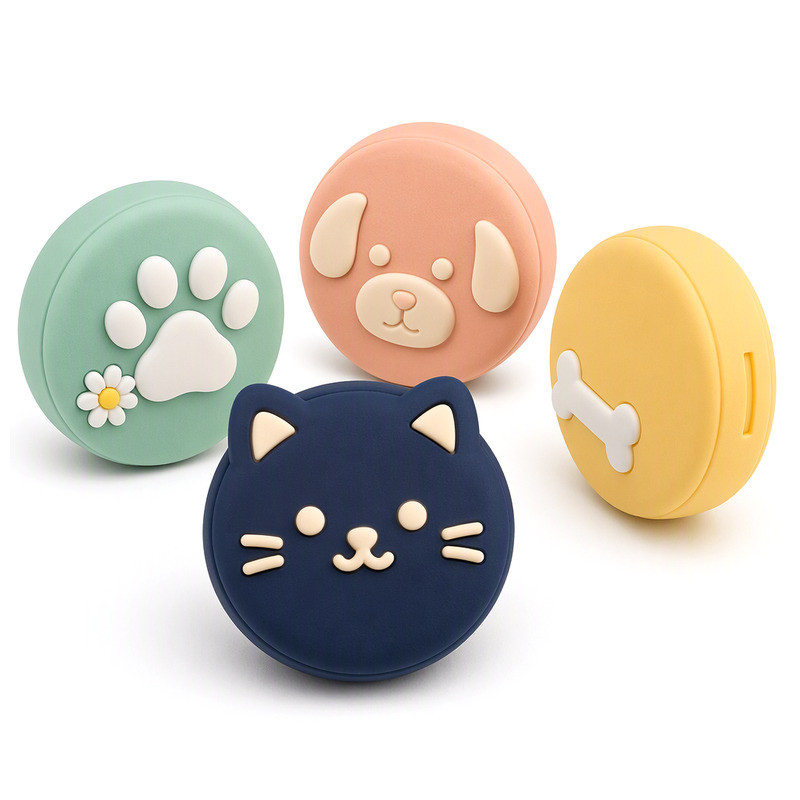
A pilot run tests the things a sample cannot: colour across a full cure cycle, flash removal on a hundred parts, packing density in a carton, and whether the assembly still fits after trimming. For a small moulded accessory such as a tracker pouch, the pilot usually reveals whether the lanyard loop tears at the gate and whether the button opening stays aligned after demoulding.
Set acceptance criteria before the pilot, not after. Appearance limits for flash and flow marks, a dimensional tolerance table, a colour reference under a defined light source and a simple functional check are enough to make the result pass or fail rather than debatable.
Production scheduling and launch risk
Three clocks run in parallel and are usually quoted as one number: tooling lead time, sample and approval time, and mass production time. A tool cut in ten days means nothing if approval takes three weeks. Ask for the four dates separately, in writing, and treat the approval date as the one that carries the risk.
Freight is the other half of the calendar. A launch planned around sea freight has roughly five weeks of slack that a launch planned around air freight does not. If the approval date slips past the sea cut-off, the difference is paid in freight rather than in schedule, and that cost lands on the first order.
Questions to Ask a Guangdong Manufacturer Before Tooling Begins
- Where is the actual production facility? Request the address and the process list performed at that address.
- Which processes are in-house? Mould cutting, mixing, moulding, printing and packing are five separate answers.
- Who owns the mould? And what happens to it if the relationship ends or the supplier moves premises.
- How many sample revisions are included? Then what a fourth revision costs in money and days.
- What must pass before mass production? The written acceptance criteria for the pilot, not a verbal assurance.
- Can you provide a dated production schedule? Four dates: tool, sample, approval, ship.
How FromRubber Approaches Custom Silicone Pet Product Manufacturing
FromRubber, the trading name of Dongguan Bohao Electronic Technology Co., Ltd. in Qiaotou Town, Dongguan, reviews a pet project in the order that reduces risk: intended use and animal size, then the drawing or reference sample, then the material and market requirement, then the quantity. The answer to the quantity question decides which press the part runs on, and that decision changes tool size, cycle time and unit cost more than most buyers expect.
The company works from two plants in Dongguan with an in-house mould shop and a mix of small and large presses, which is what allows a pilot of around a thousand pieces and a later bulk run to be quoted on suitable equipment. Multi-colour moulding, printing, spray coating and laser etching are documented on the multi-colour silicone page, and IATF 16949, ISO 9001 and ISO 14001 certificates are published on the certification page. The wider service route is set out in the product service process.
Drawings, samples or a dimensioned sketch can be sent to nani@fromrubber.com or karl@fromrubber.com, or by WeChat and WhatsApp on +86 18676210913. A feasibility answer usually comes back faster than a quotation, and it is the more useful of the two at the start.
Frequently Asked Questions
How do I verify that a silicone pet product manufacturer is based in Guangdong?
Ask for the production address and the list of processes carried out there, then check that the address appears on the company's own site rather than only on a marketplace listing. A sales office in Dongguan with moulding in another province is common and is not a problem, provided it is disclosed.
How long does new silicone product development take?
It depends on the number of approval rounds, not only on the tool. A simple part with one revision can move from drawing to production tool in a few weeks; a part with colour matching, a multi-part assembly or a packaging change usually needs more. Ask for the four dates separately.
Should I order samples before paying for a production mould?
Yes, when the geometry is new. A prototype tool costs less than a production tool and answers the questions that matter: does the part release, does the wall hold, does the logo read. Some suppliers will credit part of the prototype cost against the production tool, which is worth asking about.
What should be included in a tooling agreement?
Tool ownership, the number of revisions included, the cost of changes after approval, the maintenance responsibility, the condition of the tool on return, and the drawings that define it. Photographs of the finished tool with an identification mark are a practical addition.
How can a small brand reduce launch risk?
Start with one SKU that shares a tool family with the next two, approve a pilot against written criteria, and keep the packaging decision inside the tooling phase rather than after it. The savings come from fewer revisions, not from a lower unit price.
Sources and Notes
- Manufacturer pages cited inline, reviewed 21 October 2026. Addresses, line counts and lead times are reported as published by each company and have not been independently audited.
- American Pet Products Association, industry trends and stats, citing the 2025 National Pet Owners Survey in APPA's 2026 State of the Industry Report.
- 21 CFR 177.2600 for repeated-use rubber food-contact articles, relevant where a pet product also contacts food.
- Regulation (EC) No 1935/2004 and the LFGB for EU and German market requirements.
- Related reading on this site: mould making, quick proofing and pet supplies manufacturing.
Scores are editorial and reflect published evidence only. Confirm current tooling capacity, plant address and certification scope directly before committing to a launch date.
Book the approval date, not the ship date. The tool will arrive when it arrives; the launch slips when nobody planned the weeks between sample and signature.
Send a drawing or a reference sample to nani@fromrubber.com or karl@fromrubber.com. WeChat and WhatsApp: +86 18676210913.