UL94 V-0 Silicone Keypads: The Ultimate Guide to Flame-Retardant Interface Solutions
- Share
- publisher
- Suey
- Issue Time
- Jul 15,2025
Summary
What a UL94 V-0 rating does and does not cover on silicone keypads, how flame-retardant compounds change feel and finishing, which layers join the fire assessment, and the three documents to keep for an audit.

A UL94 V-0 claim on a keypad is often quoted for the compound and then read as if it applied to the finished panel. Those are different things, and the difference decides whether the rating holds up in a review.
This explains what UL94 V-0 silicone keypads actually commit you to: how the rating is achieved, what it does and does not cover, and what changes in the design when a panel has to carry it.
UL94 V-0 Silicone Keypads: What the Rating Actually Covers
The direct answer: in a vertical burn test, the material self-extinguishes within a short time after the flame is removed and does not drip burning material onto a cotton indicator below. V-0 is the most demanding of the three vertical ratings.
What it does not mean is equally important. It is not a statement about smoke density, toxicity or heat release, and it is not automatically a statement about the finished keypad, because the test specimen has a defined thickness and a defined geometry. A thin legend, an adhesive layer or a backlight film can change the outcome.
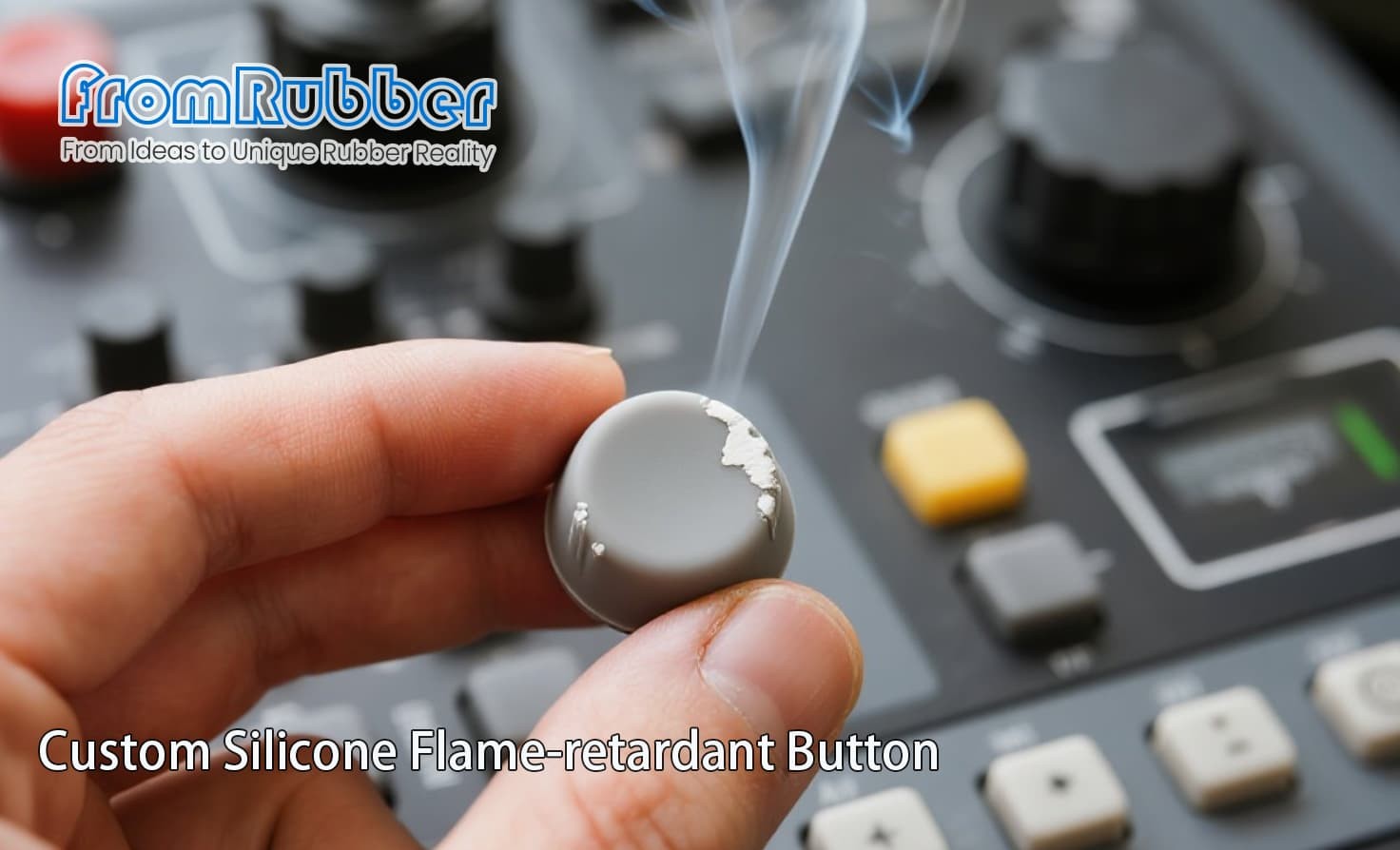
What the Rating Covers, and What It Does Not
The assembled-part row is the one that causes problems in audits, because the compound may be rated while the panel as built has not been assessed.

| Question | Covered by V-0? | What to ask instead |
|---|---|---|
| Will it stop burning after the flame is removed? | Yes, within the test conditions | The report for your thickness |
| Will it drip and ignite material below? | Yes, addressed by the test | Confirm the specimen geometry matches the part |
| How much smoke will it produce? | No | Smoke density data, if the application needs it |
| Are combustion gases toxic? | No | Toxicity data, which is a separate assessment |
| Does the assembled keypad comply? | Not automatically | Test the finished construction, or justify the deviation |
What Changes in the Design When a Panel Needs a Flame Rating
Three practical consequences. The compound becomes a flame-retardant grade, which usually means a higher hardness and a different feel, so force targets have to be re-checked. Additive loading can affect colour, so a bright colour may need a different pigment system. And the finishing methods narrow, because an adhesive or a printed layer that is not rated becomes the weak link in an assessment.
Laser-etched legends are usually the safest choice in this context, because they add no combustible ink layer. Where backlighting is required, the light guide and diffuser materials need their own rating, and this is where projects often discover a gap after the panel design is fixed.
How to Document the Claim
Keep three documents together: the compound data sheet with the rating and the thickness, the test report for the specimen that matches your part, and a drawing note stating the construction the rating applies to. If a supplier changes the compound or the backing, that note is what triggers a re-assessment rather than a silent substitution.
For applications that also involve heat, the flame rating and the temperature rating should be assessed on the same construction, because a compound chosen for one may compromise the other. The thermal side is covered in our guide to high-temperature resistant keypads, and the rated constructions are summarised on the UL94 flame-retardant keypad page.
Frequently Asked Questions
Is a V-0 compound enough for a fire-rated product?
It is a necessary starting point, not a complete answer. The finished assembly has to be assessed as built, including adhesives, backlight films and any secondary decoration.
Does flame-retardant silicone feel different?
Usually yes. Additive loading tends to raise hardness and change the return force, so dome and web geometry often need adjustment to keep the tactile target.
Can a printed legend be used on a V-0 keypad?
Sometimes, but the ink becomes part of the assessed construction. Where the rating is critical, laser etching removes that variable entirely.