What Are the Trade-Offs of Using Thicker Silicone in a Custom Silicone Hanging Basket?
- Share
- publisher
- FromRubber
- Issue Time
- Oct 28,2026
Summary
Buyers often reach for a thicker wall when a hanging basket feels flimsy, then find the tab tears anyway. This article separates stiffness from strength, explains why the load path matters more than the nominal wall, and sets out the section decisions worth making before tooling.
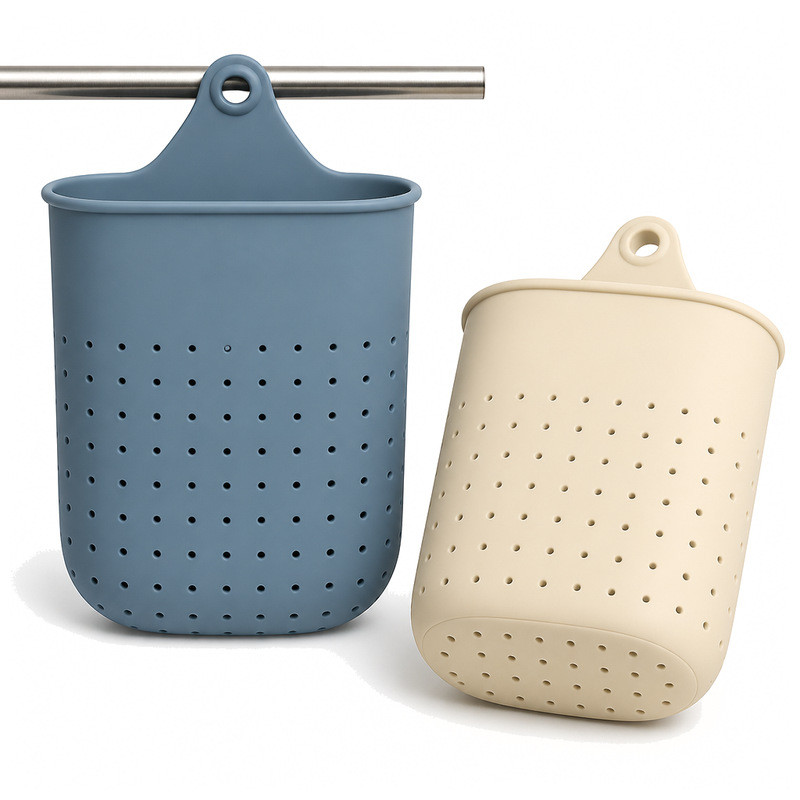
The first sample arrives and the wall is 3.5 mm. It feels substantial, it holds its shape on the bench, and everyone agrees it is much better than the 2.2 mm version. Then it goes on the rail with two kilos of potatoes in it, and within a month the hanging tab has begun to tear at the point where it meets the rim. The extra material made the wall stiffer and made the product heavier, and it did nothing at all for the one place that was actually carrying the load.
If you are sourcing a hanging basket rather than designing one, this article is still the list of questions worth putting to any supplier before tooling: what does the tab carry, where does the load go, and what will be measured on the sample. The decisions below are the ones a buyer ends up approving, whether or not they were made in the buyer's office.
Thickness is the easiest variable to change and the hardest to change sensibly. It is also the one buyers reach for first when a hanging basket feels flimsy, which is why so many projects end up with a product that is heavier, slower to mould, and no more durable than the version it replaced.
The useful question is not how thick the wall should be. It is which part of the product needs to be stiff, which part needs to stay soft, and where the load actually travels.
What Can Thicker Silicone Improve in a Hanging Basket?
Thicker Sections May Help the Basket Retain Its Intended Shape
Bending stiffness rises steeply with section thickness, so a modest increase in wall thickness produces a large increase in resistance to sagging. That is genuinely useful in a hanging basket, where the front wall is unsupported and the contents push it outward.
The effect is strongest where the section is continuous. A thick wall with a large perforated field is only as stiff as the ligaments between the holes, which is why thickness increases sometimes deliver much less than the arithmetic suggests.
A More Substantial Rim May Help the Basket Keep Its Opening
The rim is a ring, and a ring resists ovalisation far better than a flat wall resists bending. Strengthening the rim is often more effective than thickening the wall, because it keeps the opening in shape and stops the walls from leaning outward at the top. It also gives the hanging tab something solid to attach to.
Selected Reinforcement Areas May Matter More Than Overall Thickness
Most hanging baskets have three areas that deserve individual attention: the rim, the hanging tab and its transition into the body, and the base where it meets the lower wall. Each of those can be designed for its own load. The wall between them can then stay thin enough to be pleasant to handle, which is the whole point of using silicone in the first place.
What Problems Can Occur When the Silicone Is Too Thick?
The Basket May Become Less Flexible Than Users Expect
A hanging drain bag is often squeezed, turned inside out, or pushed flat to fit a cupboard. Thick walls resist all three. When the product no longer does what the category promised, the customer notices immediately, even if they cannot describe the change.
Extra Material Can Increase Product Weight and Material Consumption
More silicone means more material per part, and in a hanging product it also means more mass hanging from the same tab. The two effects compound: a heavier basket carries a heavier load at exactly the point where the load is already concentrated. Unit cost moves with material consumption, though the size of the change depends on the design, the mould, and the order quantity rather than on thickness alone.
Thick Sections and Thin Sections May Behave Differently During Production
Compression moulding fills and cures a part according to its section. Where a thick region meets a thin one, the thin region cures first and the thick region continues to shrink, and the junction is where dimensional variation and internal stress appear. This is the manufacturing reason to avoid abrupt steps, quite apart from the mechanical one.
Thick sections also take longer to reach cure temperature, which affects cycle time and can produce a part that is harder in one area than another. Variation across a production run usually traces back to section changes, not to the compound.
Thick Walls May Make Some Designs Harder to Clean or Handle
A stiff wall is harder to open while rinsing and harder to reach into. Corners that were easy to flush with a flexible wall become fixed pockets. Thickness alone does not determine cleanability, but it does determine whether the user can deform the product to clean it, and that is often the same thing in practice.
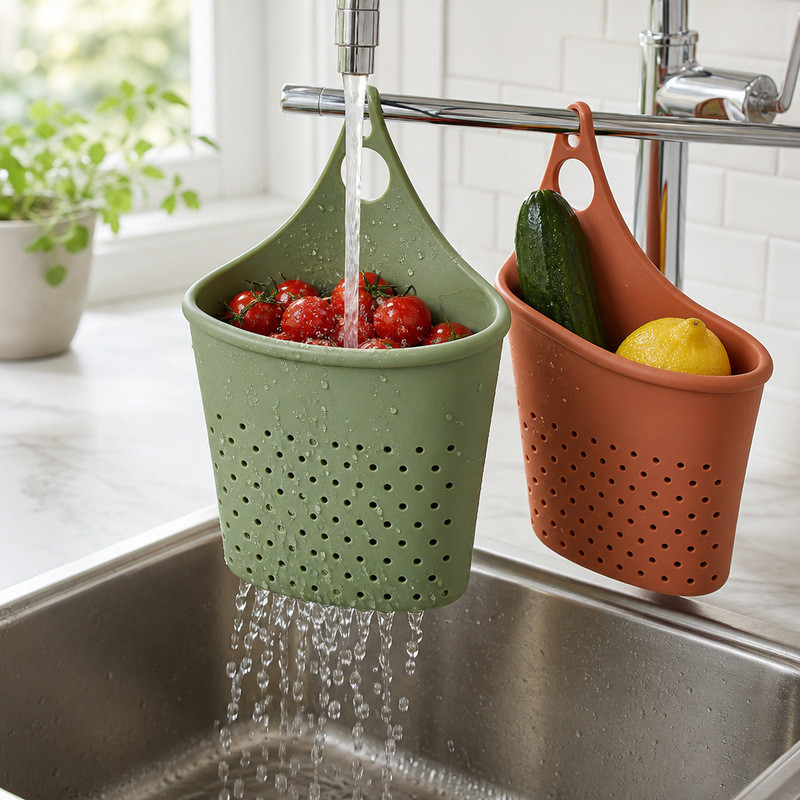
Watch what happens when a full bag is lifted off the rail by the tab alone. The rim distorts first, then the wall below it follows. If the tab transition is thin, that distortion becomes permanent within a few dozen cycles.
This is why the tab is usually the first place a hanging basket fails, and why thickening the sidewall does not postpone it.
Should Every Part of a Custom Silicone Hanging Basket Have the Same Thickness?
The Rim Has Different Requirements From the Main Basket Body
The rim needs to hold an opening and carry the hanging load. The body needs to hold contents, drain water, and remain flexible enough to handle. Those are different jobs, and a uniform section is a compromise that does neither particularly well. A slightly heavier rim with a lighter body is a normal and often successful arrangement.
Hanging Points Need to Be Evaluated for the Actual Load Path
Load enters the product at the tab, spreads through the rim, and only then reaches the walls. The tab's own section, the radius where it meets the rim, and the width of material either side of the hanging hole all matter more than the wall thickness. A generous radius at that junction distributes stress over a larger area; a sharp internal corner concentrates it into a line.
The hanging hole itself deserves the same attention. A small hole in a thin tab creates a narrow band of material above it, and that band is where a tear will start. The hole edge should be smooth and the material around it should be continuous with the rim rather than with the wall.
The Base May Need Different Support From the Sidewalls
The base carries the contents and is usually the stiffest part of the product by geometry, because it is a dished or curved surface rather than a flat panel. The sidewalls contain the contents and need to flex during cleaning. Treating them as one section wastes material in the base and leaves the wall either too stiff or too soft.
Transitions Between Thicknesses Should Not Be Overlooked
Where a 3 mm rim meets a 2 mm wall, the change should be gradual over a distance, not a step. A step is a stress raiser, a cure discontinuity, and a place where the part will fold when it is not supposed to. The exact radii depend on the product, but the principle does not: no abrupt changes in a part that flexes.
| Change | What it usually improves | What it usually costs |
|---|---|---|
| Thicker wall | Resistance to sagging under load | Weight, material use, harder cleaning, less squeeze |
| Thicker rim | Opening stays in shape, better tab support | Slightly stiffer top edge, more material |
| Thicker tab and junction | Tear resistance where the load enters | Little, if the radius is designed well |
| Harder compound | Firmer feel without adding mass | Less forgiving handle, different drape |
| Deeper base curve | Stiffness from geometry rather than material | Height, nesting, mould complexity |
| Narrower ligament between holes | More open area for drainage | Lower stiffness, higher edge stress |
How Do Thickness, Material Hardness, and Basket Shape Work Together?
Thickness and Hardness Are Not Interchangeable
Hardness changes the stiffness of the material itself. Thickness changes how far the material is from the neutral axis, and its effect on bending stiffness is far stronger than a hardness change of the same magnitude. Doubling a section makes it roughly eight times stiffer in bending, while moving from 50 to 70 Shore A does nothing of that order. Hardness is measured as indentation resistance under ISO 48-4:2018 and tensile behaviour under ISO 37:2024, so two suppliers quoting the same 70 Shore A can still sit at different points on the stress-strain curve. Our own published 70 Shore A datasheet is a useful reference point for what those numbers look like in practice: hardness 70 ± 5, tensile strength specified at 5.0 MPa against 5.7 MPa measured, and elongation at break specified at 150% against 266% measured. A designer who needs more stiffness usually gets more from section than from durometer, but pays for it in weight and feel. A designer who needs a firmer surface gets more from hardness and pays for it in flexibility.
A Wider Basket May Need a Different Structural Approach From a Compact One
A wide basket has a long unsupported span across the front wall, and the rim has to hold a larger opening. A compact basket can often be stiffened adequately by its own curvature. Copying a section from a small product to a large one is one of the most common reasons a scaled-up version sags.
The Hanging Method Changes What Needs to Be Reinforced
A basket hung from a single tab behaves differently from one hung from two points, and differently again from one that rests on a rail through a sleeve. Single-point hanging puts the whole load through one junction and requires the rim to act as a beam. Two-point hanging shares the load but requires both points to be at the same height, or the product will hang crooked and load one side. The attachment method should be fixed before sections are chosen, because it determines the load path.
Draw the load path on the drawing before changing any number. Start at the tab, follow the material into the rim, then into the walls, then into the base. Anywhere the path narrows sharply is a place that will fail first, and it is usually not the wall.
Our note on where thickness gets over-designed in silicone products makes the same point from a different product: buyers add material to the visible surface when the real constraint is somewhere else.
How Can You Choose the Right Thickness Before Mold Development?
Start With the Intended Contents and Expected Load
Define what the basket will hold, roughly how heavy a full load will be, whether the load is usually even or heaped to one side, and how long the product will stay loaded. A basket that hangs loaded for an hour and one that is filled and emptied in two minutes are not the same design problem, because silicone will follow a sustained load in a way it does not follow a brief one.
Identify Which Areas Must Stay Firm and Which Must Remain Flexible
List the areas of the product and give each one a job. The rim holds the opening. The tab carries the load. The base supports the contents. The walls hold and release. Once the jobs are written down, thickness decisions become local rather than global, and the product stops being either too floppy or too rigid as a whole.
Compare Samples With Different Design Approaches
Where budget allows, mould two or three variants that differ in one variable each: one thicker wall, one reinforced rim, one deeper base curve. Comparing them under the same load tells you which change actually mattered. Changing three things at once produces a better sample but no usable knowledge, and the next product starts from guesswork again.
Check Both Performance and User Handling
Evaluate shape retention and hanging stability, then evaluate how the product feels to fill, lift, empty, rinse, and store. A design that passes the load test and fails the handling test will generate returns for reasons that never appear in a test report.
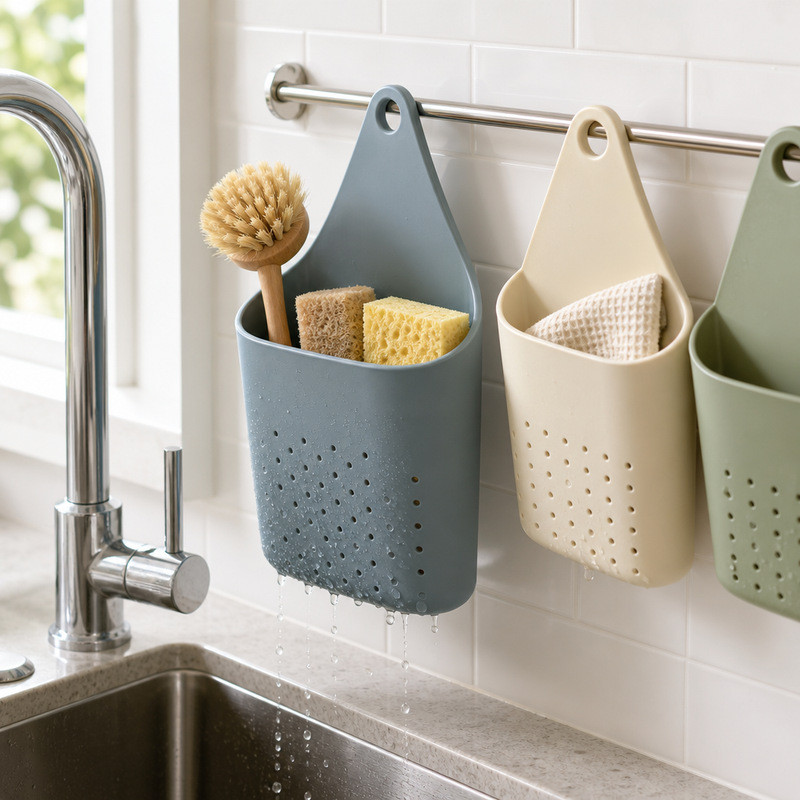
It is worth comparing products in the same family. A caddy holding sponges and a bag holding vegetables share a shape but not a load, and they should not share a section.
Matching the section to the load is the whole exercise. A caddy that is built like a vegetable bag is simply heavier than it needs to be, and a vegetable bag built like a caddy will tear at the tab.
What Should a Manufacturer Review Before Producing the Mold?
Review the Full 3D Geometry, Not Just a Single Thickness Measurement
A single number on a drawing says very little. The manufacturer needs the wall transitions, the rim section, the tab and its junction, the base curve, the perforation field, and the thickness at each of those places. Reviewing only the nominal wall thickness is how a design ends up with a thick wall and a thin tab.
Check Whether the Proposed Thickness Distribution Is Practical to Mold
Thick and thin sections in the same part affect fill, cure, and demoulding. Deep perforations in a thick wall need longer cores and can be harder to release. Very thin sections next to thick ones may not fill completely. These are process questions that are much cheaper to answer on a drawing than on a tool.
Establish Acceptance Criteria Before Approving the Sample
Agree what a loaded sample must do: how much the front wall may deflect, whether the rim may ovalise, how the tab should look after a defined number of load cycles, and how the product should feel when squeezed. Written criteria make a revision measurable instead of a matter of opinion.
How Can a Custom Silicone Manufacturer Help Balance Strength and Flexibility?
The contribution worth paying for is a review that separates the three decisions — where the load goes, how stiff each area needs to be, and how the part will be moulded — and then proposes a section that satisfies all three without adding material where it does nothing.
FromRubber has been compression and injection moulding custom silicone in Dongguan since 2010, with in-house tooling and a technical team that reviews 3D geometry before a mould is cut. For hanging products the review usually starts with the attachment and works outward, because that is where the design either holds or tears. The custom silicone parts page shows the construction types we produce, and technical support explains what the drawing review covers. We will not tell you a thickness is correct without seeing the load path it has to carry.
Frequently Asked Questions
Does thicker silicone always make a hanging basket stronger?
No. It raises bending stiffness in the areas that are thickened, but it also adds weight to the same hanging points and can introduce stress at transitions. Where the material is placed matters more than how much is used.
Will thicker silicone make a custom hanging basket more expensive?
It increases material consumption, and it can lengthen cure time. Actual unit cost also depends on the mould, the number of cavities, the finishing steps, and the order quantity.
Can I use different thicknesses in different parts of the basket?
Yes, and it is usually the better approach, provided the transitions between thick and thin areas are gradual rather than stepped.
Is harder silicone better than thicker silicone for a hanging basket?
They solve different problems. Hardness changes the feel and the material stiffness; thickness changes bending resistance much more strongly but adds weight. Most designs need a considered combination.
What information is needed for a custom silicone hanging basket quotation?
Drawings or 3D files, dimensions, intended contents, expected load, hanging method, material requirements, target quantity, and a reference product if one is available.
Sources and further reading
- Where brands over-design silicone thickness — why adding material to the visible surface often misses the real constraint.
- Uneven walls, stress whitening and cracking — what happens at thick-to-thin transitions under repeated load.
- Rib design and sink marks — the reverse-face consequence of adding local stiffness to a moulded silicone part.
The mechanical relationships described here are general principles of section design. Actual deflection, tear resistance, and cycle life depend on the specific geometry, compound, and mould, and should be verified on your own samples against agreed criteria.
Choosing sections for a hanging product?
Send the drawing with the hanging method marked on it. The attachment decides the load path, and the load path decides where thickness is worth spending.
- Email: nani@fromrubber.com or karl@fromrubber.com
- WeChat / WhatsApp: +86 18676210913
- FromRubber · Dongguan Bohao Electronic Technology Co., Ltd.
- Qiaotou Town, Dongguan, Guangdong, China
- IATF 16949:2016 · ISO 9001:2015 · ISO 14001:2015