What Causes Poor Rebound in Silicone Keypads for Portable Amplifiers?
- Share
- publisher
- FromRubber
- Issue Time
- Nov 20,2026
Summary
Poor rebound in a portable amplifier keypad has three different causes that look the same to the user: compression set in the silicone, a supporting wall that stores too little energy, or flash and parting lines that block the return path. The article separates them, explains how wall geometry and cure state affect recovery, and gives a troubleshooting sequence that starts with measurement instead of a softer compound.
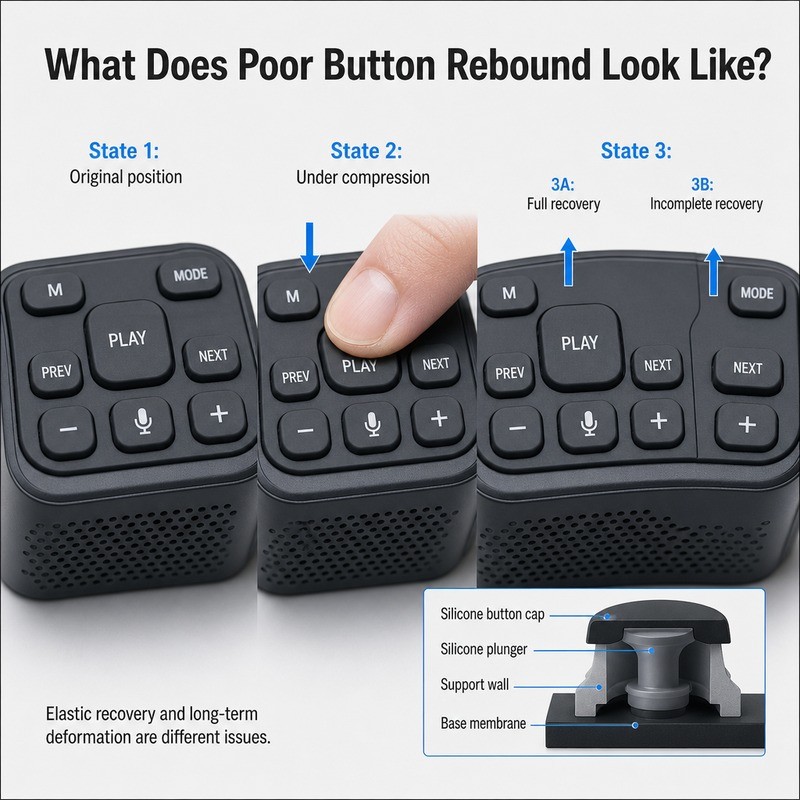
A portable amplifier keypad that returns slowly is harder to diagnose than one that does not work at all. The device still functions, so the complaint arrives late, usually as "the volume button stays down" or "sometimes it keeps going up after I let go". By then the tooling is committed, and the instinct is to order a softer compound, which is often the wrong answer.
Poor rebound in a silicone keypad for portable amplifiers comes from three different mechanisms that look identical to the user. The silicone may have taken a compression set and lost its original height. The supporting wall may be too thin or uneven to push the cap back against friction in the housing. Or the cap may be physically blocked by flash, a parting line or a tight opening, so the material is willing to return but cannot. Each has a different fix, and softening the compound only addresses the first.
Why Does a Silicone Keypad Lose Its Rebound Performance?
Rebound is the visible result of stored elastic energy being released. When the finger presses, the wall and cap deform and store energy; when the finger lifts, that energy pushes the cap back. Anything that reduces the stored energy, or that consumes it on the way back, shows up as slow or incomplete return.
The confusion starts because "rebound" is used for two different measurements. One is the speed of return after a single press. The other is whether the button still reaches its original height after thousands of presses or after weeks under load. A keypad can pass the first and fail the second, which is why a bench test on a new sample tells you very little about a device that has been in a carry case for a month.
We separate the two before touching material. If the button returns fully but slowly, the problem is usually energy loss or friction. If it returns quickly but not all the way, the problem is usually permanent deformation or an obstruction.
Silicone Material Properties Affect Elastic Recovery
Silicone is chosen for keypads because its elastic range is wide and its modulus changes relatively little with temperature. That does not make all compounds equal. Formulation affects how much energy is returned and how much is lost as heat on each cycle, and it affects how the material behaves when it is held compressed.
Hardness is a poor predictor here. Two compounds of the same hardness can differ in resilience, tear strength and compression set because the filler system and the crosslink density are different. A highly filled compound may read the same on a durometer and still return more slowly, because the filler network adds internal friction.
The practical consequence: ask for the compound's compression set and resilience data, not only its hardness. If the application involves storage under load, or long periods with a button held down, compression set is the property that decides whether the keypad still looks right after six months.
Repeated Compression Can Affect Long-Term Button Recovery
Compression set is permanent deformation after prolonged or repeated compression, measured to ISO 815-1. In a keypad it appears as a button that sits slightly lower than its neighbours, with a flattened cap and a shortened stroke. The contact may still close, but the tactile event moves and the user perceives the key as worn out.
Two conditions accelerate it: load and temperature. A device stored in a vehicle, or shipped with the buttons pressed by foam packaging, combines both. That is why a keypad that passes a room-temperature cycling test can still be reported as "sticking" in a hot climate.
The distinction from slow return matters for the fix. Compression set is a material and design issue: the section is over-stressed, the compound is unsuitable, or the button is pre-loaded by the housing. Slow return with no permanent height loss is a friction or geometry issue, and changing compound will not solve it.
How Does Silicone Keypad Geometry Influence Button Rebound?
The wall is the spring, and its shape decides how much energy it can store for a given deflection. A wall that is too thin buckles instead of compressing, which stores less energy and returns the cap with less force. A wall that is uneven around its circumference buckles in one direction, so the cap comes back tilted and rubs against the opening.
Wall height and wall angle interact. A short, steep wall is stiff and returns decisively but offers little travel. A tall, shallow wall is compliant and returns gently, which can be too gently once friction is added. The design target is a wall that stores enough energy at the working deflection to overcome the return path, with margin for cold stiffening and for molding variation.
Where the wall meets the base, a sharp internal corner concentrates stress and can initiate a tear after repeated cycling. A small radius spreads the strain and improves fatigue life without noticeably changing the force curve.
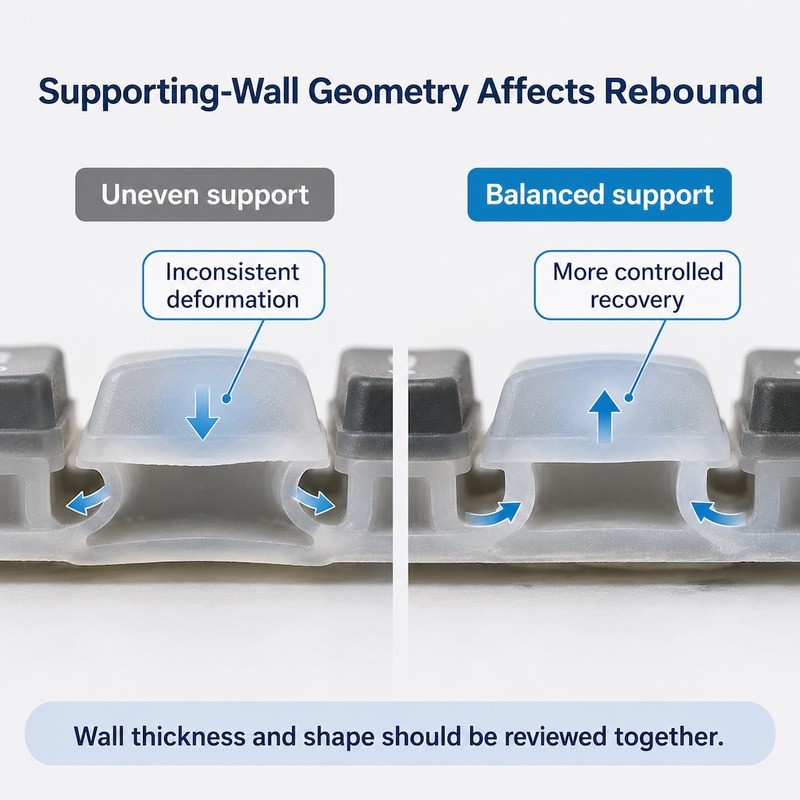
Thin Supporting Walls May Lose Their Ability to Return Consistently
A thin wall is attractive because it lowers operating force, and on a first sample it feels light and quick. The problem appears after assembly. Once the keypad sits in its housing, the wall has to overcome the friction between cap and opening, the adhesion of the pill to the PCB, and any pre-load from the frame. A wall that stores barely enough energy to return the cap in free air will fail to return it in the assembly.
Wall thickness also varies more than designers expect in a molded part. A nominal section that is thin to begin with can end up locally thinner at the point where the material has to flow furthest, and that is exactly the side that buckles first. If the wall is thin, the dimensional check has to sample several points around each button, not one.
Button Height and Supporting Structures Affect Recovery Speed
Button height sets the distance over which the wall can act. A taller button has a longer return stroke and more time to accelerate the cap, which reads as a livelier key. It also has more opportunity to tilt, so the clearance between cap and housing opening becomes critical.
The supporting structure beneath the keypad matters as much. If the base membrane rests on a flat housing surface, the wall's return energy goes into the cap. If the base is unsupported and can flex, part of the energy disappears into the panel and the cap returns sluggishly. Some designs add a local rib under the base for this reason; others rely on the housing, which then has to be flat and clean.
Closely Spaced Buttons Can Interfere With Independent Movement
Adjacent buttons share a web, and the web is part of the spring system. When one button is pressed, the web pulls its neighbour down slightly. On release, the neighbour's wall helps to return both, which can either speed up or slow down the recovery depending on the geometry.
When spacing is very tight, the cap of one button can contact the wall of the next during a deep press. The result is a button that returns only after the neighbour has been released, which users describe as "sticky keys" even though nothing is actually sticky. Checking for this is simple: press each button in turn and watch the neighbours under a low-power microscope or a phone camera with the light at a low angle.
Can Mold Design and Manufacturing Conditions Cause Poor Rebound?
Yes, and this is where many rebound investigations end. Two keypads from the same drawing can behave differently if the cavity dimensions, the cure state or the trimming quality differ. Those differences are invisible in a photo and obvious in a force-displacement curve.
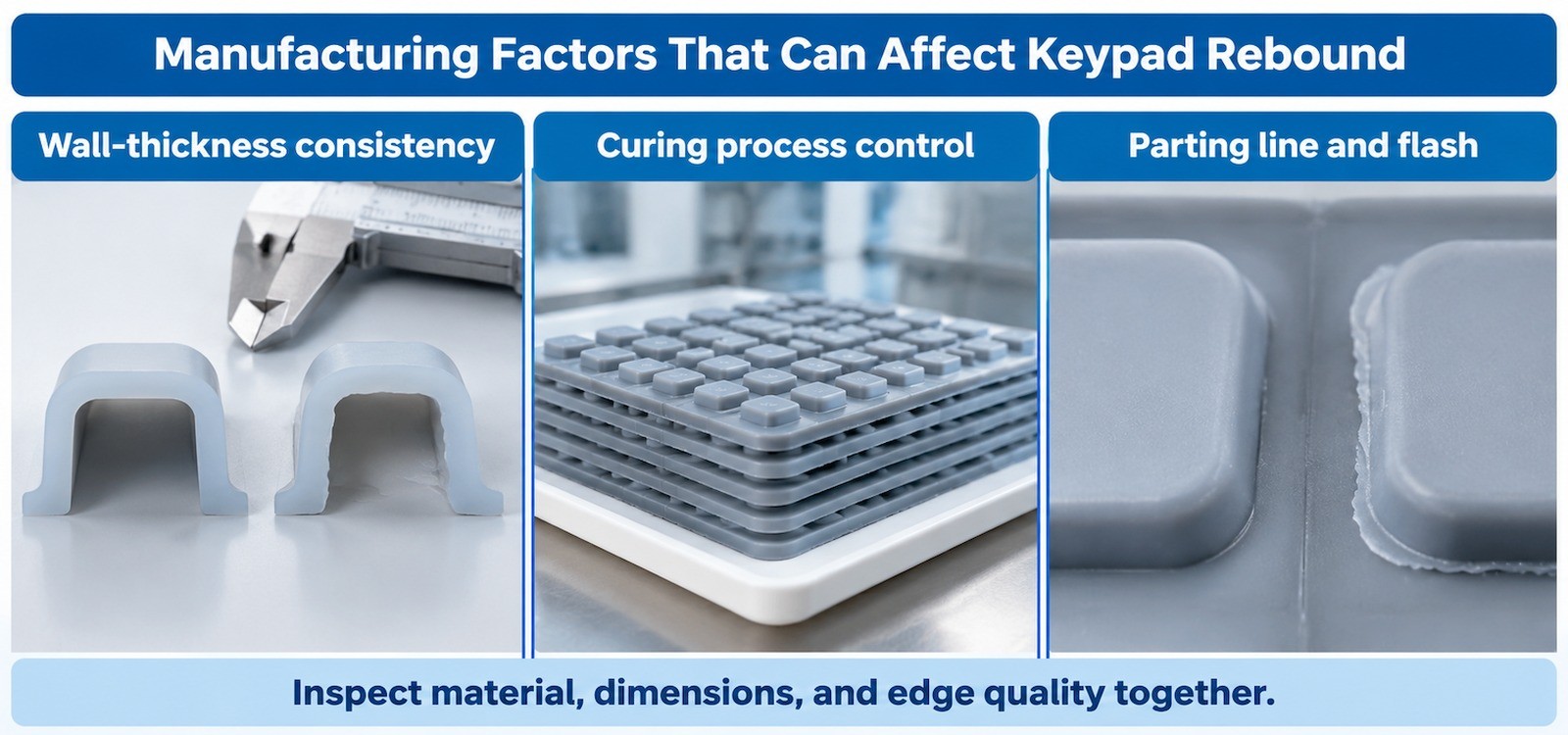
Uneven Wall Thickness Can Create Different Recovery Behaviors
In a multi-cavity mold, each cavity fills slightly differently. If the wall section is generous, the difference is small. If the wall is thin relative to the flow path, the last-filled cavities can be measurably thinner, and those buttons will be the ones that fail to return on the assembled device.
The inspection response is to measure wall thickness on several buttons from several cavities, not on one sample from the middle. A cross-section cut through a scrapped part is more informative than any external dimension, because the wall thickness that matters is inside the button.
Inconsistent Curing Can Affect Silicone Elasticity
Silicone needs enough heat and time to reach its full crosslink density. Under-cured material feels soft and returns poorly, and it often shows a slightly tacky surface or a stronger smell. Over-cured material is stiffer and can become brittle at thin sections.
Cure state is not something a buyer can see, which is why process control at the molder matters. In our plant the press parameters are recorded per batch and the cure state is confirmed by physical properties on sampled parts, not only by the appearance of the first shot. It is also why we resist changing press settings to chase a cosmetic issue without re-checking the mechanical behaviour.
Flash and Parting Line Issues May Interfere With Button Movement
A parting line placed across the wall leaves a small ridge that rubs inside the cavity. Flash at the base of the button reduces the clearance between cap and housing, and thin flash on the side of a cap can bridge the gap to the neighbouring material. All three add friction exactly where the return force is weakest.
Trimming quality therefore belongs in the rebound discussion, not only in the cosmetic inspection. A keypad that looks clean at arm's length can still have a fine flash film that drags on the housing. Visual inspection alone cannot confirm rebound performance; the part has to be cycled in its assembly.
How Can Manufacturers Improve Silicone Keypad Rebound?
The sequence matters more than any single fix. Material, geometry, molding and assembly all contribute, and changing them in the wrong order wastes sample rounds.
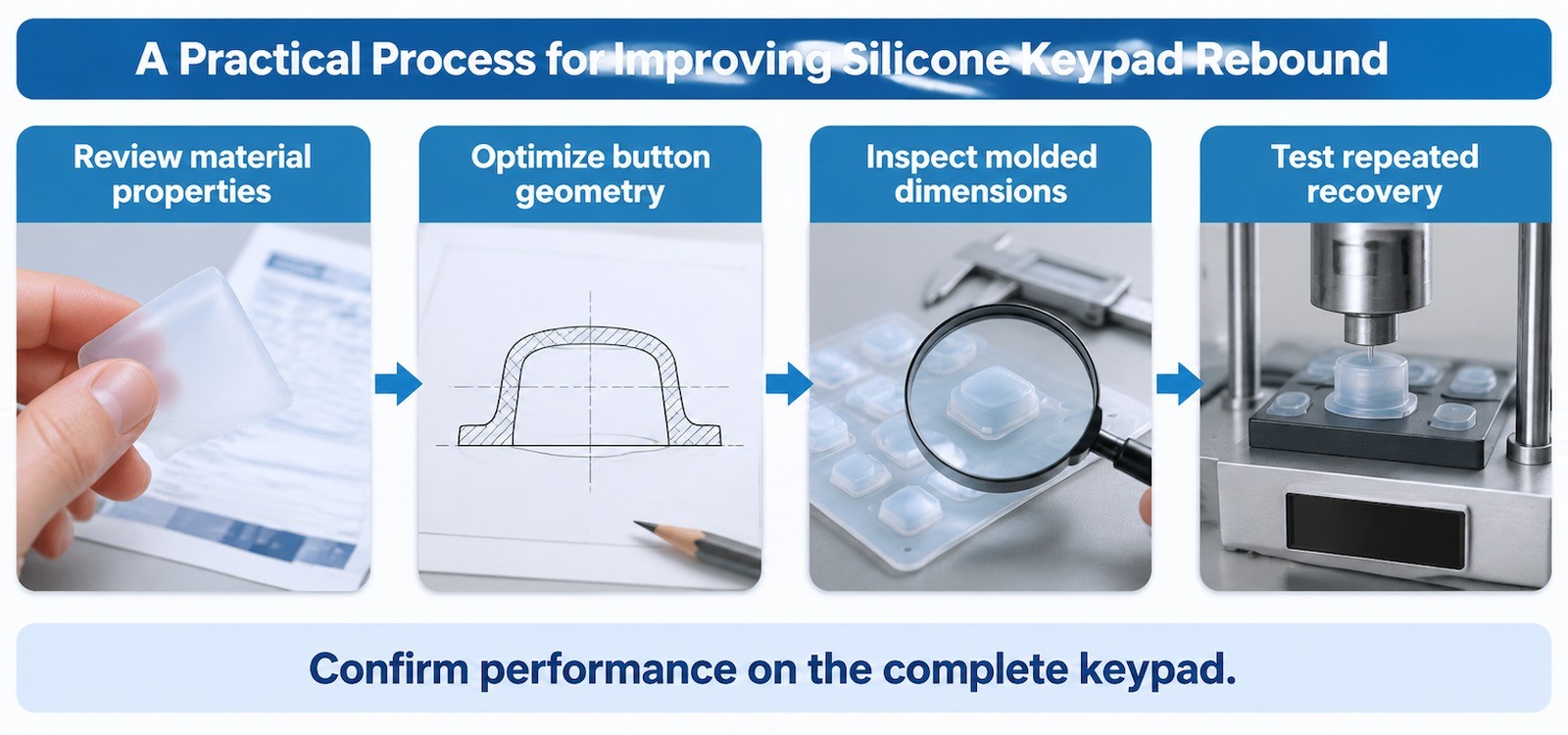
Review Material Hardness and Compression Set Requirements
Start with the application: how long the button is held, at what temperature, and whether the device is stored with the keypad loaded. Then compare those conditions with the compound's compression set data. A compound with good resilience and moderate hardness is usually a better starting point than a very soft compound, because it has more energy to return.
Hardness should be chosen to suit the required operating force, and then checked against return performance. If the only way to reach an acceptable press force is a compound so soft that return suffers, the geometry is wrong.
Adjust Button Geometry and Supporting Wall Dimensions
Once the material is sensible, tune the wall. Increase the section slightly at the base, add a relief radius at the junction, and make sure the wall is even around its circumference. Check that the cavity under the cap gives the wall room to move without the cap bottoming out.
Evaluate each button position separately. The wide buttons on a panel often have a different wall height from the narrow ones, and the small buttons near the edge of the keypad may be supported differently by the housing. A single change applied to the whole sheet usually fixes one button and creates a problem on another.
Validate Rebound Consistency Through Repeated Pressing Tests
Cycle the assembled product, not the loose keypad, and record the return height at intervals. A camera mounted at a low angle against a backlit grid is enough to see a cap that stops returning fully. Compare the first cycle, the hundredth and the thousandth, and repeat after a period under load at elevated temperature.
The output should be a statement of behaviour, not a pass mark: how far the cap returns, how long it takes, and how that changes with cycles and temperature. That is the information a designer can act on.
| What the user reports | Most likely mechanism | How to confirm | Usual correction |
|---|---|---|---|
| Button returns slowly but reaches full height | Friction in the opening, or a wall with too little stored energy | Cycle the assembled unit and watch the cap; compare free-air and in-housing return | Open the housing clearance, adjust wall section or height |
| Button stays slightly low after release | Compression set, or pre-load from the frame | Measure cap height before and after a period under load at temperature | Change compound, reduce pre-load, revise the retaining structure |
| One or two keys fail, the rest are fine | Local wall thickness, flash, or a parting line in the wrong place | Cross-section the failed keys and inspect the edge under magnification | Cavity correction, parting line move, trimming control |
| Buttons feel sticky only when pressed together | Web coupling between adjacent caps | Press one key and watch the neighbours | Reduce web thickness, adjust pitch or cap height |
| Problem appears only in cold conditions | Silicone stiffening combined with marginal return force | Repeat the return test at low temperature | Increase wall energy, reduce friction, review compound |
What Should Buyers Check When Evaluating a Custom Silicone Keypad?
A supplier evaluation should include the points that determine rebound, not only price and lead time. The list below is the one we use when a new keypad project starts.
Material specification
Hardness alone is not enough. Ask for compression set, tear strength and resilience data for the proposed compound, and confirm which grade will be used in production.
Wall geometry
Wall thickness and height should be defined on the drawing, with the measurement points marked. A nominal section without points cannot be inspected consistently.
Mold and cavity control
Multi-cavity tools need a plan for checking every cavity, not only the first. Ask how cavity-to-cavity variation is monitored.
Trimming and edge quality
Flash at the button base and cap is a functional issue. The acceptance criteria should describe where flash is not permitted.
Repeated press data
Ask for a return-height record over cycles, on the assembled part. A single press test does not demonstrate rebound.
Assembly compatibility
Return depends on the housing and PCB as much as on the keypad. Confirm that the supplier has seen both, or has a sample to test against.
How Does a Custom Silicone Keypad Manufacturer Control Rebound Performance?
Rebound is controlled through decisions that sit in different departments: compound selection, wall design, mold accuracy, cure control, trimming and final inspection. A manufacturer that only molds to a drawing can hit the drawing and still deliver a keypad that returns poorly, because the drawing rarely defines the properties that matter for return.
At FromRubber we build the keypad, the mold and the printed legends in the same plant, which makes it practical to change a wall section and re-measure within one sample round. Keypads with conductive carbon pills, backlighting or membrane switch layers are assembled and tested as a unit rather than as separate parts; the conductive pill keypad construction is one example. The silicone molding page describes the press and cure controls we work to, and the material processing page covers compound preparation.
For a project where return is already a problem in the field, the most useful starting point is a failed sample plus the housing. We measure the free-air and in-housing return, cut a cross-section through the affected buttons, and compare the wall section with the drawing. In most cases the answer is visible within a day, and it is usually not the compound.
When Softening the Compound Is the Right Answer
There are cases where material is genuinely the cause: a compound with poor resilience, a batch that is under-cured, or an application where the operating force target simply cannot be met with the available geometry. In those cases a change is justified, but it should be confirmed by measurement before the whole keypad is re-tooled.
The silicone material range we keep in stock covers hardness and resilience options for keypad work, and the silicone keypad FAQ answers the questions that come up most often during compound selection.
Frequently Asked Questions
Why does a keypad return well on the bench but poorly after assembly?
The assembly adds friction and pre-load. The cap has to overcome contact with the housing opening, the frame and the PCB. A wall with just enough return energy in free air has no margin left once those are added.
Can a slow-returning keypad be fixed by post-curing?
Post-curing can complete the crosslink and remove volatiles, and it sometimes improves compression set. It will not fix a wall that is too thin or a cap rubbing in its opening. Confirm the mechanism before adding a process step.
Does a softer compound return faster?
Not necessarily. Soft compounds deform more easily but store less energy per unit volume, and they are more sensitive to compression set. Return speed depends on the balance between stored energy and the resistance on the return path.
How many press cycles should a validation run cover?
It depends on how the product is used, but the test should be long enough to show a trend in return height, not just a pass at the end. Recording at intervals is more useful than a single final reading.
Is flash on the button base really a rebound issue?
Yes. Flash reduces clearance and adds a rubbing surface exactly where the wall is weakest. It is common on keypads that look acceptable but fail a return check in the housing.
Sources and verification notes
- FromRubber technical article: what causes poor return in silicone keypads.
- FromRubber technical article: what causes silicone keypad flash in mass production.
- FromRubber process page: rubber and plastic mold making.
- Standard designations referenced for orientation only, by name: ISO 815-1 (compression set), ISO 37 (tensile stress-strain), ISO 48-4 (hardness). Confirm the applicable edition with your test house.
Statements about mechanisms and inspection practice come from keypad development and failure analysis work on portable audio products. No universal hardness or compression-set values are given, because the correct figures depend on the button geometry and the storage conditions of the finished device.
If a keypad is returning poorly and the compound has already been changed once without result, send a failed sample with the housing it was assembled into. Measuring return in the assembly usually locates the cause faster than another material trial.
FromRubber, Dongguan Bohao Electronic Technology Co., Ltd.
WhatsApp and WeChat: +86 18676210913. The engineering team can also be reached through the contact page.