What Causes Poor Return in Gas Detector Silicone Keypads?
- Share
- publisher
- FromRubber
- Issue Time
- Nov 18,2026
Summary
Slow, incomplete or uneven button return in gas detector keypads is usually three different problems wearing the same symptom. The article separates web hysteresis, installed pre-load and compression set, then shows which drawing dimensions and tool checks make the difference measurable.
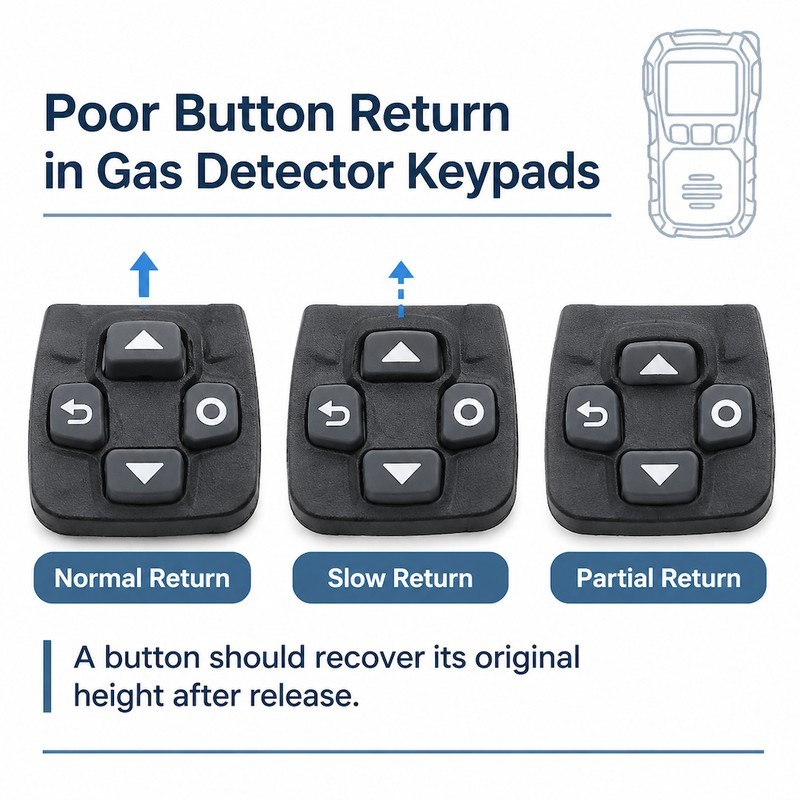
A gas detector that comes back from a bump test is usually judged by one small thing: whether the key under a technician's thumb rises again at the same speed it went down. When it hesitates, the instrument is not necessarily faulty, and the silicone is not necessarily the wrong compound. In most units we examine, poor return is the visible end of three separate mechanisms that happen to look identical from the outside: hysteresis in the moulded web, mechanical interference in the installed stack, and compression set that accumulates with use.
The practical consequence is that replacing the keypad with a harder material often fails to fix the complaint. Before changing anything, it helps to know which of the three you are actually looking at.
Reviewed by FromRubber keypad engineering · November 2026
Why Do Gas Detector Silicone Keypads Fail to Return Properly?
Field complaints arrive in three recognisable shapes. The key rises slowly but does reach full height. The key stops a fraction below the panel and stays there until it is flicked. Or one key in a row of twelve behaves differently from its neighbours, even though the drawing says they are identical.
Each shape points to a different cause. Slow but complete return is a rate problem, and rate is governed by how quickly the silicone web can recover stored energy. A key that never reaches its stop is a displacement problem, which usually means something is holding it down. A single odd key is a consistency problem that begins in the tool, not in the operator's thumb.
Slow Button Return Can Affect Repeated Operation
Gas detectors are operated in sequences, not single presses. A technician moving through a calibration menu may strike the same key six or eight times in a few seconds. If recovery takes longer than the interval between presses, the key is still travelling upward when the next press arrives. The switch may still actuate, but the feel degrades and the second press becomes shorter than the first. On instruments used with gloves, the operator compensates by pressing harder, which accelerates the next problem.
This is why a return complaint often arrives together with a "key feels weak" complaint. They are the same event described from two directions.
Some Buttons May Stay Partially Depressed After Pressing
A key resting below its stop is rarely held by the silicone alone. Typical causes are a web that has been trapped between the keypad base and the housing during assembly, a light pipe or gasket sitting slightly proud of its pocket, or a switch with a taller plunger than the one the keypad was designed around. In each case the keypad is being pre-loaded, and a pre-loaded web has already spent part of its travel before the user touches it.
Distinguishing this from material fatigue is simple. Remove the keypad, let it sit free for a minute, and measure the height of the suspect key against its neighbours. If it recovers once unloaded, the material is fine and the assembly is the problem.
Return Performance May Differ Across the Same Keypad
Within one moulded part, key size, web width and surrounding wall thickness are never perfectly uniform, because the geometry is not uniform. A wide key with a thin web will snap back faster than a narrow key with a heavier web, and a key placed next to a rigid mounting boss will feel stiffer than one surrounded by open skirt. The differences are usually small in the free state and become obvious once the part is compressed into a housing.
If only one key is affected, look at the tool and the panel opening before looking at the compound. Consistency across a panel is a design and process question, covered further in our notes on web thickness in a silicone keypad.
How Does Silicone Keypad Structure Affect Button Return?
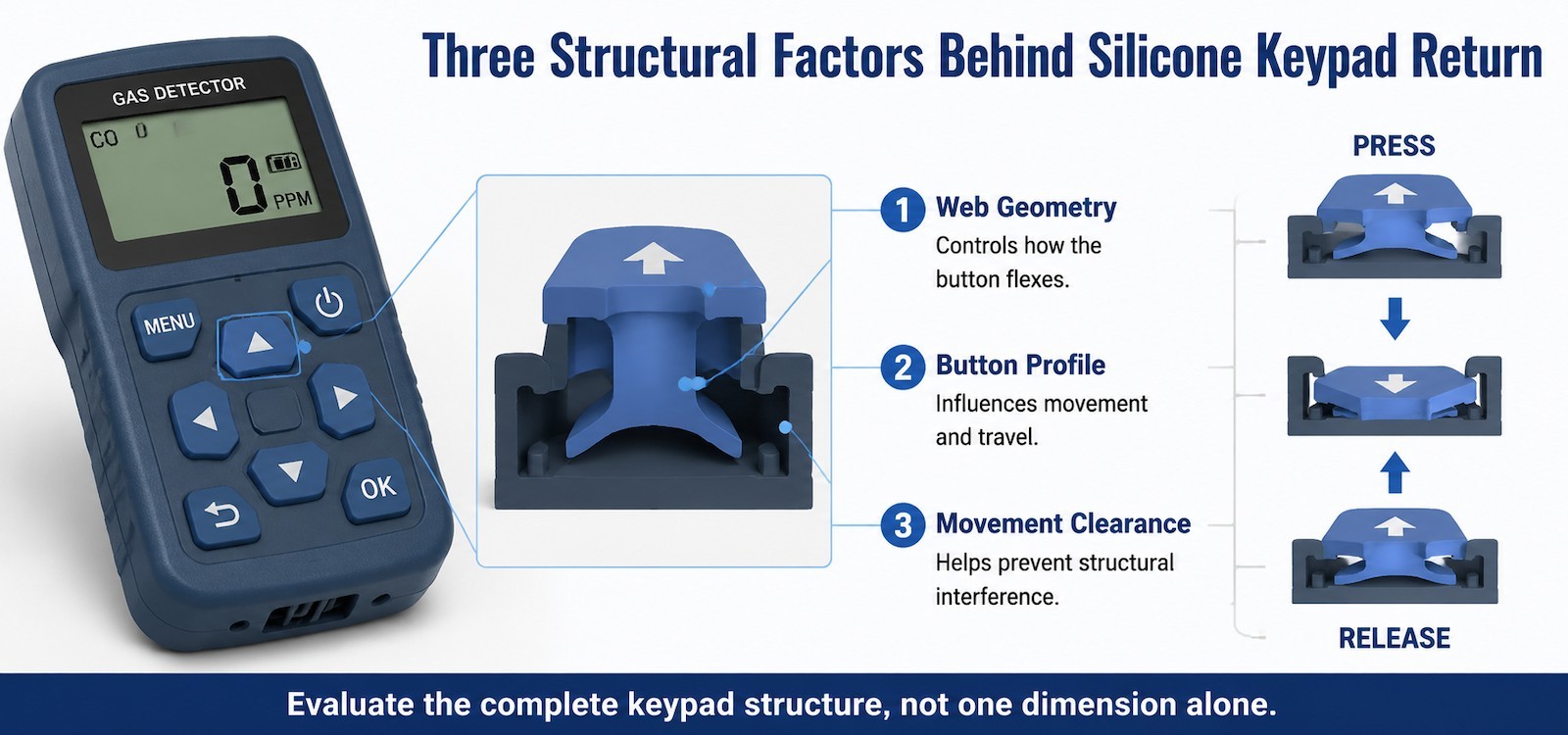
Structure decides how much energy the key stores during a press and how much of it comes back. Three features dominate.
Silicone Keypad Web Thickness Changes the Flexing Behavior
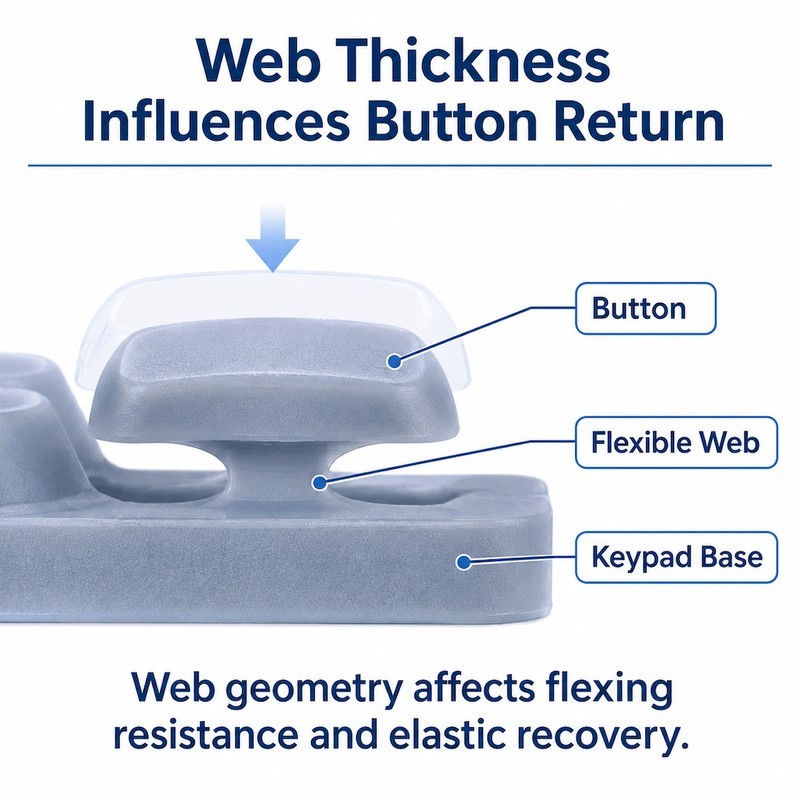
The web is a ring of silicone connecting the key to the base. A thin web deflects easily and returns quickly, but it also gives less support at the top of the stroke and can feel vague. A thick web feels solid but stores more energy per millimetre of travel and recovers more slowly, particularly at low temperature.
What matters more than absolute thickness is the ratio between web section and key footprint. A large key on a thin web behaves like a trampoline; a small key on the same web behaves like a stiff button. When a design changes key size without changing the web, return complaints usually follow within a few months of launch.
Button Height and Geometry Influence the Return Movement
Height itself does not create return force, but it changes how the force is applied. A tall key with a narrow base tips slightly under an off-centre press, and the tilted web recovers unevenly, which reads as a slow or sticky key. A shallow key with a wide top distributes the load better but offers a shorter working stroke, so any interference in the stack consumes a larger proportion of the available travel.
Poorly Designed Keypad Support Areas Can Restrict Movement
Support geometry is the least visible and most common structural cause. If the skirt around a key is too close to a housing rib, or the base is clamped on a surface that is not flat, the web is partly immobilised. The key still moves, but only through the portion of the web that remains free. Return distance shrinks and recovery speed drops, and the effect is easily mistaken for a soft compound.
- Define the working travel and the acceptable recovery time at a stated temperature.
- Review web thickness, button profile and compound hardness as one set of variables.
- Test the keypad in free state first, then installed in the housing.
- Repeat the press-and-release check at both ends of the operating temperature range.
Which Silicone Material and Hardness Factors Affect Keypad Rebound?
Material selection explains the part of the behaviour that structure cannot. It is also the parameter most often over-specified, because hardness is easy to quote and easy to compare between suppliers.
Silicone Hardness Affects the Force Needed to Press and Release a Button
Harder compounds resist deformation more, so the initial force to start the key moving rises. That is not the same as a stronger return. A 60 Shore A web and a 40 Shore A web of identical geometry will both return, but the harder one returns with more force and less visible deflection, which some operators read as "crisp" and others as "heavy". On a handheld detector used through a glove, the difference is noticed immediately.
Elastic Recovery Matters More Than Hardness Alone
Two compounds of the same durometer can differ in compression set and in hysteresis. A compound with good elastic recovery returns close to its original height after a long press; one with higher set keeps a permanent deformation and the key sits lower after a shift of use. This is the mechanism behind the complaint that a keypad "used to feel fine and now feels flat". Hardness testing on a new sample will not reveal it.
Compression set is measured rather than guessed. ISO 815-1 describes the standard method, and the value matters more for a detector that spends its life in a pocket or a hot cab than for a bench instrument. For a wider discussion of the mechanism, see slow rebound in silicone keypads.
Material Selection Should Match the Gas Detector's Operating Conditions
A portable detector may work at −20 °C on a winter site and at 50 °C inside a vehicle. Silicone tolerates that range better than most elastomers, but its modulus still changes with temperature, and a compound chosen for room-temperature feel can become noticeably slower in the cold. Instruments intended for explosive atmospheres add a second constraint: the enclosure and its sealing components are assessed under IEC 60079-0, so material changes that affect sealing or static behaviour are not a free choice.
How Can Manufacturing Issues Lead to Poor Silicone Keypad Return?
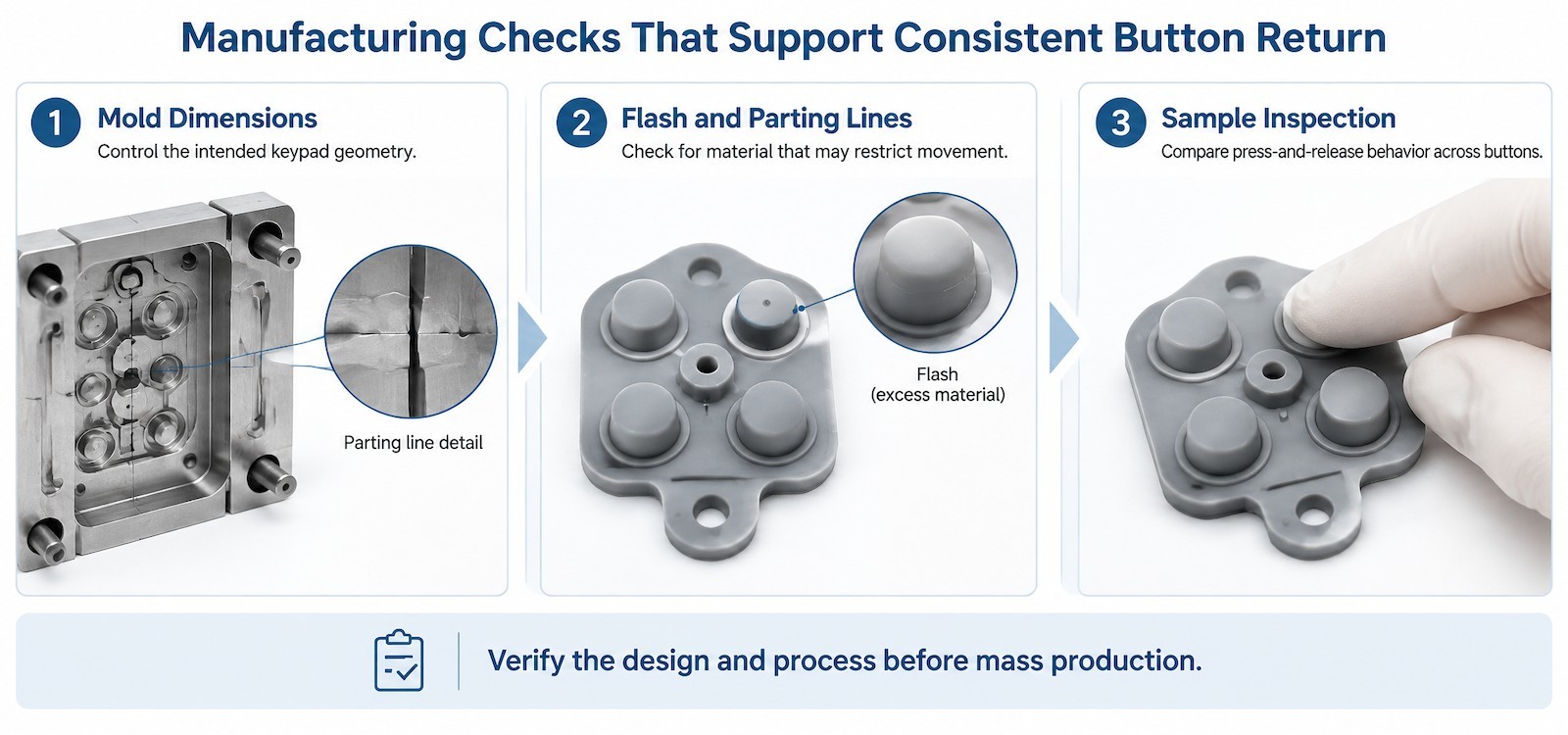
Once a design is fixed, the tool decides whether every part behaves like the sample that was approved.
Mold Dimensions Can Affect the Consistency of Keypad Structures
Web thickness is typically one of the smallest dimensions on the drawing and one of the easiest to drift. Electrode wear, polishing after repair, and a cavity that was cut slightly deep all move the web in the same direction: thinner. A thinner web returns faster in isolation but collapses more under pre-load, so the installed behaviour can move opposite to the free-state behaviour. This is why dimensional reports should include web sections, not only overall length and key height.
Uneven Curing May Cause Differences in Button Performance
Cure is often blamed for every inconsistency, and often wrongly. A part that is genuinely under-cured will show low tear strength, tackiness and a distinct odour, not a single slow key. What is more common is uneven thermal history across a large multi-cavity tool: keys near the edge of the plate see a different temperature profile from keys in the centre, and the compound crosslinks to a slightly different degree. The result is a panel where most keys match and a few do not.
Flash and Parting Line Issues May Interfere With Button Movement
Flash on the side wall of a key, or a parting line that sits inside the web travel zone, adds friction exactly where the part needs to slide. It is a small defect with a disproportionate effect, and it is invisible after assembly. Deflashing by hand is a variable process; tumbling and cryogenic deflashing are more repeatable but can round a thin web if the cycle is too long.
Custom silicone keypads have been the core of FromRubber's moulding work since 2010, across two plants in Dongguan with 32 compression presses and a tool store of more than 7,000 moulds. The reason we keep that history in one place is practical: when a return complaint arrives, the first question is whether the tool is still cutting the web that the drawing specifies.
What Should Manufacturers Check When Developing Custom Gas Detector Silicone Keypads?
The checks below are the ones that reveal return problems before tooling is frozen.
Define the Required Button Travel and Return Behavior
State the working travel, the actuation point of the switch, and the acceptable recovery time after release. "Good tactile feel" cannot be inspected; "returns to within 0.1 mm of free height within 200 ms at 20 °C" can be.
Review Web Thickness, Button Geometry, and Material Hardness Together
These three variables trade against each other. Fixing two and adjusting the third is how most keypads are tuned, but the starting point should be the switch and the panel, not the compound datasheet.
Test Prototype Samples Before Moving to Mass Production
Test in the free state, then in the housing, then after a soak at the temperature extremes the instrument is rated for. A keypad that returns perfectly on the bench and sticks at −10 °C has not passed.
| Check | What it reveals | When to run it |
|---|---|---|
| Free-state key height after 24 h rest | Compression set and moulded height drift | On first samples and on production lots |
| Recovery time after a 2 s press | Hysteresis of the web and compound | At 20 °C and at the low end of the rating |
| Key height with the keypad installed | Pre-load from housing, gasket or light guide | On the assembled unit, before sealing |
| Key-to-key height spread across the panel | Cavity and cure consistency | On every new tool and after repairs |
| Flash and parting line location | Friction in the web travel zone | On the first shot and after tool maintenance |
Which Return Symptom Points to Which Cause?
Return complaints arrive in words, not dimensions. The table maps the sentences a service desk actually hears onto the measurements that separate them. Run the free-state column first: if the key recovers once it is unloaded, the compound is not the problem and the search moves to the housing.
| What the user reports | Free state, keypad removed | Installed state | Most probable cause |
|---|---|---|---|
| Key rises slowly but reaches full height | Recovery inside the agreed time | Recovery slower than in free state | Web hysteresis, or a web that is too heavy for the key footprint |
| Key stops slightly below the panel | Returns to full height after a minute unloaded | Key sits low before it is touched | Pre-load from housing, gasket or light guide |
| One key behaves differently from its neighbours | Height or web section differs from the rest | The same difference, magnified | Cavity depth, flash on that key, or local cure variation |
| Key feels heavy and slow only in cold weather | Normal at room temperature | Slow at the low end of the rating | Compound stiffening, modulus change with temperature |
| Key returns, but the panel feels flat after months | Permanent set measurable against a new sample | Lower than at first assembly | Compression set rather than hardness |
| Key catches on one side of the opening | Moves freely in the hand | Rubs on one wall of the opening | Opening alignment, or an oversized key plan dimension |
Only two of these six rows point at the compound. That is why changing material first so often ends with a heavier key and the same complaint.
Questions we are asked most often
Can a harder silicone compound fix a slow-returning key?
Only if the cause is hysteresis in an over-soft web. If the key is being pre-loaded by the housing or restricted by flash, a harder compound will make the press heavier and leave the return problem in place.
Why does only one key on the panel return slowly?
Usually because that key differs from its neighbours in web section, surrounding support, or flash. Compare free-state height and web thickness across the panel before changing material.
Does a thicker web always give a stronger return?
It gives more stored energy but also more resistance and slower recovery. The useful range depends on key footprint and on how much travel the switch needs.
How is return performance specified on a drawing?
As a free-state height, a permitted compression set, and a recovery time at a stated temperature, measured on an assembled sample. Without those three, the requirement cannot be inspected.
Can return problems appear only after months in the field?
Yes, when compression set accumulates or when the compound slowly loses elasticity at high ambient temperature. A new-sample hardness check will not show it; a set test after ageing will.
Reference standards, cited as documents rather than links: IEC 60079-0, Explosive atmospheres, Part 0: Equipment, general requirements. IEC 60529, Degrees of protection provided by enclosures (IP Code). ISO 815-1, Rubber, vulcanised or thermoplastic, Determination of compression set, Part 1: At ambient or elevated temperatures.
Related reading on this site: why a silicone keypad sticks or fails to return, and the silicone keypad FAQ.
Return behaviour is a system property. It is decided by the web, confirmed by the tool, and finally revealed by the housing. A keypad that passes on the bench and fails in the instrument is not a material failure; it is a specification that stopped at the drawing edge.
FromRubber moulds custom keypads for detector and instrument manufacturers, including a keypad built for an air and water quality detector, and reviews the full assembly rather than the silicone part alone. Sample tools run in three to five days, production tools in ten to twelve. Drawings, panel sections and switch data can be discussed at +86 186 7621 0913 (WhatsApp and WeChat), or through the custom silicone rubber keypads page.
FromRubber is the brand of Dongguan Bohao Electronic Technology Co., Ltd. (Qiaotou, Dongguan, Guangdong), certified to IATF 16949:2016, ISO 9001:2015 and ISO 14001:2015, and moulding custom silicone keypads since 2010.