When Should You Use Solid Silicone Gaskets Instead of Sponge Silicone Seals?
- Share
- Issue Time
- Nov 3,2026
Summary
The choice between solid and sponge silicone is about voids and load paths, not softness. This article compares compression force, gap absorption, pressure capability and recovery, explains where each structure fails, and sets out a short sample test that settles the argument in the real housing before tooling is committed.
Two enclosures, same internal electronics, same ingress target. One is sealed with a dense silicone gasket, the other with a soft sponge seal because the cover is thin and the buyer did not want to overstress the plastic. The second one passes a splash test and fails a pressure test, and the failure is blamed on the material being "cheap".
The material was not the problem. The two structures do different jobs, and the difference is not softness. It is what is inside the material: a dense continuous polymer in one case, a network of gas cells in the other. That single difference decides how much force the seal needs, how much gap it can absorb, and whether it can hold a pressure differential at all.
This article is about choosing between solid silicone gasket material and sponge silicone seals on the basis of the joint, not on the basis of which one feels more forgiving in the hand.
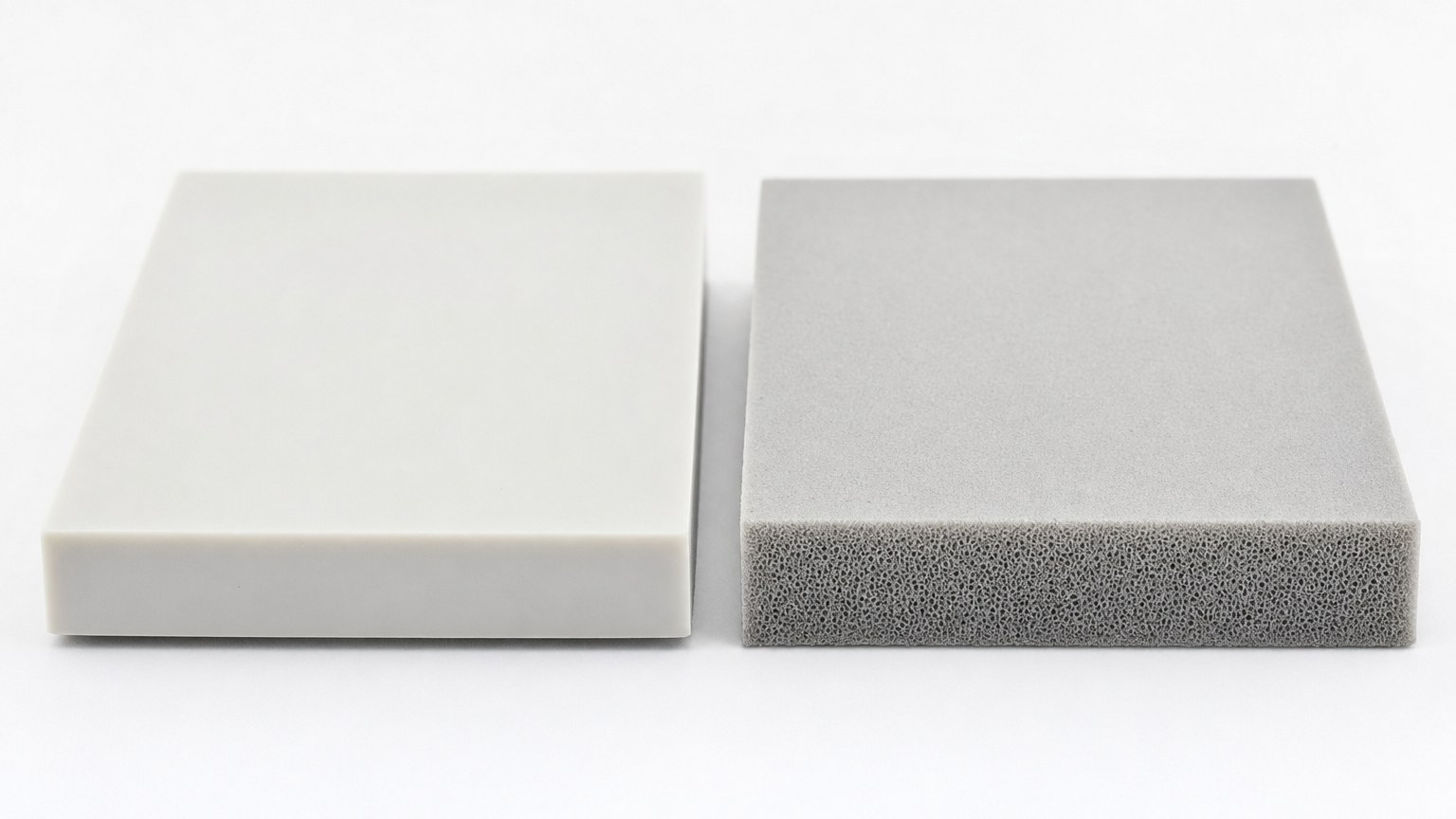
Here are the two materials side by side at the same size. The left sample is dense solid silicone: smooth, continuous, and slightly translucent at the edge. The right sample is sponge silicone, and its cut face shows the cell structure that gives it its compliance.
Both are silicone. Both are sold in the same thickness. Nothing in the appearance tells you which one will hold 0.5 bar, and that is exactly why the choice has to come from the application.
The difference is a void, not a softness rating
Solid silicone: one continuous network
Solid silicone is a continuous cross-linked network. There are no internal spaces, so when the material is compressed the polymer has to deform and the volume has to go somewhere. That is why a solid gasket resists compression and why it recovers predictably when the load is removed.
Sponge silicone: cells formed during cure
Sponge silicone contains closed cells created during vulcanisation. When the material is compressed, part of the deformation is the cell walls bending and the gas inside them compressing. That costs far less force, which is the property people are usually looking for when they ask for a softer seal.
What this does at the sealing interface
At the interface, a solid gasket produces a contact pressure that rises steeply as the joint closes. A sponge seal produces a much flatter curve: it conforms early, then stops resisting. For a static joint that only has to keep dust and splashes out, that flat curve is an advantage because it tolerates a warped cover. For a joint that has to hold pressure, the same flat curve means the seal never develops enough contact pressure to close the leak path.
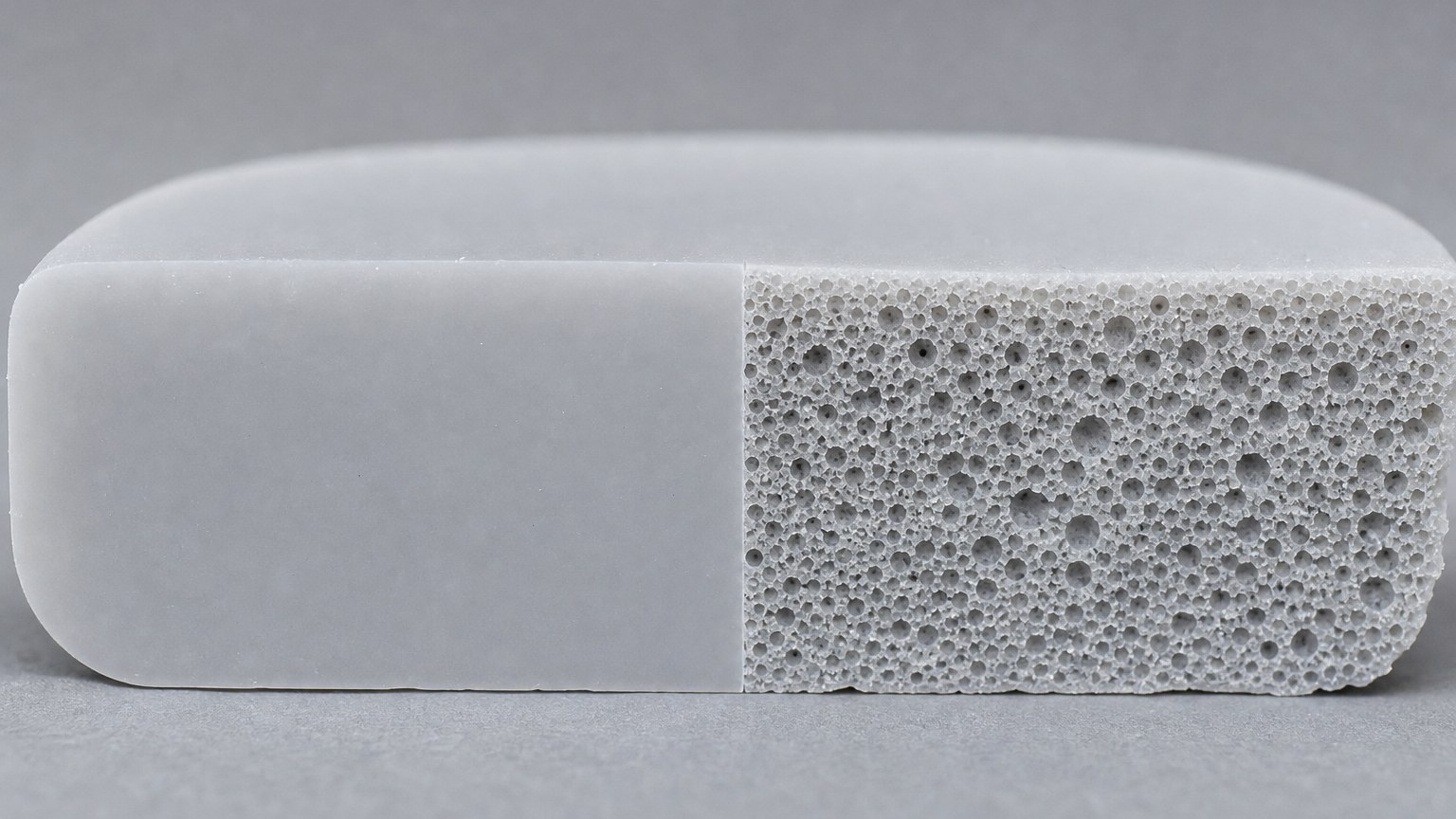
Under the microscope the difference is obvious, and so is the consequence. A crack or a leak path in solid silicone has to travel through material. In sponge it can travel through the cell structure, which is why sponge is a poor choice for fluid sealing even when it compresses beautifully.
The cell structure also explains the recovery behaviour: once the cells have been crushed and the gas has escaped or diffused, the seal does not return to its original thickness.
Compression: force, travel and what comes back
The comparison that matters is not "which one compresses more" but "which one still has something left after a year".
Solid silicone needs more force for the same compression, and that force has to be carried by the housing. On a machined aluminium casting with steel fasteners, that is easy. On a thin ABS cover with four self-tapping screws, it is not: the cover bows, the middle of the joint loses contact, and the leak appears where there was least clamping, not where the gasket was weakest.
Sponge silicone needs very little force, so the cover stays flat. What it gives up is the ability to hold that compression over time under heat. A sponge seal that is compressed hard for months will take a permanent set, and the second assembly will not seal as well as the first. Solid silicone also takes compression set, but the mechanism is different and the recovery is better at equivalent compression.
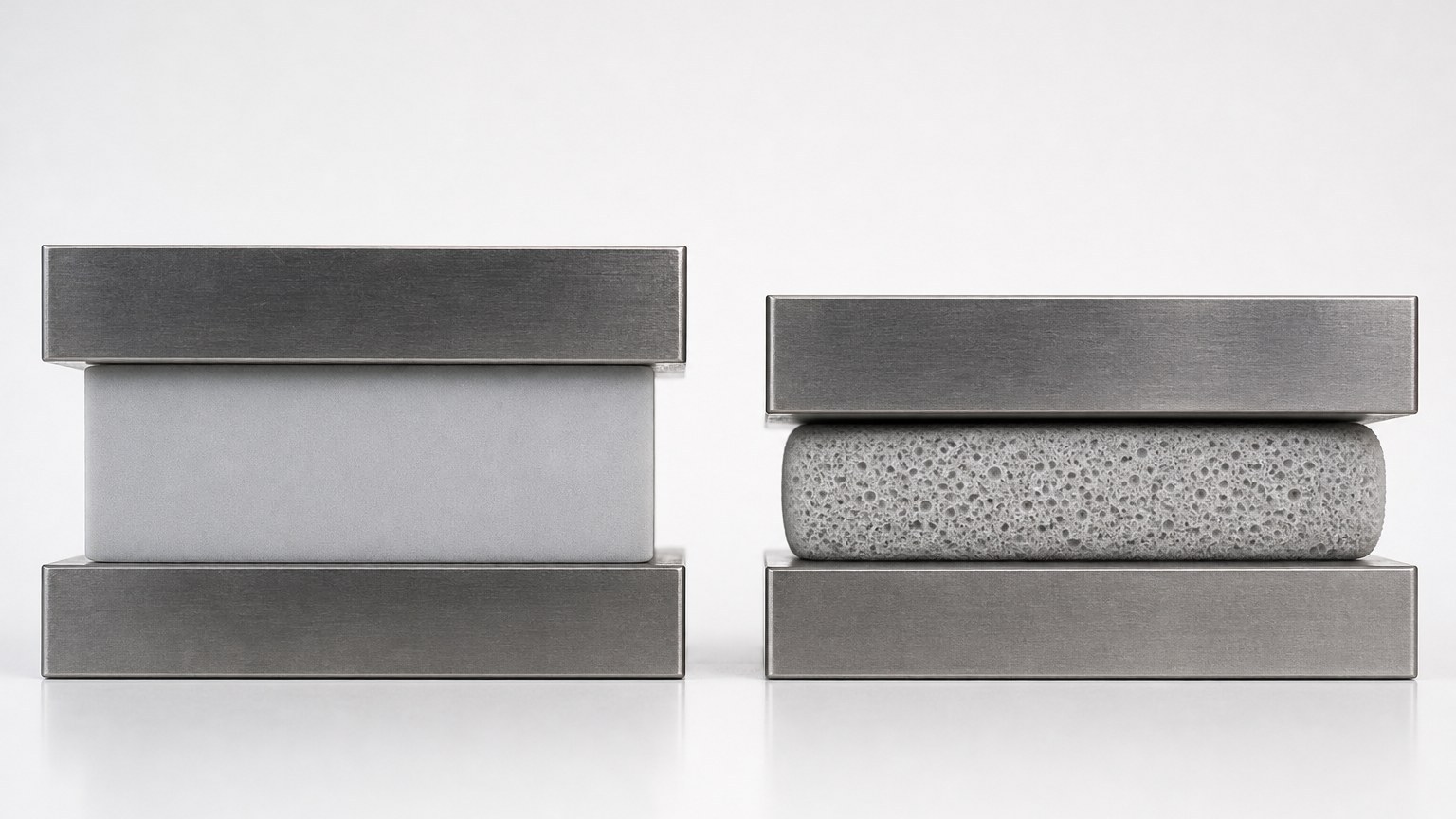
In the comparison below, both strips started at the same thickness and were closed between the same plates. The solid strip on the left is only slightly compressed and the plates stay apart. The sponge strip on the right is squeezed much further, and the plates come close together.
That is the trade in one image: the sponge accommodates a larger gap, and the solid material keeps the joint stiffer. Neither is a defect. They suit different assemblies.
When solid silicone is the better answer
Pressure, handling, and joints that get reopened
The clearest case is any joint with a pressure differential across it. Once a seal has to hold air or fluid, the material has to resist extrusion into the gap and maintain contact pressure as the joint deflects. A cellular seal cannot do that reliably, which is why solid material is the default for IP67 and above.
The second case is handling. A solid gasket holds its shape when it is picked up, placed, and checked. On an assembly line where the part has to sit in a groove before the cover arrives, that stiffness is a functional requirement, not a cosmetic one.
The third case is a joint that will be opened. A solid gasket with good compression set behaviour can be reused a few times; a sponge seal usually cannot. If the product is designed for maintenance access, this decides the material before anything else does.
One caution: solid does not mean stiff. A 40 Shore A solid silicone gasket conforms well to a machined surface and still holds pressure. The mistake is going to 70 Shore A to solve a gap problem that should have been solved by the profile.
When sponge makes more sense
Wide gaps, thin covers, and low clamping force
Sponge earns its place where the joint has a large, poorly controlled gap and the closure force is limited. A stamped cover on a plastic housing often falls into this category: the gap varies by a few tenths, nobody wants to add ribs, and the requirement is dust and splash rather than pressure.
It is also useful for vibration and for parts that must not mark a finished surface. A soft cellular seal spreads load over a wider area and does not leave the hard contact line that a dense gasket can print into a painted panel.
What it should not be used for is a joint that will be judged by a pressure decay test, or one where the seal is also expected to act as a structural spacer. Both are common misapplications, and both show up as leaks that are blamed on the moulding.
Comparing the two on the factors that decide the design
| Factor | Solid silicone | Sponge silicone |
|---|---|---|
| Internal structure | Dense, continuous | Closed cells |
| Force to compress | Higher at the same compression | Low, and rises slowly |
| Gap it can absorb | Limited by compression allowance | Large, within cell collapse |
| Pressure sealing | Suitable for pressure and IP-rated joints | Not suitable for pressure differentials |
| Recovery after long compression | Better at equivalent compression | Poorer; cells do not fully recover |
| Handling before assembly | Holds shape in a groove | Flops; needs support or adhesive |
| Tolerance to a warped cover | Low; the gasket loads the cover | High; the cover stays flat |
Specifying sponge properly, if you choose it
Sponge is usually specified only by thickness and colour, which is not enough to control behaviour. Two sponge sheets of the same thickness can need very different force to compress, depending on how dense the material is. Thickness tolerance matters too: on a 3 mm sponge seal, a ±0.3 mm variation is a tenth of the section, and it changes how much the joint has to take up.
For a solid gasket the equivalent control is hardness plus section tolerance. Both are covered by the usual moulded tolerance classes, and both should appear on the drawing rather than in a purchase note. If the drawing only says "silicone sponge, 3 mm", the supplier has no way to know whether you wanted a soft seal for a plastic cover or a firmer one for a metal panel.
There is also a question that rarely gets asked early enough: does the sponge need to be closed-cell throughout the section? A cut edge exposes the cell structure, and on a thin seal the cut edge can be a significant proportion of the sealing face. For splash protection this is fine; for anything wetter, it is not.
Testing the choice before committing to tooling
The fastest way to settle a solid-versus-sponge argument is a pair of samples in the real housing. Mould or cut both options at the intended thickness, assemble with the production cover and the production torque, and then test in the order the product will actually experience: assembly, thermal cycle, pressure or splash, then disassembly and reassembly.
We usually recommend three checks. Measure the compressed thickness of each option after 24 hours to see how much set has already occurred. Look at the contact marks on the gasket to confirm the seal band is continuous rather than patchy. Then reassemble and test again, because a joint that only seals once is not a sealed joint.
This is straightforward work when the samples and the housing are in the same place. Our plant in Dongguan moulds both solid and sponge silicone parts, so the comparison can be run on production-intent material rather than on a generic sheet, which is often where sample results and production results diverge.
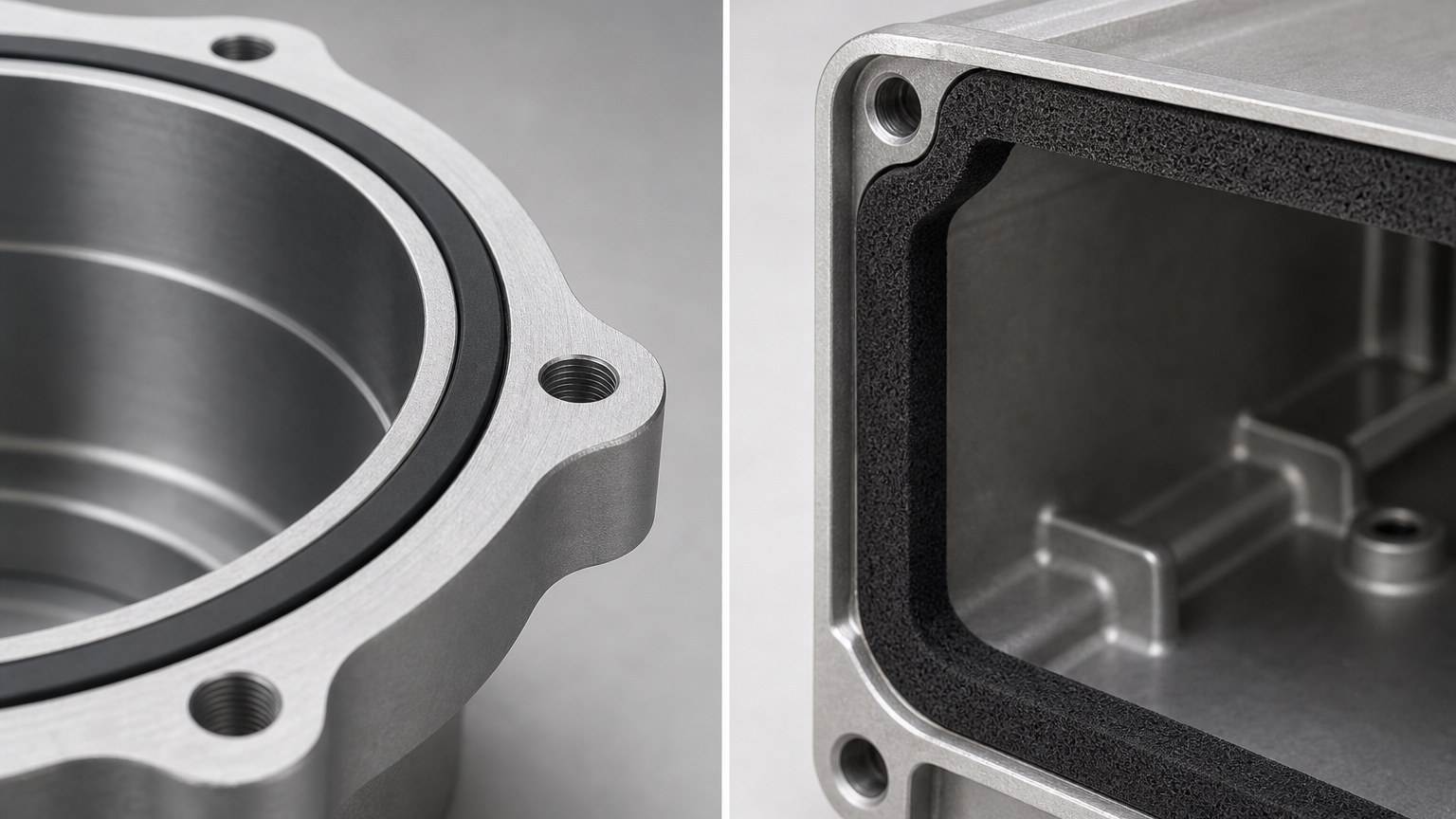
Both of these are correct uses of the material. On the left, a dense gasket sits in a machined groove where the gap is controlled and the joint has to hold. On the right, a thicker sponge seal fills a larger, less controlled gap in a housing that could not take a stiff seal.
The mistake would be swapping them. The dense gasket would not close the wide gap on the right without deforming the housing, and the sponge would not hold the machined joint on the left.
In short
Solid silicone and sponge silicone are not two grades of the same product. One is a pressure seal with predictable recovery; the other is a gap filler with low closure force. The choice follows from three numbers: the gap range, the available clamping force, and whether the joint has to hold a differential.
If you are not sure which side of that line your design sits on, our note on the difference between solid and sponge silicone seals covers the same comparison in shorter form, and our guide to silicone versus other rubber seals covers the material family question around it.
Send the housing drawing and the test condition through our inquiry page and we will tell you which structure we would sample first, and what we would check on the sample. Email: nani@fromrubber.com or karl@fromrubber.com. WhatsApp and WeChat: +86 18676210913.
Common questions about material choice
What is the difference between solid and sponge silicone seals?
Solid silicone is a dense continuous elastomer that holds contact pressure and resists extrusion. Sponge silicone contains closed cells, compresses at low force and fills a larger gap, but it cannot hold a pressure differential.
Which one suits an IP67 enclosure?
Solid silicone. A cellular seal will conform to the joint but will not maintain pressure, and it takes a permanent set under sustained compression, so the second assembly seals worse than the first.
When is sponge the right choice?
When the gap is large and poorly controlled and the cover is too thin to carry clamping force, for example dust and splash protection on a stamped or plastic cover. It is the wrong choice anywhere a pressure decay test is applied.