Which Details Matter in Marine Silicone Keypad Design?
- Share
- publisher
- FromRubber
- Issue Time
- Nov 19,2026
Summary
On a depth sounder the keypad is a sealing component before it is a user interface. This article covers flange compression, wet-hand button geometry, material selection and the interface details that decide whether a console instrument stays dry.
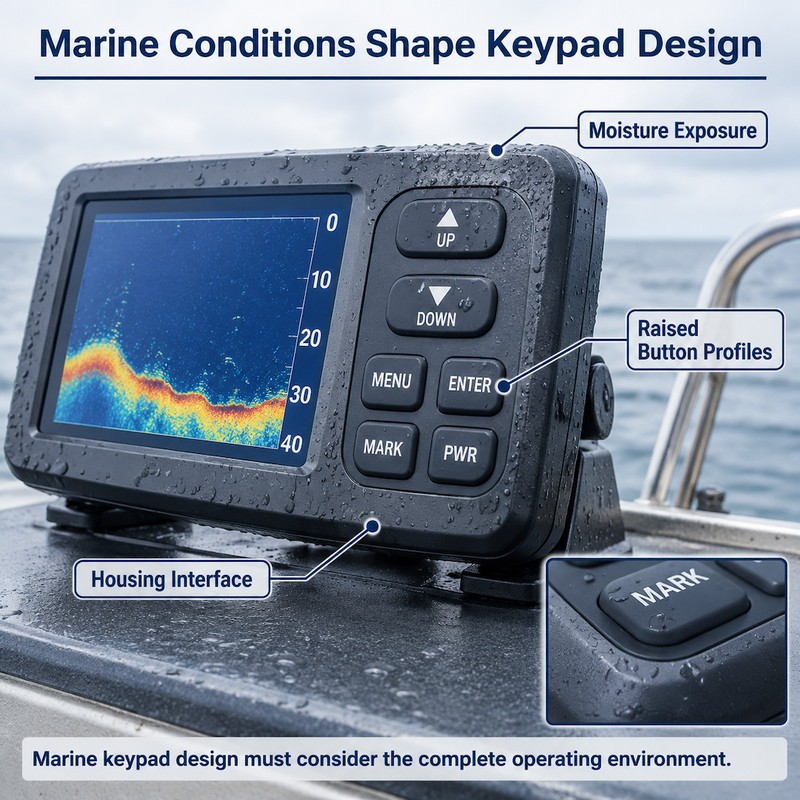
A depth sounder keypad that works perfectly on the bench in Dongguan will start to misbehave after one season on a boat, and the reason is rarely the buttons. It is the flange around them.
Marine electronics put a flexible silicone part into a rigid housing, press it against a gasket groove, and then expose the assembly to sun, salt, spray, cleaning and a temperature cycle that runs from a cold morning to a console in direct afternoon sun. The buttons have to work with wet hands, sometimes with gloves, and the whole thing has to keep water out of a compartment that contains the electronics.
That combination makes the keypad a sealing component first and a user interface second. Designing it as a button panel that happens to be waterproof is where most of the field problems begin.
Why Do Marine Depth Sounders Need Application-Specific Silicone Keypad Designs?
How Water Exposure Changes Keypad Material and Structural Requirements
Spray arrives from every angle, often at pressure, and it carries salt. Water that sits on the pad between buttons evaporates and leaves a salt film, which holds moisture against the surface and stiffens the key edges as it dries. Over a season the pad can feel different without any visible damage.
The structural consequence is that the pad needs a drainage path and a flange that keeps its compression. Water that reaches the housing joint is the housing’s problem; water that bypasses the flange is the keypad’s. Those two are separated by a few millimetres of moulded silicone and the force holding it against the recess.
Silicone is a good choice here because it retains elasticity over temperature far better than most elastomers, and because it can be moulded thin without losing tear strength. Neither property helps if the flange is designed as an afterthought.
Why Buttons Must Remain Easy to Operate With Wet Hands
A wet thumb slides. On a flat button with a shallow profile, the finger skates across the surface and the operator ends up pressing the neighbouring key. The fix is geometry: a taller crown, a defined edge, enough spacing to prevent an accidental double press, and a detent that can be felt rather than only seen.
Gloves make it worse. A neoprene or fishing glove removes most of the fine tactile feedback, so the key has to announce its actuation through force and travel rather than through surface texture. This is where a dome design that feels pleasant with a bare finger can be too soft to confirm actuation through a glove, and users press twice.
Spacing follows the same logic. Compact layouts that are fine on a benchtop instrument become a liability on a moving boat, where the operator is bracing against a rail with one hand. A few millimetres of extra gap is worth more than a slightly larger screen.
How Marine Installation Conditions Affect Keypad Durability
The console sees the full diurnal cycle and the full solar load. A dark housing in the sun can be far above air temperature; at night it drops to ambient and often below, with condensation on any surface that cools faster than the air. That cycle repeats every day for years, and it works the flange and the printed legends simultaneously.
Cleaning adds a chemical load that is easy to underestimate. Salt is usually removed with fresh water, but boat owners also use general-purpose cleaners and, occasionally, solvents. A legend that survives salt spray can still fail after a season of wipe-downs with an aggressive cleaner.
How Should Silicone Materials Be Selected for Marine Depth Sounder Keypads?
Choosing Silicone Materials for Moisture and Weather Exposure
The starting point is a compound intended for exterior use, with a pigment system that holds colour and a cure that does not leave surface residue. Beyond that, the decision is about hardness and compression set rather than about a single “marine grade” label.
Compression set is the property that matters most for the flange and the least discussed in datasheets aimed at buyers. A silicone that takes a permanent set after months under compression will leak at the flange even though the material itself is intact. Ask how the compound performs in compression set terms, and how the flange geometry compensates for it over time.
Balancing Button Hardness With Reliable Tactile Feedback
Marine keypads usually sit in the middle of the hardness range, softer than an industrial panel and firmer than a consumer remote. The reason is the combination of wet hands, gloves and a moving platform: the user needs a positive break, but also needs the key to return fully when the finger slides off rather than pressing straight down.
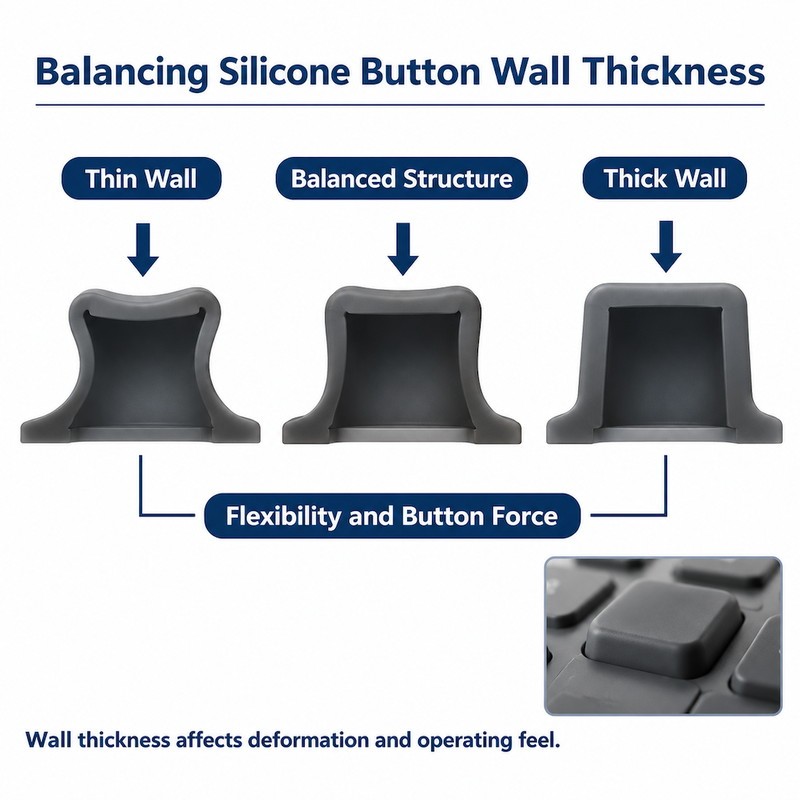
Wall thickness does more for feel than hardness alone. A relatively hard compound in a thin-walled button can feel lighter than a soft compound in a thick one, and it returns more consistently. This is why the two parameters have to be tuned together against a physical sample rather than chosen from a table.
Selecting Materials That Maintain Shape During Repeated Operation
Silicone keypads fail in two slow ways on marine equipment: the button takes a set and stops returning fully, or the web around it stretches and the key sits lower than its neighbours. Both come from sustained load and heat, and both are worse when the pad is compressed by the housing rather than only by the finger.
Material choice helps, but geometry does more. A button with a proper skirt and a defined return web distributes the load better than a simple dome. High tear strength matters too, because a thin web that has been nicked during trimming will tear from that point after a few thousand cycles in the sun.
How Should Button Geometry Be Designed for Marine Electronics?
Choosing Button Heights and Profiles for Easy Operation
Height is a compromise between findability and snagging. A tall button is easy to locate with a wet thumb but catches on ropes, sleeves and covers. A low button is protected but hard to find without looking. On a depth sounder mounted at the helm, the practical answer is usually a moderate crown with a defined edge and a wide enough top surface that the thumb does not need to be precise.
Profile matters more than height. A crowned top sheds water; a flat top with a sharp edge holds a film of water and reads as slippery. A slight crown with a small flat land around the legend gives both drainage and a clear place for the marking.
Designing Button Spacing to Reduce Accidental Presses
Spacing should be set from the finger, not from the layout grid. A wet thumb contacts a wider area than a dry one, and the contact patch shifts as the boat moves. Gaps that look generous on a drawing are often marginal in use.
Where space is tight, a raised separator rib between adjacent keys does more than extra gap alone, because it gives the finger something to feel. It also helps in the dark, which matters on a night passage.
Adjusting Wall Thickness to Balance Flexibility and Structural Stability
The wall has three jobs: flex enough to actuate the dome, stay stiff enough not to collapse under a braced hand, and keep the button from rocking when pressed off-centre. A thin wall does the first well and the other two badly. A thick wall is stable and tiring.
The practical approach is to keep the wall thin where it flexes and add material where it locates, rather than thickening the whole section. That means a tapered skirt and a defined base, which is a moulding design decision, not a material one.
What Sealing Details Matter When Installing Silicone Keypads in Marine Depth Sounders?
Designing Compression Areas Around the Keypad Perimeter
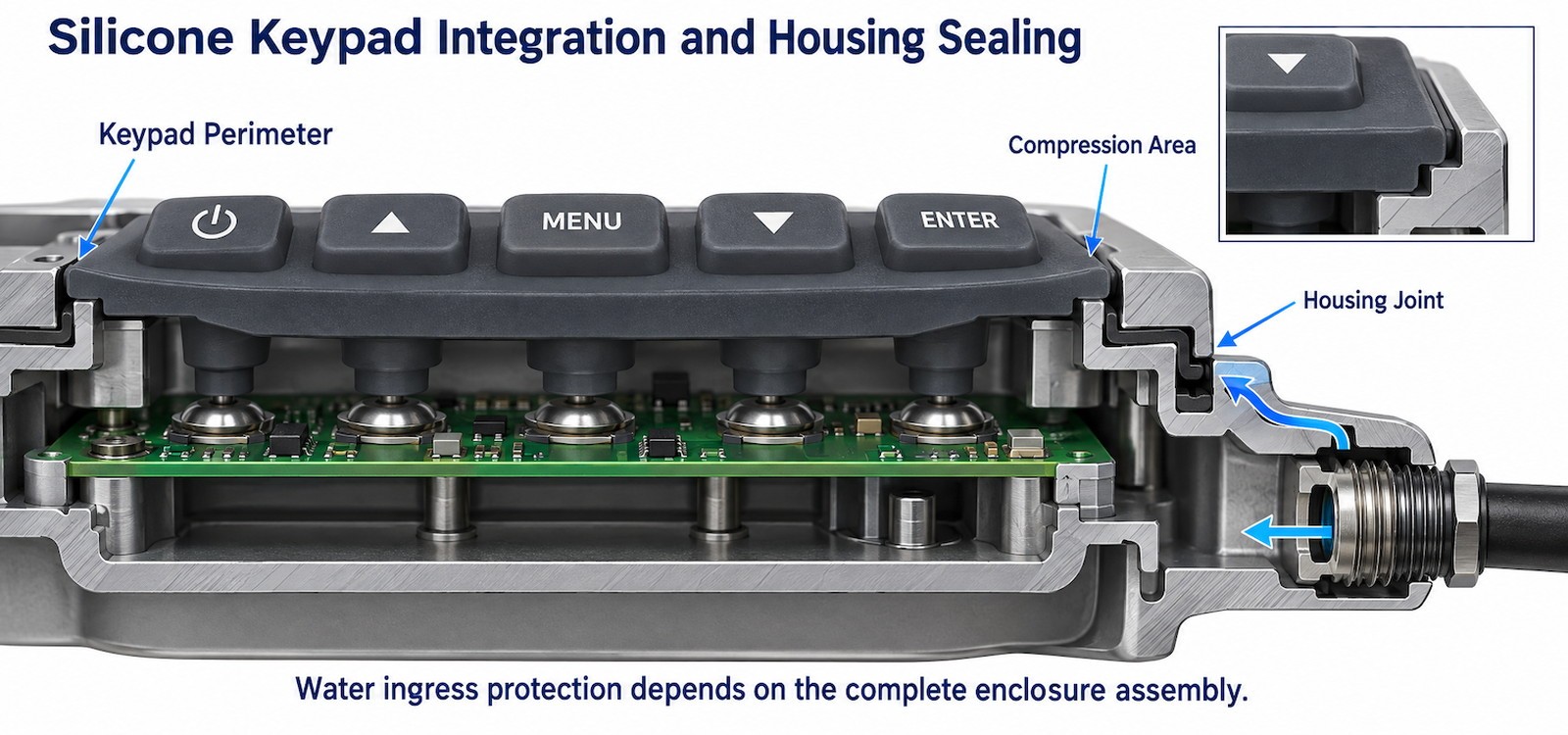
The flange needs a defined compression: enough to seal, not so much that the silicone is crushed and takes a set. That means a groove with a controlled depth, a flat mating surface, and fasteners positioned so the clamping force is even along the perimeter. Four corner screws on a long housing bow in the middle, and the flange leaks where the bow is largest.
Flange width matters as much as thickness. A narrow flange has little tolerance for housing flatness; a wider one distributes the same force over more area and tolerates more variation. On a part that will be assembled by hand in a boat yard, tolerance matters.
Matching Keypad Dimensions With Housing and PCB Structures
The keypad has to locate against the housing and clear the PCB. Locating features — small pins, a stepped edge, a keyed corner — prevent the pad rotating during assembly and keep the legends aligned with the housing window. Without them, the pad can be fitted a millimetre off, and every legend is off by the same millimetre.
Clearance above the domes is the other dimension that causes trouble. If the pad compresses the domes at rest, the keys feel preloaded and the actuation force rises. If there is too much clearance, travel is wasted before the dome breaks and the key feels vague.
Why the Complete Housing Assembly Must Be Evaluated for Water Ingress
A keypad cannot seal a housing on its own. The joint between the two housing halves, the cable gland, the connector opening and the display window are all part of the same boundary. Testing a bare keypad in a fixture proves that the flange is sound; it does not prove the product keeps water out.
This distinction matters commercially as much as technically. A supplier who claims a rating for a keypad alone is describing a test that does not exist in the standards; ingress protection ratings apply to enclosures. The honest version is a keypad designed for the interface, verified in the customer’s assembled unit. There is more on that in this sealing guide for keypads and plastic enclosures, and in this account of why a lab pass can still leak on site.
How Can Printed Legends Remain Readable in Marine Environments?
Selecting Suitable Printing Methods for Frequently Used Buttons
Legends on a depth sounder are a mix of symbols and short words: range up and down, menu, enter, mark, power. The most-used keys are usually the range keys, and those are the ones that wear first. Etched legends, either recessed into the button or cut through an opaque coating, remove the ink film from the wear path and are worth considering for those keys specifically rather than for the whole panel.
Improving Legend Visibility Under Sunlight and Low-Light Conditions
Contrast, not colour, is what makes a legend readable. A white legend on a dark grey key reads in bright sun and in low light; a low-contrast combination that looks sophisticated on a desk can disappear on a hazy afternoon. Symbol size matters too: a small arrow with a thin stroke fills in visually at a distance, which is why marine legends tend to be bolder than their office equivalents.
If the panel is backlit, the same rules as any backlit keypad apply — the legend has to be readable when the light behind it is the only light. On a boat at night, a dim panel is preferable to a bright one, which affects the ink and the LED choice together.
Considering Surface Protection for Repeated Cleaning and Handling
Salt removal is usually fresh water and a cloth. Owners also use general cleaners, and occasionally something stronger. A coating can help against chemical exposure, but it changes gloss and feel, and it becomes the surface that wears. On a keypad that is already textured for grip, a coating can reduce the grip that made the texture worth having.
| Requirement | Design parameter | How to verify |
|---|---|---|
| Seal at the housing | Flange width, compression, fastener spacing | Assembled unit exposed to spray and pressure, then inspected internally |
| Operate with wet hands | Crown height, edge definition, key spacing | Actuation trial with wet and gloved hands on a mounted prototype |
| Confirm actuation by feel | Dome force, travel, wall taper | Force-travel measurement on the assembled pad, at temperature extremes |
| Resist sun exposure | Compound and pigment for exterior use | Accelerated UV exposure, then colour, hardness and function checks |
| Resist repeated cleaning | Ink system, coating, etched legends | Wipe cycles with the actual cleaner, then adhesion and readability check |
| Keep shape under heat and load | Compression set, web geometry, material hardness | Compressed ageing, then dimensional and return check |
| Assemble correctly first time | Locating pins, keyed edge, clearance to domes | Assembly trial by production staff, not by engineers |
What Should Buyers Provide When Customizing Marine Depth Sounder Silicone Keypads?
Sharing the Equipment Housing Drawings and Keypad Installation Dimensions
Send the housing drawing, the recess dimensions, the PCB height, the dome positions and the legend artwork. The vertical stack is the part that most often goes missing and the part that decides whether the keys feel right. A 2D outline with a note “keypad as sample” leaves the most important dimensions undefined.
Defining Environmental Requirements Before Selecting Silicone Materials
State the installation type (open console, enclosed cabin, exposed flybridge), the climate, whether the unit is washed down, the cleaning agents used, and the expected service life. Each answer narrows the compound, the pigment and the printing method. “Marine environment” alone does not.
Confirming Button Feel, Marking Layout, and Assembly Fit With Prototype Samples
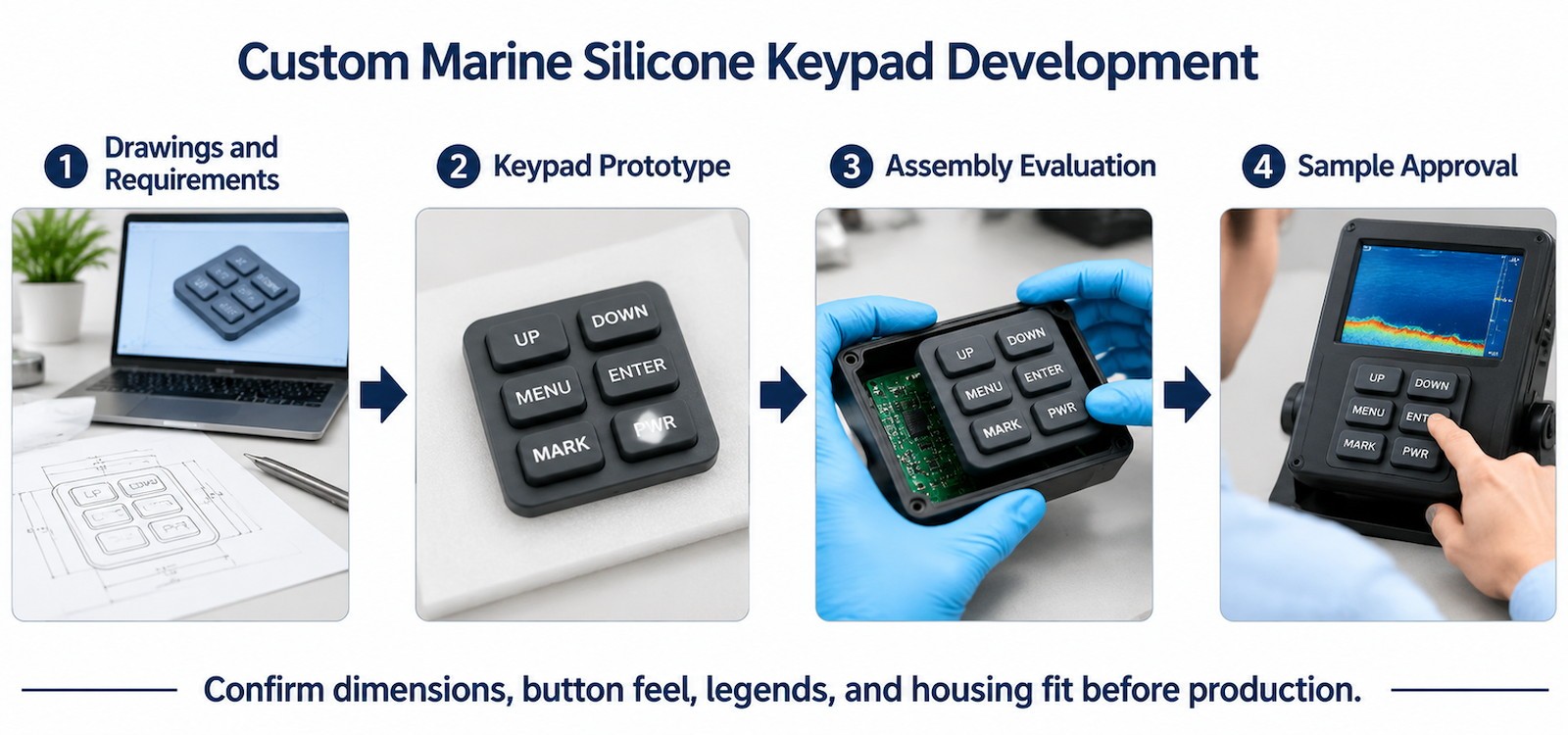
Approve the prototype assembled into a housing, with the production PCB if it exists, and press every key with a wet hand. Check that the legends line up with the housing window, that the flange sits in the recess without pinching, and that the pad does not rock. Then leave it in the sun for a week and check it again.
Final Design Considerations for Custom Marine Silicone Keypads
Marine keypad design is mostly about interfaces: the flange to the housing, the button to the finger, the legend to the light, the material to the weather. Get the interfaces right and the material choice becomes straightforward. Get them wrong and no compound will compensate.
FromRubber, trading name of Dongguan Bohao Electronic Technology Co., Ltd., has been moulding custom silicone parts in Dongguan since 2010, with 32 compression presses, in-house tooling and printing, and IATF 16949 as well as ISO 9001 and ISO 14001 certification. Marine work usually starts with a housing drawing and a conversation about the flange, because that is where the leaks are. If you are developing a depth sounder or a similar console instrument, send the drawing and the installation conditions and our engineers will review the interface before anything is quoted. WhatsApp and WeChat: +86 18676210913; the contact page has the other routes.
A note on ingress ratings. IP ratings apply to complete enclosures, not to a keypad supplied as a component. Any statement about water protection for your product has to be based on testing the assembled unit. For the silicone itself, the two measurements that matter are compression set to ISO 815 after compressed ageing, and weathering to ISO 4665 for the exposed face.
Frequently asked questions
Can a silicone keypad alone make a depth sounder waterproof?
No. The keypad seals one opening. The housing joint, the cable entry and the display window are separate paths, and the enclosure rating depends on all of them together.
Why do the keys feel different after a season in the sun?
The surface of the silicone hardens under UV while the bulk stays soft, and the button may take a slight set from sustained compression. Both change the force-travel curve. Comparing a durometer reading on the button top with one on the shielded flange shows how much of the change is surface ageing.
Is a harder silicone better for marine use?
Not on its own. Harder material resists wear and takes less set, but it raises actuation force and reduces the feedback a gloved hand needs. Wall geometry usually has more influence on feel than hardness does.
Should legends be etched or printed on a marine keypad?
Etching removes the ink film from the wear path and tolerates harsh cleaning, at the cost of colour options. Printing allows multi-colour legends and is easier to change. Many panels use both: etched for the most-used keys, printed for the rest.
What is the single most useful thing a buyer can send?
The housing drawing with the keypad recess dimensions and the PCB height. Those dimensions decide flange compression, key travel and clearance to the domes, which between them account for most of the field failures on marine keypads.