Why Are Silicone Makeup Tool Quotes Different Even When Product Designs Look Similar?
- Share
- Issue Time
- Nov 9,2026
Summary
Two silicone makeup tools can look identical and still be quoted at very different prices. This breakdown separates the real cost drivers behind a quotation, from compound grade and shot weight to cavity plan, surface finishing and the tolerance class written on the drawing, and shows what a buyer should compare before choosing a supplier.

A procurement manager sends the same rendering to five suppliers. Two reply within a day, one asks for a drawing, one asks what hardness the part should be, and one quotes a number that is almost double the lowest offer. Nothing in the picture changed. What changed is that each supplier silently turned the picture into a different set of manufacturing assumptions, and priced those assumptions instead of the picture.
Why Similar-Looking Silicone Makeup Tools Can Have Different Prices
A photo or a 3D rendering carries shape. It does not carry shot weight, silicone grade, cavity layout, deflashing method, or inspection criteria. When a quotation arrives, it is usually built on six assumptions that never appear in the image:
- the grade and supplier of the silicone compound;
- the actual weight of material per part, not the envelope size;
- the wall structure hidden behind the visible surface;
- the mold the supplier intends to build, including cavity count and parting line position;
- the finishing route: matte, gloss, texture, print, or assembly;
- the inspection standard and the acceptable defect level.
Two silicone makeup tools that look identical on a screen can therefore be two different products. One may be a single-cavity tool with a simple open-and-shut mold and a hand-trimmed edge. The other may need a multi-part mold, an insert, a textured cavity surface, and a jig to hold the part during printing. The unit prices are not disagreeing about the design. They are describing two different factories' plans for making it.
This is why comparing unit prices before comparing specifications tends to mislead. The lower number is not necessarily a better deal, and the higher one is not necessarily padded. They may not be quotes for the same object.
The outer silhouette is identical in both parts. The cutaways show why: one wall carries material evenly, the other adds mass at the connection and removes it elsewhere. A price built on the left-hand part cannot cover the right-hand one.
A practical habit: ask every supplier to return the quotation with a short basis note: material grade, part weight, cavity count, finishing steps, and inspection level. A supplier who cannot state those has not yet priced your product; they have priced a guess.
Material Specifications Can Change the Quotation
Silicone Grade and Material Selection
Silicone is a family, not a single material. Compounds differ in filler type and loading, cure system, volatility, and how they behave after repeated washing. A general-purpose molding compound and a compound formulated for skin-contact beauty tools can differ in cost before a single part is molded, and they can also differ in how easily they release from the cavity, how much flash they generate, and how consistent the surface looks across a production run.
Material selection also decides which tests are meaningful later. Hardness, for example, is measured by indentation, and the result depends on the instrument scale and the procedure used. The durometer method is defined in ASTM D2240, and the equivalent international method for Shore hardness is ISO 48-4. If a specification says "soft silicone" without a scale and a value, each supplier will aim at a different target and the quotes will drift apart for reasons nobody can see on the drawing.
For beauty tools that contact skin, water, and cleansers, material choice is also a compliance question rather than only a cost question. Where a silicone part is intended for repeated contact with food or drink, for instance, the permitted elastomers and extraction limits are set out in 21 CFR 177.2600. A supplier quoting a compound that already satisfies the intended end use may look more expensive per kilogram and still be cheaper than reformulating later.
Hardness and Material Consumption
Shore A hardness changes feel, but it also changes the part. A softer compound deforms more under the same load, so a soft sponge or a soft scraping edge often needs a thicker section to keep its shape. Thicker sections consume more material per shot, add cure time, and can change how the part releases from the mold. Two tools with a similar silhouette can therefore have different shot weights, and shot weight is one of the honest drivers of unit price.
Hardness is not a single-point decision either. A part can be molded in one hardness and assembled with another, or molded in two hardnesses in one cycle. Each of those choices adds process steps, and each process step has a cost that belongs in the quotation.

Hardness and thickness are two separate variables that often get written as one line on a specification. A durometer reading describes the compound; a section drawing describes how much of it the part contains.
Product Structure and Mold Design Affect Manufacturing Costs
Wall Thickness and Structural Complexity
The visible surface is the easy part. The cost usually hides in what the surface is doing: a deep groove that needs a thin steel blade in the cavity, a recessed logo that must be engraved after the mold is hardened, a rim that is thin enough to tear during demolding, or a transition where a thick base meets a flexible lip.
Uneven wall thickness is one of the most common structural cost drivers in silicone beauty tools because curing is a time-and-temperature process. A thick section needs more heat time than a thin one. The mold cannot cure different sections at different rates, so the thickest section sets the cycle, and the thinnest section has to survive that cycle without scorching or distorting. When a design mixes extremes, the supplier either extends the cycle, adds a mold-temperature compromise, or accepts a higher defect rate. All three show up in the price.
Mold Cavities and Mold Development Requirements
Tooling is quoted separately in most B2B projects, but it still shapes the unit price, because cavity count decides how much labor and machine time each part absorbs. A single-cavity prototype mold and a multi-cavity production mold can produce the same geometry and still land at very different unit costs, simply because setup, press time, and handling are divided across a different number of parts.
Mold development effort is not proportional to part size. A small holder with a closed internal cavity, an undercut, and a textured face can take more engineering than a larger, simpler mat. The extra effort goes into parting line placement, ejection, and cavity polishing, and it is visible in the quote as a higher tooling line, not as a higher material line.
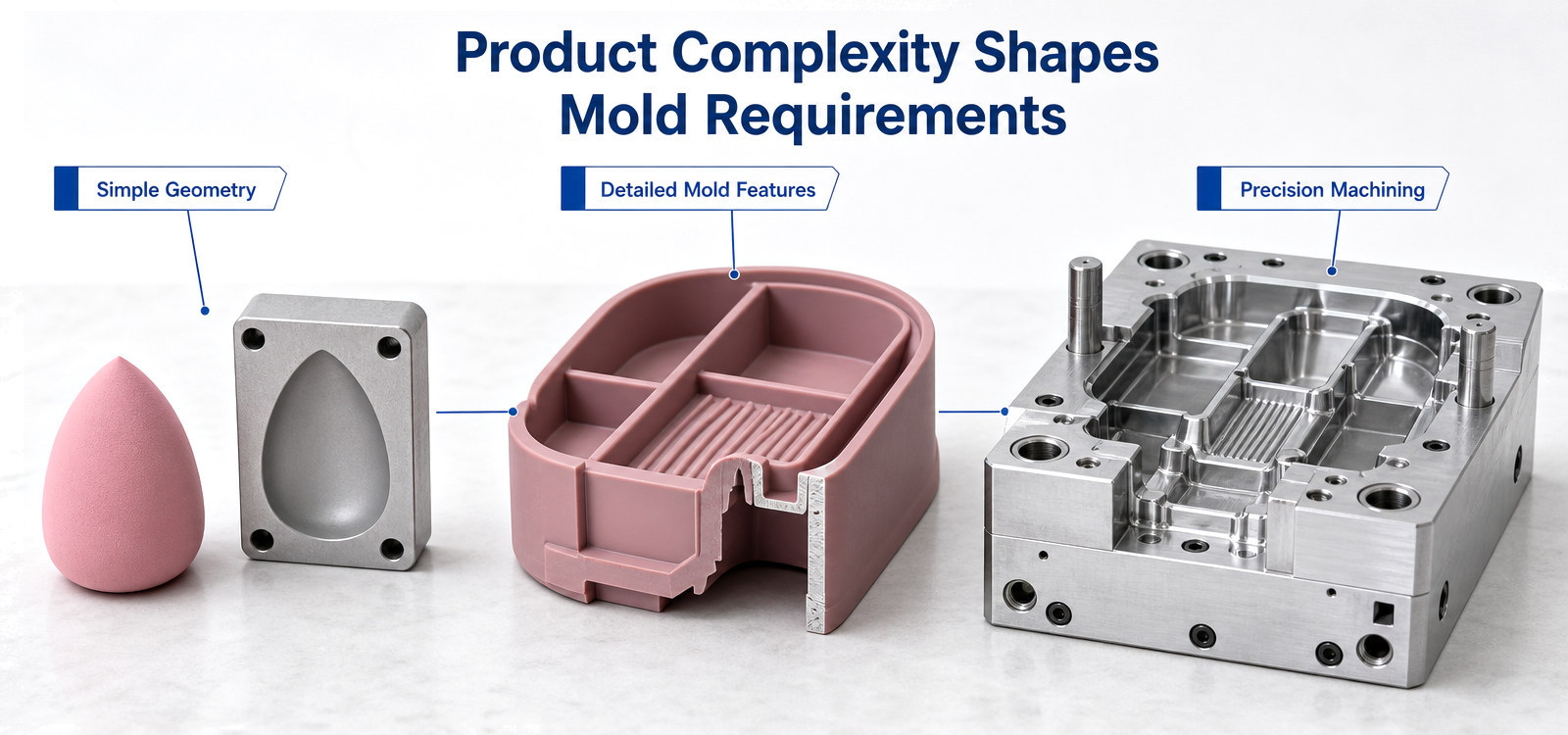
Tooling effort follows geometry, not product size. A simple cavity can be cut in a day. A cavity with grooves, recesses and blended sections needs more machining passes and more polishing before it produces a clean part.
Parting lines deserve their own conversation. On a cosmetic tool, the parting line is often the first thing a brand manager notices, and moving it to a less visible edge may require a different mold split, a slide, or a secondary trim step. Our own notes on mold design and parting lines on silicone beauty tools go deeper into that trade-off, and the companion piece on flash and uneven edges after molding explains why two factories can quote different trimming effort for the same shape.
Surface Finish and Customization Requirements Add to the Cost
Matte, Glossy, Textured, and Embossed Surfaces
Surface finish is decided in the mold, not in the finishing room. A matte face usually means the cavity was etched or bead-blasted to a specific roughness. A gloss face means the cavity was polished to a finer grade. A fine texture means both, plus a consistent etch depth across the whole cavity, because a shallow etch in one area and a deeper etch in another will read as a patchy surface under retail lighting.
This is where small decisions become expensive. A texture that is too fine can clog with mold release or cured residue and need cleaning more often, which shortens the interval between mold cleanings. A texture that is too deep can trap cleanser residue in a beauty tool that is washed daily. Either way, the supplier has to build a maintenance routine into the price.
Colors, Logos, and Custom Packaging
Color is not a single line item either. A stock color costs one thing. A matched color costs another, because pigment loading changes cure behavior and can shift hardness, and because the color has to be verified against a physical standard rather than a screen. Multi-color parts add a second molding step or a second material, and the alignment between the two becomes a quality gate of its own.
Logos follow the same logic. A molded-in logo needs engraving in the cavity and adds draft and ejection considerations. A printed logo needs a fixture, an ink or pad that adheres to a low-surface-energy material, and a cure or adhesion check. Packaging sits outside the part, but it still belongs in the landed cost, and mixing it into the unit price without separating it is one of the fastest ways to make two quotes incomparable.
Production Quantity and Quality Requirements Influence Unit Prices
How Order Quantity Affects Production Costs
Every order carries fixed work: material preparation, press setup, first-article approval, and tooling amortization. The same fixed work spread over a small batch raises the unit price, and no supplier can avoid that arithmetic. This is also why a prototype quotation and a mass-production quotation for the same part are not directly comparable. One is buying a decision, the other is buying output.
Quantity interacts with cavity count, so the cheapest quantity is not always the largest order. A part with a long cycle time may be better served by more cavities at a moderate order size than by a very large order on a single-cavity mold. That calculation depends on the geometry, and it is worth asking a supplier to show it rather than assume it.
Inspection Standards and Acceptable Tolerances
Dimensional tolerance on molded rubber is a class, not a promise. ISO 3302-1 sets tolerance classes for moulded, extruded, and calendared solid rubber products, and a tighter class generally costs more because it demands more stable process control, more frequent measurement, and sometimes a different mold construction. A drawing that calls out a tight tolerance on a dimension that does not matter functionally is paying for precision nobody uses.
Appearance criteria work the same way. "No visible defects" is not a standard; it is an instruction to reject everything and accept everything, depending on who is looking. A written appearance standard with defined defect types, sizes, and locations turns inspection into a repeatable task, and it also stops the quote from carrying an invisible margin for uncertainty.
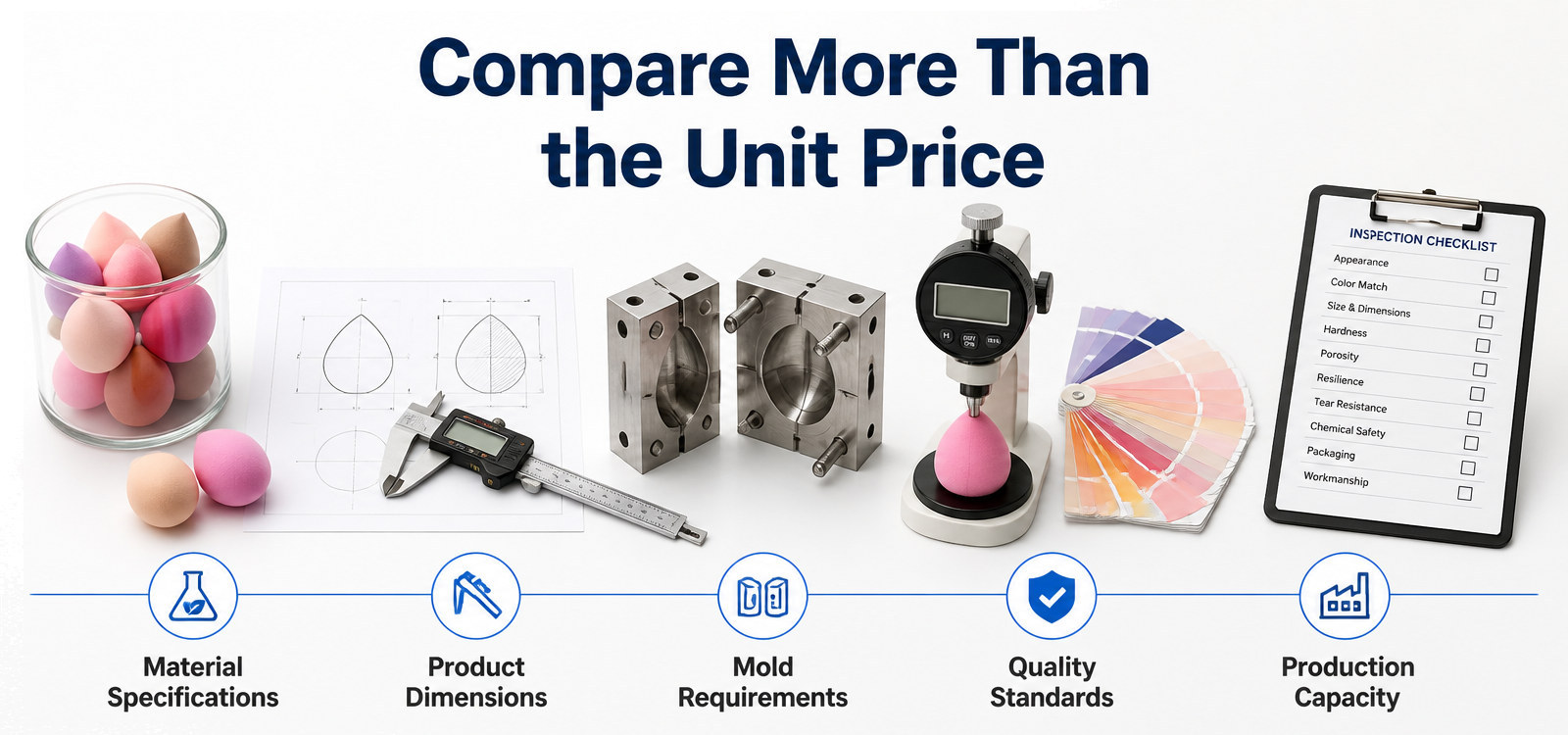
A comparable quotation is built from objects a buyer can check: measured dimensions, a hardness reading, a mold plan, and a written inspection standard.
What Should Buyers Compare Before Choosing a Silicone Makeup Tool Supplier?
Compare specifications, not photographs. The following comparison points will separate quotes that are actually about the same product:
| What to compare | What a useful answer looks like |
|---|---|
| Material specification | Compound type, hardness with scale, and the end-use requirement it is chosen for |
| Part weight and dimensions | Shot weight in grams, plus the critical dimensions and the tolerance class applied to each |
| Mold arrangement | Cavity count, parting line position, who owns the tool, and what happens to it after the order ends |
| Customization capability | Which steps are done in-house and which are subcontracted, plus how samples are approved |
| Inspection | Written appearance criteria, measurement method, sampling plan, and who signs the first article |
| Lead time | Tooling time and production time quoted separately, with the assumptions behind each |
If two suppliers cannot answer these in the same format, the unit prices are not yet comparable. The cheapest route is rarely the lowest number; it is the quote whose assumptions you have already verified.
What Information Should You Provide for an Accurate Silicone Makeup Tool Quote?
A complete inquiry shortens the quotation cycle and removes most of the guesswork:
- a 2D drawing or 3D file, or a reference sample if no file exists;
- overall dimensions and the sections that are functionally critical;
- required hardness, with the scale, and any skin-contact or cleaning requirement;
- color reference and surface finish: matte, gloss, or a named texture;
- logo method and position, if branding is involved;
- estimated order quantity and whether it is a first run or a repeat;
- packaging and inspection requirements, if those are part of the landed cost.
If a file does not exist yet, say so early. It changes the scope of the work from quoting to development, and it is better to price that openly than to discover it after tooling starts. Our guide to reading a silicone product drawing is a useful checklist for what a supplier actually needs to see on the page.
Work with a Silicone Makeup Tools Manufacturer for Custom Projects
Early engineering review is the cheapest stage of a project. A short conversation about wall sections, cavity layout, and surface finish can remove a tooling revision that would otherwise appear after the first sample round, when the schedule is already tight.
FromRubber is a custom silicone manufacturer based in Dongguan, China, working with beauty brands, cosmetic tool importers, and OEM buyers on molded silicone parts. Our production floor runs 40 compression molding machines, and our in-house tooling shop includes 10 CNC machines, which means mold changes and sample iterations stay inside one supply chain instead of moving between vendors. If the project involves a brush cleaning mat, a sponge holder, or a brush organizer, the related design notes on silicone makeup brush holder stability and sponge case design for travel are a reasonable starting point before drawings exist.
Send a drawing, a 3D file, or a physical sample, and we will return a quotation with its basis stated: material, weight, cavity plan, finishing route, and inspection level. If something in the design is likely to raise cost without adding value, we will say so before the mold is cut. You can reach our team through the FromRubber inquiry form, or by WhatsApp and WeChat at +86 18676210913.
Frequently asked questions
Why can two suppliers quote very different prices for the same silicone makeup tool?
Because each quote is built on assumptions that the drawing does not contain: material grade, shot weight, cavity count, finishing steps, and inspection level. When those assumptions differ, the quotes describe different products.
Does a higher quote always mean better quality?
No. A higher price can reflect a tighter tolerance class, a better compound, or more inspection, but it can also reflect an inefficient mold plan. The only reliable test is comparing the basis of each quote line by line.
Should tooling be quoted separately from the unit price?
Separating them is clearer. It lets a buyer see the one-time investment, decide who owns the tool, and compare production cost without a hidden amortization built into a per-part number.
Why does hardness affect the price if the shape stays the same?
Hardness changes deformation and ejection behavior, which often changes the required wall thickness and therefore the shot weight. It can also change cycle time and defect rate, and both are part of the unit cost.
What is the fastest way to get a comparable quote?
Send a drawing or sample, a hardness target with its scale, the color and finish, the estimated quantity, and the inspection expectation in one message. A supplier who receives all six can quote once instead of guessing twice.
Sources and further reading
- ASTM D2240-15(2021), Standard Test Method for Rubber Property, Durometer Hardness. ASTM D2240 standard page (https://store.astm.org/d2240-15r21.html)
- ISO 48-4:2018, Rubber, vulcanized or thermoplastic, Determination of hardness, Part 4: Indentation hardness by durometer method (Shore hardness). ISO 48-4 standard page (https://www.iso.org/standard/74969.html)
- ISO 3302-1:2014, Rubber, Tolerances for products, Part 1: Dimensional tolerances. ISO 3302-1 standard page (https://www.iso.org/standard/62492.html)
- 21 CFR 177.2600, Rubber articles intended for repeated use, U.S. Code of Federal Regulations. eCFR full text of 21 CFR 177.2600 (https://www.ecfr.gov/current/title-21/chapter-I/subchapter-B/part-177/subpart-C/section-177.2600)
- FromRubber technical notes: mold design and parting lines, flash and uneven edges, reading a silicone product drawing.