Why Do Backlit Silicone Keypads Have Uneven Lighting on CNC Control Panels?
- Share
- publisher
- FromRubber
- Issue Time
- Nov 18,2026
Summary
Bright spots, dim keys and unreadable legends are rarely solved by switching to clearer silicone. The article treats each legend as a light path with three losses, shows why LED pitch and button pitch drift apart, and lists the prototype checks that expose the problem before the panel design is frozen.
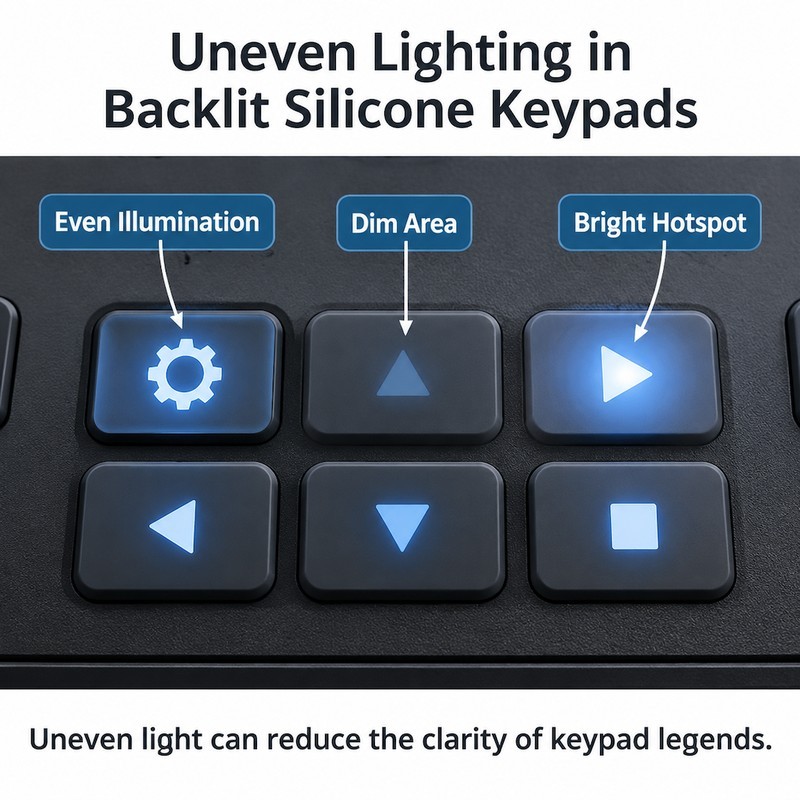
Operators notice backlight problems in a specific order. First the panel looks uneven at night. Then one legend becomes hard to read from a standing position. Then someone puts a torch on the panel during a night shift and the machine gets a service call. By the time the complaint reaches the keypad supplier, the project is usually already trying to fix it by asking for clearer silicone, which rarely helps.
The reason is that a backlit keypad is not a lamp behind a translucent sheet. It is a light path with three losses, and uneven lighting almost always comes from a mismatch inside that path rather than from the material alone.
Reviewed by FromRubber keypad engineering · November 2026
Why Does Uneven Lighting Occur in Backlit Silicone Keypads?
On a CNC control panel the silicone keypad sits above a PCB with LEDs spaced on a regular grid. The keys are spaced on a different grid, because key size follows finger size and legend length, not LED pitch. The two grids drift apart across the panel, and the drift is what the eye sees: a bright key where an LED sits close to a legend, a dim key where the same LED is offset by a few millimetres.
Add wall thickness variation and the effect compounds. A key that is both offset from its LED and thicker on one side will show a gradient inside a single legend.
Some Button Areas Appear Brighter Than Others
A hotspot is light arriving with nowhere to spread. It happens when the LED sits directly under a thin legend window, when the cavity above the LED is too shallow to let light mix, or when a blocking layer stops short of the legend edge. On a panel with a metal dome or tact switch array, the dome height also changes the air gap between LED and silicone, and therefore the size of the bright patch.
Backlit Characters May Look Dim or Difficult to Read
Dim legends are the opposite failure: light that cannot reach the aperture. Common causes are a coating that is thicker than the etch depth, an aperture that is smaller than the character it is supposed to show, or a light-blocking layer that overlaps the character edge by a fraction of a millimetre. The last one is invisible in CAD and obvious on a lit panel.
Lighting Differences Become More Noticeable in Low-Light Environments
Contrast is relative. A panel that looks acceptable under office lighting can look badly uneven in a darkened machine shop, because the eye adapts to the brightest legend and everything else falls away. This is why backlight validation has to be done with the room lights off and the panel at its production brightness, not on a bench under a window.
How Does the Silicone Keypad Structure Affect Light Distribution?
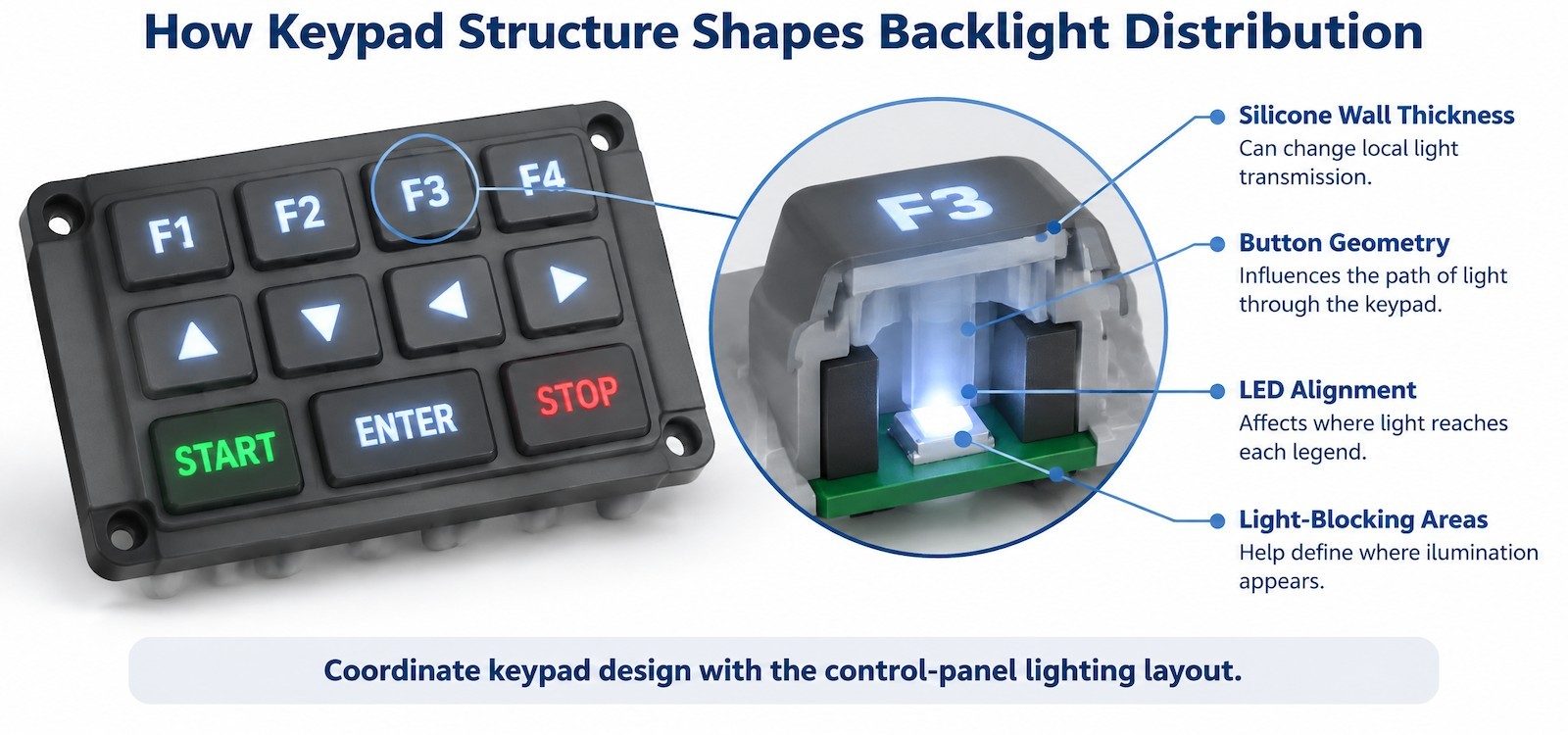
Structure decides how much of the LED's output reaches the legend and how evenly it arrives.
Uneven Wall Thickness Can Cause Differences in Light Transmission
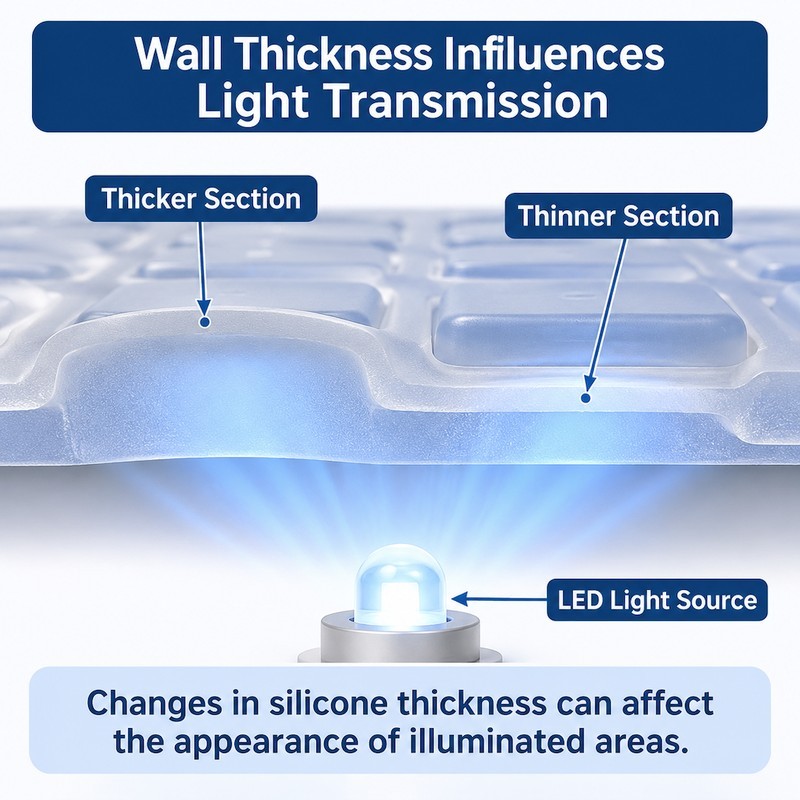
Silicone is not glass. Light entering it scatters, so thickness behaves like a diffuser and an attenuator at the same time. A 3 mm section passes a softer, dimmer light than a 1.5 mm section; both can be correct, but not on the same panel if the legends are meant to match.
Wall thickness also varies inside a single key, because a key with a sloped side wall is thicker at the base than at the top. That is why some legends show a bright centre and a dim rim, or the reverse, depending on where the LED sits relative to the slope.
Button Shape and Internal Geometry Influence Lighting Uniformity
A domed key top acts as a weak lens. A flat top spreads light evenly but shows the LED image; a domed top blurs it but concentrates brightness in the centre. Where the key has an internal cavity, the cavity walls bounce light back into the legend area, and if the cavity is asymmetric the legend lights unevenly from one side.
Poor Alignment Between Buttons and Light Sources Can Create Dark Areas
This is the most common structural cause on CNC panels, because the LED layout is usually fixed by the electronics team before the keypad is designed. If the design cannot move the LEDs, the keypad has to redistribute light: a wider etch window, a diffuser pad, or a light guide moulded into the key base. Asking the silicone to be more transparent does not move light sideways.
- Obtain the LED coordinates before the keypad layout is frozen.
- Light prototype sections at production current rather than on a bench lamp.
- Photograph each iteration with fixed exposure so panels can be compared.
- Re-check the assembled panel after a thermal cycle, not only at room temperature.
Which Material and Color Choices Affect Backlit Silicone Keypad Performance?
Silicone Color and Pigment Formulation Influence Light Transmission
Pigments absorb and scatter. A white or light grey compound transmits more than a black one at the same thickness, and a compound with a high pigment load will not pass enough light through a thin legend even if the base material is described as translucent. Colour matching and light transmission are separate requirements and should be specified separately.
Translucent Silicone Does Not Always Guarantee Uniform Backlighting
A translucent compound transmits, but it does not equalise. Uniformity comes from geometry and from the blocking layer, not from the base material. This is the point that is most often missed when a project changes compound in an attempt to fix a brightness complaint: the panel gets brighter overall and just as uneven as before.
Light-Blocking Layers Help Control Where Illumination Appears
Most backlit keypads are built from more than one layer of material: a translucent body, an opaque mask, and a legend opening. The mask is what creates the shape of the light. Its registration against the legend is a printing and moulding tolerance, and it is where a fraction of a millimetre turns into a visible halo.
How Do Printing and Laser Etching Affect Backlit Silicone Keypads?
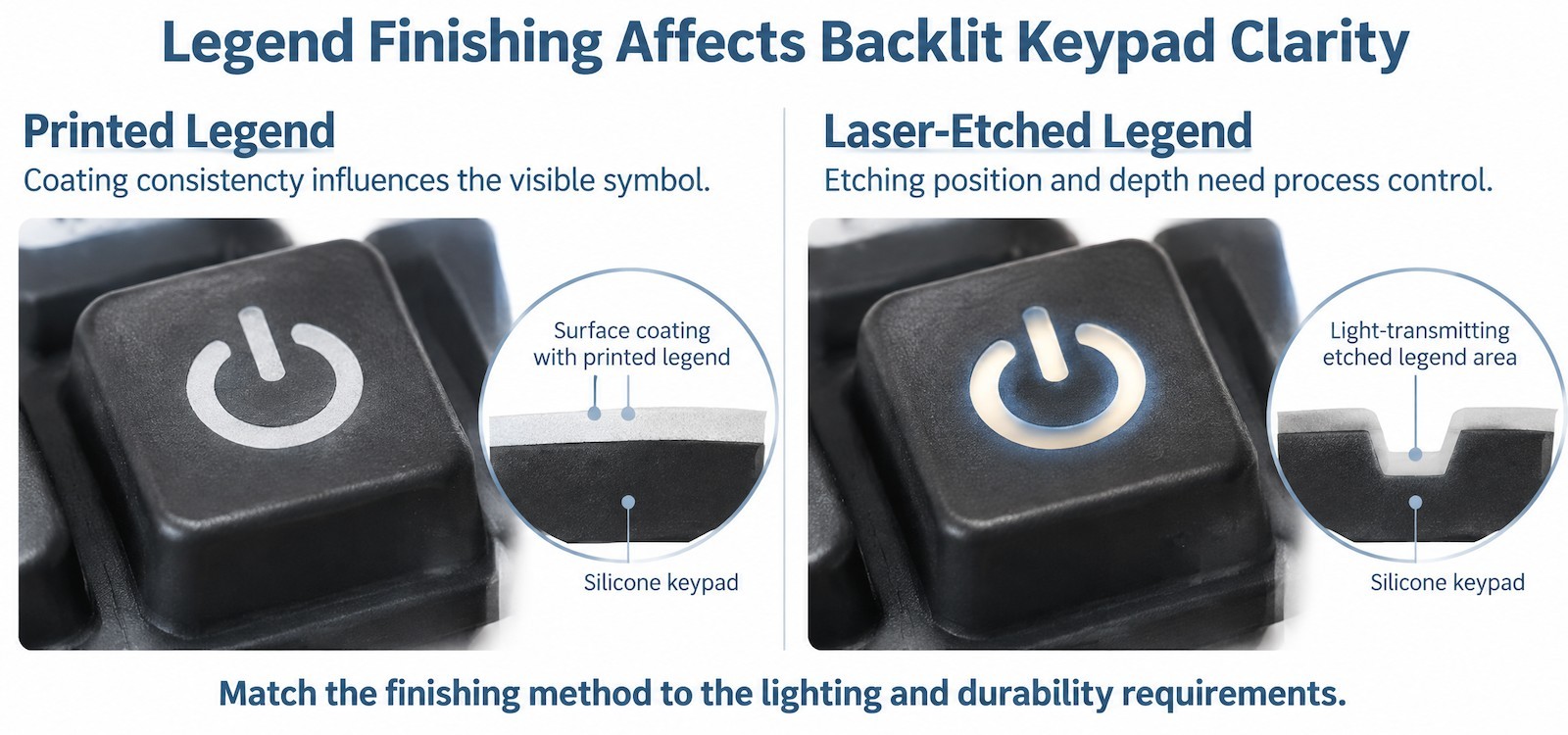
Inconsistent Coating Thickness Can Affect Character Brightness
Sprayed coatings vary in thickness across a panel, and a coating that is thicker over one legend blocks more light there. The variation is small in absolute terms and large in visual terms, because the eye compares adjacent legends rather than absolute brightness. Coating thickness should be controlled where it matters, which is over the apertures.
Laser-Etched Symbols Need Consistent Depth and Positioning
Laser etching removes material to open a window. Depth controls brightness, and position controls shape. A laser that is slightly out of focus produces a wider, shallower window; a panel that moves during etching produces a legend that is offset inside its key. Both are process control problems, and both show up as uneven lighting rather than as a marking defect.
Keypad Coating and Surface Finishing Must Match the Lighting Design
A matte finish scatters ambient light and reduces glare, but it also diffuses the legend slightly. A gloss finish gives a crisper legend and more reflection from overhead lights. On a machine with a work lamp above the panel, the choice affects readability more than the LED brightness does.
How Can Manufacturers Improve Lighting Uniformity During Custom Keypad Development?
Coordinate Silicone Keypad Geometry With the LED Layout
Get the LED coordinates before the keypad layout is frozen. If the two grids cannot be aligned, decide early where the light will be redistributed, and make that a moulded feature rather than a printing fix.
Test Wall Thickness and Light-Transmission Areas With Prototype Samples
Cut prototype sections at two or three thicknesses and light them with the production LED at production current. Photograph the result with a fixed exposure; the camera is more consistent than the eye and gives the project something to compare across iterations.
Check Lighting Consistency Under Actual Operating Conditions
Validate on the assembled panel, at the rated supply voltage, after a thermal cycle. Coating adhesion and legend clarity can change after temperature cycling, which is covered by IEC 60068-2-14, and sealing after coating is assessed under IEC 60529 if the panel carries an IP rating.
| Observation | Likely cause | Where to fix it |
|---|---|---|
| One key much brighter than its neighbours | LED directly under a thin legend window | Key base thickness or diffuser feature |
| Bright centre, dark rim inside one legend | Sloped key wall and off-centre LED | Key profile and LED position |
| Legend edge halo | Mask registration against the aperture | Printing tolerance and etch alignment |
| Whole panel slightly dim but even | Compound, pigment load, coating thickness | Material and coating specification |
| Unevenness that appears only when cold | Coating or mask behaviour after thermal cycling | Finish selection and cure control |
Which Measurement Locates an Uneven Backlight?
Brightness complaints are difficult to settle because the eye is a poor instrument. Four measurements turn the argument into a comparison, and each one removes a different part of the light path from suspicion.
| Measurement | How it is taken | What it separates | Reading that points to structure |
|---|---|---|---|
| Legend luminance, key by key | Fixed-exposure photograph, panel at production current | Overall uniformity | One key consistently brighter, pointing to the LED-to-legend gap |
| Wall thickness at key centre and rim | Sectioned sample, or moulded witness marks | Thickness-driven attenuation | Bright centre with a dark rim, pointing to a sloped wall |
| Legend aperture against mask opening | Optical comparator on a lit sample | Registration error | Halo on one edge, pointing to print or etch offset |
| LED position against key centre | PCB layout overlaid on the keypad layout | Pitch mismatch | Drift increasing from left to right across the panel |
| Coating thickness over the aperture | Coating weight, or a microscope section | Coating attenuation | Dim legends with a normal etch depth |
If the first row is even and the fourth row shows drift, the panel is not suffering from material clarity. It is suffering from two grids that no longer agree.
Questions we are asked most often
Will a more transparent silicone make the backlight even?
It will make the panel brighter overall, and usually no more even. Uniformity comes from LED alignment, key geometry and mask registration.
Can we correct uneven lighting with printing alone?
Partly. The mask can widen or narrow the aperture, which shifts perceived brightness, but it cannot move light that never reaches the legend area.
Why does the panel look worse at night than in the workshop?
Contrast is judged relative to the brightest legend. In low ambient light the eye adapts to the hotspot and the dim keys drop away.
Does laser etching always give a sharper legend than printing?
It gives a cleaner edge in most cases, but depth and focus must be controlled. A shallow etch can be dimmer than a well-printed legend.
When should the LED layout be shared with the keypad supplier?
Before the keypad layout is finalised. Moving LEDs later is expensive; moving a legend window is not.
Reference standards, cited as documents rather than links: IEC 60529, Degrees of protection provided by enclosures (IP Code). IEC 60068-2-14, Environmental testing, Part 2-14: Tests, Test N: Change of temperature.
Related reading on this site: backlight bleed and LED diffusion, avoiding light leakage in backlit keypads, and how silicone keypads are backlit.
Even lighting is a stacking problem. The LED grid, the key geometry, the wall thickness and the legend aperture all have to agree, and the only place to prove that they do is an assembled panel photographed at production brightness.
FromRubber produces backlit silicone keypads with in-house screen printing and laser etching, so legend depth and mask registration are controlled in the same plant as the moulding. A recent example is an laser-etched equipment keypad with a chemical-resistant surface. Prototype panels can be discussed at +86 186 7621 0913 (WhatsApp and WeChat).
FromRubber is the brand of Dongguan Bohao Electronic Technology Co., Ltd. (Qiaotou, Dongguan, Guangdong), certified to IATF 16949:2016, ISO 9001:2015 and ISO 14001:2015, and moulding custom silicone keypads since 2010.