Why Do Blood Glucose Analyzer Silicone Keypad Markings Wear Out?
- Share
- publisher
- FromRubber
- Issue Time
- Nov 17,2026
Summary
Printed legends on blood glucose analyzer keypads fail at the bond line before the ink wears through. The article separates the mechanisms, compares screen printing, coating and laser marking, and sets out the tests worth running before production.
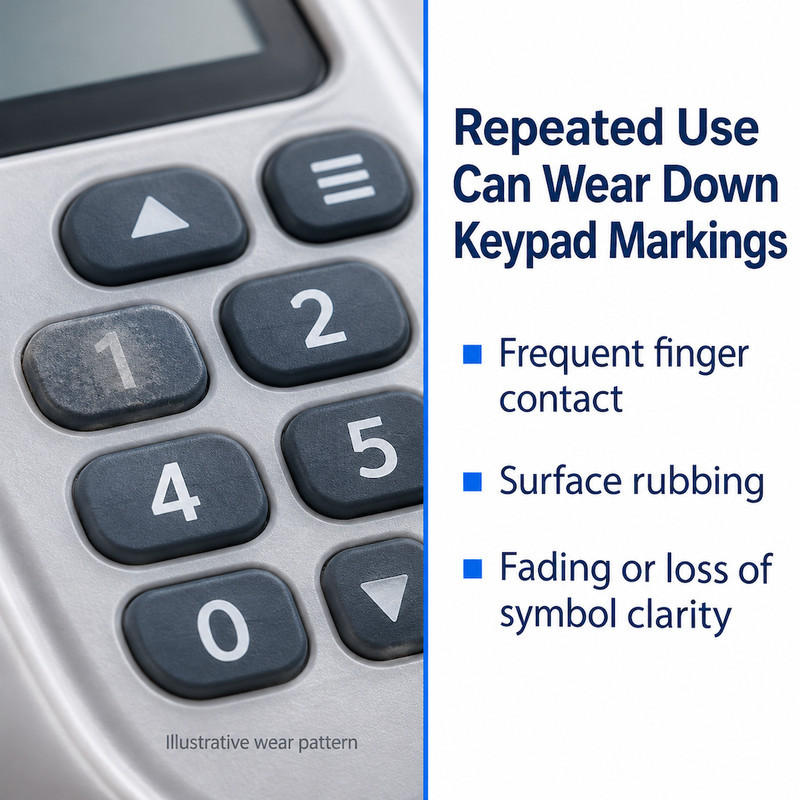
A blood glucose analyzer rarely comes back from service with a broken button. It comes back with a button whose number is half gone. The user can still press it, but the legend that told them which key to press has worn to a pale smudge, and in a clinical or home-care setting an unreadable key is a usability fault even though the electronics are fine.
The instinct is to blame the ink. Ink is part of the answer, but only part. On a silicone keypad the legend is a thin film sitting on a surface that flexes, stretches and slowly releases oil, and it is rubbed by a finger that approaches at an angle rather than straight down. When a marking fails early, the cause is usually a mismatch between those four things rather than a single bad batch of ink.
This article looks at how printed markings actually degrade, which process choices change the outcome, and what has to be decided before the keypad mold is cut.
Why Do Silicone Keypad Markings Wear Out During Daily Use?
A legend on a silicone key is not a printed page. The substrate under it deforms by a few tenths of a millimetre on every press, and the ink film has to deform with it without cracking or lifting at the edge. That is a fatigue problem before it is an abrasion problem, and it explains why a marking can look perfect for a year and then fail quickly once a micro-crack starts at the perimeter of the print.
The second mechanism is chemical. Silicone compounds contain low molecular weight fractions that migrate to the surface over time. That bloom is useful for release and feel, and unhelpful for adhesion, because it forms a weak boundary layer exactly where the ink needs to bond. A keypad that was printed after a long warehouse stay can behave differently from one printed the same week it was moulded, even with identical process settings.
The third mechanism is mechanical shear. A finger does not land vertically on a key; it arrives at an angle and slides a millimetre or two before the press. Over thousands of cycles that sliding contact works on the highest point of the button, which is usually the centre of the crown, and that is where the legend is normally placed.
How Does Repeated Finger Contact Damage Printed Symbols?
Contact damage is concentrated, not uniform. On a numeric keypad the "1" key of a glucose analyzer is pressed more often than the menu key by a wide margin, so the marking on that key reaches the end of its life while its neighbours are still crisp. This is why a keypad can look "randomly" worn in a photograph: it is not random, it is a map of usage frequency.
Cleaning adds to it. Alcohol wipes and quaternary ammonium sprays are standard in clinical use, and repeated wiping softens some ink films and attacks the bond line at the edge of the print. A marking that survives finger contact can still fail under a daily wipe, and the failure looks identical in the field.
Why Do Some Silicone Keypad Markings Peel or Fade Faster?
Three causes account for most early failures. The first is insufficient surface preparation: if the moulded surface still carries release agent or bloom, the ink bonds to the contamination rather than to the silicone. The second is under-curing of the ink, which leaves the film soft and easy to abrade. The third is a print that was applied over a curved surface without accounting for the curvature, so the ink film is thinner at the crown and thicker at the edge, and it fails where it is thinnest.
A fourth cause is less obvious and often missed: printing across a moulded feature such as a raised rim or a texture band. The ink has to climb over an edge, and that edge becomes the start of a lift.
Which Silicone Keypad Printing Methods Affect Marking Durability?
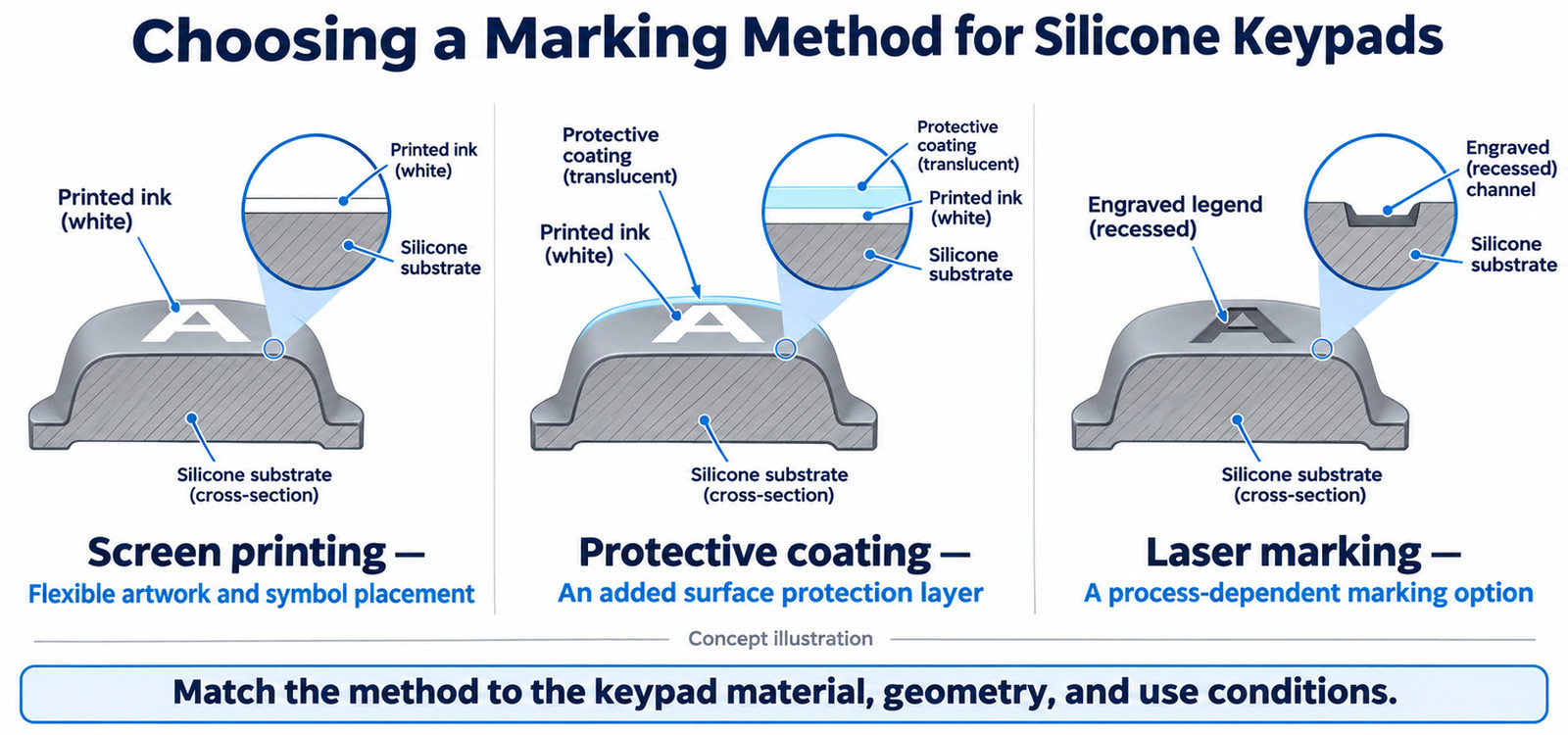
There are three practical routes for legends on a silicone key, and they fail in different ways. Choosing between them is a question of how the key will be used and cleaned, not a question of which process is newer.
How Does Screen Printing Perform on Silicone Keypads?
Screen printing remains the workhorse because it is flexible: it handles numbers, arrows, small symbols, multiple colours and fine positioning, and it can be applied to a keypad that is already moulded. The limitation is that the ink sits on the surface, so it is exposed to every contact and every wipe. Durability therefore depends almost entirely on preparation and cure discipline, which is a process-control problem rather than a design problem.
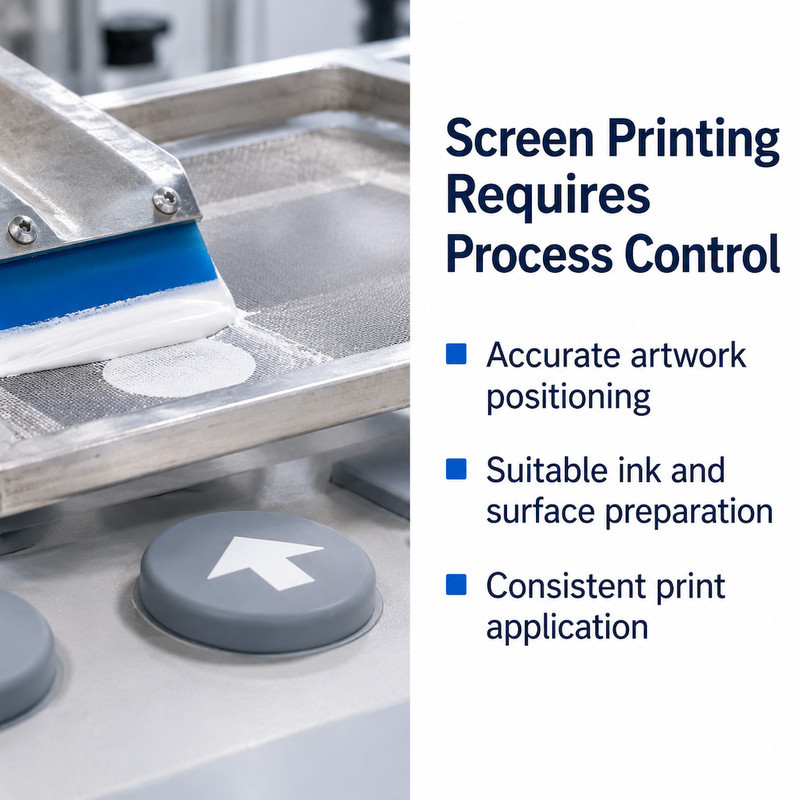
Two details matter more than most specifications. The first is the primer or surface treatment step: it is the difference between ink on silicone and ink on a release layer. The second is registration, because a print that is 0.2 mm off centre on a small key looks acceptable on a flat sheet and visibly off-centre once the key is domed.
Where the design needs several colours or a fine symbol on a small key, screen printing is usually still the practical choice. The full set of options, including multi-colour and conductive printing, is summarised in this note on printing options for custom silicone keyboards.
When Is Coating or Protective Surface Treatment Necessary?
A protective coating buys time, but it changes the surface the user touches. The coating has to be compatible with the ink underneath, flexible enough to move with the button, and thin enough not to fill the fine edge of the symbol. A coating that is too thick will blur a small legend; one that is too thin will wear through at the crown before the ink does.
Coating is worth considering when the keypad will be wiped frequently, when the legend is small and low-contrast, or when the instrument is used in a wet environment. It is less useful when the marking has failed because of poor adhesion in the first place, because a coating over a weak bond line does not restore the bond.
How Does Laser Etching Differ From Printed Silicone Markings?
Laser marking removes or alters material instead of adding a film, so the legend becomes part of the silicone rather than something sitting on top of it. That removes the peel-and-abrade failure mode almost entirely, and it is why etched legends are common on keypads that see heavy use or aggressive cleaning.
The trade-offs are real. Colour range is limited, because the mark is produced by the material rather than by an ink. Fine detail depends on the compound and on the laser parameters, and the same settings will not produce the same contrast on a different silicone. Laser marking also has to be planned with the mold, since the mark is usually applied to a moulded surface whose geometry affects focus. For backlit keys the interaction is even closer, because the etched area and the light path have to be designed together.
| Method | Where the legend sits | Best fit | Main wear risk |
|---|---|---|---|
| Screen printing | Ink film on the moulded surface | Numbers, arrows and multi-colour symbols on small keys | Abrasion at the crown; adhesion loss if the surface carries release agent or bloom |
| Protective coating over print | Ink film with a clear layer above it | Panels wiped frequently; low-contrast legends that need extra protection | Coating wears through at the crown; a thick coating fills fine detail |
| Laser marking | Recessed or altered silicone surface | Heavy use, aggressive cleaning, backlit keys | Limited colour range; contrast depends on compound and laser parameters |
How Do Silicone Material and Button Geometry Affect Marking Wear?
Why Does Silicone Surface Condition Matter for Ink Adhesion?
Adhesion is a surface phenomenon. Anything that sits between the ink and the silicone reduces it: release agent from moulding, dust from storage, plasticiser bloom, or handling oils. That is why a print line that produces consistent results on Monday can produce a failing batch on Friday after a mould change, without any change to the ink.
The practical control is to define the window between moulding and printing, and to treat surface preparation as a measured step rather than a wipe. Where the marking has to survive perspiration or repeated disinfection, the surface condition becomes the dominant variable, which is the finding in this study of legend adhesion failure under artificial perspiration testing.
How Can Button Curvature and Raised Profiles Increase Marking Wear?
A domed crown is the worst place for a printed legend in contact terms, because it is the first point of contact and it is also the point of maximum shear as the finger slides. A flat-topped key with a small chamfer puts the legend on a plateau and moves the sliding contact to the edge, which is one reason flat-top designs last longer in heavy-use applications.
Position matters as much as geometry. A legend placed slightly off the crown, toward the lower half of the key where the finger lands first, will wear faster than one placed at the crown. On a small analyzer key there may be only 1 mm of adjustment available, but that millimetre is free and rarely used.
Does Silicone Hardness Affect Printed Marking Durability?
Hardness changes how much the surface deforms under the same press. A softer compound stretches more, so the ink film sees more strain per cycle, which shortens fatigue life. A harder compound deforms less but transmits more of the finger's shear to the ink, so the two effects partly cancel.
That is why hardness alone is a poor lever. Changing from 50 to 60 Shore A to fix a marking problem usually shifts the failure rather than removing it, and it may make the key feel wrong. Hardness should be chosen for the feel the instrument needs, and the marking process should be chosen to suit that hardness.
How Can Manufacturers Improve Silicone Keypad Marking Durability?
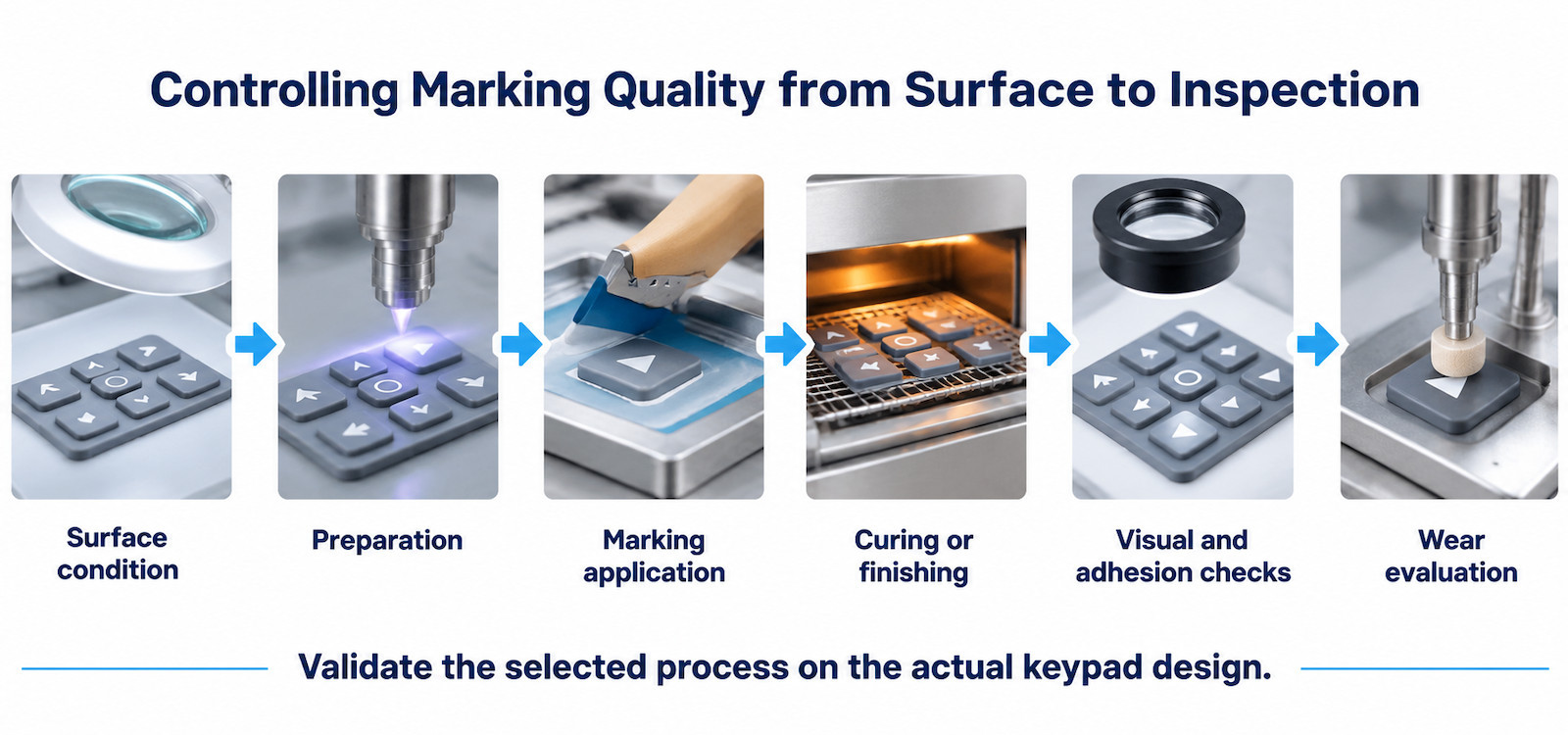
The improvements that work are unglamorous: control the surface, control the cure, control the geometry where the ink has to live, and validate with a test that resembles the actual use.
What Should Be Checked Before Selecting a Printing Process?
Five questions are enough to narrow the choice:
- How small is the marking, and how many colours does it need?
- What is the button geometry at the marking position: flat, domed, or textured?
- How often will the key be pressed, and how hard is the finger contact?
- What cleaning agents will be used, and how often?
- Does the legend need to be legible at an angle, or backlit?
Which Tests Help Evaluate Marking Performance?
Four tests cover most of the risk, and they should be run on the actual keypad rather than on flat coupons. Repeated pressing evaluates the fatigue path. Rubbing or abrasion with a defined medium evaluates surface wear. An adhesion check, such as a tape pull or a cross-hatch on a witness area, evaluates the bond line. A cleaning resistance check, using the actual wipe the customer specifies, evaluates the chemical path.
Visual inspection after each test matters more than the pass or fail number, because the interesting result is where the marking starts to fail, not whether it survived a fixed cycle count.
How Can Production Quality Control Reduce Inconsistent Markings?
Consistency comes from three controls: ink viscosity and curing parameters held within a narrow band, surface preparation applied uniformly rather than by feel, and inspection of position, clarity and adhesion at the start and end of each run. On a medical keypad, the inspection record is also part of the traceability story, which is why the printing step is usually documented separately from moulding.
What Should Blood Glucose Analyzer Manufacturers Confirm Before Custom Keypad Production?
Which Artwork and Technical Details Should Be Provided?
Artwork should be supplied as vector files with the exact symbol geometry, including line weight and corner radius, because a legend that is redrawn from a screenshot will not match the regulatory label. Alongside the artwork, the keypad drawing should state button layout and dimensions, required colours and contrast, silicone hardness, and the cleaning regime the device will be validated for.
If the analyzer falls under IEC 60601-1, the cleaning and disinfection instructions in the accompanying documents are part of the device's safety case, so the keypad marking is effectively validated against those instructions. It is worth confirming that the ink and coating are compatible with the wipes named there before the print process is fixed.
Why Should Printing and Molding Be Evaluated Together?
Because the mould decides where the ink can live. Crown height, edge radius and surface texture all change how a print sits and how it wears, and a marking position that works on a flat key can fail on a domed one. Reviewing the two together is also the only way to catch the case where a texture band runs through the legend area, which is a common and avoidable cause of early wear.
FromRubber prints and moulds in the same plant, so the mark-up for a legend change can be evaluated against the existing cavity before the customer commits to a new tool. The keypad design and technical support page explains the review sequence.
Questions Buyers Ask About Keypad Markings
How long should a printed legend last?
There is no universal figure, because the answer depends on press frequency, cleaning chemistry and button geometry. What can be defined is a test: the actual wipe, the actual press pattern, and an acceptance criterion for legibility after a stated number of cycles. Ask for that protocol rather than a service-life claim.
Is laser marking always more durable than printing?
It removes the peel failure mode, so it usually wins under heavy abrasion. It is not automatically better for contrast, colour range or fine detail, and on some compounds the mark is shallow enough that repeated wiping still changes it. The material and the required appearance decide.
Why did the same ink fail on one batch and not another?
Most often because the surface changed: a longer interval between moulding and printing, a different release agent, or a mould that was cleaned differently. The ink is usually the constant, and the substrate is the variable.
Can we change the legend without changing the mold?
Yes, if the new legend fits inside the existing flat or crowned area and does not cross a texture or a raised edge. Position and size changes within that area are a print change, not a tooling change.
The Legend Is a Wear Part
Treating the legend as a wear part changes the design conversation. A wear part needs a defined life, a defined test and a defined failure criterion. Once those exist, the choice between printing, coating and etching stops being a matter of preference and becomes a matter of matching the process to the number of presses and wipes the device will actually see.
It also changes where the effort goes. Most marking failures that reach the field start in the two steps before the ink is applied, and in the geometry the ink has to sit on. Those are cheap to fix before tooling and expensive to fix afterwards.
Sources and notes. Medical electrical equipment requirements are set out in IEC 60601-1:2005 with amendments 1:2012 and 2:2020, which is also the reference point for cleaning and disinfection instructions in the accompanying documents. Perspiration and cleaning exposure tests referenced here are described in the linked FromRubber study on legend adhesion. Cycle counts and service-life figures are not stated because they depend on the actual use conditions and on the agreed test protocol.
FromRubber, Dongguan Bohao Electronic Technology: moulded silicone keypads with screen-printed, coated or laser-etched legends. Send the artwork and the cleaning regime and we will propose a marking route with a matching test plan. WhatsApp and WeChat: +86 18676210913.
Published by the FromRubber keypad engineering team.