Why Do Fine Bristles of Silicone Face Scrubber Deform During Molding or Demolding?
- Share
- Issue Time
- Nov 10,2026
Summary
Fine silicone bristles fail in three distinct ways, and the position of the defect points to its cause. This article separates filling, venting, cure and release mechanisms, then covers mold geometry, root design, venting and demolding control for fine bristle structures.
A face scrubber comes off the press with four percent of its bristles leaning in the same direction. The obvious conclusion is that the mold is wrong. The mold is measured, found correct, and put back. The next run produces the same lean in the same zone, and the run after that produces it only in the last hour of the shift.
Fine bristles are the most sensitive feature in a molded silicone beauty tool, because they are the only feature where filling, curing and release all act on a section thinner than the tolerance they have to hold.
What Causes Fine Silicone Bristles to Deform During Molding?
The short answer is that three separate processes decide the final shape, and only the first one happens while the mold is filling. Incomplete filling produces a short or rounded tip. Trapped air produces a tip that never forms. Uneven cure produces a bristle that is dimensionally correct when it leaves the cavity and then moves. Most production defects are a combination of the first and the third.
Start by reading the defect as a location rather than as a percentage. A pad where every bristle in one sector is short points to venting or to a local temperature difference. A pad where only the outermost row leans points to mold mismatch or to draft. A pad where single bristles at random are bent points to debris in the cavity or to a damaged cavity wall.
What all three have in common is that the bristle is the smallest section in the part, so it is the first place where the process runs out of margin.
Narrow Mold Cavities Make Fine Bristles More Difficult to Fill
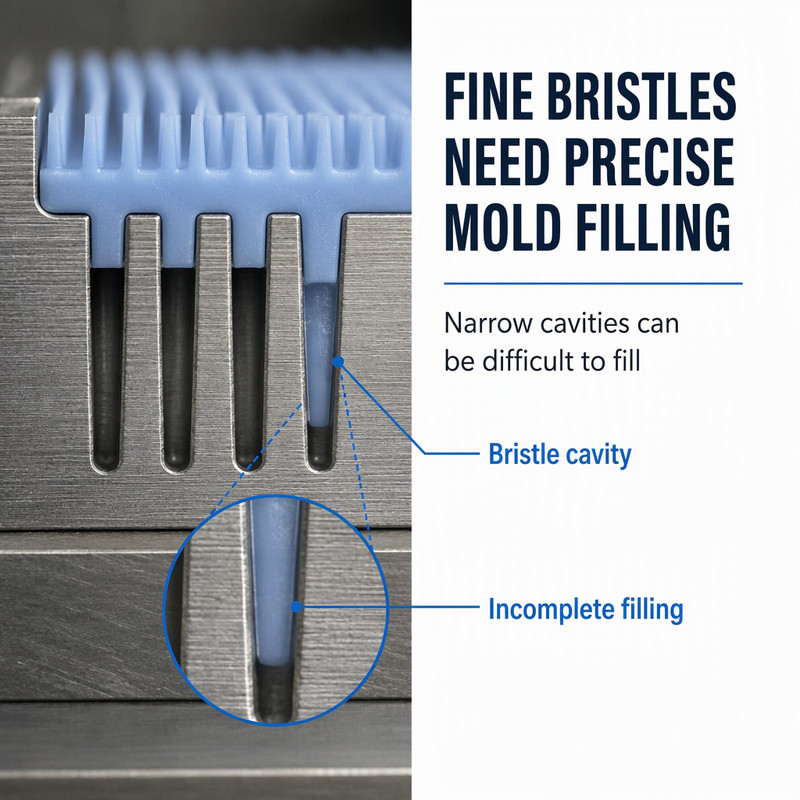
Flow resistance in a narrow cavity rises steeply as the diameter falls. A cavity a fraction of 1 mm across cannot accept material at the same rate as a cavity three times wider, so the fine bristles finish filling after the rest of the part. If the press closes fully before they are filled, they never will be: the cavity is closed, the material has nowhere to go, and the tip stays short.
Trapped Air Can Prevent Bristles from Forming Completely
Every bristle cavity is a dead end. Air inside it has to leave through the same narrow gap that the silicone is entering, and silicone is far more viscous than air. When the air cannot leave fast enough, it compresses, heats, and forms a bubble that the material cannot displace. The result is a tip that is rounded, short, or missing its end.
Uneven Curing Can Affect Bristle Shape and Dimensional Stability
Cure is a chemical reaction that proceeds faster at higher temperature. A thin bristle heats quickly and can cure before a thick base does, which sounds harmless but produces a part with two different states of cure at the moment the mold opens. The bristle is already rigid while the base is still soft, so any movement during release is transferred to the bristle rather than absorbed by the base.
Excessive Material Pressure Can Affect Thin Structural Features
More pressure is not automatically better. Beyond the point where the cavities are full, additional pressure has nowhere useful to go: it pushes material into the parting line as flash, it distorts thin features, and it can displace a bristle sideways while the compound is still fluid.
The useful pressure is the one that fills the finest cavity in the tool with a small margin, not the maximum the press can deliver. That value is found during trial by increasing pressure until the last cavity fills, then adding a margin that the process can hold repeatably.
Why Do Fine Silicone Bristles Bend or Tear During Demolding?
Filling decides whether the bristle exists. Release decides whether it is straight. The forces involved are small in absolute terms and large relative to a bristle that is a fraction of 1 mm across.
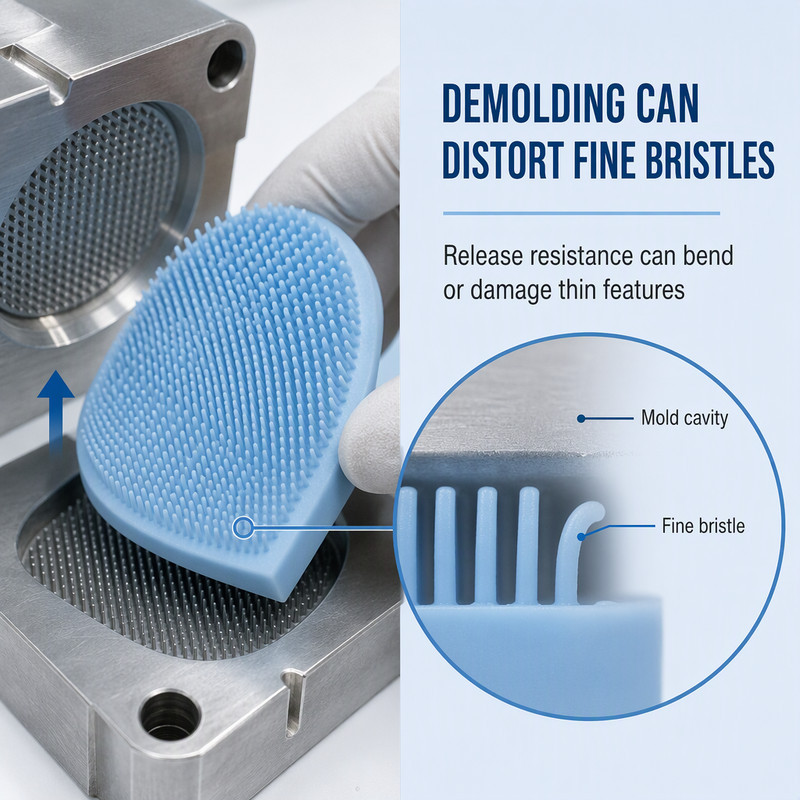
During release, the surface of the bristle is in contact with the cavity wall over its entire length. The total friction is the sum of that contact, and it acts in the opposite direction to the part's movement. The bristle therefore behaves like a column loaded laterally at the base, which is the least favourable way to load a slender feature.
Two things make it worse: releasing a part while it is still warm, when the silicone is softer and more prone to permanent deformation, and releasing it by peeling from one edge, which loads one group of bristles before the rest of the part has moved at all.
High Friction Between Bristles and Mold Cavities Creates Resistance
Cavity surface finish controls friction. A highly polished cavity releases more easily than a finely machined one, but polishing a deep, narrow cavity is difficult and can round the cavity bottom, which changes bristle height. This is one of the few places where surface finish and dimensional accuracy compete directly.
The compromise is usually a polished working length with a controlled bottom, and a draft angle that relieves contact as soon as the part starts to move.
Deep Cavities and Undercut Features Make Demolding More Difficult
Depth increases contact area, and contact area increases friction. A bristle cavity with any undercut, even a slight one caused by tool wear or by a badly dressed edge, turns friction into a mechanical lock. The part then has to stretch to release, and a fine bristle does not stretch evenly.
Thin Bristle Roots Are More Vulnerable to Pulling Forces
The root is where the bending moment is highest and where the section changes fastest. A sharp internal corner concentrates stress, and a thin root has little material to distribute it. That combination produces the two classic failures: a white stress mark at the base, and a tear that starts on the tension side of the bend.
A generous fillet at the root and a gradual transition into the base cost almost nothing in appearance and change the failure mode from tearing to bending, which the material can survive.
Improper Demolding Direction Can Distort Bristle Alignment
Bristles should leave the cavity along their own axis. If the part is stripped at an angle, each bristle is bent as it leaves, and the ones at the leading edge are bent furthest. That is how a whole zone ends up leaning in one direction while the tool is perfectly symmetrical.
The release direction should be decided at the design stage, together with the parting line, and then fixed in the work instruction. Changing it between shifts is a reliable way to produce a batch with a visible directional pattern.
How Can Manufacturers Improve Mold Design for Fine Silicone Bristles?
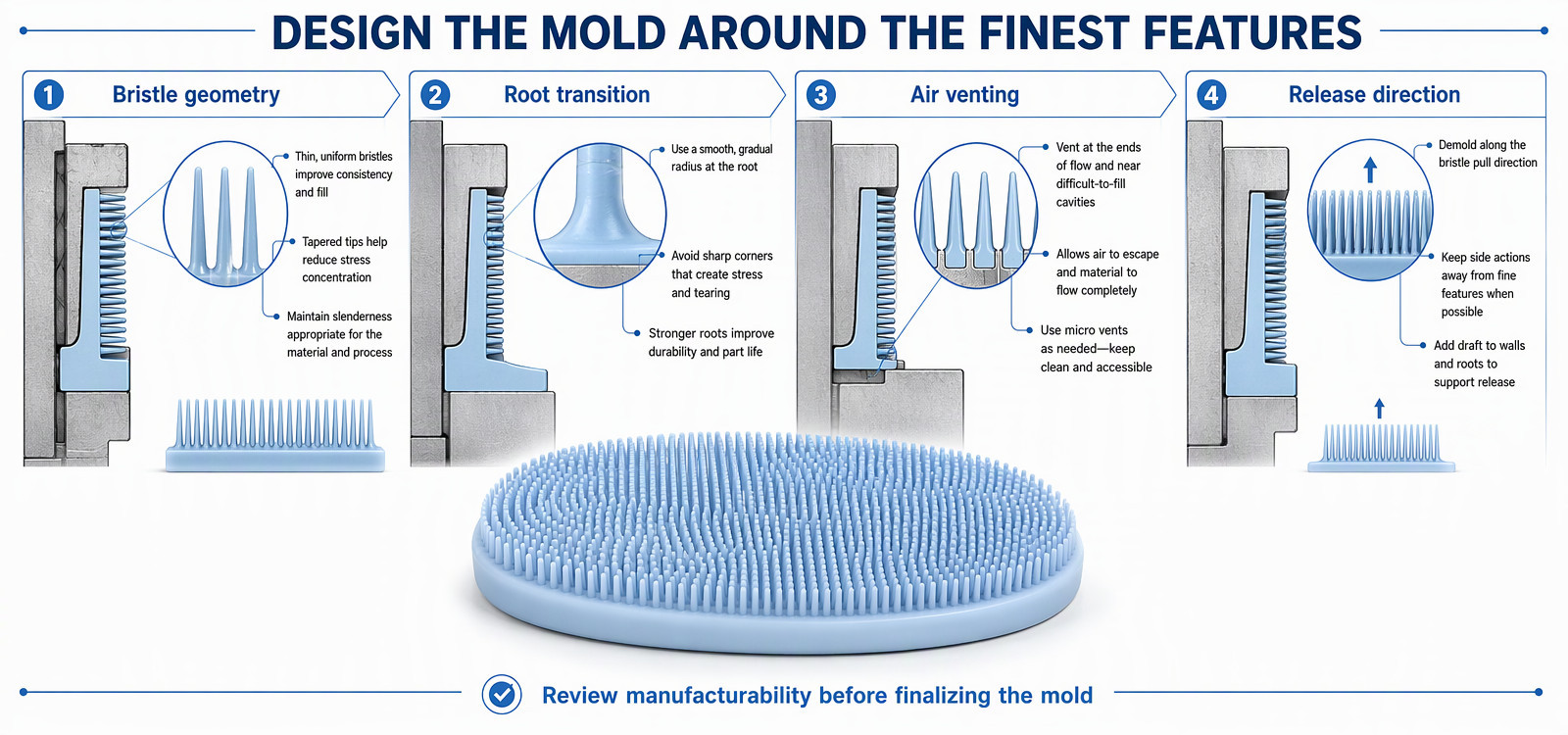
Most of the available improvements are geometric, and all of them are cheaper before the tool is cut. The four below address filling, stress and release in that order.
Optimize Bristle Diameter and Height Before Opening the Mold
The ratio of height to diameter is the number that predicts manufacturing difficulty better than either dimension alone. As that ratio rises, the cavity becomes harder to fill, harder to vent and harder to release, and the bristle becomes more likely to buckle.
When a design calls for a very high ratio, the useful conversation is not "can you make it thinner" but "what else can change". Shortening the bristle by a small amount, adding a slight taper, or grouping bristles into a raised pad all reduce the ratio without changing the sensation much.
Design Stronger Bristle Roots Without Changing the Intended Cleaning Surface
Reinforcement should happen below the working length. A fillet and a short conical transition at the base add material where the stress is highest and leave the contact area unchanged. What should be avoided is thickening the whole bristle to fix a root problem, because that changes the feel the product was designed around.
Improve Venting in Deep and Dense Bristle Areas
Vents should be placed where the air actually accumulates: at the end of the deepest cavities and at the centre of dense fields. A vent that is convenient to machine but far from the last-filled point does very little.
Evaluate Mold Release Angles and Cavity Surface Finish
Draft on a bristle cavity is measured in fractions of a degree, but it is what allows the part to start moving without stretching. Where draft is limited by the bristle shape, release depends on surface finish and on the elasticity of the compound.
Both should be reviewed during tool design, with a trial that measures release force or at least records how the part behaves when the mold opens. Waiting until defects appear means the tool has to be modified while it is in production, which is the most expensive time to change it.
Which Production Adjustments Can Reduce Fine Bristle Deformation?
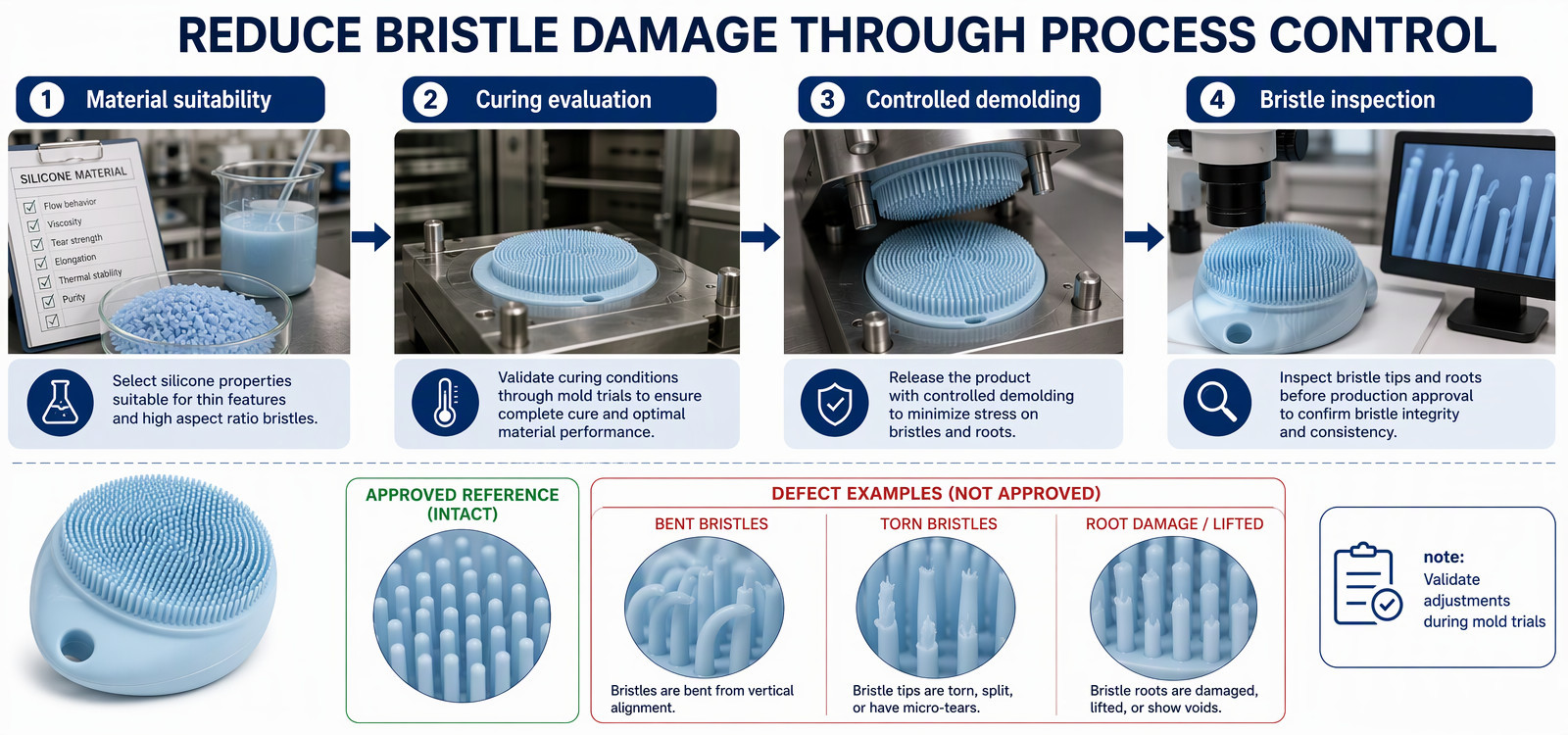
Once the tool exists, the remaining levers are material, cure and handling. They interact, so they should be adjusted one at a time and recorded.
Match Silicone Material Properties to the Bristle Structure
Hardness gets the attention, but tear strength and elasticity decide whether a fine bristle survives release. A compound with good tear resistance tolerates a small stress concentration at the root that would tear a more brittle one.
Flow behaviour matters just as much at the other end of the process: a compound that is too stiff will not fill the finest cavities at a reasonable pressure, and a compound that is too soft may deform under its own weight before cure is complete.
Optimize Curing Conditions for Stable Bristle Formation
The target is not the shortest cure, it is the cure that gives the part enough strength to be handled without taking a set. That usually means a slightly longer cycle than the press is capable of, and a temperature that is even across the plate rather than highest in the middle.
Use Controlled Demolding Instead of Excessive Manual Pulling
Manual release is acceptable when the geometry is forgiving and the operator is trained. It is not acceptable as a substitute for a release-friendly design on fine bristles, because the variation between two people is larger than the tolerance.
Inspect Bristle Shape Before Moving to Mass Production
Inspection should separate the three failure signatures: short tips, leaning bristles, and torn roots. Each has a different cause and a different fix, and treating them as one defect rate hides the information the process needs.
What Should Buyers Check When Approving a Custom Silicone Face Scrubber Sample?
- Bristle diameter, height and spacing, measured rather than estimated from a drawing.
- Tip shape and surface finish, compared with the intended contact feel.
- Root thickness and the transition into the base, checked for stress marks.
- Overall flexibility and recovery after a sustained press.
- Whether the sample can be released from the tool without visible damage, and whether it was.
- Consistency between repeated samples from the same cavity and across cavities.
- Whether the approved sample is actually manufacturable at the quoted cycle time, not only in a trial.
Flash and edge condition belong on the same checklist, because they are produced by the same closing and release conditions that affect the bristles. Our notes on uneven edges and flash on silicone makeup tools and on uneven wall thickness in silicone beauty parts cover the adjacent failure modes.
Frequently Asked Questions About Silicone Face Scrubber Bristle Deformation
Why do fine silicone bristles bend after demolding?
Usually because the part was released before it had enough strength, or because it was stripped at an angle so the bristles were bent as they left the cavity. A bristle that is still leaning several minutes after release has taken a permanent set and will not recover.
Can mold design prevent silicone bristles from tearing?
It can reduce the risk substantially. A root fillet, a gradual transition into the base, adequate draft and a polished cavity wall all lower the stress at the point where tearing starts. Tear strength of the compound is the other half of the answer.
Does softer silicone make fine bristles easier to deform?
Softer compounds are more likely to take a permanent set under their own weight or under light handling, especially when warm. They also fill fine cavities more easily, which is why the choice is a balance rather than a rule.
Why are some silicone cleansing brush bristles incompletely formed?
Most often because air could not escape from a deep cavity, or because the cavity closed before the material reached the tip. The position of the short bristles, whether in a sector, at the edge or at random, tells you which of the two is more likely.
Can manufacturers make thinner silicone bristles without increasing production defects?
Sometimes, but the height-to-diameter ratio is the real limit. Beyond a certain ratio, filling, venting and release all become marginal at the same time. Reducing height, adding a taper or grouping bristles is usually more reliable than pushing the diameter down.
Fine Bristle Stability Depends on Both Structural Design and Demolding Control
Fine bristles fail at the two ends of the process: they are either not formed at the tip, or they are formed and then bent at the root. Both are design and handling questions more than material questions, and both are easier to answer before the tool is cut than after the first production run.
FromRubber molds silicone face scrubbers and cleansing brushes with fine bristle structures for brands and OEM buyers, and reviews bristle geometry against tooling feasibility before a mold is opened. If you have drawings, a reference sample or a bristle specification, send them through the inquiry form for a manufacturing review, or reach us on WeChat and WhatsApp at +86 18676210913.
Sources and further reading
- Huang, J.-H. et al. (2018). A microfluidic method to measure bulging heights for bulge testing of polydimethylsiloxane (PDMS) and polyurethane (PU) elastomeric membranes. RSC Advances 8, 21133–21138. Thin silicone membranes below about 50 µm crumple and tear when released from a substrate, and adhesion makes peeling difficult without damage — the same mechanism that governs fine bristle release. pmc.ncbi.nlm.nih.gov
- FromRubber technical notes: flash and uneven edges after molding, uneven thickness in silicone makeup tools.