Why Do Handheld Diagnostic Device Silicone Keypads Collapse?
- Share
- publisher
- FromRubber
- Issue Time
- Nov 17,2026
Summary
A key that stays low is usually a preload problem before it is a material problem. The article explains how the travel budget is consumed, how wall geometry and hardness interact with compression set, and which tests reveal long-term deformation risk.
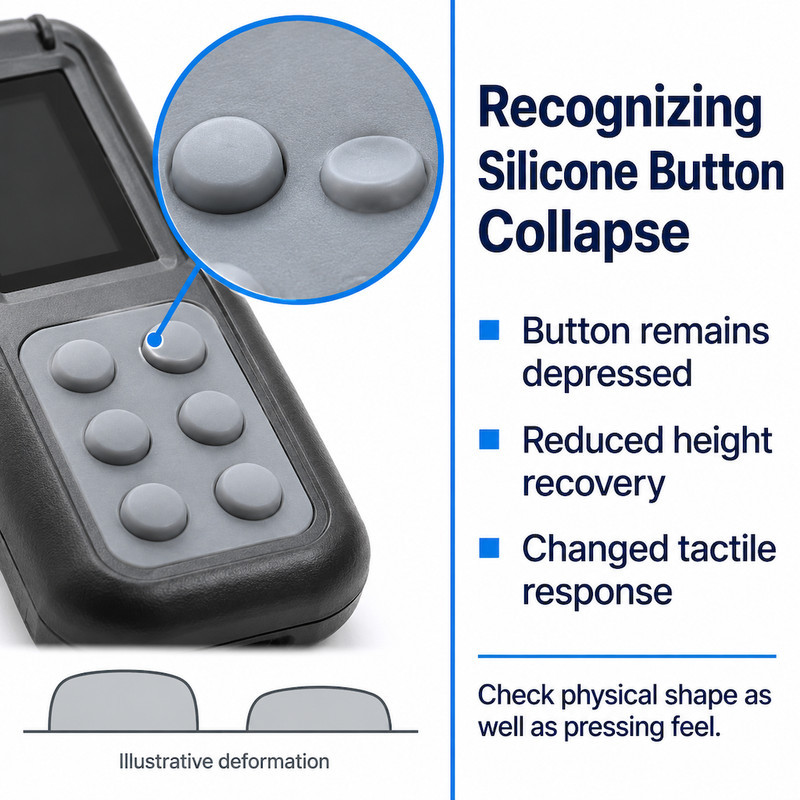
The complaint is almost always the same sentence: the button does not come back up. On a handheld diagnostic device that has been in service for a year, one or two keys sit lower than the rest, the click has gone flat, and the user has started pressing harder to compensate. Nothing has broken. The silicone has simply stopped returning to the height it was moulded at.
This is usually described as collapse, and it is usually explained as a thin wall or a soft compound. Both can contribute, but they are not the whole mechanism. A keypad in a sealed handheld device spends its life preloaded: the front panel clamps it, the housing compresses it, and the gasket around it pushes back. The button does not get a rest position. It gets a loaded rest position, and the material slowly takes a set at that position.
So the useful question is not "how thick should the wall be" but "how much of the travel budget is being consumed before the user even touches the key".
What Does Silicone Keypad Collapse Look Like in Handheld Diagnostic Devices?
Collapse is a shape change, not a force change, although the two arrive together. The button loses height, the crown flattens slightly, and the side wall may bow outward. The click becomes shorter and softer because the dome or the wall is no longer starting from its designed geometry.
It is often uneven. The keys pressed most often during a training session or a ward round fail first, and the keys under the thumb rest position fail next, because they carry load even when they are not being pressed.
On a device that is carried in a pocket or a bag, the whole keypad can be compressed for hours at a time by whatever is next to it. That is a load case the drawing review usually ignores, and it is often the one that produces the first visible set.
How Can You Identify a Collapsing Silicone Button?
Four signs, in the order they usually appear:
- The button stays slightly depressed after release, then recovers over a few seconds or not at all.
- The button height is measurably lower than its neighbours when the device is at rest.
- The press feels shorter, with the break arriving earlier than on the other keys.
- The legend area starts to look polished or flattened, because the crown is sitting where the finger rests.
Measuring height is the only reliable way to separate a real collapse from a subjective complaint. A dial indicator or a simple height gauge on the assembled device, compared against a known-good unit, settles the question in a minute.
How Is Button Collapse Different From Poor Tactile Feedback?
A key with poor feedback still returns to full height; it just does not announce the press clearly. A collapsed key has lost height and has changed shape. The distinction matters because the fixes are different: feedback is a geometry and force-curve issue, while collapse is a material, preload and support issue.
A button can also feel soft without collapsing, particularly if the compound is soft and the wall is thin. Checking the physical shape before changing the compound prevents a lot of unnecessary rework.
Why Do Handheld Diagnostic Device Silicone Keypads Collapse?
Four factors interact: the wall geometry that carries the button, the hardness of the compound, the support the button gets from the membrane and the housing, and the compression history of the part.
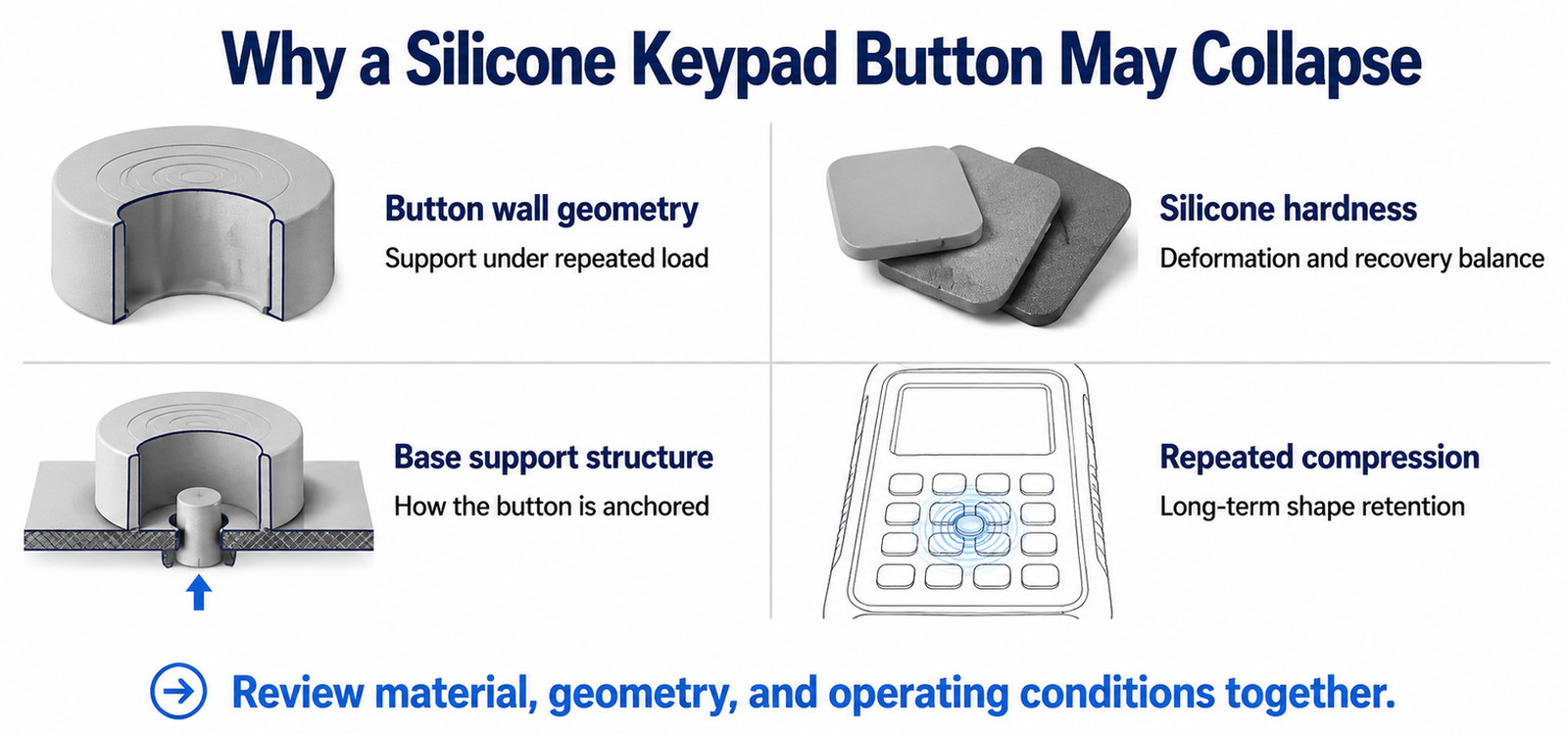
How Can Insufficient Button Wall Thickness Cause Deformation?
The wall is the column that holds the crown up. If it is thin relative to the button diameter and height, it buckles rather than resists, and buckling is not elastic in the way a straight column is. Each press pushes the wall slightly out of shape, and after enough cycles the material settles into the buckled shape.
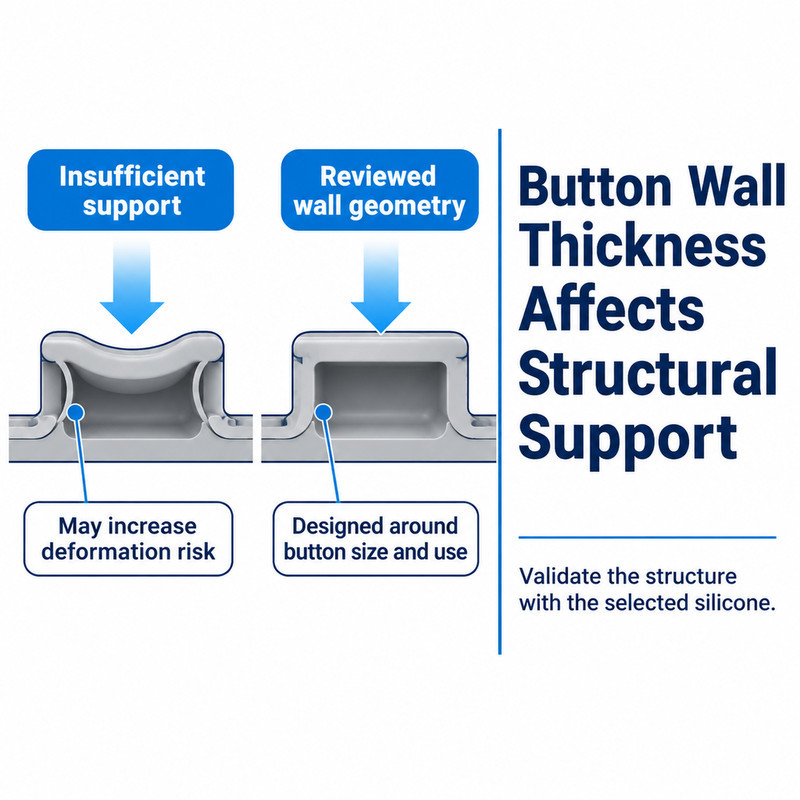
The relationship is not linear. A small increase in wall thickness can remove the buckling mode entirely, while a large increase makes the key heavy and slow. The useful target is the thinnest wall that still carries the load without buckling at the specified force.
Wall thickness also has to be read together with height. A tall thin wall buckles earlier than a short one at the same thickness, which is why "make the button taller so it has more travel" can make collapse more likely rather than less.
Why Can Excessively Soft Silicone Affect Button Stability?
A soft compound deforms more under the same load, and it also recovers more slowly. On a key that is preloaded by the housing, a soft compound will creep into the preload and stay there. That is the mechanism behind a keypad that looks correct on the day of assembly and low after a month in a bag.
Softness is not automatically bad. It is a problem when the design uses softness to compensate for a geometry that is too stiff, because the same softness removes the material's ability to hold its own shape.
How Can Poor Supporting Structures Affect Button Recovery?
The button base is where the return force is stored. If the membrane around the button is unsupported and free to deflect, the button pushes the membrane down instead of pushing itself back up. The result is a key that feels soft and stays low, even though the wall and the compound are reasonable.
Support can come from the membrane thickness, from a raised boss in the housing, or from the PCB behind the keypad. Whichever is used, the support has to be continuous around the button base. A support that touches only one side lets the button tilt, and a tilted button wears unevenly and collapses on one edge.
How Does Repeated Pressing Contribute to Permanent Deformation?
Every press is a small compression cycle, and every cycle leaves a small amount of unrecovered strain. In a well-designed part that strain is negligible and the material recovers fully between presses. In a part that is already working near its limit, the unrecovered strain accumulates, and the button height drifts down over thousands of cycles.
Compression set is the standard measure of this behaviour, and it is normally evaluated under a defined compression at a defined temperature for a defined time, following a method such as ISO 815-1. The relevant question for a handheld device is not the single test result but how the material behaves at the actual preload and the actual storage temperature. The same mechanism is examined in this note on compression set and rebound loss in silicone keypads, where the load case is temperature rather than preload.
How Do Compact Device Structures Increase Silicone Keypad Design Challenges?
Why Can Limited Internal Space Restrict Button Support?
In a handheld diagnostic device the space behind the keypad is shared with the display, the battery, the connector and often a cartridge or sensor path. The keypad is usually the last item to be given depth, and the depth it gets is whatever is left between the front panel and the PCB.
That depth has to cover the button height, the travel, the dome or wall structure and the gap needed for the contact. When it does not, the design compensates by reducing button height or by preloading the keypad. Both reduce the margin against collapse.
How Can Thin Keypad Structures Affect Overall Stability?
A thin overall keypad has less material to store return force and less resistance to taking a set. It also has less room for a proper transition radius at the button base, which is where the return force is generated.
Local reinforcement is often a better answer than thickening the whole membrane. A raised ring at the button base, or a locally thicker pad under the crown, adds support where the load is applied without making the entire keypad stiff.
How Can Manufacturers Prevent Silicone Keypad Collapse?
Prevention starts with the travel budget and the preload, and then moves to geometry, material and validation in that order.
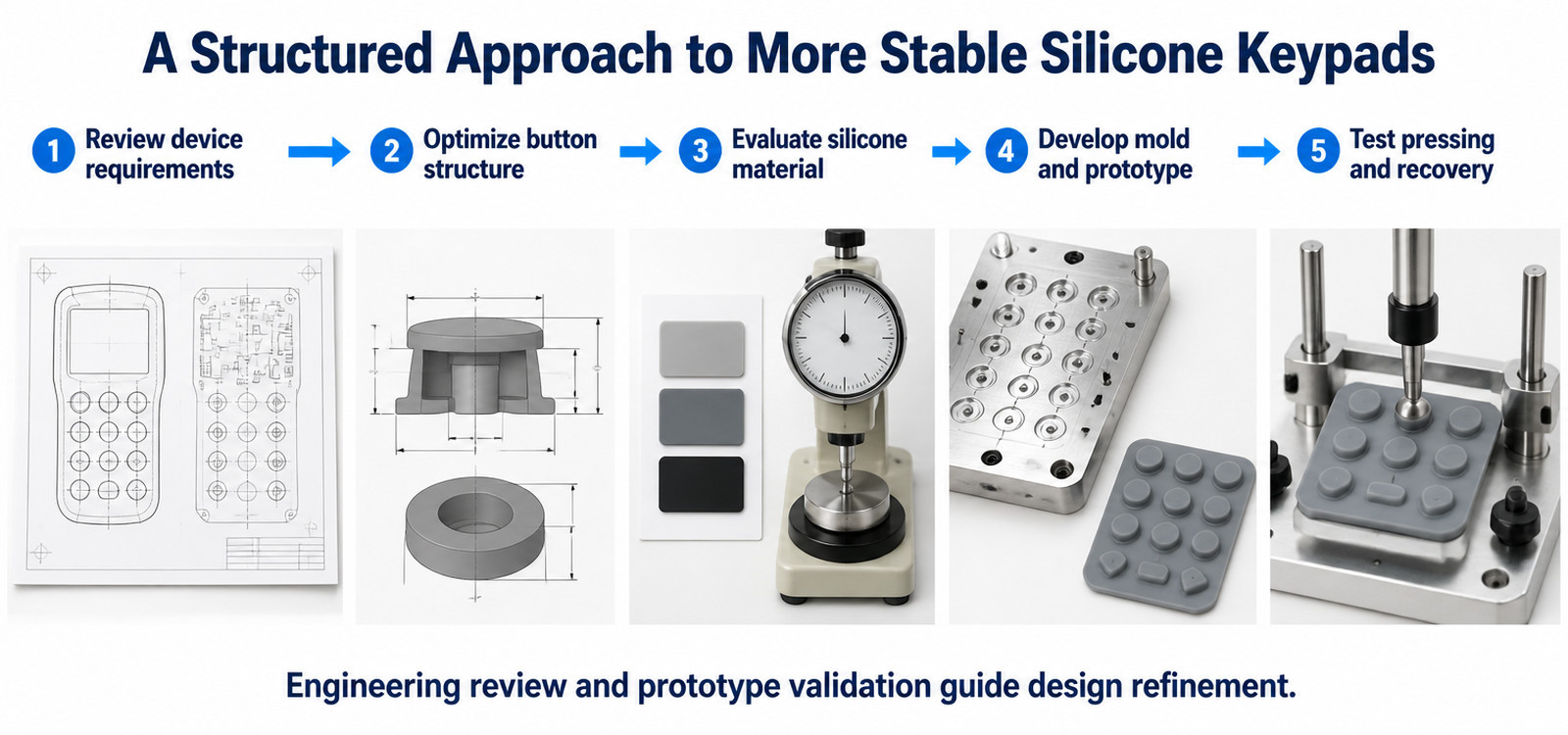
How Should Button Geometry Be Optimized?
Five adjustments cover most cases: reduce button height if the travel budget allows, increase wall thickness only up to the point where buckling stops, add a transition radius at the base, avoid abrupt thickness changes between wall and membrane, and add local support under the button rather than across the whole part.
Each of these changes the feel, so they should be evaluated as a set on a prototype. Making them one at a time on a drawing produces a design that is theoretically stable and practically inconsistent.
How Should Silicone Hardness Be Selected?
Select hardness for the durability and sealing requirement first, then adjust geometry for the feel. A compound that is soft enough to press easily through a glove may be too soft to hold its height under preload, and the trade cannot be resolved by hardness alone.
What helps is testing the candidate compounds at the actual preload, at the actual storage temperature, for a period that resembles the device's life. A short press test will not reveal a creep problem.
Which Tests Can Reveal Long-Term Deformation Risks?
Four tests, run on the assembled device rather than on loose buttons: button height before and after a repeated-press run, compression set on a witness sample from the same batch, recovery time measured after a sustained load, and a storage test at the upper end of the operating temperature range with the device assembled and the keypad preloaded.
Height measurement is the most useful of the four, because it is the same quantity the customer sees. A change of a few tenths of a millimetre across a service life is enough to be visible and enough to change the feel.
Why Do Mold Design and Manufacturing Quality Affect Stability?
How Can Mold Accuracy Influence Button Wall Thickness?
The wall is formed by a cavity and a core, and the gap between them is the wall. Any eccentricity between the two, any tool wear, any difference in thermal expansion during the cycle shows up directly as wall thickness variation. On a button with a thin wall, a small variation is a large percentage change, and the keys at one end of the tool can collapse earlier than the keys at the other.
This is why wall thickness should be inspected as a dimension with a tolerance, not just checked visually. The inspection data is also what tells you whether a field failure is a design problem or a tool problem.
Why Does Consistent Silicone Molding Matter for Mass Production?
Because the properties that resist collapse are process-sensitive. Cure level, material batch, and the time between mixing and moulding all affect how completely the compound crosslinks, and an under-cured part will take a set sooner than a fully cured one. The difference does not show up in a dimensional check, which is why process records matter as much as inspection data.
For a medical device, this is also where the quality system connects to the design. If the device falls under IEC 60601-1, the keypad is part of the equipment's mechanical and safety-related construction, and a change of compound or cure schedule is a change that has to be assessed rather than absorbed.
What Should You Prepare Before Customizing a Handheld Diagnostic Device Silicone Keypad?
Which Technical Details Help Manufacturers Identify Collapse Risks?
Six inputs make the risk review possible: button dimensions and layout, target pressing force, silicone hardness or durability target, keypad thickness and support structure, PCB and enclosure drawings including the gap behind the keypad, and the expected pressing frequency plus storage conditions.
If the device is already in service, a failed sample and a known-good sample are worth more than a drawing, because the height difference can be measured and the preload can be estimated from the housing.
How Can a Custom Silicone Keypad Manufacturer Help Improve Structural Reliability?
The contribution is a structural review that treats the keypad as a preloaded spring: how much of the travel is consumed before the user presses, where the return force comes from, and which feature is carrying the load at rest. That review usually produces two or three geometry options with different feel and different stability margins, which is what a design team needs in order to choose.
FromRubber moulds keypads for handheld and medical devices with tooling, moulding and printing in the same plant, so a geometry change can be prototyped and measured before a production tool is committed. The keypad design and technical support page describes that sequence, and this note on consistent pressing feedback on medical diagnostic keypads covers the feel side of the same review.
Questions Device Designers Ask About Keypad Collapse
Will a taller button stop the key from collapsing?
Usually not. Height increases the bending moment on the wall and can make buckling more likely. If the travel budget allows, a shorter button with a better supported base is often the more stable choice.
Is collapse a material defect?
Sometimes, but not usually. It is more often a design that puts the material under continuous load near its limit, or a process that leaves the part under-cured. Material, geometry and preload have to be looked at together.
Can we fix a collapsed keypad by changing to a harder compound?
It may slow the collapse, but it also changes the feel of every key and can make the device hard to use through a glove. If the wall is buckling, hardness will not remove the buckling mode.
How long should a keypad hold its height?
That should be defined as a requirement, with a test that matches the storage and use conditions. A press-cycle test alone will not answer it, because the dominant load in a handheld device is often the continuous preload, not the presses. This note on press-cycle capability explains how the two requirements are separated.
The Travel Budget
Collapse looks like a material failure and behaves like a budget failure. Every millimetre of space behind the front panel is already allocated: to button height, to travel, to the contact gap, and to the preload that the housing applies. When the preload takes more than its share, the button starts its life part way down and the material spends the rest of it trying to get back.
The design review that prevents this is short. Measure the gap, decide how much of it the preload may use, choose the wall and base support to hold that position, and confirm the result on an assembled sample after a sustained load. None of those steps is expensive before tooling. All of them are expensive after a field complaint.
Sources and notes. Compression set is evaluated using methods such as ISO 815-1:2008, which defines the test at ambient or elevated temperature; the relevant result for a device depends on the preload and storage conditions, not on the standard test alone. Medical electrical equipment requirements are set out in IEC 60601-1:2005 with amendments 1:2012 and 2:2020. Height changes and recovery times quoted in this article are described qualitatively because the acceptance values must come from the device specification and the agreed validation protocol.
FromRubber, Dongguan Bohao Electronic Technology: custom silicone keypads for handheld diagnostic and medical devices. Send the enclosure section behind the keypad and a failed sample if you have one, and we will review the preload and the wall geometry. WhatsApp and WeChat: +86 18676210913.
Published by the FromRubber keypad engineering team.