Why Do Silicone Washers Leak Around Screw Connections? Hole Size, Thickness and Contact Pressure
- Share
- Issue Time
- Nov 5,2026
Summary
Silicone washers seal an annulus, not a disc. This article explains how bore size removes sealing area, why thickness is set by the assembly gap rather than the part, and how to trace a leak around a screw before changing the washer design.
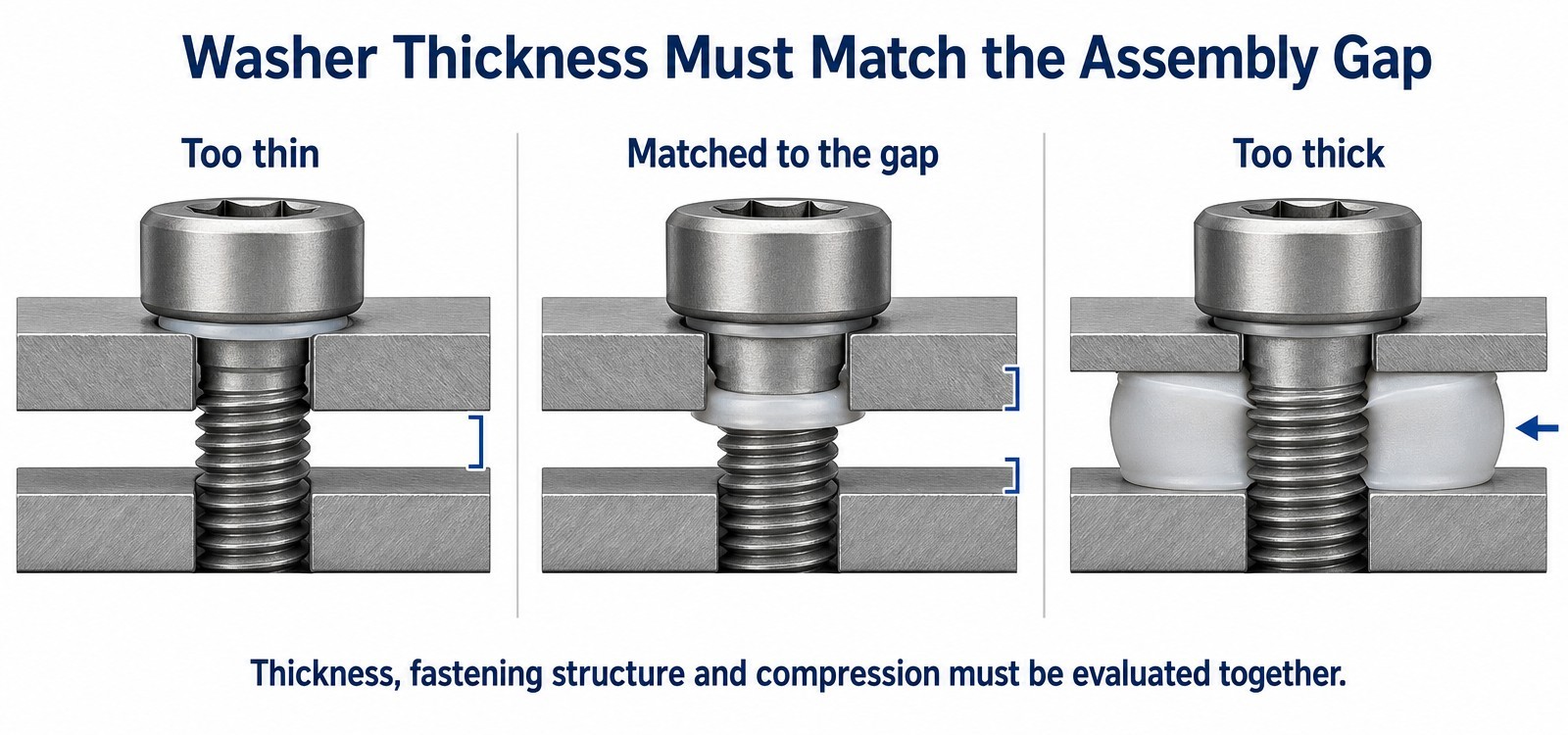
A silicone washer fails around a screw for a reason that has nothing to do with the screw being loose. It fails because the water never had to cross the washer — it went around it, through the hole clearance, and out under the head.
Most washer specifications describe two numbers: inner diameter and outer diameter. That is enough to buy a part and not enough to seal a joint. A washer under a screw head is a radial seal, and what it seals is an annulus, not a disc. Get the annulus wrong and the part can be perfectly moulded, perfectly centred, correctly torqued, and still wet.
The useful way to look at a screw connection is as three concentric circles: the bearing circle of the screw head, the inner hole of the washer, and the hole in the panel. The sealing job lives in the space between the last two. Everything else — thickness, hardness, outer diameter — exists to keep that space closed under load.
Why Can a Silicone Washer Leak Around a Screw Connection?
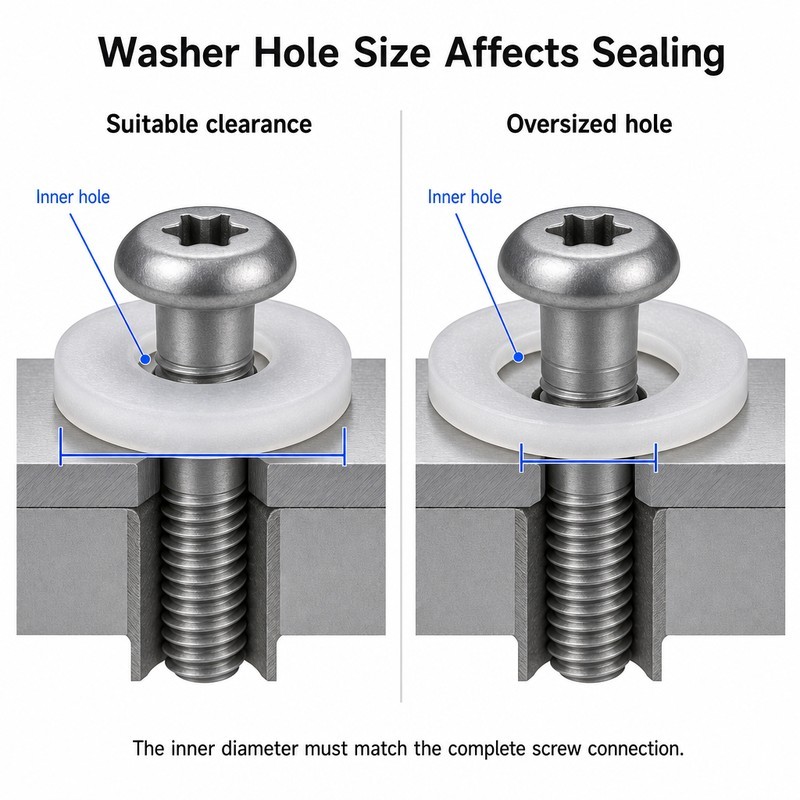
The Center Hole Is Too Large for the Screw Assembly
An oversized hole does two things at once, and both are bad. It removes radial material, so the contact band that must cover the panel hole gets narrower. And it creates an open annular gap between the screw shank and the washer bore — a gap that connects the wet side directly to the underside of the head, bypassing the sealing surface entirely.
This is why a washer can look generous and still leak. The outer diameter is large, the part looks substantial, but the sealing band is a thin ring that has to cover a panel hole which may be larger than expected.
The Washer Does Not Make Continuous Contact With the Mating Surface
Silicone conforms well, which is often read as a licence to ignore surface condition. It is not. A burr at the edge of a punched hole lifts the washer locally; a scratch across the sealing band gives water a channel; a panel that is dished around the hole means the washer touches on one side of the circle and not the other.
Because the contact band is narrow, a defect does not have to be large to matter. A raised burr of a few tenths of a millimetre is enough to hold the washer off the surface across a measurable arc, and a leak path only needs one arc.
Insufficient or Uneven Fastening Pressure
Fastening pressure in a screwed joint is not uniform, and it is not simply torque divided by area. The screw head tilts as it seats, the panel deflects between fasteners, and the washer is compressed most where the head bears hardest. On a multi-screw cover, the last screw to be tightened often carries the least load because the earlier ones have already pulled the panel down.
The practical result is that some washers in an assembly are compressed to a fraction of what the drawing assumed, while others are crushed. Both conditions leak — one because there is no squeeze, the other because the material has been pushed out of the sealing band.
A note on the thread as a leak path
A screw thread is a spiral channel, not a smooth cylinder. In a blind hole the thread terminates and the channel dead-ends; in a through hole it does not. This is why two identical covers, one with blind fastening bosses and one with through holes, can behave completely differently with the same washer. If the design has through holes, the washer is the only barrier — there is no second line of defence.
How Does Silicone Washer Hole Size Affect Sealing Performance?
Matching the Inner Diameter to the Screw and Assembly Structure
The inner diameter has to satisfy two constraints that pull in opposite directions. It must be large enough to slide over the thread without being stretched during assembly, and small enough to leave a sealing band wide enough to cover the panel hole plus assembly tolerance.
The design reference is therefore not the screw's nominal diameter. It is the panel hole diameter, the positional tolerance between panel hole and screw axis, and the head's bearing diameter. A washer sized from the screw thread alone ignores two of the three.
Why an Oversized Hole Can Reduce the Sealing Contact Area
Contact area is what resists leakage. When the bore grows, the band shrinks from the inside, and the loss is not proportional — it is the remaining ring that has to do all the work. Once the band is narrower than the combined positional tolerance of the panel hole and the screw, part of the panel hole edge sits outside the compressed band and is never sealed, no matter how tight the screw is.
Why an Undersized Hole Can Cause Installation Problems
A tight bore is not a better seal. A washer forced over a thread is stretched at assembly; it stays slightly conical and slightly thinner where it was stretched, and it no longer sits flat on the panel. On a soft silicone part the stretch can be permanent enough to leave a wavy inner edge, which is exactly where the leak path starts.
On automated assembly the effect is worse: a tight washer slows the driver, gets picked badly, or tears at the bore and is installed damaged without anyone noticing.
How Should Washer Thickness Be Selected for Screw Sealing?
What Happens When the Silicone Washer Is Too Thin?
A thin washer has little compression allowance. It can absorb surface roughness and a small amount of panel deflection; it cannot absorb a joint that opens and closes with temperature or vibration. It is also less tolerant of the tolerance stack, so a joint that seals on a good day leaks on a bad one.
Thin washers do have an advantage: they transmit fastening load more directly, so the local pressure on the sealing band is high. That is useful for a rigid joint with a good surface and no thermal cycling — and wrong for anything else.
What Happens When the Washer Is Too Thick?
An over-thick washer becomes a spring in the load path. The screw has to compress it before the joint closes, so the screw carries less preload than intended, and the joint is more sensitive to relaxation. On a soft silicone part the material also bulges outward, and if the washer is thicker than the space available under a countersunk or recessed head, the head never seats.
A second effect is often missed: changing washer thickness changes the height of the fastener stack. On assemblies where that height matters — a cover that must sit flush with a housing, a PCB held at a fixed distance — the gasket has become a shim whether the designer intended it or not.
| Condition | Effect on the joint | When it still works |
|---|---|---|
| Too thin | Almost no compression allowance; the joint opens under thermal cycling | Rigid joint, flat surface, no cycling |
| Matched to the gap | Continuous contact on both faces with an even bulge at the edges | Most screwed joints |
| Too thick | Absorbs preload; a countersunk head never seats | No joint, unless the stack height is designed for it |
How Do Outer Diameter and Washer Shape Influence the Sealing Area?
Selecting an Appropriate Outer Diameter Around the Screw Head
The outer diameter should be set by the panel's sealing surface, not by the screw head. The washer must extend far enough past the head to leave a compressed band on clean, flat panel material, and stop before it reaches a radius, a step or another hole.
Where the washer is much larger than the head, the outer part of the washer is not compressed by the head at all. It sits there looking like sealing area while contributing nothing — and if the panel has a recess, it can lift and become a trap for water.
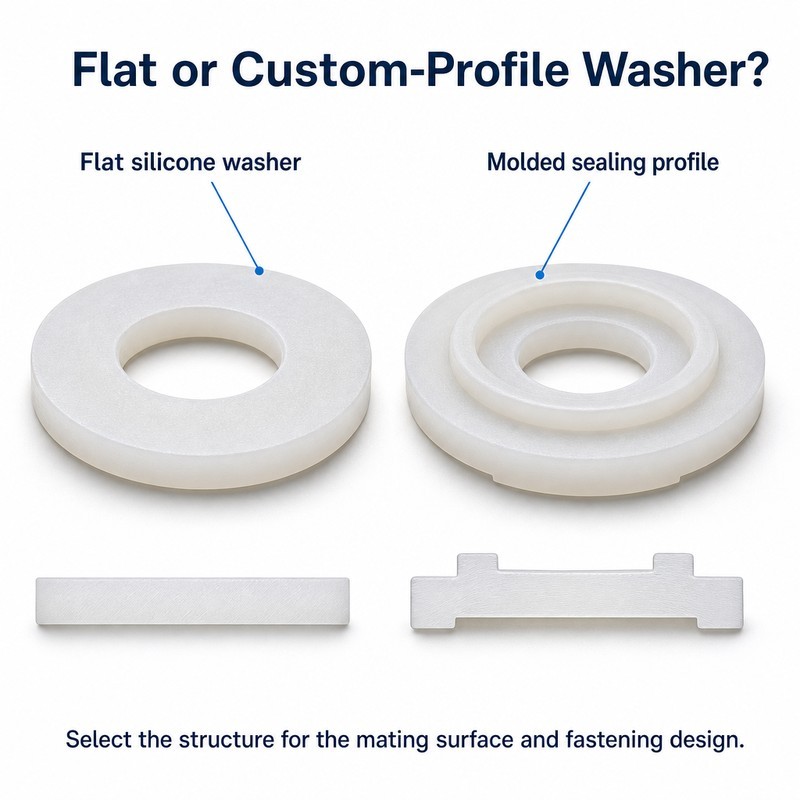
Comparing Flat Silicone Washers and Custom-Profile Washers
A flat washer seals by compressing its whole face. It needs a flat, continuous, reasonably smooth surface, and it works well when the head is large relative to the hole.
A moulded washer can carry a raised lip near the bore, a small rib on the panel face, or a step that seats into a recess. The lip concentrates pressure exactly on the annulus that matters, which is useful when the panel is not flat or when the head is small. The trade-off is a tool rather than a die-cut, and a part that must be oriented correctly at assembly.
Designing Washers for Countersunk and Recessed Connections
Countersunk heads and recessed pockets change the geometry of the seal completely. In a countersink, the head bears on a cone, and the load path spreads outward rather than straight down. A flat washer placed under a countersunk head is often loaded on its outer edge and barely touched near the bore — the opposite of what is needed.
In a recess, the washer must fit inside the pocket diameter with clearance, which usually forces a smaller outer diameter than the ideal sealing band. The practical fix is a moulded profile that puts the sealing feature within the pocket while the locating feature handles centring.
How Do Silicone Hardness and Compression Behavior Affect Washer Performance?
Selecting Hardness Based on the Fastening Structure
Hardness decides how the material distributes load. A soft washer conforms to surface defects and seals uneven panels, but it extrudes sideways under high preload and takes a permanent set more readily. A firmer washer holds its section and resists extrusion, but needs a flatter surface and a more consistent fastening load to seal at all.
The joint decides. A hand-tightened plastic cover with a large head tolerates soft material. A small head, a thin metal panel and a defined torque need something firmer, or the material simply leaves the sealing band.
Understanding Compression Set in Long-Term Applications
Compression set is the reason a joint that passed a leak test in the factory fails six months later. The material is held compressed, relaxes gradually, and does not return to its original thickness when the load is released or when the joint opens slightly under thermal cycling.
Published work on elastomer seals shows the effect is strongly temperature-dependent: compression set rises steeply as the material is cooled toward its glass transition, and continues to change with time after unloading. Silicone's transition is far below normal service temperatures, which is a real advantage — but the mechanism still applies at elevated temperatures, and it applies to silicone gaskets in hot equipment just as it does to O-rings in flange joints.
Considering Temperature and Environmental Exposure
Standard silicone is a poor choice for many oils and fuels, and a good choice for water, many aqueous chemicals and outdoor exposure. The material selection has to follow the media, not the temperature alone. Where the washer seals an enclosure that will be tested against water or dust ingress, the whole enclosure has to meet the relevant test conditions — IEC 60529 defines the IP code and the test severities — and the washer is only one contributor to that result. A perfect washer cannot compensate for a housing gap elsewhere.
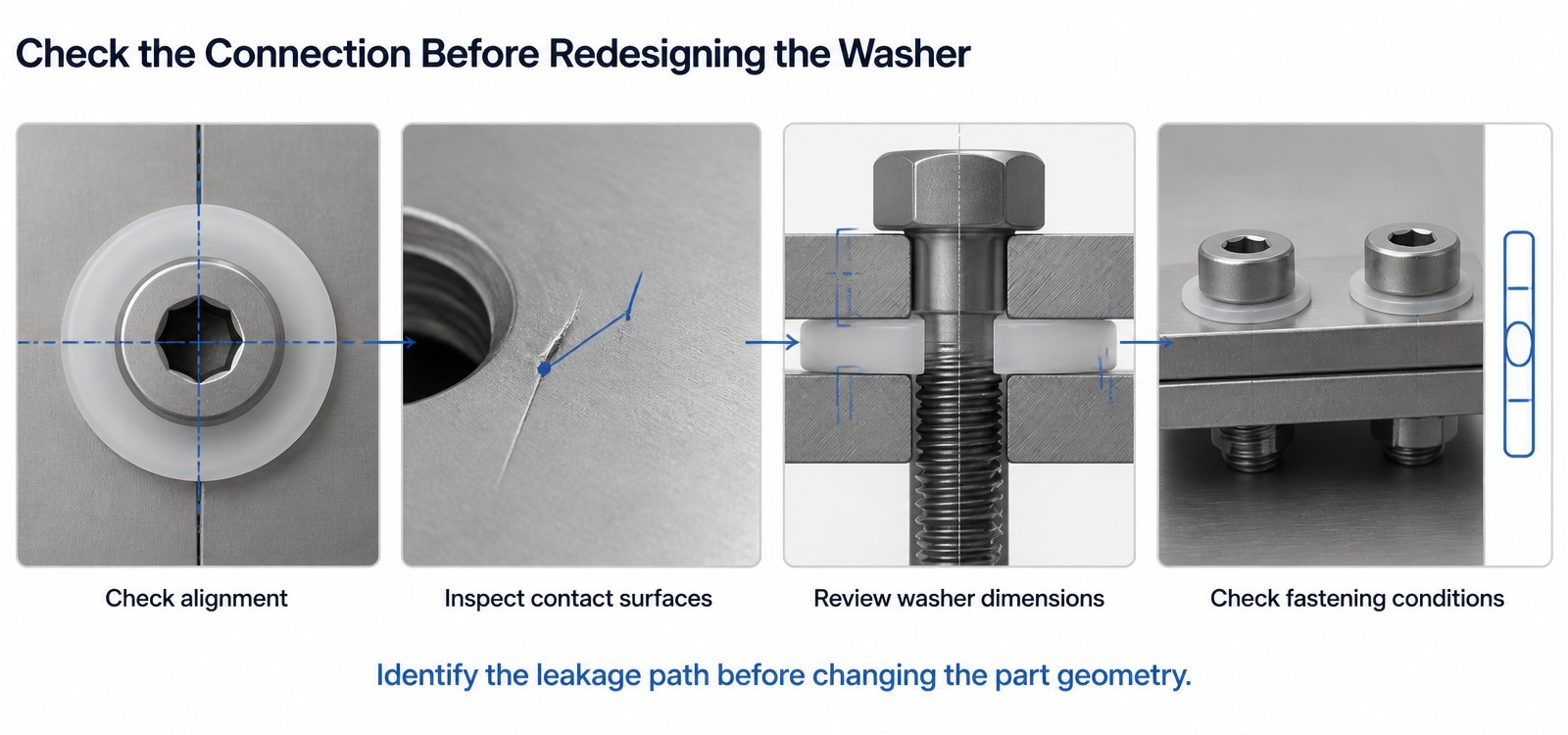
How to Identify the Cause of Leakage Before Changing the Washer Design
Check the Screw Hole and Washer Alignment
Look straight down the screw axis. If the washer bore, the panel hole and the screw are not concentric, the sealing band is eccentric, and one side of the annulus is doing all the work. Offset is usually a tolerance issue between the panel hole and the fastener position, not a washer problem.
Inspect the Contact Surfaces for Scratches and Burrs
Run a fingernail across the sealing band on the panel. Any catch is a potential leak path. Pay particular attention to the edge of a punched or drilled hole, where a burr often remains on the side that faces the washer.
Review Fastening Consistency and Assembly Conditions
Check whether the joint closes evenly. A cover that rocks before the screws are tight will compress its washers unevenly no matter how carefully they are torqued. Sequence matters as much as value: tightening from one end drives the panel down at that end first.
Compare Different Washer Dimensions During Sample Testing
Change one variable at a time. Test bore size first, since it has the largest effect on the sealing band; then thickness; then hardness. Changing all three at once produces a result but no information.
What Information Should Buyers Provide When Ordering Custom Silicone Washers?
A dimension list is a weak brief. What is needed is a drawing of the connection: the screw, the head type and bearing diameter, the panel thickness, the panel hole, the recess or countersink if there is one, the fastening method, and the media the joint will see. From that, the washer can be designed rather than guessed.
Where the joint already exists and leaks, a photo of the failed washer in place, taken before disassembly, often explains more than a dimension sheet — it shows whether the part was stretched, extruded, displaced or never compressed.
Custom Silicone Washer Manufacturing at FromRubber
FromRubber moulds and die-cuts silicone washers and sealing parts in Dongguan, where 32 compression moulding machines (30 vacuum-assisted, 2 plate presses) run alongside a seven-machine CNC tool shop, with tooling and inspection in-house. Washer work is usually small-part work: thin sections, tight bores, and a profile that has to be identical across a few hundred thousand pieces.
The engineering conversation starts with the connection drawing, because bore size and thickness only mean something relative to the panel hole and the head. Where a customer needs a sealing lip inside a recess, or a washer that cannot be installed the wrong way round, that is a tooling decision made at drawing review — before the mould is cut.
Frequently Asked Questions About Silicone Washers
Can a silicone washer seal around a standard screw?
Yes, provided the bore is sized from the panel hole and the head's bearing area rather than from the thread alone. A standard screw with a large head is easier to seal than one with a small head, because the load is spread over a wider band.
Should the washer inner diameter be the same as the screw diameter?
No. A bore equal to the nominal screw diameter will be stretched over the thread at assembly. The bore is normally set by the panel hole and the required sealing band, with clearance for the thread.
Does a thicker silicone washer provide better sealing?
Only up to the point where the joint still closes. Beyond that, thickness reduces the preload reaching the sealing band and can stop a countersunk head from seating.
Why does a silicone washer deform after tightening?
Because the material is being compressed beyond what its section can accommodate, usually on a small head or a thin panel where the local pressure is high. A firmer compound or a larger bearing area distributes the load instead of squeezing the material out.
Can silicone washers be made with different inner and outer diameters?
Yes. Both are set by the joint: the bore by the panel hole and clearance, the outer diameter by the sealing surface available around the head. Moulded parts can also carry a lip or a step that a flat die-cut part cannot.
Start From the Joint, Not the Part
A washer that leaks is telling you where the water went. Find the annulus that was supposed to be sealed, check whether it was covered and compressed, and only then decide whether the part needs a different bore, a different thickness or a different profile.
If you have a connection that will not stay dry, send the assembly drawing or a photo of the joint as it failed. We can tell you which dimension is doing the damage. WeChat and WhatsApp: +86 18676210913.
Sources
- IEC 60529 — Degrees of protection provided by enclosures (IP Code), IEC Webstore.
- Elastic recovery after compression in HNBR at low and moderate temperatures, Polymer Testing 61 (2017), SINTEF.
- Silicone Gasket Thickness and Its Effect on Compression and Service Life, FromRubber.