Why Does Rubber Grommet Hardness Affect Cable Protection?
- Share
- Issue Time
- Sep 22,2026
Summary
Grommet hardness decides how the part deforms against a cable, not how well it protects. This article explains what durometer actually measures, what happens at both ends of the scale, why cable chafing is an interface problem, and how hardness, wall thickness and cable movement have to be selected together.
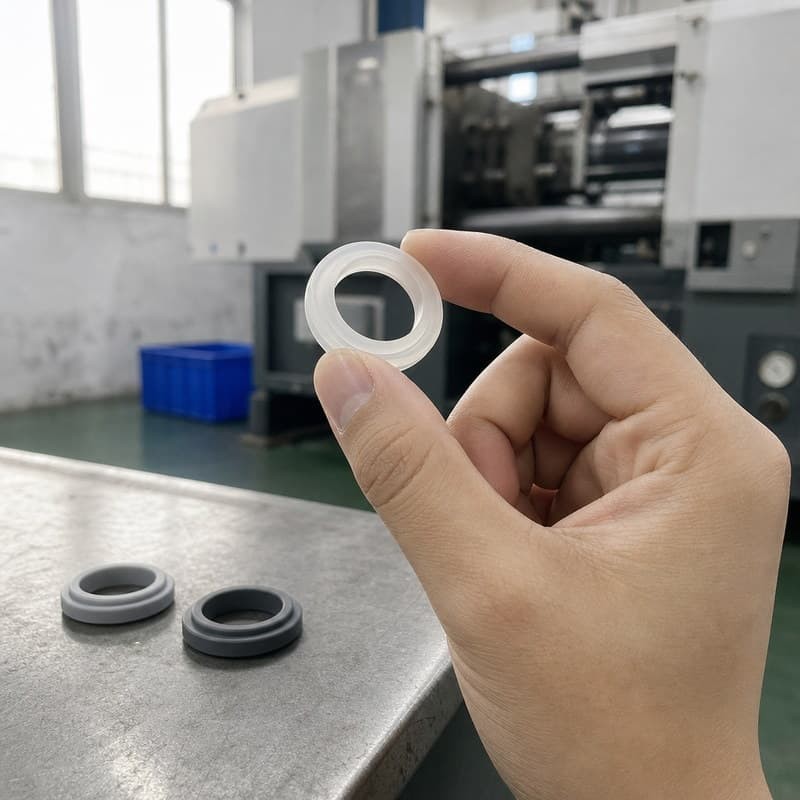
A cable jacket fails after eighteen months in a panel that was supposed to protect it. The grommet is still in place, still the right size, still in one piece — and its hardness has been quietly grinding away at the cable the whole time. Durometer is one of the few grommet properties that changes the outcome without ever looking wrong.
Short answer
Hardness sets how much and where a grommet presses on a cable. A firmer part holds a tighter, more concentrated contact line and resists movement; a softer part conforms over more of the cable surface but deforms further under load. Neither is better on its own — protection depends on the match between hardness, wall thickness, bore size and how much the cable actually moves.
What Grommet Hardness Actually Measures
Durometer is a resistance-to-indentation reading. A shaped indentor is pressed into the material under a defined load and the depth of penetration is converted to a number on a scale. For normal-range rubber and silicone parts that scale is Shore A, and the test methods are standardised (ISO 48-4 and ASTM D2240, both listed in the sources below).
Three things follow from that definition, and they are the reason hardness gets misused in grommet specifications.
- It is an indirect reading. It tells you how the surface behaves under a small, hard probe, not how the part behaves under a cable that moves thousands of times.
- It is a range, not a point. A 50 Shore A compound is a window of a few points, and measurement on a curved moulded surface reads differently from measurement on a flat test slab.
- It says nothing about tear strength, compression set or aging. Those are separate properties with separate tests, and they are usually the ones that decide whether a grommet is still protecting anything in year three.
A durometer figure is therefore a starting condition, not a performance promise. The rest of this article is about what that starting condition does to the cable.
How Hardness Changes the Contact Between Grommet and Cable
Think of the grommet as a spring wrapped around the cable. The cable sits in the bore, the wall thickness sets how much spring there is, and hardness sets how stiff that spring is.
A soft compound conforms. It closes small gaps in the cable surface, follows the jacket through a slight bend, and distributes the contact load over a wider band along the bore. The trade-off is that it also deforms more when the cable pulls sideways, so the bore can open up under load and let the cable shift.
A firm compound keeps its shape. It stays concentric, holds the cable on the centreline, and resists being pushed open by lateral pull. The trade-off is that the contact band is narrower and the pressure inside it is higher for the same deflection.
That last point is the one that matters for cable protection. Chafing is driven by local contact pressure combined with relative movement. Raise the pressure in a narrow band and you accelerate wear there, even though the grommet itself looks perfectly healthy.
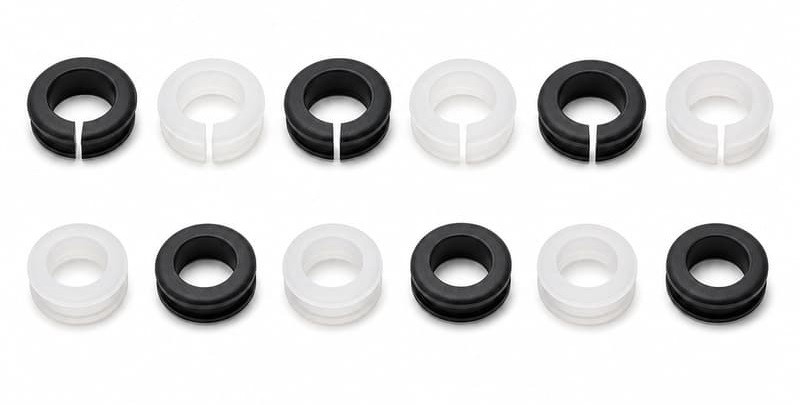
What Happens When the Grommet Is Too Hard
This is the failure mode most often blamed on the cable, because the cable is what fails first.
- Poor conformity. The bore does not close onto an oval or slightly irregular jacket, leaving one high spot carrying most of the contact load.
- Higher local contact pressure. The same insertion force is spread over less area, which is exactly the condition that wears a jacket through.
- More resistance to cable movement. A cable that should slide through a bend instead fights the grommet, and the load transfers to the jacket and to the connector behind it.
- Harder installation. Both the panel fit and the cable feed need more force, which brings its own risk of damaging the part before it is in service.
- Reduced ability to absorb movement. Vibration reaches the panel edge instead of being damped in the elastomer.
Note that the grommet itself usually survives all of this. It is the cable, the connector or the panel edge that shows the damage — which is why a hardness problem so often gets diagnosed late.
What happens when it is too soft
- Excessive deformation. The bore opens or the profile flattens under sustained cable load.
- Reduced dimensional stability. The part takes a set and does not return to its moulded shape.
- Loosening from the panel. A soft groove lip is easier for the panel edge to climb out of, especially where the panel vibrates.
- Poor resistance to repeated movement. Constant flexing works the material, and a soft compound fatigues differently from a firm one.
- Distortion around the cable. The bore can squeeze closed around a small cable or flatten into an oval that no longer seals.
From the moulding floor
Most hardness questions we get are really cable-movement questions. When a customer asks us to change the durometer, we ask three things instead: the cable outside diameter with its tolerance, whether the cable is static or moves, and the panel thickness the grommet sits in.
Those three answers settle the hardness range more often than a specification table does. They also catch the cases where the real problem is a bore that is 0.5 mm too large, which no hardness change will fix.
Chafing Is an Interface Problem, Not a Hardness Problem
Cable chafing needs three things to happen at once: contact, relative movement, and enough pressure to make the movement do damage. The grommet removes the third condition when it works well — it holds the cable away from the panel edge, so the sharp surface never touches the jacket.
How well it does that depends on more than durometer:
- Bore size. A bore that matches the cable keeps contact pressure even around the circumference. A loose bore lets the cable rattle, and each rattle is a small impact.
- Wall thickness. Thicker walls reduce the deflection for a given load, which lowers peak pressure and extends the wear band.
- Lip geometry. A generous radius where the bore meets the face spreads the cable's bend over a longer arc instead of a single line.
- Contact length. A deeper bore gives a longer bearing surface, so the same load is shared along more of the jacket.
Two grommets at the same 50 Shore A can chafe a cable at completely different rates, because hardness is only one of six or seven parameters that set the interface. Treating durometer as the chafing variable is a common and expensive shortcut.
Does Cable Movement Change the Ideal Hardness?
Yes, and more than most specifications admit. The same grommet can be correct in one installation and wrong in another, purely because of what the cable does after assembly.
| Cable condition | What the grommet has to do | Hardness direction |
|---|---|---|
| Static, fully supported | Hold the cable on the centreline and close the panel opening | Mid-range is usually adequate; geometry dominates |
| Static, cable hanging free below the panel | Carry a permanent dead load without taking a set | Firm enough to resist creep; check compression set (ISO 815-1) |
| Vibration, small amplitude | Damp movement and keep the jacket off the panel edge | Softer helps absorb, provided the bore stays closed |
| Repeated flexing near the panel | Survive millions of bend cycles without cracking | Flex fatigue and tear strength matter more than durometer |
| Moving harness inside a machine | Allow the harness to slide without abrading the jacket | Lower friction and a longer bearing surface beat a hardness change |
| Cable that pulls laterally against the panel | Resist the bore opening under side load | Firm and thick-walled, or change to a strain-relief design |
The dynamic cases are the ones where durometer gets over-trusted. Where a cable bends thousands of times, the failure is usually fatigue cracking at the bore edge, and the lever that fixes it is the radius and the wall, not the compound stiffness.
Geometry and Hardness Work as a Pair
Hardness does not act on its own, and this is where a specification written as a single number goes wrong. The properties below all change what a given durometer does in service:
- Inner hole size — sets the starting interference on the cable.
- Wall thickness — sets how much the bore can deflect for a given side load.
- Lip design — controls how the cable enters and exits the bore.
- Groove structure — decides whether the grommet stays where it was fitted.
- Contact area — decides how the load is spread around the circumference.
- Material hardness — sets the stiffness everything above works through.
A useful way to think about it: stiffen the geometry, and you can relax the hardness. Thicken the wall by a third and a mid-range compound will often hold a cable as firmly as a firm compound in the original wall. That trade is usually cheaper than changing compound, because it costs tooling time rather than a new material qualification.
Choosing a Hardness Without Guessing
Work through the application in this order. The durometer figure falls out of the answers rather than being chosen first.
- Cable outside diameter, including tolerance and any sleeve or jacketing.
- Does the cable move, vibrate or bend, and roughly how much?
- Panel thickness and hole diameter, since the panel fit also loads the profile.
- Installation method — by hand, with lubricant, with a tool.
- Service environment: temperature range, oils, cleaning agents, UV.
- Required flexibility at the point where the cable leaves the grommet.
- Expected mechanical stress: dead load, side pull, vibration amplitude.
- Then narrow the compound range, and confirm the choice with a fit and flex trial rather than a data sheet.
Steps one to four usually eliminate half the catalogue before durometer is even discussed.
Silicone Compared With Other Grommet Rubbers
Material choice and hardness choice are separate decisions, and it is worth keeping them apart.
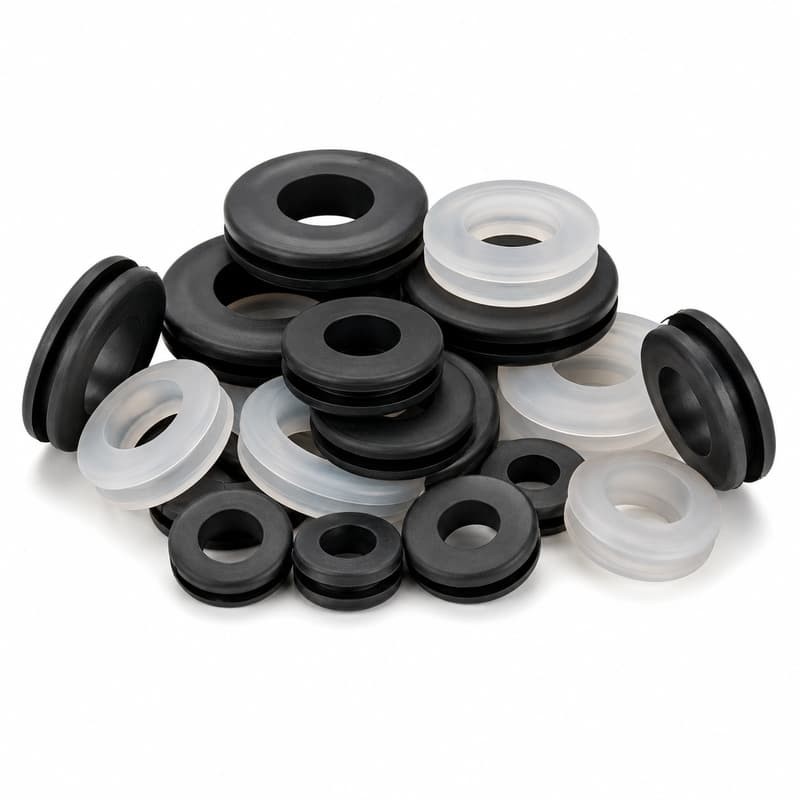
Silicone holds its properties across a wide temperature range and stays flexible when cold, which is why it is common on cables that run hot or see outdoor temperature swings. It is also available in grades that resist yellowing and ozone. General-purpose rubbers such as EPDM and nitrile have their own strengths — nitrile resists oils better, EPDM handles weather and water well — and the right choice depends on what the grommet will actually contact.
What matters for this discussion is that the same nominal durometer behaves differently across materials. A 50 Shore A silicone and a 50 Shore A nitrile will not deflect identically under the same cable load, because the underlying polymer networks differ. That is why durometer should never be carried across a material substitution without re-testing the fit.
Common hardness-selection mistakes
- Choosing a durometer from a catalogue number instead of from the cable duty.
- Ignoring movement, then treating chafing as a material defect.
- Ignoring panel thickness, which loads the same profile in a different direction.
- Applying one durometer across every cable size in a range.
- Assuming hardness is the only variable behind cable protection.
- Changing durometer without re-checking bore size, wall thickness and groove fit.
What to Take From This
Hardness controls how a grommet transfers load to a cable — where the contact pressure sits, how far the bore moves, and how the part behaves when the cable does not stay still. It does not, by itself, protect anything.
Specify it alongside bore size, wall thickness and groove geometry, and set it from the cable's duty rather than from a table. Where a part has already failed, check the interface before changing the compound: the durometer figure is usually the last thing that needed to move.
Sources
- ISO 48-4:2018, Rubber, vulcanized or thermoplastic — Determination of hardness — Part 4: Indentation hardness by durometer method (Shore hardness). https://www.iso.org/standard/74969.html
- ASTM D2240-15(2021), Standard Test Method for Rubber Property — Durometer Hardness. https://store.astm.org/d2240-15r21.html
- ISO 815-1:2019, Rubber, vulcanized or thermoplastic — Determination of compression set — Part 1: At ambient or elevated temperatures. https://www.iso.org/standard/74943.html
- ISO 4649:2024, Rubber, vulcanized or thermoplastic — Determination of abrasion resistance using a rotating cylindrical drum device. https://www.iso.org/standard/86603.html