Why Does a Rubber Grommet Keep Popping Out of the Panel?
- Share
- Issue Time
- Sep 21,2026
Summary
A troubleshooting approach for rubber grommets that loosen, rotate or pop out of a panel. Works through hole diameter, panel thickness, groove geometry, cable side loading and installation damage, with a symptom table and a prevention checklist.
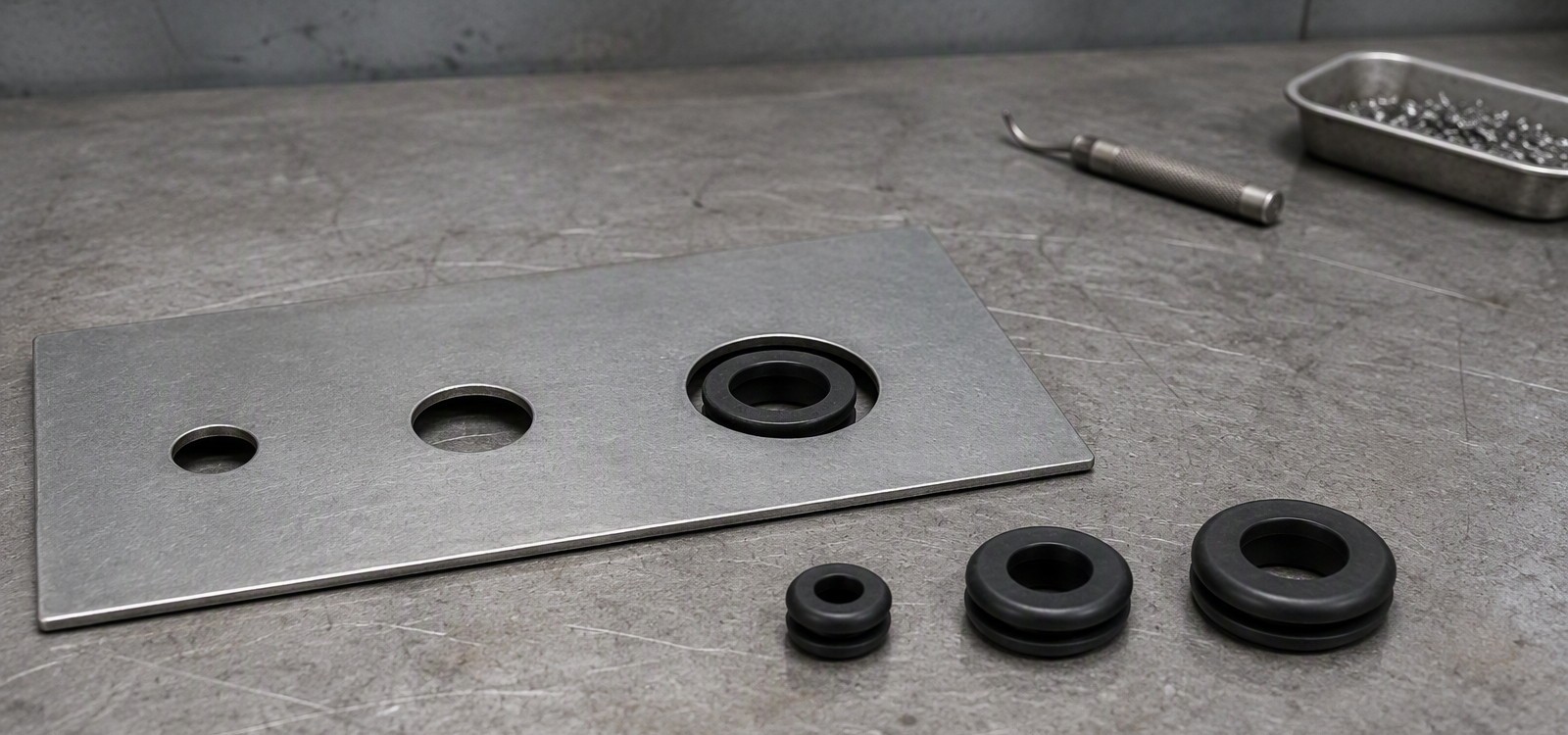
It seats on the bench, it looks seated at first build, and then it walks out of the hole. By the time anyone notices, the cable is resting on bare metal and the part gets blamed. In our experience a Rubber Grommet that keeps popping out is almost never a bad moulding. It is a retention budget that got spent before the assembly ever reached the end of the line.
Why Does a Rubber Grommet Pop Out of a Panel?
Think of retention as a reserve of force. The groove closes around the panel and develops a grip, and that grip has a finite size. Anything that consumes it — an oversized hole, a thin panel, a stretched installation, a cable that pulls sideways — eats into the same reserve. Spend enough of it and there is nothing left holding the part in place.
That reframing matters because it changes the diagnosis. Instead of asking "is the rubber good enough", you ask "what is consuming the reserve", and that question usually has a dimensional answer.
The usual consumers, roughly in the order we see them:
- Incorrect hole diameter — the most common single cause
- Panel thickness outside the range the groove was designed for
- Groove mismatch between the part and the actual sheet
- Insufficient flange engagement or a flange that cannot develop bearing pressure
- Cable movement and side loading that the grommet was never meant to resist
- Rubber hardness that does not suit the geometry or the installation method
- Installation damage that removes material from the groove or flange root
- Panel edge defects that stop the groove closing evenly
- Dimensional tolerance accumulation across all of the above
Hole Diameter Problems That Cause Grommet Failure
The groove grips the hole wall. That makes the hole the single most influential dimension in the whole assembly, and it is also the dimension most likely to drift in production.
Hole too large
The flange still covers the opening, so the part looks installed, but the groove is no longer squeezing the sheet. What is left is friction, and friction does not survive vibration. This is the classic pop-out case, and it is often invisible from the front because the flange hides the gap.
Hole too small
The part has to be forced in, and the rubber is left under permanent strain. Immediately after installation the part may hold better than a correctly sized one, which is misleading. Over weeks the strained groove relaxes, the flange lifts, and the retention that seemed generous at build disappears.
Hole diameter variation
A punching tool that has run for a long time produces a spread of hole sizes. If the grommet is selected against the nominal hole, the largest holes in the batch will be the ones that fail. Select against the upper end of the actual hole range.
Out-of-round holes
An oval hole compresses the groove on two sides and leaves it unloaded on the other two. The loaded sides take all the stress and the unloaded sides have no grip at all, so the part rotates and then lifts. A round grommet in an oval hole is a retention problem waiting to appear.
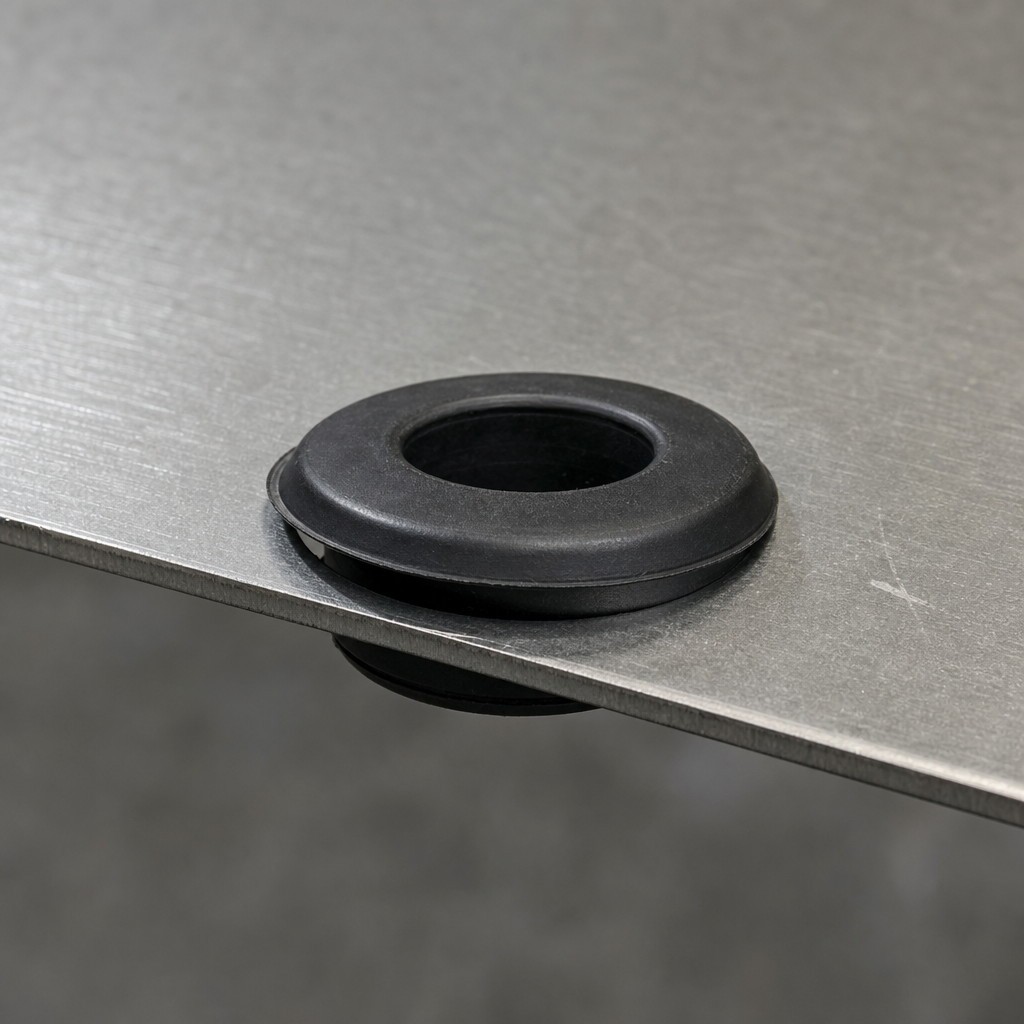
What a properly seated Rubber Grommet looks like. The flange sits flat against the panel face all the way round, with no visible gap under any part of the rim. The groove is closed around the sheet, not sitting proud of it. Pressing the flange by hand should produce a small elastic movement and then a return — not a slide, and not a click as the part drops further into the hole.
How Panel Thickness Affects Rubber Grommet Retention
Panel thickness decides how much of the groove actually engages the sheet, and the relationship has three states rather than two.
Groove narrower than the panel
The groove cannot close around the sheet. Installation force climbs, the flange is left standing proud of the panel face, and the rubber is under permanent compression. On thin or soft sheet this is also where the panel itself starts to deform.
Groove wider than the panel
The groove closes, but without any preload. The grommet sits in the hole instead of gripping it. This is the state that produces slow, quiet failures: the part stays put until something moves it, then it moves easily.
Correct groove-to-panel relationship
The groove is slightly narrower than the measured panel thickness so the rubber has to deflect to seat, and that deflection is what generates the grip. Thickness should be treated as a primary design input, taken at the hole edge, and expressed as a range rather than a single value.
A grommet is not a fastener
It is worth saying plainly: a plain flanged Rubber Grommet develops retention through elastic preload, not through mechanical locking. There is no thread, no barb and no positive stop. That is why small changes in hole size or sheet thickness have such a large effect on whether the part stays put.
When an application genuinely needs positive retention, the answer is a different geometry — a deeper groove, a ribbed groove wall, a larger bearing flange or a retaining feature — rather than a harder material in the same shape.
Why the Grommet Groove May Not Hold the Panel Properly
The groove is a small piece of geometry doing a large amount of work, and four of its dimensions act together.
- Groove width sets the thickness range the part can grip.
- Groove depth sets how far the rubber wraps the hole wall, which is what resists rotation.
- Groove diameter is the dimension in contact with the hole wall and therefore the one that creates interference.
- Flange geometry determines the bearing area, and bearing area is what turns the elastic preload into something that resists being pushed out.
Rubber deformation ties them together. When the flange is pressed, the rubber has to go somewhere, and part of what moves is the groove. A groove that measures correctly on a drawing can behave differently once the flange is loaded, which is why groove dimensions are best verified on a seated part rather than on a loose one.
It is also worth resisting the reflex answer on hardness. A softer compound installs more easily and conforms to a rough edge better, but it also deflects further under the same load and stores less elastic energy for retention. A harder compound holds better but costs installation force and can crack at the flange root on a badly deburred hole. Neither is always correct; the right value depends on the panel, the hole and how the part is fitted.
Can Cable Pulling Force Make a Rubber Grommet Pop Out?
Yes, and this is where a retention problem gets misdiagnosed as an installation problem. A grommet protects and positions. It is not a strain relief device, and the two functions get confused constantly.
The loads that work on the grommet through the cable are:
- Cable weight — a suspended run hanging from the panel converts directly into a force pulling the grommet off-centre
- Cable tension — during installation, someone pulling the slack through loads the grommet in the pull direction
- Repeated movement — a cable that is flexed daily works the groove loose in small increments
- Vibration — sustained vibration reduces friction at the groove-to-panel interface even when the preload is correct
- Bending — a tight bend radius close to the panel turns every cable movement into a lever acting on the flange
- Side loading — a cable clipped at an angle pulls the grommet laterally, which is the direction the groove resists least
Two useful tests: if the grommet moves when you push the cable sideways but stays put when nothing touches it, the load path is the problem, not the fit. If the grommet moves on its own with the cable undisturbed, the dimensional fit is the problem.
Where strain relief belongs
If the cable carries load or moves regularly, the retention job should be taken off the grommet and given to a proper clamp, a cable tie anchored to the panel, or a conduit fitting. That usually solves the pop-out without changing the grommet at all.
Once the load is removed you can also tell whether the grommet ever had enough grip, which is otherwise impossible to judge on a loaded assembly.
Installation Problems That Damage Rubber Grommets
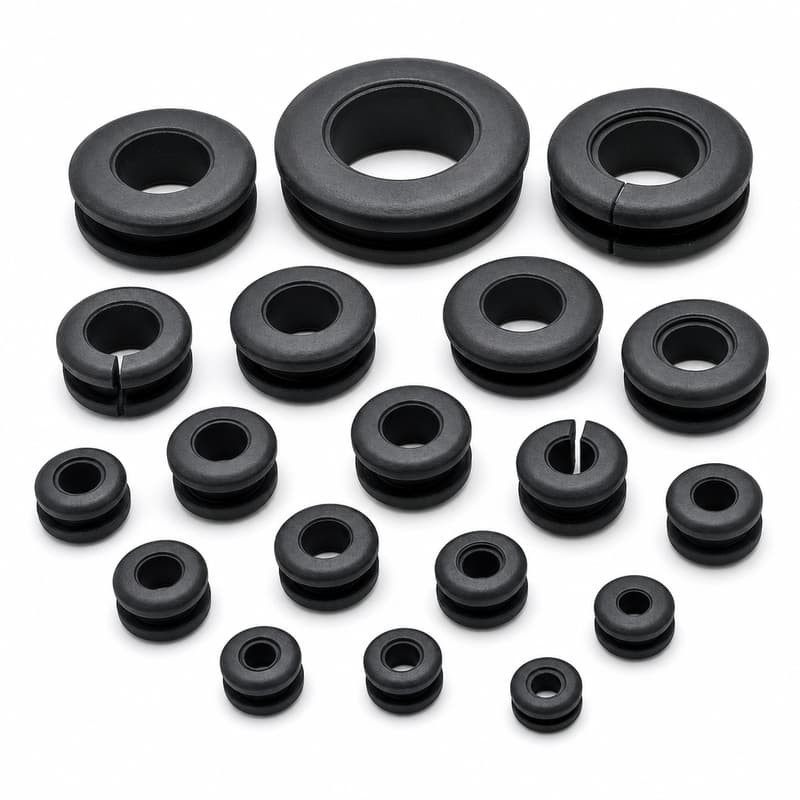
Some pop-outs are pre-damaged parts that were never going to hold. The damage usually happens in the last twenty seconds of assembly.
- Excessive stretching — pulling the part through the hole by the flange instead of seating it progressively
- Sharp panel edges — a burr cuts the groove wall on the way in, removing the material that creates interference
- Incorrect tools — a flat screwdriver used as a lever rolls the flange and tears the groove root
- Twisting during installation — a part seated with a twist never sits flat, and the high side works itself out
- Lubricant incompatibility — a lubricant that swells or softens the compound changes the groove dimensions permanently
- Partial seating — one side engaged, the other resting on the panel face, which looks seated from the front and is not
Rubber Grommet Troubleshooting Table
| Symptom | Possible Cause | What to Check |
|---|---|---|
| Grommet falls out with no load on the cable | Hole too large for the groove | Actual hole diameter across the batch, not the nominal value |
| Flange does not sit flat against the panel | Panel and groove mismatch | Panel thickness at the hole edge against groove width |
| Grommet rotates in the hole | Poor rotational retention | Groove depth and how much of the hole wall it wraps |
| Rubber tears at the flange root | Excessive installation force or a sharp edge | Edge condition, installation method, material hardness |
| Cable moves far more than the grommet | No independent strain relief | Cable support and clamping design along the run |
| Grommet pops out only on machines that vibrate | Reserve consumed by vibration | Groove interference and whether the hole is at the top of its range |
How to Prevent Rubber Grommets from Popping Out
Work through this list before changing the part. In most of the cases we see, at least one item is out of spec and the grommet is not at fault.
- Verify the actual hole diameter across the production range, using the largest hole as the design case
- Verify actual panel thickness at the hole edge rather than the nominal sheet thickness
- Match groove dimensions to the measured thickness range, including allowance for material spring
- Confirm the material hardness suits both the geometry and the way the part is installed
- Inspect the panel edge for burrs and rollover, and deburr where needed
- Check cable loading and add independent strain relief where the cable carries load or moves
- Verify the installation method, including the tool used and the direction of seating
- Review tolerance stack-up across hole, thickness and cable instead of each dimension separately
When Should the Rubber Grommet Design Be Modified?
If the panel cannot be changed and the load path is already correct, the part itself becomes the variable. Design changes that genuinely move the needle:
- Different flange geometry, including a wider flange or a thicker flange root
- Different groove dimensions matched to the real thickness range rather than a nominal value
- Different rubber hardness, chosen for the installation method as well as for retention
- Modified inner diameter to control how the cable sits and how much it can move
- Added retention features such as a ribbed groove wall or a secondary sealing lip
- A completely custom profile where the standard round form does not suit the opening
What Information Helps a Manufacturer Diagnose a Loose Grommet?
A failure review is much faster when the enquiry includes the following, because it lets the dimensional work start immediately instead of after a round of questions.
- Panel drawing, or a sketch of the opening with dimensions
- Actual hole diameter, with the production tolerance
- Panel thickness measured at the hole edge
- Current grommet drawing, or a sample of the part that is failing
- Cable or bundle diameter, including any sleeve or conduit
- Photographs of the installed condition, showing the flange at the point of failure
- The failure location, since a part that lifts on one side tells a different story from one that drops out evenly
- The installation method and the tooling used on the line
Frequently Asked Questions
Why does my rubber grommet keep coming out?
The most common reason is an hole that is larger than the groove was designed for, which leaves the part sitting in the opening instead of gripping it. The second most common reason is a cable that loads the grommet sideways, so the part is being pushed out by the cable rather than by its own fit. Measure the hole range first, then look at cable loading.
Can a larger grommet solve the problem?
Only if the problem is genuinely the hole size. Fitting a larger part into an oversized hole restores interference but reduces flange coverage and increases installation force, so it trades one problem for two. If the hole is at the top of its tolerance range, correcting the hole or resizing the groove is usually the better route.
Does rubber hardness affect retention?
Yes, but not in one direction. A harder compound stores more elastic energy in the groove and therefore develops more grip for the same interference, at the cost of higher installation force and greater sensitivity to a sharp sheet edge. A softer compound conforms better and installs more easily but deflects further under load. The right value depends on the panel, the hole and the assembly method.
Can vibration cause a grommet to loosen?
Vibration reduces friction at the groove-to-panel interface, so a part that was only just holding will start to move. If the assembly vibrates, size for a genuine interference at the groove and treat cable support as a separate design task rather than expecting the grommet to absorb it.
How can I improve grommet retention?
In order of effort: verify the hole range and thickness range, add independent strain relief so the cable stops loading the grommet, then change the part if those two are already correct. Geometry changes such as a deeper groove, a wider flange or a ribbed groove wall usually do more for retention than a material change alone.
Sources
- ISO 3302-1:2014, Rubber — Tolerances for products — Part 1: Dimensional tolerances. https://www.iso.org/standard/62492.html
- ASTM D2000-18, Standard Classification System for Rubber Products in Automotive Applications. https://www.astm.org/d2000-18.html
- ISO 2768-1:1989, General tolerances — Part 1: Tolerances for linear and angular dimensions without individual tolerance indications. https://www.iso.org/standard/7748.html
About this guide
FromRubber is the export brand of Dongguan Bohao Electronic Technology Co., Ltd., a manufacturer of custom moulded silicone and rubber components. Retention failure reviews of this kind are routine work: reading the panel, the groove and the load path together, then deciding whether the answer is a dimensional correction or a new profile. Custom groove geometry, flange design, material and durometer selection and prototype tooling are all part of that process.