Why Does a Silicone Colander Drain Slowly? How Hole Layout Affects Water Flow
- Share
- publisher
- FromRubber
- Issue Time
- Oct 28,2026
Summary
A silicone colander can carry ninety holes and still leave a puddle around the base. This article treats drainage as three bottlenecks rather than one, explains why a soft base can close its own openings, and gives buyers a sequence of tests to run on a sample before approving the tool.
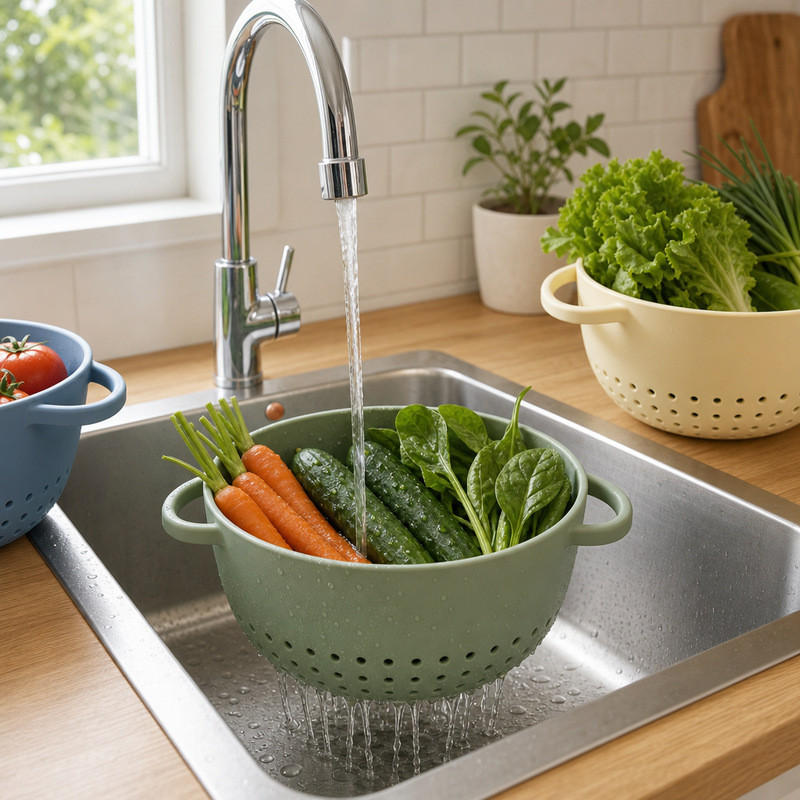
The hole count looked generous on the drawing. Ninety-six openings across the base and the lower wall, evenly spaced, properly deburred. Then the first production sample went into a sink with a head of wet lettuce and the water simply sat there in a shallow pool around the base, draining in a slow, reluctant trickle. Adding forty more holes would not have fixed it, because the problem was never the number of holes.
Drainage in a flexible colander behaves like a system with three separate bottlenecks, and flow is set by the narrowest one. Buyers usually optimise the first bottleneck, the hole area, and then wonder why the product still performs badly.
The other two are geometric: how far water has to travel sideways before it reaches an opening, and whether the water that has passed through an opening can actually get away from the underside.
Why Doesn't a Silicone Colander Drain as Quickly as Expected?
A High Hole Count Does Not Guarantee Efficient Drainage
What matters is the effective open area: the fraction of the wetted surface that is actually open, weighted by how well each opening is placed to receive water. Twenty small holes in the middle of a flat base can offer less useful open area than eight larger holes spread across the lowest regions of a dished base, even though the count is higher.
The arithmetic is worth doing once on the drawing. A 4 mm round hole removes 12.6 mm² of surface. On a 20 mm square pitch, that hole accounts for about 3% of the area it sits in. Reaching 12% open area with the same hole size means a pitch closer to 10 mm, which is roughly four times as many holes and a quarter of the ligament width. That is the trade every perforation layout makes, and it is settled by numbers rather than by how busy the pattern looks.
There is a second effect that is easy to miss. Holes reduce the remaining material, and once the base deflects under load, the openings near the centre are no longer circular in projection. A soft base sitting on its own sagging centre can close its own drainage area, which is why a colander sometimes drains worse when it is full than when it is empty.
Water Needs a Clear Path Toward the Drainage Openings
If the base is flat, water spreads into a thin film and moves only when it is deep enough to flow. A film two millimetres deep will not push itself across thirty millimetres of flat surface to reach a hole; it needs a slope or a channel. This is why a slightly dished or subtly conical base drains noticeably better than a flat one with the same openings: the geometry does the collecting, and gravity does the rest.
Water also has to be replaced by air. In a deep basket full of fine food, the openings can be covered by a film of leaves or pulp while the space above the water is still closed by the contents. The flow stops because the air path is blocked, not because the holes are too small.
Food Can Block the Openings During Normal Use
Blinding is the technical name for it, and every kitchen has seen it: rice, lentils, small berries, or a paste of flour and water settles into the openings and seals them. The relevant question is not "how big should the holes be" but "what is the smallest particle this product is meant to pass through, and what is the smallest particle it is meant to retain".
A colander designed for pasta and whole vegetables can use large openings. A colander intended for rinsing rice or quinoa cannot, and a product that tries to serve both will do neither particularly well. Deciding which job the product has is the single most useful drainage decision a buyer can make.
How Does Hole Size Affect Drainage and Food Retention?
Small Holes May Restrict Water Flow When the Openings Become the Bottleneck
When the openings are small enough that food bridges across them, the effective open area can drop close to zero within seconds of loading. Small holes also hold water by surface tension at the edge of each opening, which leaves a thin residue that never quite leaves the base.
Larger Holes May Let Water Through More Easily but Can Lose Small Food Pieces
The trade-off is familiar, but it is worth quantifying in the right way: compare the area of the largest particle you must retain with the smallest dimension of the opening. A hole that is comfortably larger than the retained particle will pass water well and lose nothing that matters. A hole that is only slightly larger will pass water well until the particle rotates, and then it will jam.
Hole Shape and Edge Geometry Also Deserve Attention
Round holes are the default because they are easy to tool, but slots and elongated openings can offer more open area per unit of removed material in a given direction, and they can be oriented to follow the slope of the base. The edge matters too. A sharp, moulded edge gives water a clean line to detach from; a rounded, thick edge encourages water to cling and creep back along the underside of the base.
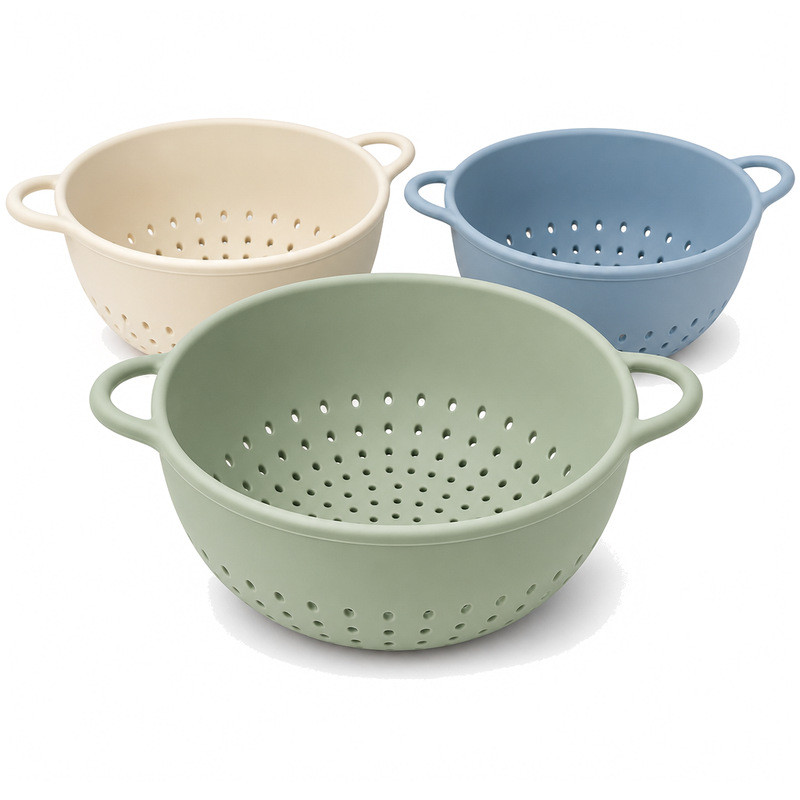
Look at where the perforations stop. On all three of these samples the upper wall is solid, which keeps the product stiff and keeps water from escaping sideways when the colander is carried.
The cost is that any water above the perforated band has to travel down through the contents before it can leave. For a shallow fill that is irrelevant. For a full load of wet leaves it is the difference between a product that drains in seconds and one that drips for a minute.
Where Should Drainage Holes Be Placed on a Silicone Colander?
The Base Layout Should Match the Way Water Collects
Placement should follow the low points, not the visual symmetry. On a dished base the low point is the centre, so the densest cluster belongs there, thinning outwards. On a base with a slight radial slope towards a ring, the ring is where the holes belong. On a completely flat base there is no low point at all, which is precisely why flat bases pool.
The same pattern behaves differently on different profiles, and this is the most common reason a hole layout copied from one product fails on another. A layout is not a design element that can be transferred; it is a response to a specific base geometry.
Sidewall Openings Can Help With Drainage but Serve a Different Purpose
Openings in the lower sidewall are useful when the colander is tilted to pour, and they add a second escape route when the base is partly blocked. They do not help much with water trapped under the contents, because that water is below the level of the sidewall holes. Treating wall openings as a substitute for a well-shaped base is a common design mistake.
Uneven Spacing Can Create Areas That Drain Differently
Large unperforated zones are where water sits. But closing every gap is not the answer either, because the material between openings is what carries the load — the same ligaments that hold the base flat. A practical compromise is to keep spacing fairly regular through the high-load centre and to allow the pattern to open up slightly towards the rim, where the base is supported and load is lower.
| Layout factor | What it changes | What to check on the sample |
|---|---|---|
| Total open area | How fast water can leave when nothing is blocking | Fill with water only, time how long the base takes to clear |
| Hole diameter | What passes through, and what blinds the openings | Test with the smallest food the product must retain |
| Spacing between holes | Width of the load-carrying ligaments, and edge stress | Load the basket and look for whitening or stretching between holes |
| Placement relative to low points | How far water must travel sideways to escape | Pool water on a level surface and see where it remains |
| Base profile | Whether water collects or runs to the openings | Compare a flat and a dished version with identical hole patterns |
| Clearance underneath | Whether drained water can get away from the base | Rest the colander on a flat sink floor and repeat the test |
Can a Flexible Silicone Base Interfere With Drainage?
A Base That Sags May Change the Intended Drainage Path
A loaded base that sags becomes a bowl, and a bowl holds water at exactly the point where the holes are densest. The water still drains, but it drains from a deeper pool, and the last few millimetres have to climb out through the openings rather than fall through them. The result is a slow finish rather than a slow start, which is why the complaint is often "it never quite empties".
Thin Sections Between Holes May Affect Shape Retention
Closely spaced openings leave narrow ligaments, and narrow ligaments flex early. When they flex, the whole perforated panel changes shape, and the holes change shape with it. A base that looks well supported on the drawing can behave like a net once it is loaded.
The Drainage Pattern and Structural Design Should Be Reviewed Together
Hole layout cannot be optimised in isolation from base thickness, basket diameter, material hardness, and the expected contents. Change the base thickness and the deflection changes; change the deflection and the drainage path changes. This is the practical reason why drainage problems are so often misdiagnosed as hole-count problems.
A soft, wet base resting flat on a stainless sink floor can form a light seal around the outermost openings. Water leaving the colander then has to escape sideways through a very thin gap, and the flow slows even though the openings themselves are clear.
Lifting the colander two centimetres off the sink floor and watching the flow rate is a quick way to see whether you are looking at a hole problem or a clearance problem. Our note on how product shape affects cleaning performance follows the same logic: geometry decides where water goes, and the material only decides how it feels.
How Can You Evaluate Drainage Performance Before Approving a Sample?
Test the Colander With Water Alone First
Fill the colander to a marked level with clean water, set it on a level surface, and watch where the water goes. Note whether it clears evenly from all sides or from one area only. This test isolates geometry from food, and it is the fastest way to find a base that is not doing its job.
Repeat the Check With the Intended Food Types
Water alone will never reveal blinding. Repeat the test with the actual contents: leafy greens, small berries, pasta, or whatever the product is designed for. Watch where food collects against the openings and whether water continues to move once the surface is covered.
Observe Drainage on Different Supporting Surfaces
A colander in a sink behaves differently from one on a countertop or on a draining board. On a flat sink floor, clearance is minimal and the seal effect appears. On a raised rack, water leaves freely and the same product can seem perfectly adequate. Test on all the surfaces the product will realistically meet.
Record the Results Against Defined Product Requirements
Document the sample version, the fill level, the contents, the supporting surface, the time to clear, and where pooling remained. Photographs help more than notes. There is no universal flow-rate target to appeal to, because a pasta colander and a berry strainer are not the same product; what matters is that the requirement is written down before the test and that every revision is measured the same way.
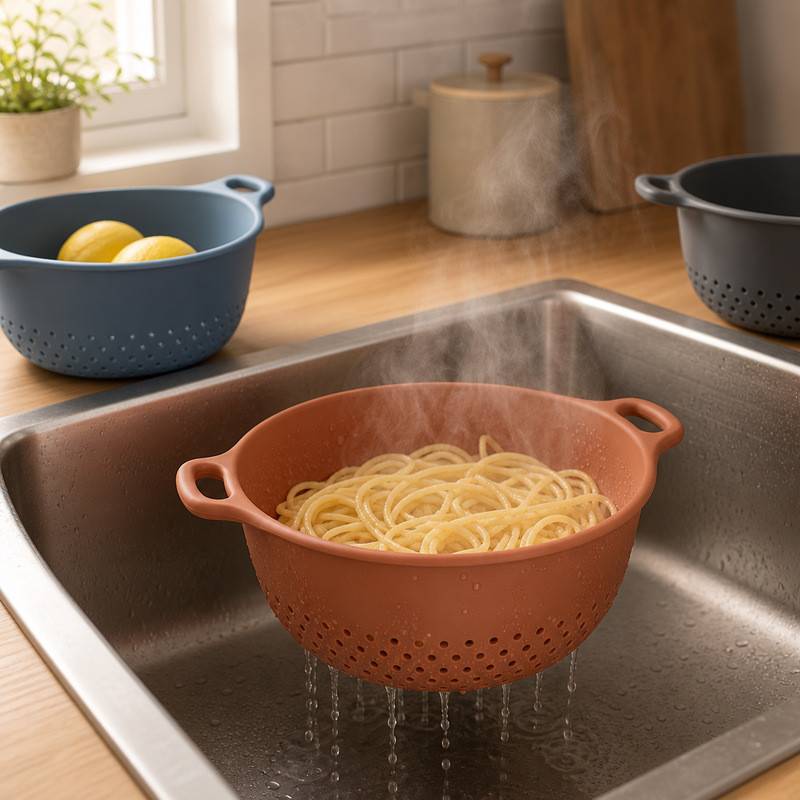
Hot water adds a variable that bench testing usually ignores. It softens the material slightly, it raises the temperature of the base, and it makes a marginal section behave a little more flexibly. If a design is only just adequate with cold water, the hot version is where the weakness becomes visible.
This is also the case where the colander is lifted and tilted, so the load shifts to one side of the wall while the base is still full of water.
What Should Be Checked Before Developing a Custom Silicone Colander Mold?
Confirm the Opening Dimensions and Spacing
Review the hole diameter or slot width, the spacing in both directions, the distribution across the base and wall, and the remaining ligament width. Ask for the ligament width to be stated explicitly on the drawing, because it is rarely dimensioned and it is the number that governs both strength and mould life.
Check the Base Profile and Structural Transitions
Review the slope towards the low point, the curvature where the base meets the wall, and any change in thickness in that transition. The base-to-wall junction is where deflection usually begins, and it is also where the mould is most likely to need a generous radius.
Consider Mold Complexity and Demolding
Every opening needs a core feature or a matching pin, and the feasibility of a pattern depends on its density and its position. Very small holes in a thick section are harder to form consistently than the same holes in a thin one, and openings close to a parting line need more careful tooling. None of this rules out a design; it simply means the pattern should be reviewed against the process rather than assumed to be free. Our note on release direction and parting line placement in moulded silicone covers the same tooling questions from a different product.
How Can a Silicone Manufacturer Help Refine the Drainage Design?
The most useful review happens before the pattern is fixed. It consists of agreeing what the product must pass and what it must retain, checking that the base geometry actually leads water to the openings, marking the ligament width on the drawing, and confirming that the sample will be tested on the surfaces and with the foods that matter.
FromRubber reviews drawings and 3D files for custom kitchen silicone projects and comments on drainage layout, wall transitions, and tooling feasibility before a mould is committed. The company has been moulding silicone in Dongguan since 2010 and produces both moulded parts and the tooling that makes them. If you are still choosing a base profile, the custom silicone parts range shows the construction types we work with, and technical support explains how a drawing review is handled.
Frequently Asked Questions
Will adding more holes make a silicone colander drain faster?
Only if the openings are the bottleneck. If water is pooling because the base is flat, because food is blinding the holes, or because the base is sealed against the sink floor, extra holes change very little.
Are larger drainage holes always better?
No. Larger openings drain faster and clean more easily, but they let small food through and they remove more of the material that keeps the base flat. The right size follows from what the product must retain.
Why does water collect in the bottom of my silicone colander?
The usual causes are a flat base with no low point, a base that sags and forms a pool, blocked openings, or insufficient clearance underneath the base.
Can drainage holes make a silicone colander weaker?
They reduce continuous material and concentrate stress at each opening edge. Very dense patterns with narrow ligaments are the ones most likely to flex or tear under load.
What should I provide when requesting a custom silicone colander quote?
A drawing or 3D file, dimensions, the food types the product must handle, the drainage requirement, any material preference, the target quantity, and a reference product if you have one.
Sources and further reading
- How product shape affects cleaning performance — the same geometry-first reasoning applied to a different moulded silicone product.
- Release direction, dimension families and parting line placement — why a simple-looking silicone cup can still be hard to tool.
- Why a moulded silicone cup loses its shape over time — deflection and recovery, which is what turns a flat base into a pool.
The drainage behaviour described here is general design reasoning, not measured flow data for a specific product. Flow rates depend on the actual opening geometry, the food, the temperature, and the supporting surface, and should be confirmed on your own sample.
Working on a colander or strainer?
Tell us what the product must pass, what it must retain, and where it will be used. Those three answers usually decide the hole layout before anything else is drawn.
- Email: nani@fromrubber.com or karl@fromrubber.com
- WeChat / WhatsApp: +86 18676210913
- FromRubber · Dongguan Bohao Electronic Technology Co., Ltd.
- Qiaotou Town, Dongguan, Guangdong, China
- IATF 16949:2016 · ISO 9001:2015 · ISO 14001:2015