Why Tractor Silicone Keypads Fail in Agricultural Equipment Control Panels
- Share
- publisher
- FromRubber
- Issue Time
- Sep 18,2026
Summary
A tractor keypad that stops responding is usually called a silicone problem, and usually is not. This article separates the mechanisms that are easy to confuse: compression set and slow elastic recovery, dust pumping around the bezel, condensation inside the housing, effort spread across a gloved hand, and carbon pill face wear against the pad. Each leaves a different signature and calls for a different change in design, material or sealing.
Why Tractor Silicone Keypads Fail in Agricultural Equipment Control Panels
A tractor cab in August is a dust chamber with a seat in it. The operator climbs in with mud on the boots and works a Tractor Silicone Keypad for eight hours without a missed press. Two seasons later, buttons that felt crisp at first article check need a second push. Some go soft. Some register twice from one press. A few look untouched and still refuse to do anything at all.
The duty environment is unforgiving in a specific way: dust through every gap the cab does not close, condensation when a cool night follows a hot working day, years of sunlight on exposed rubber, and gloved hands working the same three or four keys while the rest sit nearly idle. Failure in an Agricultural Equipment Silicone Keypad usually begins in one of six places, and from the seat they all look the same. This article separates the six, gives a diagnostic that tells them apart, and is direct about what a keypad cannot do for the enclosure around it.
Where Silicone Keypads Sit in Tractor Control Panels
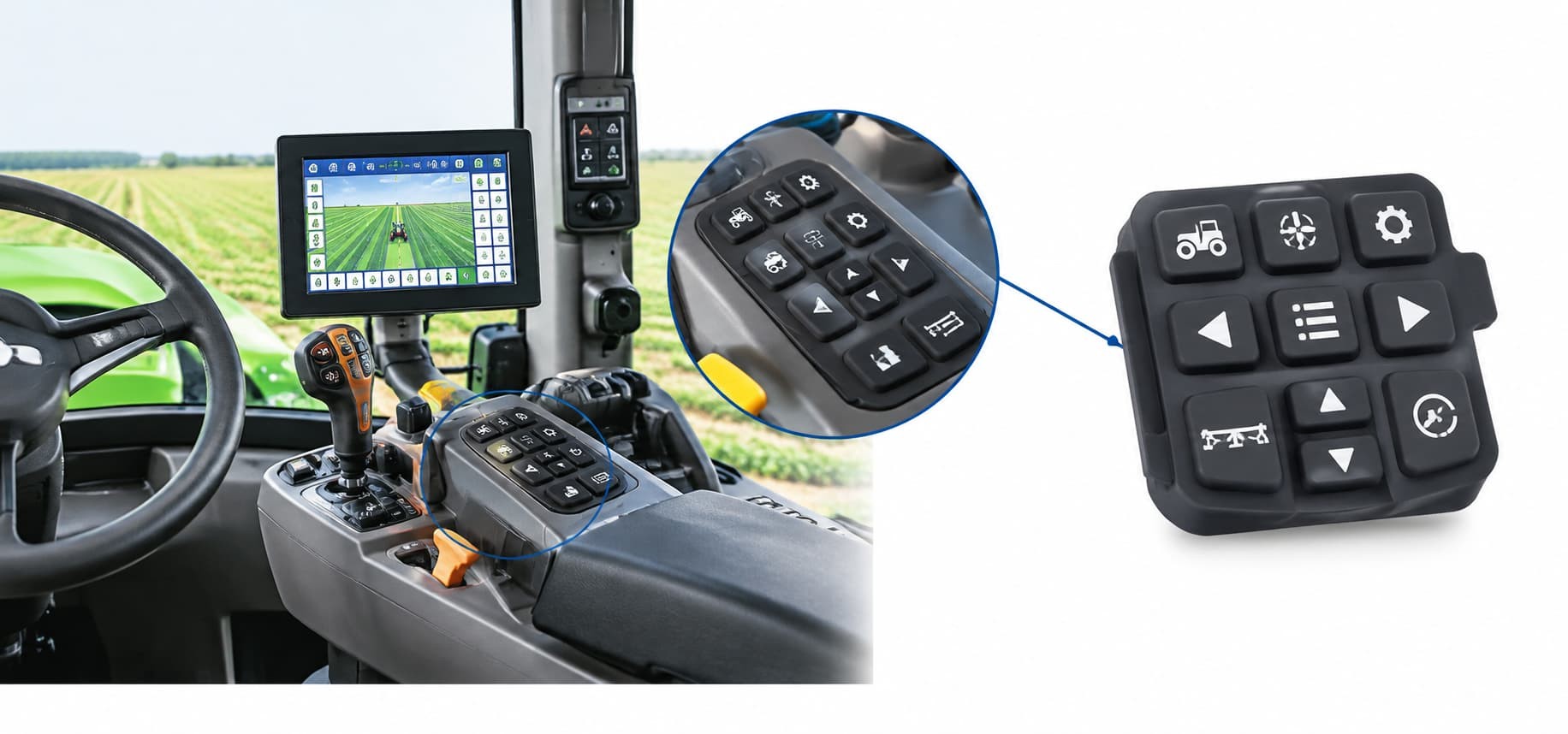
A Tractor Control Panel Silicone Buttons set is rarely one keypad. Typical clusters are dashboard buttons near the steering column, auxiliary controls on the right console, lighting keys, climate interfaces, instrument panel buttons around a small display, and armrest panels carrying work-function keys. Exact functions vary by model and by cab trim.
What the positions share matters more than what they do. The panel is reached with a gloved hand, often without looking down, often while the machine moves across uneven ground. That pushes design toward raised geometry, generous spacing, readable legends and a one-piece molded construction, where an elastomer web holds every button in registration. Silicone rubber buttons for agricultural machinery earn their place through that construction logic: one part can carry the press cycles, act as its own return spring and hold a conductive carbon pill behind each button. Most keypad complaints on a work vehicle turn out to be interface complaints.
Common Causes of Tractor Silicone Keypad Failure
Six mechanisms account for most field complaints: compression set and lost elastic recovery, dust pumping around the bezel, internal condensation, effort distribution across a glove, carbon pill face wear, and the interaction between housing geometry and legends. They overlap in symptom, which is why swapping the material alone so often fixes nothing.
Compression Set and Loss of Elastic Recovery
ISO 815-1 defines compression set as the permanent deformation left after a rubber specimen is held under a specified compressive strain and then released. That describes the web around a heavily used button. The elastomer sits compressed for hours while warm from the cab and the panel electronics, and gradually stops returning to its molded height. The operator feels a spongy button that needs a longer push; inside, the face no longer travels far enough to seat the carbon pill on its pad. Return force also falls, so the button can hang near the actuation point. A forklift panel showing the same pattern is worth reading as a parallel case: silicone keypads that went spongy after 2,000 hours. ISO 188 describes the accelerated ageing tests used to rank compounds before a mold is cut; they compare candidates rather than predict service life.
Dust Pumping Around the Bezel
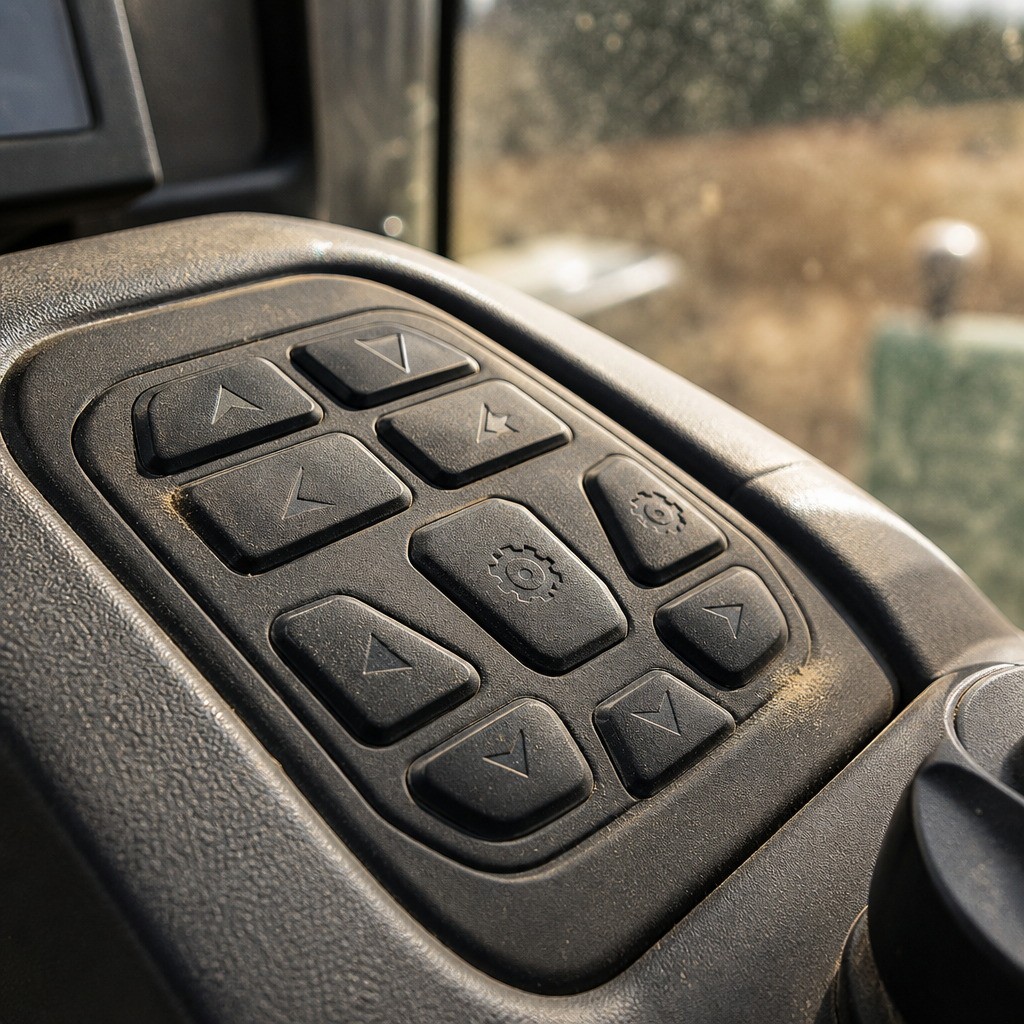
Every press displaces air. A skirted silicone button behaves like a small bellows, pushing air out as it descends and drawing it back in as it rises, and the return stroke pulls fine particles into the annular gap around the button. Dust then reaches the web, the stem and eventually the contact surfaces, while the keypad itself still looks undamaged.
Trapped grit acts as a lapping compound, wearing the skirt on every stroke and slowly widening the passage that admits more dust. Mud speeds this up by drying into a crust that breaks into grit. Grit between web and bezel also adds friction to the return stroke, so buttons feel inconsistent long before the contacts are affected.
Secondary sealing reduces pumping but tends to move the air path rather than close it, so identify where air goes on each press.
Internal Condensation
IEC 60068-2-78 covers damp heat steady state testing, used to evaluate equipment held for long periods at high humidity. The failure mode that matters in a cab is not rain on the surface but water vapour entering the enclosure while the panel is warm, then condensing on the cooler board overnight. That happens on the inside, where nobody inspects, and a film on the pads raises contact resistance enough to produce the intermittent fault that appears at dawn and clears by mid-morning.
The honest caveat: a keypad alone does not make a control panel sealed. Sealing is a system property built from gasket, split line, cable entry, connector, window and keypad together, and a molded keypad with a good sealing lip still lets moisture into a housing whose cable gland is open. Panel-level verification is the only way to know what the assembly achieves.
Effort Distribution Across a Glove
Actuation force is designed around an assumed finger, and a glove changes the assumption twice. Padding spreads load over a larger area and damps the tactile signal, so the operator cannot feel the snap point and presses harder than needed. It also reduces the precision of the approach angle, so many presses land near the button edge.
Off-centre loading differs mechanically from a centred push: one side of the web stretches more, the stem tilts, and the carbon pill lands partly off its pad, so contact can be marginal on a cold morning and fine later. That is why feel complaints track weather rather than hours of service, as in this note on why industrial panel buttons feel different in winter. Settle force against a gloved hand on the real console while tooling can still change.
Conductive Carbon Pill Face Wear
ASTM D991 covers volume resistivity of electrically conductive rubber, the property behind every carbon pill. It measures bulk resistivity, a useful screening value. Field failure is rarely bulk drift; it is the condition of the pill face and the mating pad.
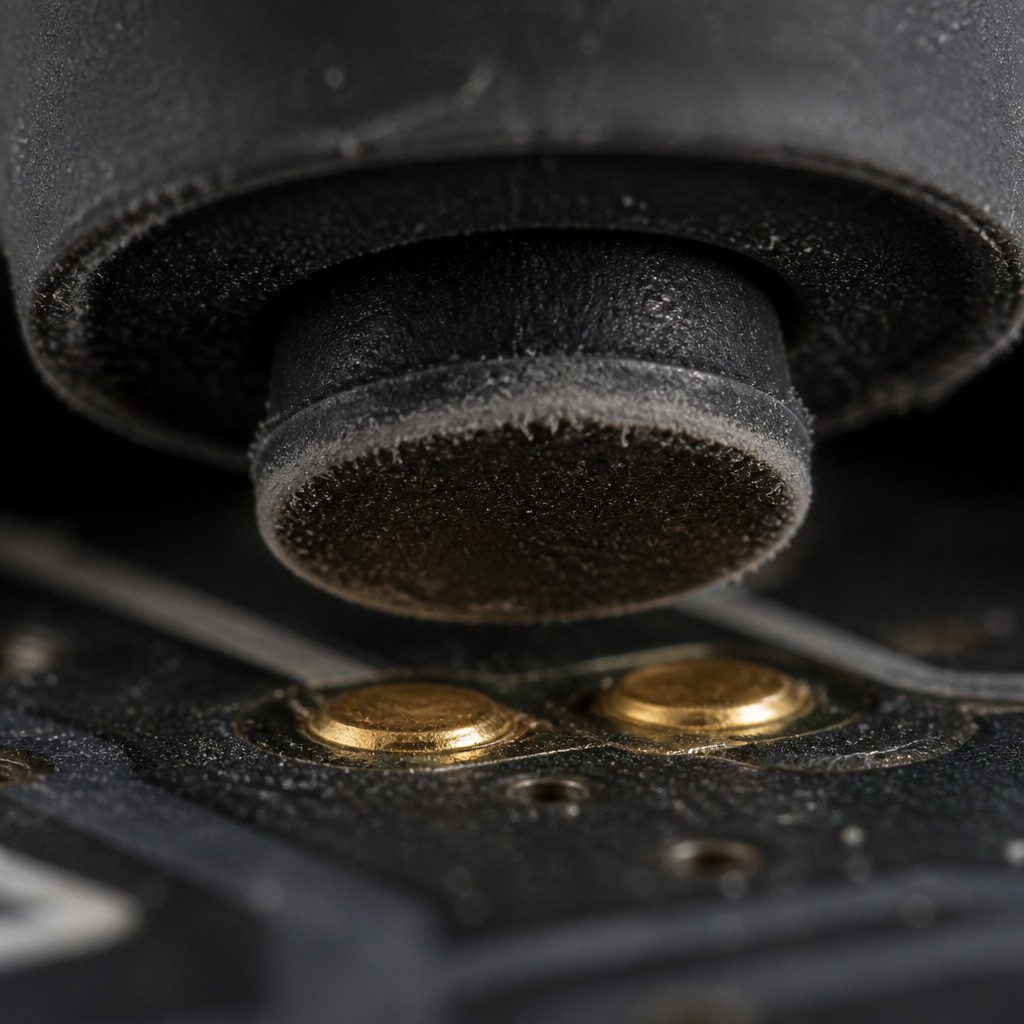
Repeated cycles polish the pill face, and the carbon-loaded elastomer sheds fine conductive debris. Mixed with dust and condensed moisture, that debris forms a resistive film on both surfaces, so contact resistance creeps upward while the button still travels its full stroke and still clicks.
Geometry matters as much as material: a pill that is too small or slightly too proud concentrates current and accelerates wear, and pad finish and alignment tolerance matter as well. The wear mode is followed in detail in this analysis of carbon contact wear on an inclinometer keypad, and it cannot be diagnosed from outside the panel.
Housing, Legends and Tooling Interaction
The last mechanism is in the fit between the molded part and the housing. If the keypad can shift laterally in its pocket, some buttons travel off-axis and load the web asymmetrically. If the bezel opening is tighter than the molded button allows, the skirt is compressed on assembly and starts life pre-loaded, which shortens the road to compression set.
Legends interact with the same geometry: etched or printed legends on a button shoulder get scuffed by the bezel edge on every press, and a worn legend makes a working button unusable to the operator. Underneath sits process control, where tool wear, parting-line flash and cavity-to-cavity variation show up as buttons that feel different from each other. A first article check confirms the tool, not the process.
How Silicone Material Selection Affects Tractor Keypad Durability
Tractor keypad failure is often blamed on the compound before anything else is examined. Material sets the ceiling on durability without setting the outcome, because two panels built from the same silicone behave differently depending on hardness, web geometry, contact design and housing fit. Outdoor silicone keypad durability is a system result.
Silicone Hardness and Elastic Recovery
Hardness governs the relationship between travel, force and feel. A softer compound returns easily and asks less force, but deflects further under a given push and can sag under sustained load, which speeds up compression set in a warm cab. A harder compound holds its shape and gives crisper feedback, then fights the operator through a thick glove. Elastic recovery connects hardness to service life, because it decides how completely the button returns after each press.
Silicone Compound Selection for Outdoor Applications
Outdoor exposure asks for resistance to temperature cycling, ultraviolet light, ozone, moisture and repeated mechanical work, and those requirements pull in different directions. Heat-ageing resistance usually means adjusting the cure system and fillers, surface durability can mean a different additive package, and changing either affects hardness, compression set and cost. ISO 188 compares candidates after accelerated ageing instead of relying on datasheets, and it helps to separate bulk ageing from surface ageing: a keypad can lose its appearance long before its mechanical properties move.
Why Material Selection Should Match the Application Environment
Selection depends on operating conditions, expected service life, button design and the manufacturing process that will produce the part. A panel in an enclosed cab on a low-hour machine and one on an open platform in a wet region are different briefs. Write the environment down first: cycling range, dust load, hours per year, glove use, cleaning method and service life target. Given those, material, hardness and geometry can be chosen together rather than guessed in sequence.
Design Features That Improve Tractor Silicone Keypad Reliability
Geometry decides how long a keypad survives more often than any material decision does.
Button Geometry
Height, surface shape, edge design and spacing all affect how a gloved thumb finds and works a button. A modestly raised crown helps the finger locate the centre without looking down, and a generous top radius avoids the sharp shoulder that catches on a glove. Spacing has to leave room for a winter glove without letting one hand bridge two buttons.
Flexible Web Structure
The web is the return spring, and its thickness and profile set travel, snap feel, and how much actuation load the elastomer carries instead of the PCB. Thick webs live longer under sustained load and demand more force; thin webs feel light and creep sooner. Whatever profile is chosen has to be consistent cavity to cavity, because web variation turns directly into force variation.
Proper Contact Design
Contact design is mostly about alignment. The pill should land squarely on its pad over enough area, with a tolerance stack-up that survives the keypad sitting in its pocket and the board in its mounts. Contact and seal geometry around the button and the housing opening belong in the same review, in the spirit of this look at seal geometry around buttons and housing openings. Neither pill nor pad should absorb tolerance that belongs somewhere else.
Mechanical Support and Positioning
A keypad that can move inside its housing produces uneven operation no matter how good the material is. Positive location through molded locating features, consistent perimeter clamping, and controlled compression on any sealing feature belong in the design. Reviewing them alongside the wider set of machinery rubber and plastic product solutions keeps keypad, housing and board tolerances in one conversation rather than three.
Failure Symptoms Engineers Should Investigate
Diagnosis starts with the symptom, which points at a mechanism, which points at the people who can change something. Treat each row as a hypothesis; two mechanisms are often present at once.
| Symptom reported | Likely mechanism | Area to check first |
|---|---|---|
| Button needs excessive force | Hardness too high, web too stiff, or grit adding friction | Material and keypad geometry |
| Button will not return properly | Compression set, lost elastic recovery, pre-loaded skirt | Web profile and ageing |
| Intermittent contact while feel seems normal | Pill face film, pad contamination, off-axis pill landing | Electrical interface and tolerance stack-up |
| Legend wears or goes unreadable | Surface treatment abraded by gloved fingers and bezel edge | Surface finishing and button clearance |
| Buttons feel different from each other | Cavity-to-cavity variation, tool wear, keypad shifting in its pocket | Tooling records and process control |
| Fault appears cold, fades later in the day | Condensation on pads, moisture entering through the housing | Enclosure sealing and panel-level verification |
Only one row points primarily at the compound. The rest are geometry, tooling, process control, surface treatment or the enclosure, which is why replacing silicone is such an unreliable repair.
How to Improve Tractor Silicone Keypad Reliability During Development
Most of the cost of a keypad failure is committed before the first production order. These seven steps keep the expensive decisions in the right order.
- Define the environmental conditions in writing. Cycling range, dust load, moisture pattern, cleaning method, sun exposure and expected hours per year belong in the specification.
- Confirm the force requirement against a gloved hand. Set a target actuation force with a range, then check it in the coldest working month.
- Review the material options together. Compare hardness and ageing behaviour as a pair; a hard compound with poor recovery and a soft one with good recovery behave very differently.
- Match the conductive contacts with the PCB design. Agree pad size, pad finish, pill diameter and protrusion before the board is released.
- Check the housing and sealing structure. Walk the air path on a press stroke; state what the keypad seals and what the housing must seal.
- Prototype and evaluate button feel. Get a first article into a gloved hand on a real console, since force curves do not say whether a panel feels right.
- Run repeated operation testing at the intended duty. Cycle with off-centre loads at the temperature extremes, then inspect the contact faces.
Two steps get skipped most often. Housing sealing is treated as somebody else's drawing, and inspection of the contact faces after testing is replaced by a pass or fail on the electronics.
Questions to Ask Before Ordering Custom Tractor Silicone Keypads
These are questions a keypad supplier should be asking before a custom tractor keypad goes to tooling, and ones a buyer is entitled to ask back.
- What environmental conditions will the keypad actually face? Season length, dust load, condensation pattern and cleaning chemicals change the material brief.
- What is the expected button life, and how is it counted? Cycles per button, per year, and the split between heavily and rarely used keys.
- Will operators wear gloves? If so, force and geometry need evaluating with the glove, not on a bare bench.
- Is the PCB already finalized? If the pad layout is fixed, the keypad absorbs the tolerance stack-up, and that limit is worth knowing early.
- What actuation force and travel are required? A target with a range, agreed in writing, so both sides measure the same thing.
- Is surface printing necessary, and by which method? The legend method should match the abrasion the surface will see.
- Are there colour or identification requirements? Colour matching, backlighting and contrast under dust affect finishing choices.
Tractor Silicone Keypad Reliability Depends on the Whole Interface
Reliability here comes from five things working together: material selection, mechanical design, electrical contact design, environmental protection and manufacturing consistency. Remove one and the others cannot compensate.
The practical conclusion is that the keypad belongs in the same design conversation as the housing and the board rather than being specified at the end.
FromRubber, the brand of Dongguan Bohao Electronic Technology Co., Ltd., has developed custom silicone and plastic parts since 2010 and works from drawings, samples or sketches. Steps five and seven still assume the panel is verified as an assembly.
FAQ
Why do tractor silicone keypads become hard or lose elasticity?
Usually because the elastomer has taken a compression set rather than because the compound was wrong. ISO 815-1 describes how that permanent deformation is measured: the material is held compressed, released, and the residual deformation recorded. Buttons in a cab sit compressed for hours while warm, which accelerates the effect.
Can silicone keypads withstand agricultural dust and moisture?
The silicone handles both well; the interfaces around it are the usual problem. Dust enters the annulus around a button by pumping, and moisture reaches the contacts as vapour that condenses on the cooler board. Both are managed by geometry, gasket design and housing construction.
How does silicone hardness affect tractor control panel buttons?
Hardness sets the balance between the force applied and the travel delivered. Softer compounds press easily but deflect further and can take a set under sustained load. Harder compounds give crisper feedback, then demand more effort through a glove. The right value depends on the glove, the button size and how often the key is used.
What causes intermittent contact in a tractor silicone keypad?
Most cases come from the contact interface or from moisture, not from the silicone body. A resistive film of carbon debris and dust builds on the pill face and the pad, raising contact resistance until the threshold is missed.
Can a custom silicone keypad be designed for an existing tractor PCB?
Yes, and it is a common starting point, provided the pad positions are known accurately. The keypad then absorbs variation from the board, the housing and the mounting, so pill diameter and protrusion need reviewing together.
Sources and standards referenced
- ISO 815-1:2019 Rubber, vulcanized or thermoplastic, determination of compression set: https://www.iso.org/standard/74943.html
- ISO 188:2023 Rubber, vulcanized or thermoplastic, accelerated ageing and heat resistance tests: https://www.iso.org/standard/80468.html
- IEC 60068-2-78:2025 Environmental testing, damp heat, steady state: https://webstore.iec.ch/en/publication/82357
- ASTM D991 Standard test method for volume resistivity of electrically conductive and antistatic products: https://store.astm.org/d0991-89r20.html