Why Won't a Collapsible Silicone Colander Stay Open? Design Checks Before Mold Development
- Share
- publisher
- FromRubber
- Issue Time
- Oct 28,2026
Summary
A collapsible colander has to work as a container and as a flat disc, and the failure usually happens halfway between the two states. This article explains why a corrugated wall is stiff in the wrong direction, how the open angle interacts with the moulded hinge, and what to settle before the mould is cut.
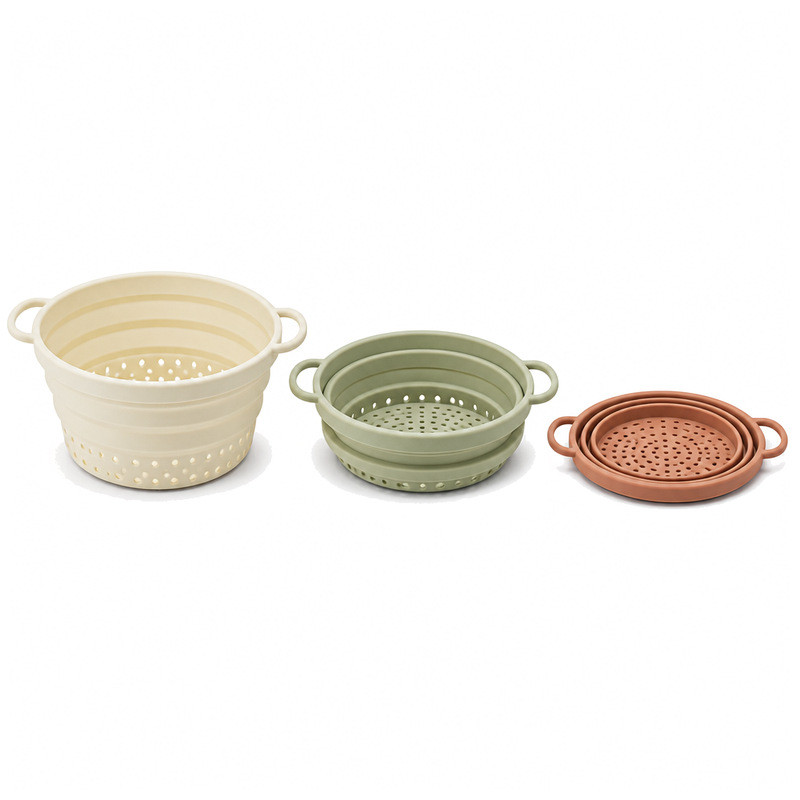
It opens with a satisfying click of the rim, sits on the counter looking exactly like the render, and then the first handful of wet spinach pushes one wall inward and the whole thing folds halfway shut. The buyer sends a message saying the silicone is too soft. In most cases the compound is fine, and the real problem is that the wall was designed to be soft in one direction and ended up soft in all of them.
A collapsible product has to be two products: a container that holds its shape under load, and a flat disc that stacks in a drawer. Between those two states there is a third one, half open, which is where users actually spend most of their time — filling it, carrying it, tilting it to pour.
Design reviews that only check the fully open and fully folded states tend to miss the failure that customers complain about.
What Makes a Collapsible Silicone Colander Difficult to Keep Open?
The Design Must Balance Two Different States
The fold geometry has to do two opposite jobs. It must be compliant enough along the fold direction to collapse with modest hand force, and stiff enough in the hoop direction that the wall does not buckle when contents press against it. Those two requirements act on the same material in the same place, which is why the solution is rarely a single number.
Hoop stiffness is the resistance of a ring-shaped section to being pushed out of round, and it is what keeps a filled colander's opening circular. A smooth cylinder has it in abundance. A corrugated wall trades most of it away in exchange for the ability to shorten, and that is the central bargain of every collapsible design.
The usual approach is a series of concentric corrugations: alternating ridges and valleys that behave like a stack of shallow hinges. Each hinge is easy to bend, and the stack is easy to compress. The trade-off is that the same corrugation that allows the wall to shorten also allows it to straighten out sideways, and that sideways straightening is what a user sees as a wall caving in.
Flexible Sections Can Become Weak Points When the Colander Is Open
A corrugated wall is not uniformly flexible. It is stiff in the panels between folds and soft at the folds themselves. When the colander is open, the folds are the only places where the wall can move, so all lateral movement is concentrated into a few narrow bands rather than distributed over the wall. That concentration is why failure looks so specific: one band folds in, the rest of the product stays where it was.
The Colander May Be Stable When Empty but Unstable During Use
An empty collapsible colander is held open by its own moulded shape plus the rim. Fill it, and two new forces arrive: the outward pressure of the contents, and the downward force of the base as it takes the weight. Add a hand on the rim and the wall is now being pushed from three directions at once. A design that was stable on the shelf can be unstable in the sink without anything being wrong with the material.
Which Structural Features Should Be Checked First?
Folding Ribs Need to Support the Open Shape Without Preventing Collapse
The profile of the corrugation decides how the wall behaves. A shallow, rounded corrugation folds easily but gives little resistance to inward movement. A deeper, more angular profile with a defined crease holds the open shape better but needs more force to collapse, and it concentrates stress at the crease. The choice is a genuine compromise, and it should be made against a stated opening force rather than by feel.
There is also an orientation question. A V-shaped corrugation resists inward movement in one direction better than the other, so a wall made of identical rings can be strong when pushed from outside and weak when pushed from inside. Since contents push from inside, the profile should be reviewed for that direction specifically.
The Transition Between Flexible Walls and the Rim Can Affect Stability
The rim is the only genuinely stiff ring in the product. If the top corrugation meets the rim through a thin, abrupt junction, the rim stops acting as a ring and starts acting as a loose edge. A generous, well-supported transition lets the rim carry hoop load and keeps the opening circular, which in turn keeps the walls aligned.
It is common to see material added at this transition to stop the wall leaning. That helps only if the added material does not create a stiff-to-soft step, because a step is where the wall will hinge instead. Smooth transitions usually beat heavy ones.
The Base Must Support the Opened Sidewalls
In a collapsible colander, the base is usually a separate disc joined to the lowest fold. That joint is the most heavily loaded part of the product: it carries the contents, it resists the outward push of the walls, and it is the place where the product is lifted from when a user picks it up by the base. A thin joint here produces a base that tilts, and a tilting base pulls one wall inwards.
Handle and Support Features Should Match the Intended Use
Ears, tabs, or a reinforced section of rim all change how load enters the wall. A handle placed low on the wall pulls the wall outward when lifted; a handle on the rim pulls the whole ring. Neither is wrong, but the choice should match how the product is expected to be carried, and it should be checked with the colander full rather than empty.

Outdoor use is a useful stress case because the colander is filled while it stands on an uneven table, then lifted by one ear. That single-sided lift is precisely the loading that collapses a wall whose folds are not oriented to resist inward movement.
It is also where the practical benefit shows: the folded unit takes up almost no space, which is the entire reason a buyer tolerates a more complex mould.
Could Silicone Hardness Be the Reason the Colander Keeps Folding Inward?
A Softer Compound May Make the Product Easier to Fold
Lower hardness reduces the force needed to collapse the wall, which matters for a product aimed at elderly users or at one-handed operation. It also reduces the force needed to push the wall inward accidentally, and it reduces the spring-back that helps the colander hold its open shape.
A Harder Compound May Improve Support but Make Folding More Difficult
Raising hardness improves the wall's resistance to buckling and increases the force the rim can carry. It also makes the product harder to collapse, slower to open, and less pleasant to squeeze. At the extreme, a wall that is too hard will not fold along the intended line at all; it will buckle somewhere else instead. There is no universally correct hardness value, and any figure quoted without reference to a specific geometry should be treated as a starting point rather than a specification.
Material Hardness Cannot Replace a Suitable Folding Geometry
Hardness changes the force scale. It does not change where the wall bends. If the fold line is in the wrong place, or if the open angle does not match the angle the moulded hinge wants to sit at, a harder compound will simply make the wrong behaviour stiffer. The order of work should be geometry first, then hardness, then confirmation on a sample.
A folding wall behaves a little like a toggle. As the wall approaches fully open, the hinge passes through a position where further opening requires force, and beyond that position the wall wants to stay. If the design's fully open angle sits before that point, the wall will always be trying to fold back, no matter how the rim is finished.
The practical check is simple: open the sample fully and let go. If the wall springs back even slightly, the open position is not stable and the fix belongs in the fold geometry, not in the compound. Our note on release direction and parting line placement in moulded silicone covers the tooling side of the same question.
How Can You Tell Whether the Problem Comes From the Design or the Sample?
Check Whether the Colander Opens Fully and Consistently
Open the sample ten times and look at whether the rim ends up in the same place each time. If the rim sits at a slightly different height after each cycle, the folds are not reaching a defined position, and the product will behave differently in use depending on how it was last handled.
Apply the Types of Forces the Product Will Experience in Use
Fill the colander with the intended contents, lift it by one ear, set it down, tilt it to pour, and put it back. Repeat with a hand resting on the rim. These are ordinary actions, not abuse, and they are the ones that expose a wall with no hoop stiffness.
Observe Whether the Shape Changes After Repeated Folding
Fold and open the sample fifty times, then check whether it still opens to the same height and whether the rim is still circular. Repeated folding can reveal a slow set in the material or a crease that has begun to tear, neither of which appears in a single demonstration.
Record Where the First Unwanted Movement Occurs
Note which band folds first, whether the base tilts at the same time, and whether the movement happens only under load. A single band folding points to a local profile problem. A whole wall leaning points to hoop stiffness or rim support. A base that tilts points to the base joint. Each of those leads to a different fix, and guessing between them is how projects end up changing the material three times without solving anything.
| Symptom when filled | Likely cause | Check that separates it |
|---|---|---|
| One band folds inward, the rest stays put | That corrugation is too shallow or its thickness is below the panels either side | Measure wall thickness at the fold and at mid-panel; open the product ten times and see whether it always fails at the same band |
| Whole wall leans, rim turns oval | Hoop stiffness or rim support is insufficient | Load the product, then measure the opening across two axes and compare with the empty state |
| Base tilts, one side lifts | Base-to-lowest-fold joint is thin or unevenly supported | Fill it, set it on a flat surface, and look for a gap under the rim |
| Product opens fully but springs back at once | Open angle sits before the fold's stable position | Open fully, release, and watch whether the wall returns |
| Stable when empty, closes when lifted by one ear | Asymmetric load path; rim cannot carry the resulting moment | Fill, lift by one ear only, and note which band moves first |
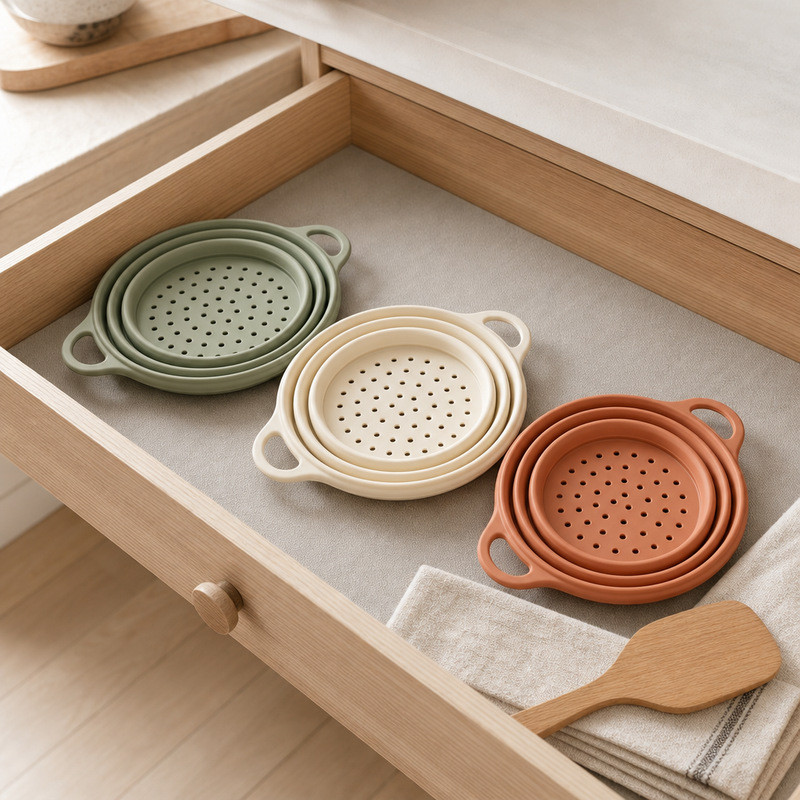
Flatness in the drawer is a design outcome, not a material one. It comes from the number of corrugations, the depth of each fold, and how completely the stack compresses.
There is a direct trade-off between this and stability when open. More, deeper folds give a flatter collapsed height and a more flexible wall. Fewer, shallower folds give a stiffer wall and a thicker stack. Deciding where to sit on that line is a product decision that should be made explicitly.
What Should Be Resolved Before Opening a Custom Mold?
Define the Required Open Height, Folded Height, and Overall Dimensions
Both states need to be dimensioned, not just the open one. The folded height determines how many corrugations are needed; the open height and diameter determine how much wall area each corrugation has to cover. A drawing that shows only the open product leaves the most important dimension to the toolmaker.
Confirm the Position and Thickness of Each Folding Section
Review where each fold sits, the wall thickness at the fold compared with the panel, the profile of the corrugation, and the junction between the top fold and the rim and between the bottom fold and the base. Thickness at the fold is usually the single most influential number in the whole product, because it sets both the opening force and the resistance to buckling.
Check Whether the Design Can Be Molded and Demolded Reliably
Deep corrugations, thin sections, and undercut features all affect how the part is formed and released. A wall with many tight folds can be difficult to fill evenly and difficult to strip without stretching the thin sections. None of this makes the design impossible; it means the tooling needs to be planned around the folds rather than adapted afterwards.
Agree on Sample Acceptance Criteria Before Tooling Approval
Decide in advance how fully the product must open, how much force it should take to collapse, what it must do when filled and lifted by one ear, and how many fold cycles it should survive without visible damage. Written criteria turn a subjective argument about "feels flimsy" into a test that either passes or does not.
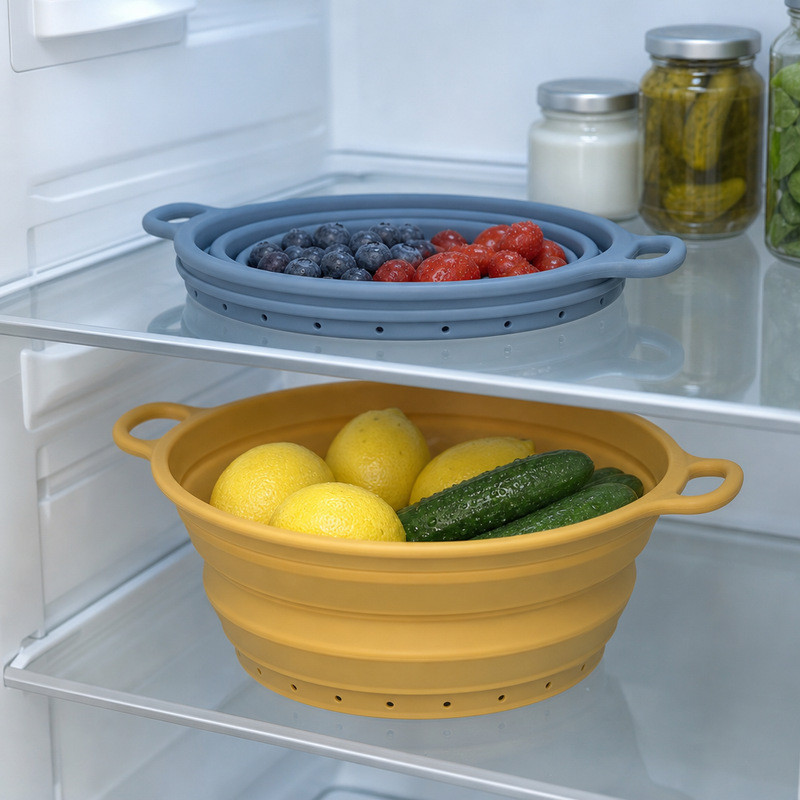
Cold and time together are a useful test. A wall that holds its shape for two minutes of rinsing may lean after an hour of standing loaded in a fridge, because the material has had time to follow the load.
If the product is likely to be used this way, the sample review should include a loaded standing test rather than only a loaded handling test.
How Can a Custom Silicone Manufacturer Help Improve the Design?
The review that matters most happens on the drawing, before steel. It looks at the fold profile, the thickness ratio between fold and panel, the rim junction, the base joint, the moulded angle of each hinge, and the force the wall will need to resist when the product is full.
FromRubber has been moulding custom silicone in Dongguan since 2010, with in-house tooling and a technical team used to thin-section and multi-step parts. For collapsible products the conversation usually starts with the two states and the force expected between them, then moves to corrugation profile and section. The custom silicone parts page shows the constructions we produce, and technical support describes the drawing review stage. No design can be called validated until it has been moulded and tested, and we would rather say that plainly than promise a shape will hold.
Frequently Asked Questions
Why does my collapsible silicone colander fold inward when filled?
Usually because the corrugated wall has little resistance in the hoop direction, or because the fully open angle does not sit past the point where the fold wants to stay open. Load then pushes the wall back along its easiest path.
Should I choose harder silicone to make a collapsible colander stay open?
Hardness raises the force needed to deform the wall, but it also makes the product harder to fold and does not correct a fold line in the wrong place. Geometry should be reviewed first.
Can I make a collapsible colander more stable without making it difficult to fold?
Often yes, by changing the corrugation profile, supporting the rim junction, and stiffening the base joint rather than thickening the whole wall.
Can the folding structure be changed after the first sample?
Sometimes, but a changed corrugation profile or a moved fold usually means a new mould. Changes to sections within an existing profile are more likely to be feasible.
What files should I send a manufacturer before developing a collapsible silicone colander?
3D files or drawings, dimensions in both the open and folded states, the intended contents, expected opening and closing force, material preference, estimated quantity, and a reference sample if one exists.
Sources and further reading
- Release direction and parting line placement in moulded silicone — why thin, shape-dependent parts need the tool planned around them.
- Uneven walls, stress whitening and cracking — why abrupt section changes become hinge points and later cracks.
- Why a moulded silicone cup loses its shape after repeated use — the repeated-use and recovery checks referenced above.
The mechanics described in this article are general principles of thin-wall silicone design. Opening force, stability under load, and fold life vary with the actual profile, section, compound, and mould, and must be confirmed by moulding and testing your specific design.
Designing a folding product?
Send the open and folded dimensions, the contents, and the force you want a user to feel when collapsing it. Those three answers shape the corrugation before the mould does.
- Email: nani@fromrubber.com or karl@fromrubber.com
- WeChat / WhatsApp: +86 18676210913
- FromRubber · Dongguan Bohao Electronic Technology Co., Ltd.
- Qiaotou Town, Dongguan, Guangdong, China
- IATF 16949:2016 · ISO 9001:2015 · ISO 14001:2015