What causes silicone rubber parts to turn yellow or become brittle over time?
- Share
- Issue Time
- Mar 2,2026
Why silicone turns yellow & brittle: the polymer science behind aging
Silicone rubber is celebrated for flexibility and heat resistance, yet after months or years, parts can discolour (yellow/brown) and lose elasticity, becoming brittle or even cracking. This degradation is not a sign of poor quality—it's the result of complex environmental attacks on the siloxane backbone. As a silicone gasket and custom parts manufacturer, FromRubber analyses these failure modes daily. Below we break down the six primary culprits, how they work, and how custom compounding can extend part life dramatically.
| Environmental factor | Visual / mechanical symptom | Chemical mechanism (simplified) |
|---|---|---|
| UV radiation (sunlight) | Surface yellowing, chalking, then fine cracks (crazing). | UV photons break Si-O bonds and oxidise methyl side groups; free radicals cause chain scission and crosslinking. |
| Prolonged high heat (>200°C) | Amber discolouration, hardening, loss of elongation. | Thermo-oxidation: oxygen adds to silicone backbone, forming silanol and additional crosslinks. |
| Ozone / corona discharge | Deep cracks perpendicular to stress (typical in high-voltage environments). | Ozone attacks vinyl groups or unsaturated sites, leading to rapid chain cleavage. |
| Chemical vapours (acids, solvents) | Swelling, then brittleness after evaporation; surface tackiness. | Chemicals extract low-molecular-weight oligomers or break crosslinks; residues catalyse further degradation. |
| Hydrolysis (hot water/steam) | Softening then hardening, whitish bloom, loss of strength. | Water attacks siloxane bonds at high temp (>80°C), especially with acidic/alkaline impurities. |
| Natural aging + extractables | Gradual yellowing, slight tackiness, then stiffening. | Unreacted oligomers or catalyst residues migrate to surface, oxidise and act as discolouration nuclei. |
1. UV & light exposure — the yellowing accelerator
Silicone's inorganic backbone is relatively UV-stable compared to organic rubbers, but many commercial silicones contain phenyl groups or vinyl groups that absorb short-wave light. This generates free radicals that yellow the polymer. In outdoor applications (seals, gaskets, insulators), yellowing appears first on the surface. However, when brittleness follows, it means the degradation has penetrated the bulk. FromRubber offers UV-stabilised grades with nano-titanium dioxide or hindered amine light stabilisers (HALS) that reflect UV without affecting mechanicals.
2. Thermal degradation — when heat turns flexibility into brittleness
Silicone can typically handle 200–250°C intermittently, but continuous heat close to its limit causes oxidative crosslinking. The material stiffens, and discolouration deepens from pale yellow to dark brown. Many designers assume silicone is "inert" forever—in reality, the type of filler and vinyl content matters. Precipitated silica vs. fumed silica also influence yellowing. FromRubber custom mixes use low-vinyl polymers and high-purity iron-oxide-free additives to maintain whiteness even after 1000h at 225°C.
| Grade type | Max continuous use | Yellowing after 500h @ 200°C | Flexibility retained |
|---|---|---|---|
| General purpose silicone | 200°C | Moderate yellow | ~65% |
| FromRubber HT/HR series | 250°C | Very slight (ΔE < 3) | >88% |
| Fluorosilicone (FVMQ) | 200°C | Amber shift | ~80% |
3. Ozone and electrical stress — invisible crack initiators
In motors, transformers, or near corona discharges, ozone (O₃) levels rise. Ozone attacks double bonds or residual vinyl in silicone, creating surface cracks. These cracks grow under flex, making the part feel brittle even if the bulk is still elastic. FromRubber anti-ozone formulations incorporate proprietary waxes or EPDM blends for hybrid parts, but for pure silicone we adjust crosslink density to minimize unsaturation.
Additives, fillers, and their role in discolouration
Many off-the-shelf silicone parts contain extenders like calcium carbonate or lower-cost silica. These can catalyse yellowing when exposed to UV or humidity. Moreover, pigments (especially red/orange) sometimes bleed and cause uneven yellowing. FromRubber uses only low-iron, high-purity silica and platinum-cure systems (instead of peroxide-cure) that leave fewer by-products that yellow over time. The table below outlines common additive effects.
| Additive / filler | Purpose | Side effect on aging if uncontrolled |
|---|---|---|
| Fumed silica | Reinforcement | Can increase yellowing if trace metals present; FromRubber uses ultra-pure grades. |
| Calcium carbonate | Cheap filler | Degrades at >150°C, causes chalking & brittleness; never used in our technical parts. |
| Titanium dioxide (rutile) | Whitening / UV screen | If poorly dispersed, acts as photo-initiator; our dispersion ensures protection. |
| Platinum catalyst residues | Cure system | Peroxide cure leaves acidic residues that promote yellowing; platinum is cleaner – we use it. |
Moisture & hydrolysis — the hidden brittleness trigger
Even though silicone is hydrophobic, steam or hot water (above 80°C) can hydrolyse the backbone, especially if the part is under tensile stress. This leads to "stress corrosion cracking" in silicone. Initially the part may soften, then it hardens and becomes brittle as re-polymerisation occurs chaotically. FromRubber's hydrolysis-resistant compounds use hydrophobic treatments on fillers and a denser crosslink network, extending lifespan in hot water seals by up to 4×.
Side‑by‑side: what brittleness looks like (SEM view)
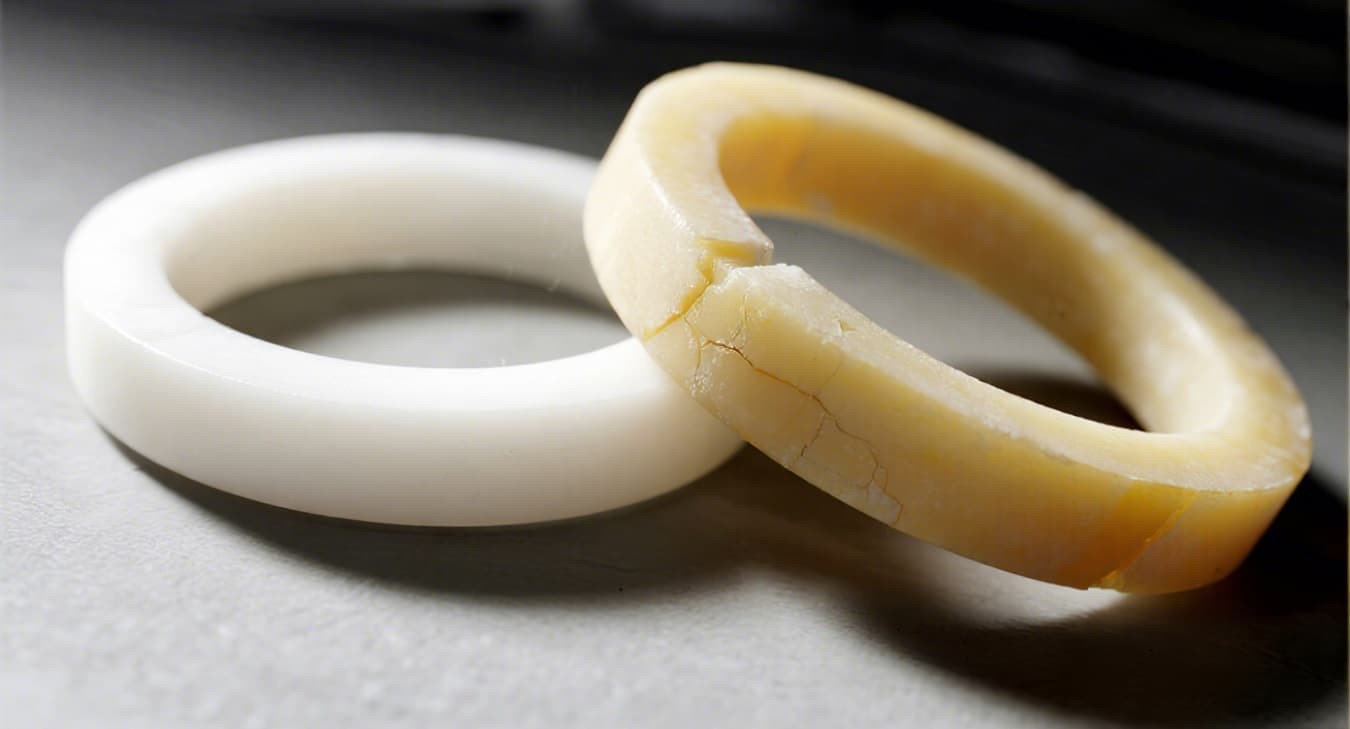
Although we cannot show a microscope here, the side‑view image at the top illustrates the difference: a brittle silicone surface exhibits micro‑cracks that scatter light, creating a dull, yellowed appearance. Our custom parts maintain a smooth, uniform edge even after accelerated aging (5 years equivalent).
Prevention through custom formulation — the FromRubber approach
As a dedicated silicone manufacturer, we don't just sell standard grades; we blend to match your environment. Whether your parts face Arizona sun, chemical sprays, or engine heat, we adjust:
- Polymer type: methyl-vinyl (VMQ), phenyl (PVMQ) for low-temp, or fluoro (FVMQ) for chemical resistance.
- Stabiliser package: UV absorbers, anti-oxidants, and metal deactivators.
- Post-curing: We oven-post-cure all critical parts to remove volatiles that later yellow.
- Colour stability: Custom blues, greys, or whites that match your aesthetic without sacrificing aging.
Real-world example: outdoor transformer gaskets
A client used generic silicone gaskets in outdoor electrical cabinets. Within 18 months, the gaskets turned yellow-brown and cracked under light pressure. FromRubber supplied a custom UV-stabilised, low-creep silicone (grade FR-UV60) with the same hardness. After 4 years, the gaskets remained flexible with only minimal surface colour shift. The side‑view image at the top of this page illustrates that exact comparison.
FromRubber engineers custom silicone compounds for your exact stressors. Request a consultation or material sample.
Silicone aging mechanisms, tailored for engineers and purchasers. FromRubber manufacturing since 2002, ISO 9001:2015 certified.