What is a silicone rubber inner keypad and when do you need one?
- Share
- Issue Time
- Sep 8,2026
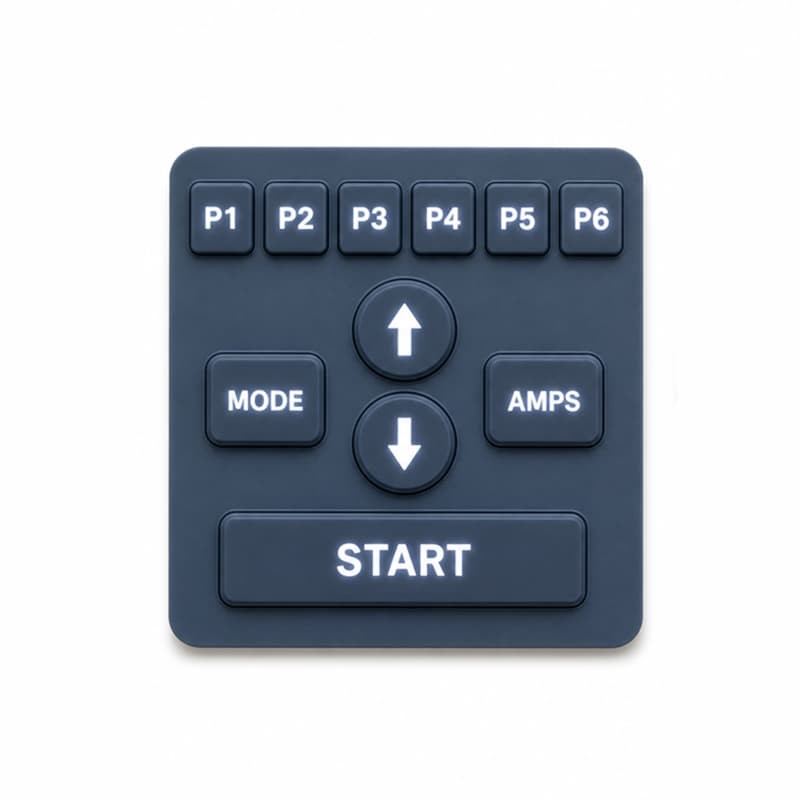
What is a silicone rubber inner keypad and when do you need one?

Detailed Explanation: Anatomy of a Silicone Rubber Inner Keypad
Buyers often use the words inner keypad, hidden keypad, rubber contact layer, elastomeric switch mat, or conductive rubber keypad to describe the same thing: a compression-molded silicone sheet that lives behind a fascia, a membrane overlay, or a plastic cover, and does the electrical switching job. From the user's perspective only the top surface is visible; the silicone layer below carries the tactile spring action, the sealing lip, and the conductive contact.
An inner keypad is not the same as a "regular" silicone keypad you can see and press directly. The construction choices shift accordingly:
1. The Silicone Web — the Spring & the Seal
The webbing around each key is the elastic hinge that buckles when pressed and returns the key to rest. For an inner keypad, web geometry is biased toward high-return force and low creep because the outer fascia usually carries the cosmetic legends. Common web designs are:
- Standard web (conical) — balanced rebound, the most common in instrument panels.
- Inverted web — crisp snap, used in security panels where missed presses must be obvious.
- Curved web — softer feel, suits medical handhelds where long shifts of use are common.
- Dual web — two-stage collapse, used in high-frequency data-entry panels.
Recommended web angle range is 25°–45° with a compression ratio of 30%–40% for predictable long-term actuation force.
2. The Conductive Pill — Where the Switch Closes
The conductive element is molded into, bonded to, or printed onto the underside of each key. Three families dominate the inner-keypad market:
- Carbon pills (cost-effective default) — carbon-loaded silicone discs, typical contact resistance 10–200 Ω, 500k–5M cycle life. Suits nearly every consumer and industrial panel.
- Gold or nickel pills (low-resistance circuits) — sub-10 Ω contact resistance, used in defibrillators, automotive controllers, and other low-voltage, dry-circuit applications. Resists oxidation; price roughly 3–6× a carbon pill.
- Printed conductive ink — silver or carbon-loaded ink deposited directly on the web, geometry-flexible, but lower cycle life than a molded pill.
3. The PCB or Membrane Counter-Layer
Beneath the silicone sits a rigid PCB, a flex circuit, or a membrane switch with exposed interdigitated (comb-shaped) pads. The comb pattern ensures reliable bridging regardless of pill orientation. For an inner keypad the PCB pad finish should be either gold-plated or carbon-over-printed silver — bare copper pads age quickly under repeated silicone contact.
4. The Bezel & Outer Skin — the Cosmetic Layer the User Sees
Unlike an exposed keypad, an inner keypad is normally hidden behind printed overlays, laser-etched polycarbonate, IMD/IML plastic, or acrylic windows. The bezel — usually ABS, PC, or aluminum — provides the rigid compression needed to seal the silicone edge against the housing. A one-piece molded sealing lip is typically added to the silicone edge to deliver IP54–IP67 with no extra gasket.

When You Need One — and When You Don't
The rule of thumb is simple. Use an inner keypad when the visible surface is something other than silicone (plastic panel, glass window, metal fascia), but the user still expects crisp tactile snap, reliable switching, and environmental sealing. Skip it when:
- Your product has no outer skin and the silicone itself is the cosmetic surface (use a normal silicone keypad instead — it is one piece, cheaper, and faster to tool).
- The product is a one-touch membrane switch where tactile feel is not required (a flat polyester overlay is enough).
- The application needs more than ~10 mm of key travel or true mechanical latching (then you are building a full mechanical keyboard, not an inner keypad).
- The visible surface is glass and you only need 1–2 capacitive areas — a projected-capacitive (PCAP) module is the simpler answer.
FromRubber's engineering team uses a four-question checklist to confirm whether the inner keypad is the right call: (1) Does the product need a tactile feel that a flat membrane cannot deliver? (2) Will the housing be sealed against water or dust? (3) Is the visible surface plastic, glass, or printed? (4) Do you need conductive switching inside a closed assembly? If three of four are "yes," you almost certainly need an inner keypad.
Case Study: Industrial Air-Quality Monitor Panel
Industrial air-quality monitor, 16 keys, IP65 front panel, FromRubber 2025
An environmental-monitor OEM was redesigning the front panel of a wall-mounted air-quality meter. The previous design used a flat membrane keypad, and end users complained that operators wearing gloves missed presses more than 15 % of the time, and the panel yellowed after eight months in sunlight.
FromRubber supplied a Shore A 60 silicone inner keypad with carbon pills, two-shot overmolded onto a PC/ABS bezel, sealed with an integrated silicone lip to IP65. The outer surface was a laser-etched polycarbonate overlay with UV-stable pigment, mounted directly against the keypad. Actuation force was set at 220 gf ± 30 gf for confident gloved-hand operation.
Result after a 12-month fleet audit of 8,500 units: missed-press rate fell from 15 % to 1.4 %, zero field returns related to keypad wear, and the UV-rated overlay showed no perceptible color shift (ΔE < 1.2). The OEM extended FromRubber's program to two follow-on instruments.
Case Study: Automotive HVAC Inner Keypad
Mid-tier SUV HVAC control panel, 32 keys, FromRubber 2024
An automaker needed a 32-key climate-control panel that would survive 15,000 actuations per key per year for an 8-year service life, work at −40 °C to +85 °C, and resist hand creams, sunscreen, and IPA wipes. A direct-molded silicone keypad was rejected because the visible surface had to match a piano-black plastic bezel.
FromRubber delivered a carbon-pill inner keypad, Shore A 65, with conductive-trace IML-printed bezel. Web geometry was an inverted design for crisp snap, pill diameter 3 mm, contact resistance tuned to ≤ 80 Ω, and the integrated silicone lip sealed against the housing to IP54. The complete panel passed 1.5 million cycle validation, 1,000 hours ASTM G154 QUV, and 30-day ASTM D471 immersion in 50 % IPA. Three years and 220,000 vehicle-units into production, the panel-related warranty claim rate is 0.06 %.
Data: Inner-Keypad Selection Cheat-Sheet
| Dimension | Options / Range | Best fit |
|---|---|---|
| Visible surface | Plastic / glass / printed overlay / metal fascia | Plastic + printed overlay (most common) |
| Shore A | 40 – 80 | 55 – 70 for inner (firmer than exposed, to fight creep) |
| Web style | Standard / inverted / curved / dual / narrow-waist | Inverted (crisp) for medical/instrument, standard for HVAC |
| Contact | Carbon pill / gold pill / nickel pill / printed ink | Carbon pill (industrial), gold pill (low current), ink (thin profile) |
| Contact resistance | 5 Ω – 5 kΩ | ≤ 100 Ω for digital inputs |
| Cycle life target | 500 k – 10 M | 1 M (HVAC, remote), 3 M (medical), 5 M+ (instrumentation) |
| Travel | 0.8 – 2.0 mm | 1.0 – 1.5 mm for most inner-keypad apps |
| Actuation force | 120 – 350 gf | 180 – 250 gf for gloved / industrial use |
| Sealing | IP54 – IP67 | IP65 outdoor, IP67 wash-down |
| Operating temp | −40 °C to +250 °C (compound-dependent) | −40 °C to +85 °C (auto), −40 °C to +180 °C (industrial) |
Send us your 3D model, the outer-skin material you have chosen, your target actuation force, and the cycle-life spec — FromRubber will return a DFM-marked drawing, recommended compound (Shore A, post-cure schedule), and a quote for prototype tooling inside five working days.
CONTACT US · Discuss an Inner Keypad Project
Related Questions
Conductive Pill vs. Carbon Pad
Which contact technology matches your actuation force, circuit, and lifecycle target?
Press Cycles of a Conductive Silicone Keypad
1 million, 5 million, or 10 million — what realistic cycle life should you target?
P+R Keypad vs. Full Silicone
Hybrid plastic-and-rubber keypads explained: where they beat pure silicone, and where they don't.