How many press cycles can a conductive silicone inner keypad withstand?
- Share
- Issue Time
- Sep 8,2026
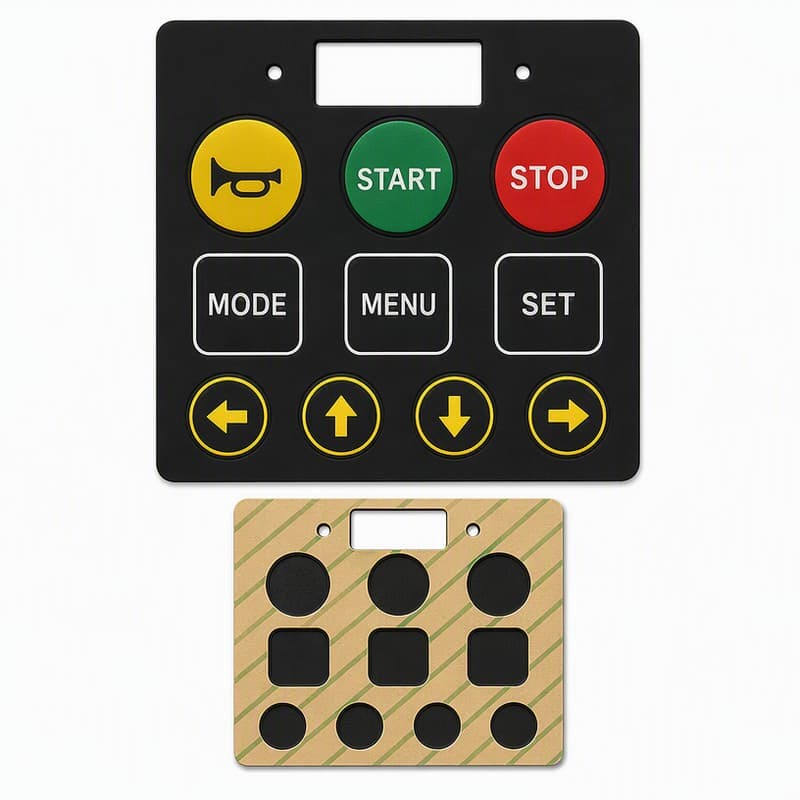
How many press cycles can a conductive silicone inner keypad withstand?

Detailed Explanation: What Determines Cycle Life
"Press cycles" is the engineering term for the number of times a single key can be fully depressed and released before its actuation force drifts outside the spec window or contact resistance rises above the rated limit. It is the single most important reliability number on any keypad datasheet, and it is the number that tends to fail first when a product is over-spec'd. For a conductive silicone inner keypad, the levers that actually move cycle life are well understood:
1. Conductive Contact Type
The contact is where the wear happens. Each technology has a typical rating window:
- Carbon pills: 1,000,000 – 5,000,000 cycles. The cost-effective default for consumer and industrial keypads. Resistive range 10–200 Ω.
- Gold or nickel-plated pills: 5,000,000 – 10,000,000 cycles. Sub-10 Ω contact resistance, oxidation-resistant, used where the circuit is low-current and the cost of a missed press is high (medical, automotive, instrumentation).
- Printed conductive ink (carbon or silver): 500,000 – 2,000,000 cycles. Geometry-flexible, lowest profile, but the printed film is mechanically thinner than a molded pill and wears faster.
- Metal dome + non-conductive silicone: 3,000,000 – 10,000,000 cycles. The metal carries the switching; silicone only acts as the spring and seal. Longest life, highest cost.
2. Silicone Durometer (Shore A)
Harder silicone (Shore A 65–75) yields more cycles because the webbing stores less compressive strain per press. Softer silicone (Shore A 40–55) feels premium but accelerates compression-set. FromRubber's industrial default is Shore A 60 ± 3, balancing feel and durability.
3. Web Geometry
Compression ratio, web angle, and wall thickness together determine how much strain each press puts on the elastomer. Recommended targets are 25°–45° web angle and 30%–40% compression ratio. Steeper angles and higher compression ratios dramatically shorten life.
4. Actuation Force and Travel
Higher force means more strain per cycle. Industrial panels commonly use 180–350 gf with 1.0–2.0 mm travel. Tactile ratio (snap / actuation) should stay between 1.4 and 1.8 for unambiguous feedback.
5. Post-Cure Treatment
Post-cure removes unreacted oligomers and stabilizes the cross-linked matrix. FromRubber's standard schedule is 4 hours at 200 °C; this single step typically increases cycle life by 30%–60%. Skip it on consumer-grade keypads and the snap and force decay noticeably inside six to twelve months.
How Press Cycles Are Measured (the Honest Version)
There is no single international test for "press cycles." Different manufacturers test at different speeds, forces, and ambient conditions — comparing their numbers head-to-head is misleading. The realistic engineering benchmarks are:
- Test fixture: automated pneumatic or cam-driven rig, single key or full keypad, calibrated force gauge.
- Stroke: full rated travel, typically 1.0–1.5 mm.
- Force: 1.2–1.5× rated actuation force, applied through a soft polymer tip that mimics a fingertip.
- Speed: 2–4 Hz (manufacturers that claim 10 Hz "million-cycle" results are skipping the creep damage that real users experience).
- Ambient: 23 °C / 50 % RH baseline; add high-temp (60 °C, 85 % RH) and low-temp (−20 °C) variants for automotive or outdoor specs.
- Pass criteria: actuation force within ±15 % of nominal, contact resistance within ±25 %, no cracks, no perceptible tactile decay.
FromRubber's in-house rig runs 16 keys in parallel to one million presses minimum before first-article release. Medical and automotive programs add an additional chamber sweep across the rated temperature window.
Case Study: 5 Million Cycle Handheld Diagnostic Keypad
Portable blood-analyzer keypad, 24 keys, FromRubber 2024
A point-of-care diagnostics OEM specified 5,000,000 cycles per key for a handheld blood-analyzer keypad used in clinical environments with constant gloved-hand use and daily IPA wipes. The previous supplier had failed field validation at 1.8 M cycles — actuation force had drifted to +47 % above the rated 220 gf, causing operators to over-grip and miss presses.
FromRubber delivered an inner keypad with gold-plated carbon pills (hybrid contact, sub-15 Ω initial resistance), Shore A 65 ± 2 compound, inverted-dome web geometry (snappy tactile ratio of 1.55), and a 4 h @ 200 °C post-cure. Validation rig: 2.4 Hz continuous, 25 °C / 50 % RH, full 24-key matrix scan. At the 5 million cycle mark the mean actuation force had drifted only +9.4 % (target ≤ +15 %), contact resistance was within ±12 %, and no visual defects appeared. The program is now in second-year production with 0.04 % warranty rate.
Case Study: Field Audit of Three-Year-Old Industrial Keypad Fleet
Factory-floor operator panel, 14 keys per unit, 6,500 units deployed, 3-year audit
FromRubber retrofitted a customer fleet of 6,500 industrial operator panels with carbon-pill inner keypads rated for 1 million cycles. After 36 months in service, FromRubber's reliability team pulled 120 units at random and tested each key on a calibrated cycle rig.
Average actuations per key at audit: ~740,000 (estimated from usage logs). Mean actuation force drift: +6.1 %. Mean contact resistance drift: +8.4 %. Failure rate (key outside spec): 1.2 % of keys, all concentrated in panels located near oven exhausts. Conclusion: the rating was conservative for the rated environment; only the elevated-temperature panels needed a hard-spec follow-up.
Data: Cycle-Life by Contact Type & Application
| Contact technology | Typical rating | Contact resistance | FromRubber recommended applications |
|---|---|---|---|
| Printed carbon ink | 500 k – 1 M cycles | 500 – 800 Ω | Consumer remote controls, low-cost toys, single-use devices |
| Carbon pill (standard) | 1 M – 3 M cycles | 10 – 200 Ω | HVAC, access control, instruments, white-goods |
| High-grade carbon pill | 3 M – 5 M cycles | ≤ 100 Ω | Industrial controllers, automotive HVAC, marine |
| Gold / nickel pill | 5 M – 10 M cycles | ≤ 10 Ω | Medical devices, test & measurement, EV charging, aerospace |
| Metal dome + non-conductive silicone | 3 M – 10 M cycles | ≤ 0.5 Ω | POS terminals, defibrillators, premium remotes |
| Hybrid: metal dome over silicone pill | 10 M+ cycles | ≤ 1 Ω | Mission-critical HMIs, public safety, military |
Choosing the right number for your spec: target the highest realistic cycles the application actually needs — over-spec'ing the contact technology drives cost up by 2–4×. Most industrial instruments are well served by 1 M–3 M ratings; medical, automotive, and metering applications typically need 3 M–5 M; mission-critical and public-safety devices justify 10 M+ via metal dome hybrids.
Send us the target environment, actuation force, estimated daily cycles, and any cleaning chemicals used — FromRubber will return a recommended contact technology, compound spec, and a sample program for in-house cycle validation within five working days.
CONTACT US · Request a Cycle-Life Sample
Related Questions
Silicone Inner Keypad Basics
What an inner keypad is, how it differs from an exposed silicone keypad, and when you need one.
Conductive Pill vs. Carbon Pad
Choosing the right contact geometry for the right cycle-life window.
IP Rating for Inner Keypads
Sealing the bezel-silicone interface from IP54 to IP67 without adding a separate gasket.