Why Does a Silicone Patch Lift at the Edges on Stretch Fabric?
- Share
- Issue Time
- Oct 7,2026
Edge lifting on stretch fabric is not a weak adhesive. It is a stiffness mismatch. A silicone patch is a plate and a stretch knit is a membrane, and the only place the difference between them can express itself is the bond line at the perimeter. That is why the patch stays bonded over most of its area while one or two points on the edge open and close with the fabric.
The fix is to reduce the differential movement between patch and fabric, which means thickness, flexibility, edge geometry and placement, in that order. Increasing bond strength alone rarely holds.
Why the load lands on the perimeter
Over the middle of the patch, the fabric is held and largely cannot stretch. At the perimeter, the fabric is free on one side and held on the other, so the transition from free to held happens across a couple of millimetres. That is where the strain gradient is steepest, which is why the edge lifts first. The edge is not weaker; it is doing more work per unit area than any other part of the patch.
Cyclic loading makes it worse over time. Research on elastic knitted fabrics under cyclic loading shows that loading and unloading curves do not coincide: there is hysteresis and an amount of unrecovered elongation that depends on elastane content and on how far the fabric is taken past its elastic region. The practical consequence for a patch is a slow accumulation of slack, so the perimeter is asked to absorb slightly more differential movement every week. That is the mechanism behind the complaint that is so hard to answer: the same patch was fine for two years and now it lifts. The patch did not change; the number of cycles went up.

Edge geometry, not the logo face, decides where a patch starts to lift.
Does a thicker silicone patch stop the edges lifting?
For a plate, bending stiffness rises steeply with thickness, roughly with the cube rather than in proportion. Halving the base web thickness reduces resistance to bending by something close to eight times, depending on construction. That stiffness has to go somewhere, and where it goes is the bond line at the perimeter, which now has to hold a lever that is much harder to bend.
Peer specifications put the working range in context. One manufacturer publishes a 1 mm thickness for its 3D silicone patches, describing it as the balance between flexibility and a pronounced 3D effect. Another publishes printed silicone from flat up to a 1.5 mm limit, with moulded silicone at 1.5 mm and above. In other words, the industry band for printed and lightly raised apparel work sits around 1.0 to 1.5 mm, and going above it is a decision about visual depth rather than durability.
Material data explains the rest of the mismatch. A typical 70 Shore A silicone datasheet lists elongation at break of 150 percent as the requirement, with 266 percent achieved on test, against tensile strength around 5.0 to 5.7 MPa. Knitted fabric with elastane in it can move far further than that in normal wear. The patch does not need to match the knit, but the bond line has to survive the difference, and a thinner, more compliant patch leaves less difference to absorb.
Shape decisions that decide edge life
| Design decision | Effect on edge stress | Practical direction |
|---|---|---|
| Corner radius | Sharp corners concentrate stress where two free edges meet | Round corners generously in the artwork before the tool is cut |
| Narrow projections | Very little bond area behind a lot of moving perimeter | Widen or shorten fine details where the brand allows |
| Relief shoulder profile | A vertical wall concentrates bending on one line | Use a gradual shoulder instead of a step |
| Edge land width | A flat ring of contact keeps the peel front away from the relief | Keep a continuous land all the way around |
| Perimeter to area ratio | Fine, intricate logos carry far more free edge per unit of bonded area | Trade detail against thickness or relief height, not against nothing |
That last row is the one most often missed. Two logos of the same overall size are not comparable at the material level if one is a solid rounded shape and the other spells a word in fine strokes. The second has more free edge, more entry points for moisture, and more opportunities for the knit to work the perimeter loose.

A thin, low-profile label bends with the knit instead of levering against it.
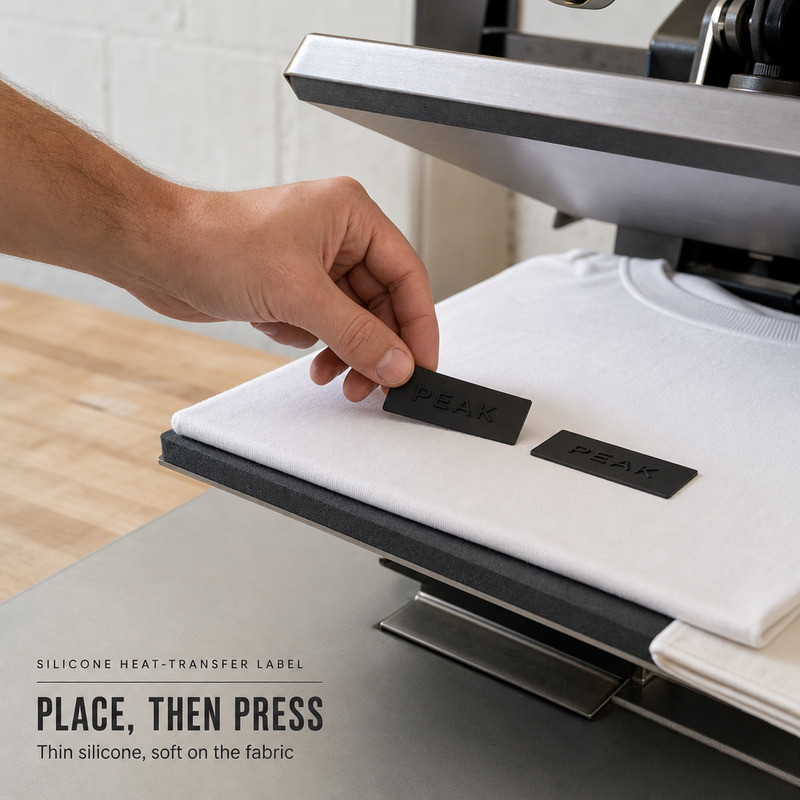
Edge lifting that is created at the press
Some edge lifting is manufactured on day one, and it is easy to separate from fatigue because it is visible immediately.
- Pressure too low, so the relief edges never fully contact the fabric and the bond exists only under the flat areas
- Temperature too low, so the adhesive reaches tack rather than full activation at the outer perimeter
- Dwell too short for heat to travel to the edge land of a thick patch
- Uneven pressure from a small platen, or from pressing a curved garment area with a flat platen
- Placing the patch over a seam, so part of the perimeter is only touching rather than being pressed into the fabric
- Removing the carrier film while the bond is still hot
Peer application instructions handle that last point with numbers. One manufacturer specifies a cold peel and advises laying the fabric flat for 15 minutes so it reaches ambient temperature before the film is removed, adding that the fabric and label should not be bent during that period. The same document allows a hot peel only if the film is removed within 5 seconds. Those are not interchangeable: the peel method is part of the specification, not an operator preference.
The same source sets a stretch-test rule that is worth copying into your own procedure: do not stretch the transfer from the centre of the print, grab at least 5 cm away from it. Pulling from the centre loads the bond in a direction the garment never applies and produces a failure that has no field equivalent.
Where the patch lands is decided by hand long before the wash cycle tests it.
How should edge durability be tested on stretch fabric?
1. Apply on production fabric in production geometry
If the patch will sit on a curve or a seam, replicate that. A flat test piece overstates edge performance.
2. Characterise the fabric, then test at working extension
Tensile testing of fabrics with elastomeric fibre follows the strip method in ISO 13934-1:2013, and the standard notes it is not normally applicable to coated fabrics. Use it on the fabric, then test the patch at the extension the garment actually sees.
3. Cycle, wash, dry, then stretch again
The stretch after drying is the step most routines skip and the one that finds real failures.
4. Score edge lifting separately from adhesion
Two columns: how much of the perimeter has lifted, and whether the patch is still attached over the bonded area. They fail at different stages.
Limits worth stating Silicone itself is a poor performer in three respects that matter here: silicone rubber data sheets describe it as having poor tensile strength, tear resistance and abrasion resistance. On stretch fabric those weaknesses show up at the perimeter, not in the middle. Where a garment sees sustained high extension plus abrasion, a thinner and more compliant patch reduces both loads. Silicone material data, such as the tensile and elongation values determined under ISO 37:2024, describes the compound; it does not describe the patch on a knit.
What should be fixed first when the edges lift?
- Confirm the peel and cooling procedure at the press, because it is free to fix
- Check placement, and move the logo onto the flattest available area of the panel if the brand allows
- Increase corner radii and confirm a continuous edge land in the artwork
- Reduce base web thickness to the lower end of the working range, and reduce relief height where the brand allows
- Re-test on production fabric with the real wash and dry cycle
- Only then discuss formulation changes with the supplier
Teams that start at step six usually arrive at step one several trials later, having paid for tooling in between.

Lower thickness is usually the cheapest durability change available.
FromRubber is a custom silicone manufacturer in Dongguan, China: Dongguan Bohao Electronic Technology Co., Ltd., Jingcheng Road 122, Langxia Village, Qiaotou Town, Dongguan, Guangdong, China. Operating since June 2010, with 32 compression moulding machines across two sites and IATF 16949:2016, ISO 9001:2015 and ISO 14001:2015 certification. Silicone labels, patches and heat-transfer markings for apparel are among our main custom lines.
Send us the artwork, the fabric details and the wash-and-wear expectation, and we can flag the geometry that is likely to lift first. Email nani@fromrubber.com or karl@fromrubber.com, or message us on WeChat and WhatsApp at +86 18676210913.
Sources
- ISO 13934-1:2013, Textiles - Tensile properties of fabrics - Part 1: Determination of maximum force and elongation at maximum force using the strip method: https://www.iso.org/standard/60676.html
- ISO 37:2024, Rubber, vulcanized or thermoplastic - Determination of tensile stress-strain properties: https://www.iso.org/standard/86892.html
- Impact of the Elastane Percentage on the Elastic Properties of Knitted Fabrics under Cyclic Loading, 2022: https://www.mdpi.com/1996-1944/15/19/6512
- Modification of Surface Energy and Wetting of Textile Fibers, Ferrero and Periolatto, IntechOpen, 2015: https://www.intechopen.com/chapters/48818
- Custom 3D Silicone Patches, Custom Patch Factory (1 mm thickness, pressing and aftercare parameters): https://www.custompatchfactory.com/product/patches/3d-silicone-patches
- Custom Silicone Patches for Clothing Labels, Jin Sheu (printed limit 1.5 mm, moulded 1.5 mm and above, backing options): https://www.jinsheu.com/en/category/custom-silicone-patches.html
- Heat Transfer Product User Manual, HMJ Silicone Sticker, Dongguan (cold peel, 15-minute flat cooling, 5 cm stretch-test rule): https://hmjsiliconesticker.com/wp-content/uploads/2024/02/HMJ-Silicone-Printing-Heat-Transfer-application-instruction.pdf
- Material Properties - Silicone Rubber, MEC (70 Shore A hardness, elongation at break, tear and abrasion limits): https://mec-uk.co.uk/new-admin/uploads/pdf/Material%20Properties%20-%20Silicone%20Rubber.pdf