Silicone Patch for Sportswear: How to Prevent Edge Lifting?
- Share
- Issue Time
- Oct 7,2026

Edge lifting on sportswear is prevented before tooling, not after. Four decisions control it: how much the patch has to bend to follow the knit, how much free edge the logo carries, how much heat the lightweight fabric receives at the press, and whether the press was validated on the assembled garment or only on a flat swatch.
Get those four right and edge lifting becomes an exception rather than a recurring complaint. Get them wrong and no change of adhesive will hold, because the load is being applied to the wrong part of the patch.
What is genuinely different about sportswear
The fabric list is familiar; what matters is how those fabrics behave differently.
- Elasticity is high and directional. A circular knit may recover well in both directions; a warp knit or stretch woven may move far more along one axis. A patch that is effectively rigid across the direction of greatest movement will always lift on that edge first.
- The surface is engineered, not natural. Performance knits are brushed, sanded or finished to manage moisture, and moisture-management finishes are surface treatments by definition. That treated surface is what the adhesive has to wet.
- Fabric mass is low. Thin knit heats fast and cools fast, so the window between correct activation and over-pressing is narrower than on heavy twill. A recipe validated on a uniform will over-press a performance knit.
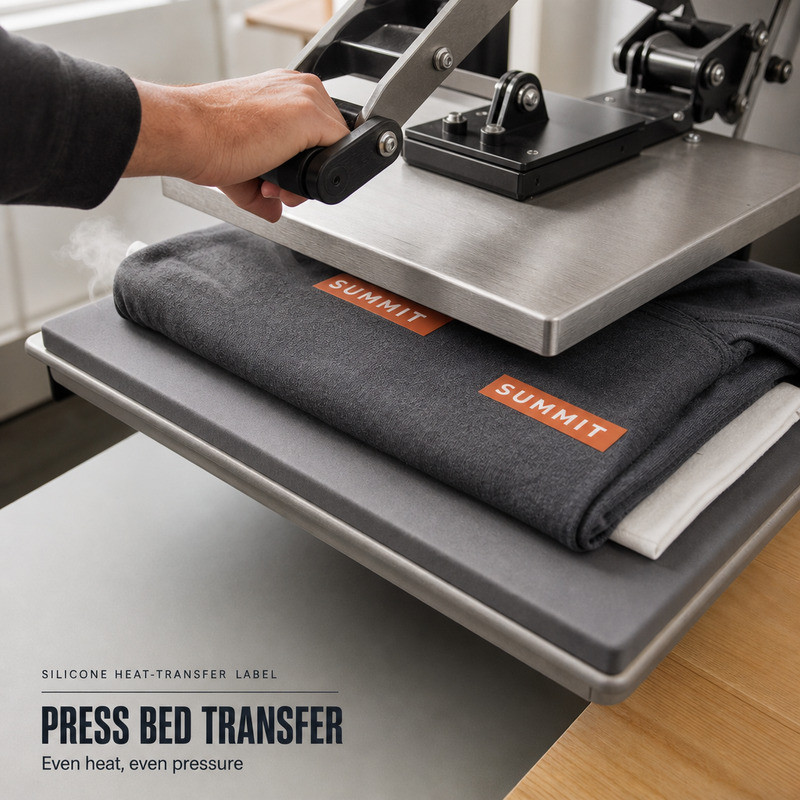
A flatbed press applies even pressure only when the garment panel is flat.
Three fatigue loads, not one
| Load | What it does to the patch edge | What it calls for |
|---|---|---|
| Mechanical: cyclic strain and abrasion | Works the perimeter at the point of highest strain gradient; contact with straps and bags adds abrasion | Lower bending stiffness, larger corner radii, a full edge land |
| Thermal: repeated drying heat | Applies heat while the garment is moving, when the bond is under load | Test the drying method the customer uses, including tumble |
| Chemical and moisture: sweat, detergent and residue | Wets into any perimeter gap; dried residue sits between fabric and bond line on a re-press | Clean before any re-press, and test the real detergent and temperature |
Abrasion deserves a note of its own. Martindale-type abrasion testing is standardised in ISO 12947-2:2016 for textile fabrics, and the standard is not intended for coated fabrics. A patch on a knit is a coated system, so the fabric's abrasion result does not describe the patch's behaviour. Test the assembly.
How does logo shape affect edge lifting on sportswear?
Take two logos of the same overall size. One is a solid rounded rectangle; the other spells a word in fine strokes with narrow gaps. The second carries far more free edge per square millimetre of bonded area, which means more places where the strain gradient acts and more entry points for moisture. Nothing is different at the material level; their edge lives are not comparable.
That gives a design conversation a number instead of an opinion. When a brand wants fine lettering, the counter-proposal is not "make it simpler", which is subjective, but "this shape carries more perimeter per unit of area", which is measurable and can be traded against thickness, relief height or placement.
Colour count is a second design constraint that shows up early in tooling. Peer specifications for this product family recommend no more than six colours on printed silicone, and no more than two on moulded silicone, because additional colours raise production difficulty and the failure rate. A sportswear logo that needs five colours printed over deep relief is asking for two difficult things at once.
Sleeve and side-panel placements need a lower profile than a flat chest panel.
Placement on the body is not placement on the table
Press validation usually happens on a flat platen with flat fabric. On the garment, the patch may sit on a shoulder curve, over a raglan seam, across a wrapping side panel, or on a tapering sleeve. There the platen cannot develop uniform pressure and the surface is not planar, so the patch ends up well bonded in the middle and lightly bonded around part of the perimeter.
It passes a flat test. It fails in wear. On sportswear, where much of the branding sits on sleeves and side panels, this is not an edge case.
Two responses: validate on the assembled garment rather than on a swatch, and consider moving the placement. A logo that is equally legible 10 mm further onto a flat panel will behave completely differently, and that change is free.
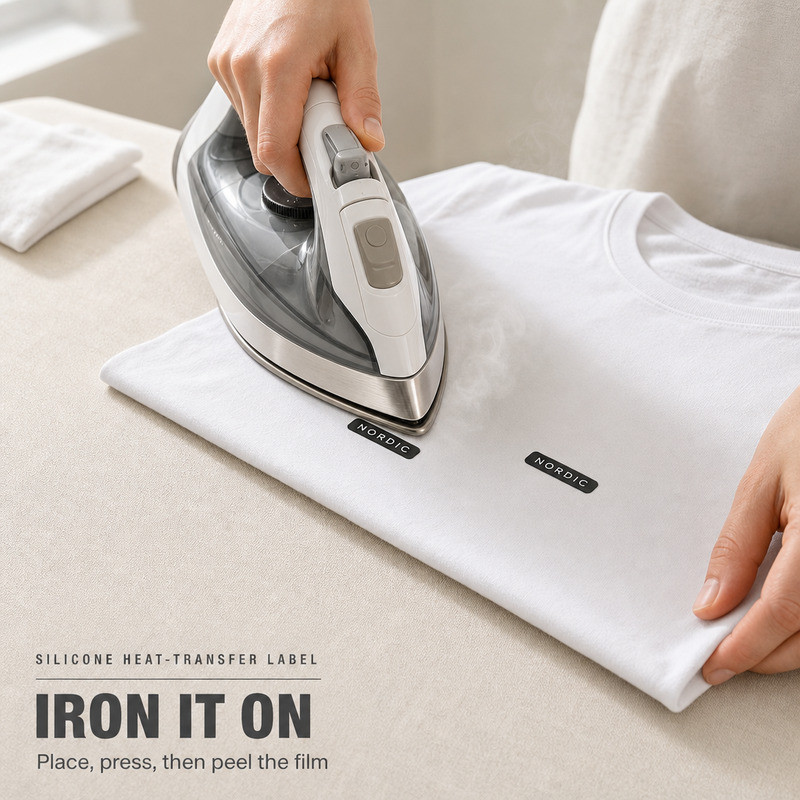
Where the platen cannot reach, the perimeter never fully bonds.
How should a sportswear patch be tested before mass production?
1. Apply on production fabric and production geometry
On the assembled panel, with production settings. Peer application instructions are explicit that fabrics and thicknesses differ and that the factory must confirm press parameters and washing standards on its own samples.
2. Respect the cooling step
One published instruction calls for a cold peel with the fabric laid flat for 15 minutes to reach ambient temperature before the film is removed, and warns against bending the garment during that time.
3. Wait before washing
Published waiting times before any physical or washing test range from a minimum of 24 hours to at least 48 hours. The bond needs to develop before it is judged.
4. Stretch, wash, dry, stretch again
Stretch to the extension seen in wear, then wash at the customer's temperature with the customer's detergent, then dry the way the customer dries, then stretch once more before inspecting. That last stretch is where real failures appear.
5. Report each failure mode separately
Edge lifting, partial detachment, cracking, deformation and appearance change are five different results, not one pass or fail. Combining them hides which axis is failing.
Limits worth stating Silicone heat transfers are not a universal answer. Peer application guidance excludes dry cleaning and chemical laundry routes such as bleach, enzyme wash and stone wash, and advises against pressing or steaming directly on the transfer. Some manufacturers also advise against heat-transfer application on delicate substrates such as silk or fine knit beanies, because the heat itself damages the fabric. Where the garment must survive those routes, the patch has to be validated against them rather than assumed.
Movement over a garment's life, and why stiffness matters
A training top is washed more often than a jacket, worn closer to the body, stretched further, wetted with sweat from the inside and dried at higher heat than care labels usually admit. Each of those is a small load. What matters for the patch is that they repeat, and that the knit does not return perfectly to its starting dimensions after each cycle.
Why a lower-profile patch helps is mechanical. For a plate bonded to a flexible substrate, bending stiffness rises roughly with the cube of thickness, so small reductions in base web thickness produce large reductions in the load carried at the perimeter. Industry-published specifications for this product family sit around 1 mm for 3D patches and up to a 1.5 mm limit for printed silicone. Beyond that band, extra thickness buys visual depth and costs edge durability.
Published silicone material data supports the same conclusion from the other side. Silicone rubber keeps its properties across a very wide temperature range, with heat-resistance testing at 225 °C for 70 hours producing only a few points of hardness change, but the same datasheets describe silicone as having poor tear resistance and abrasion resistance. A patch that is thermally robust can still be mechanically fragile at a thin edge. Durability comes from geometry and cure, not from mass.
FromRubber is a custom silicone manufacturer in Dongguan, China: Dongguan Bohao Electronic Technology Co., Ltd., Jingcheng Road 122, Langxia Village, Qiaotou Town, Dongguan, Guangdong, China. Operating since June 2010, with 32 compression moulding machines across two sites and IATF 16949:2016, ISO 9001:2015 and ISO 14001:2015 certification.
If you are developing a patch for a performance knit, send the fabric details, the logo and the wash requirements, and we will tell you which geometry is likely to lift first. Email nani@fromrubber.com or karl@fromrubber.com, or reach us on WeChat and WhatsApp at +86 18676210913.
Sources
- ISO 12947-2:2016, Textiles - Determination of the abrasion resistance of fabrics by the Martindale method - Part 2: Determination of specimen breakdown: https://www.iso.org/standard/61058.html
- ISO 6330:2021, Textiles - Domestic washing and drying procedures for textile testing: https://www.iso.org/standard/75934.html
- Impact of the Elastane Percentage on the Elastic Properties of Knitted Fabrics under Cyclic Loading, 2022: https://www.mdpi.com/1996-1944/15/19/6512
- Custom Silicone Patches for Clothing Labels, Jin Sheu (thickness limit, colour count guidance, backing options): https://www.jinsheu.com/en/category/custom-silicone-patches.html
- Custom 3D Silicone Patches, Custom Patch Factory (1 mm thickness, 150 to 160 °C for 25 to 30 seconds, cold peel, 48-hour wait before washing): https://www.custompatchfactory.com/product/patches/3d-silicone-patches
- Heat Transfer Product User Manual, HMJ Silicone Sticker, Dongguan (cold peel, 15-minute flat cooling, 24-hour wait, wash-route exclusions, delicate-substrate caveats): https://hmjsiliconesticker.com/wp-content/uploads/2024/02/HMJ-Silicone-Printing-Heat-Transfer-application-instruction.pdf
- Material Properties - Silicone Rubber, MEC (wide service temperature range, heat-resistance results, tear and abrasion limitations): https://mec-uk.co.uk/new-admin/uploads/pdf/Material%20Properties%20-%20Silicone%20Rubber.pdf
- How To: 3D Silicone Heat Transfers, Stahls' UK (high-build raised construction, stretch resistance, shape retention after repeated washing): https://www.stahls.co.uk/blog/how-to-3d-silicone-heat-transfers.html