Why Does a Silicone Patch Crack on Workwear After Repeated Washing?
- Share
- Issue Time
- Oct 7,2026

A cracked workwear patch is telling you a different story from a peeling one. Peeling is a failure of the interface: the patch came away from the fabric. Cracking is a failure inside the silicone: the patch is usually still bonded, often well bonded, but the face has split along the relief or developed a fine web of lines across the base.
That single observation matters because it removes the adhesive conversation entirely. Replacing the adhesive will not fix a cracking patch, and neither will a stronger bond. The fix lives in geometry, ageing behaviour and cure state.
Start with a failure map, not a cause list
| Observation | Failure type | Where the problem usually lives |
|---|---|---|
| Patch separates, silicone underside clean | Adhesion failure | Bond line, press settings or fabric finish |
| Perimeter free, centre still bonded | Edge lifting | Geometry, thickness, strain at the perimeter |
| Face splits along or beside raised lettering | Cracking | Relief geometry, shoulder radius, formulation flexibility |
| Dense surface crazing with no clear origin | Material fatigue or under-cure | Compound and cure cycle |
| Shape changed, corners curl, dimensions open | Deformation | Compound, thickness, heat history |
Five results get called "the patch broke" in an inspection room, and they have different owners. Writing them into separate columns is the most useful thing you can do before contacting a supplier.
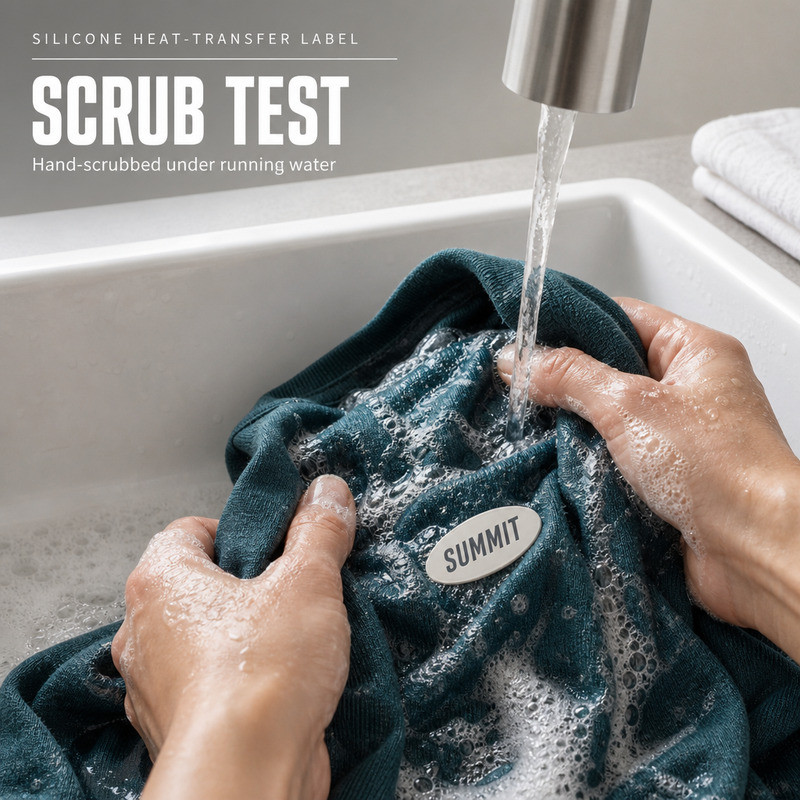
Workwear patches face abrasion, heat and chemistry at the same time.
Is industrial laundering worse than home washing for silicone patches?
The difference is not only frequency. ISO 15797:2017 specifies test procedures and equipment for evaluating workwear intended to be laundered industrially, and it is explicit about the limits of laboratory simulation: because reproducing an industrial laundry process in a laboratory is often impractical, the standard uses intermediate-scale equipment and defined procedures, and it advises that testing in the actual industrial equipment and process is advisable when finally determining product and process compatibility.
For a patch, that advice is the whole story. A programme validated on a domestic cycle and then shipped into an environment with tunnel finishing, high-temperature drying and aggressive mechanical action has validated the wrong process. Four stress mechanisms are worth tracking separately, because each one has a different remedy:
- Mechanical: drum agitation, garment-to-garment friction, repeated bending at seams and pocket edges
- Thermal: high wash temperature plus drying or tunnel finishing heat
- Chemical: alkaline detergents, bleach systems where used, and the residue they leave
- Flexural: repeated bending of a patch that has already been aged by the three above
Cracking starts at the geometry, not the compound
Section a cracked patch and look at the origin of the split. The same candidates appear in the same order of frequency.
The shoulder of the relief. A raised logo edge with a near-vertical wall and a small radius is a stress riser. Under bending, material on the outside of that shoulder is strained far more than the flat land beside it, and fatigue concentrates into a line a fraction of a millimetre wide. Once that line cracks, it propagates along the relief or down through the base.
The fine-detail zone. Thin strokes, narrow gaps between letters and any feature where the section becomes thin behave as the weakest link: less material, less ability to absorb bending, and a shorter path for a crack to travel.
The transition between thick and thin. Where a base web meets a tall raised element, stiffness changes abruptly, and abrupt changes are where strain localises. In mould terms this is the draft and radius argument, and it is normally settled before the compound is chosen.
This is why the fastest crack fix is sometimes a drawing change: a larger shoulder radius, relief height reduced by a few tenths of a millimetre, a stroke widened enough to carry stress. The brand mark is preserved; the stress path is not.

Complex logos put more geometry into the patch, and every transition is a potential crack origin.
Two ageing channels, measured separately
Silicone has a deserved reputation for heat stability, and that reputation is sometimes used to argue that thermal ageing cannot be the problem. The reputation concerns bulk material. What fails first is thin sections and the bond line.
Published material data shows how small the thermal changes can be on a well-cured compound, and simultaneously how large they can be on a marginal one. On a typical 70 Shore A silicone rubber datasheet, heat-resistance testing at 225 °C for 70 hours produced a hardness change of 4 points, no change in tensile strength and a 3 percent change in elongation. The same document reports a compression set of 9 percent after heat ageing at 175 °C for 22 hours, and quotes an operating temperature range tested from -50 to +225 °C. Against those numbers, a laundry tunnel is not an extreme thermal environment for the material.
Fluid exposure is a separate channel with its own numbers. In the same datasheet, immersion in a reference oil at 150 °C for 70 hours changed hardness by 3 points, tensile strength by 3 percent, elongation by 7 percent and volume by 4 percent, while water at 100 °C for 70 hours changed hardness by 2 points and volume by 3 percent. Detergent solutions are not aggressive in the way solvents are, but immersion with mechanical action at elevated temperature is a different regime from a drip test, and the property changes that matter for a patch show up as stiffness and surface change rather than obvious swelling.
The international framework for these two channels is separate as well. Accelerated ageing and heat resistance testing is standardised in ISO 188:2023, which distinguishes accelerated ageing from heat resistance testing at a service temperature. Chemical exposure follows ISO 1817:2026, which evaluates the resistance of vulcanized and thermoplastic rubbers to liquids by measuring properties before and after immersion. Run them as two experiments, not one: a patch that survives heat but changes after detergent immersion has a different fix from one that survives chemistry and embrittles in the tunnel.
A common finding Insufficient post-cure is an under-appreciated cause of cracking. Published reference processes for solid silicone rubber use a press cure followed by a separate post cure, for example a press cure at 170 °C for 12 minutes followed by a post cure at 120 °C for one hour. Post cure removes residual volatiles and stabilises the section. If those fractions remain, they can migrate over time, and thin sections and bond lines are where that shows first. A cracking pattern that is dense, uniform and not centred on any geometric feature is worth investigating as a cure-state issue rather than a design issue.
Are thicker silicone patches more crack resistant?
A thinner base web bends more easily, so it puts less stress on the relief shoulder and on the bond line during flexing. A thicker base web carries the same relief but resists bending, pushing more strain into the geometry transitions, which is exactly where cracks begin. Relief height compounds it: a tall raised logo on a thick base is the stiffest possible configuration, and stiffness is what fatigue exploits.
Thickness should be chosen for the visual and tactile requirement, the mould's ability to fill the detail, and a comfortable match to the fabric's stiffness. Peer specifications for this product family sit around 1 mm for 3D patches and up to a 1.5 mm printed limit. Material data explains why going thicker is not a shortcut: silicone rubber is described in its own datasheets as having poor tensile strength, tear resistance and abrasion resistance, so durability comes from the fatigue behaviour of the formulation, from smooth transitions and from a consistent cure.
Where cracks appear, and what that points to
| Crack location | Likely cause | What to adjust first |
|---|---|---|
| Along the shoulder of raised lettering | Sharp transition, insufficient shoulder radius | Mould geometry and relief height |
| Across narrow strokes or fine detail | Too little section to carry bending | Artwork: widen the stroke or reduce depth |
| At corners of an angular logo | Stress concentration at a sharp corner | Corner radius |
| Uniform fine crazing across the face | Material fatigue or incomplete cure | Formulation and cure cycle |
| Only after high-temperature drying | Thermal exposure of a thin section | Heat-resistance testing at service temperature |
| After bending at a seam | Flexural fatigue at a high-strain location | Compatibility of flexibility and placement |

Test the aged patch, not the new one: cracking is cumulative.
A durability test that answers workwear questions
1. Baseline inspection
Appearance, dimensions, surface and edges, photographed at a fixed magnification so later stages are comparable.
2. Launder to the real process
Use the customer's washing conditions. If the garment will be tunnel finished, test that route, not a domestic cycle.
3. Dry and finish as the customer does
Thermal load at this stage is often the deciding factor for a thin section.
4. Flex the aged patch
Bend it repeatedly around a radius that matches the garment's use, then inspect for cracking.
5. Inspect against the failure map
Record cracks, surface splitting, edge lifting, deformation and adhesion separately, then run the sequence again to the agreed endpoint.
Limits worth stating Silicone heat-transfer markings are not compatible with every laundry route. Peer application instructions exclude dry cleaning and chemical wash routes including bleach, enzyme wash and stone wash, and advise against ironing or steaming directly on the transfer or scratching it with metal or fingernails. If the workwear care protocol includes any of those routes, the patch has to be tested against them. Where the garment is re-pressed after a wash, remove detergent residue first: bonding over residue reproduces the previous failure.
FromRubber is a custom silicone manufacturer in Dongguan, China: Dongguan Bohao Electronic Technology Co., Ltd., Jingcheng Road 122, Langxia Village, Qiaotou Town, Dongguan, Guangdong, China. Operating since June 2010, with 32 compression moulding machines across two sites and IATF 16949:2016, ISO 9001:2015 and ISO 14001:2015 certification.
If you have a workwear patch that is cracking, send a photograph of the crack origin and the laundry conditions, and we can say whether a design change or a cure change is worth testing first. Email nani@fromrubber.com or karl@fromrubber.com, or reach us on WeChat and WhatsApp at +86 18676210913.
Sources
- ISO 15797:2017, Textiles - Industrial washing and finishing procedures for testing of workwear: https://www.iso.org/standard/65152.html
- ISO 188:2023, Rubber, vulcanized or thermoplastic - Accelerated ageing and heat resistance tests: https://www.iso.org/standard/80468.html
- ISO 1817:2026, Rubber, vulcanized or thermoplastic - Determination of the effect of liquids: https://www.iso.org/standard/91331.html
- ISO 4637:1979, Rubber-coated fabrics - Determination of rubber-to-fabric adhesion - Direct tension method: https://www.iso.org/standard/10594.html
- Material Properties - Silicone Rubber, MEC (heat-resistance test at 225 °C for 70 hours, compression set after ageing at 175 °C, oil and water immersion results, press and post cure reference process, tear and abrasion limitations): https://mec-uk.co.uk/new-admin/uploads/pdf/Material%20Properties%20-%20Silicone%20Rubber.pdf
- Custom 3D Silicone Patches, Custom Patch Factory (1 mm thickness, cold peel, aftercare, wash and dry cycle durability): https://www.custompatchfactory.com/product/patches/3d-silicone-patches
- Heat Transfer Product User Manual, HMJ Silicone Sticker, Dongguan (wash-route exclusions, 24-hour wait before testing, edge handling warnings): https://hmjsiliconesticker.com/wp-content/uploads/2024/02/HMJ-Silicone-Printing-Heat-Transfer-application-instruction.pdf