How Small Can a Small Silicone Logo Be on Clothing?
- Share
- Issue Time
- Oct 9,2026
There is no single minimum size for a silicone logo on clothing. The practical limit is set by the smallest feature inside the artwork, not by the overall footprint, so a simple solid mark can be produced much smaller than a detailed one in the same material.
That means the honest answer to "how small can this go?" is a follow-up question: small enough that which parts of the mark still survive? Once the smallest line, the narrowest gap and the smallest text height are known, the size question usually answers itself.
What actually sets the limit
- Overall width and height. The footprint decides how much room every internal feature has. Shrink it and each feature gets less space, whether or not the file was redrawn.
- Minimum line width. Thin outlines and narrow strokes destabilise first. They can lean during demoulding, vary in height along their length, or simply become too small for the tool to hold across a long run.
- Gap size and negative space. Two strokes that are individually fine still merge into one shape if the space between them closes up at final size.
- Text height and font structure. Narrow faces, small counters and light strokes tolerate reduction badly. Letter spacing and stroke weight decide whether a small word is read or guessed.
- Thickness and three-dimensional geometry. A tall feature casts a stronger shadow and can read clearly even when narrow, while a shallow feature on a small part may disappear from normal viewing angles.
- Attachment and garment requirements. A part that must survive repeated stretching, washing or bonding to a coated fabric has less margin than one sewn onto a stable woven panel.
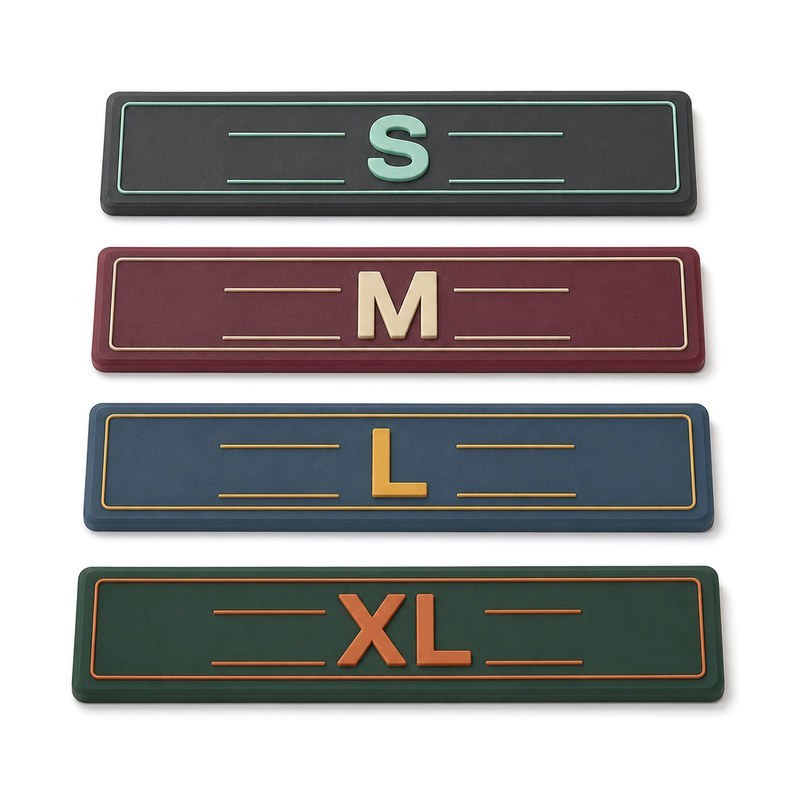
Size runs make the effect visible on one page. These strips carry the same construction at four grades from S to XL. At the small end the letterform still reads, but the rules framing the strip have progressively less room to breathe.
This is the point buyers usually miss: the marking itself may survive a reduction while the framing elements around it do not. If the small variant is going onto a hem label, the frame has to be redrawn, not scaled.
Redraw for the small size, do not resize
Consider three versions of the same mark at roughly 30 mm, 20 mm and 10 mm wide. These numbers are for discussion, not manufacturing limits, and what matters is what changes between them. At the large size almost everything in the file is safe. At the medium size the thinnest outline and the smallest gap start to matter. At the small size the design usually has to lose something: the tagline goes, or the outline is removed and the mark is carried by a bold shape, or the whole mark is replaced by a compact version drawn for that size in the first place.
Proportional scaling fails because it preserves every relationship while shrinking the absolute values the process actually needs. A separate small-size version of a brand mark is normal practice in printing and embroidery, and silicone is no different — a compact variant is a design decision, not a failure of the original.
Monograms are a good test case because they combine a large solid form with small internal spaces. In this set the letters read at the size shown, but the usable space inside each letterform varies enormously between them.
If a brand initial stands alone on the part, it tolerates a much smaller size than the same initial surrounded by a wordmark and a border.

What to measure at the finished size
Each of these values behaves differently as a mark gets smaller. Checking them individually is far more reliable than judging the whole logo by eye.
| Element at final size | What it controls | What usually goes wrong |
|---|---|---|
| Thinnest raised line | Whether the line stands consistently along its length | Uneven height, wobble after demoulding |
| Smallest gap | Whether two elements stay visually separate | Merging into a single shape |
| Smallest text cap height | Whether letters are identifiable at all | Counters closing, strokes disappearing |
| Feature depth | Whether a recess reads as a recess | Flattening into the surrounding surface |
| Clearance to the outline | Whether edge detail survives trimming and wear | Chipped or blurred perimeter detail |
The reference framework for agreed dimensions on moulded rubber parts is ISO 3302-1:2014, which sets out tolerance classes and their values (https://www.iso.org/standard/62492.html). Tolerances govern defined dimensions; they do not describe how legible a small mark looks, which is why both checks are needed.
Where this runs out
A small part with fine edges is more exposed to repeated flexing on a stretch fabric than the same part on a stable woven panel, and a heavier profile can pull at a soft jersey. Fabric does not set the minimum mouldable size, but it changes what is sensible. Material hardness does not settle it either: two parts moulded from the same hardness can behave differently because stiffness also depends on wall thickness, span, ribs and cross-section (https://www.wydsilicone.com/blog/how-to-choose-silicone-hardness/). The workable values for a specific project come from the material and process being used, confirmed on a sample.
Can a silicone logo be made without text?
Yes, and removing small text is often the single most effective change. A mark that carries its identity through shape and colour tolerates a much smaller size than one that depends on reading a word.
Does logo thickness affect the minimum size?
It does. Thicker features cast stronger shadows and read more clearly at small dimensions, but they change how the part feels and may not suit every garment or attachment method. Adding thickness is a trade-off, not a free improvement.
A range of base shapes is a practical way to find the smallest size a brand can live with. Different silhouettes carry different amounts of internal detail, so the smallest usable size moves with the silhouette rather than staying fixed.
Test several shapes at the same nominal size and the answer becomes visible: one construction still reads, another has already collapsed into a solid patch.
Send the original artwork with the intended finished dimensions, and ask for a manufacturability review before a size is committed to.

Sources and further reading
- ISO 3302-1:2014, Rubber — Tolerances for products — Part 1: Dimensional tolerances. https://www.iso.org/standard/62492.html
- Liquid Silicone Rubber (LSR) moulding design guidelines, including minimum wall thickness and feature considerations. https://www.protolabs.com/services/injection-molding/liquid-silicone-rubber-molding/design-guidelines/
- Typography: readability and legibility — how stroke weight, spacing and counter size affect whether characters stay distinguishable. https://www.sitepoint.com/typography-readability-and-legibility-part-1/
- Silicone hardness selection: why Shore A alone does not determine part behaviour. https://www.wydsilicone.com/blog/how-to-choose-silicone-hardness/
About this answer
Prepared by the engineering team at FromRubber (Dongguan Bohao Electronic Technology Co., Ltd.), a custom silicone label and silicone patch manufacturer. Artwork is reviewed at its intended finished size, and the features that will set the practical limit are identified before tooling begins.
Approving a sample at the size it will actually be used remains the most reliable step in the whole process.
See custom silicone label options