Why Does a Silicone Heat Transfer Label Fail on Stretch Fabric?
- Share
- Issue Time
- Oct 9,2026
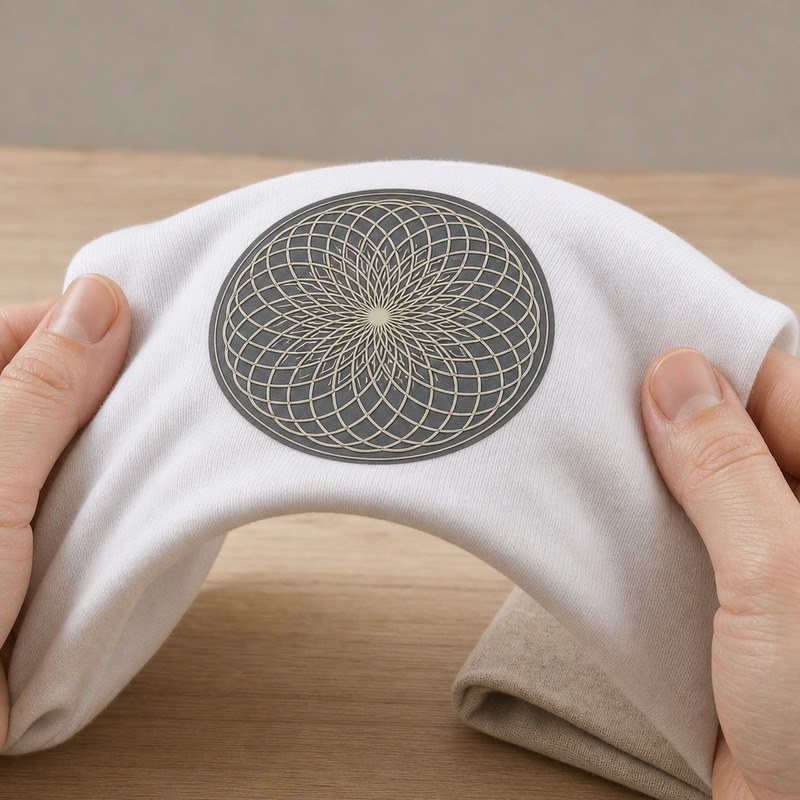
Failure of a silicone heat transfer label on stretch fabric is usually described as one problem and is actually several. An edge that lifts right after pressing is a different fault from a label that survived a week and then cracked along a thin feature, and both differ from a label that passed an initial peel check and failed after a few washes.
The dominant load in every case is the same: the garment stretches and recovers repeatedly, while the label extends far less. That mismatch concentrates stress at the perimeter, which is where the bonded area ends. Diagnosing by symptom is what makes so many fixes get applied to the wrong stage of the process.
Five failure patterns, five different causes
- Edge lifting. Separation starts at a corner or along the perimeter because that is where stress concentrates when the fabric moves. Lifting only at the corners immediately after pressing points to contact and pressure rather than to the material.
- Partial detachment. One area releasing while the rest stays bonded indicates uneven contact: a seam, a fold, a thicker zone of fabric, or a platen applying different pressure across the label.
- Cracking or permanent distortion. The bond may be intact and the label itself is the problem. If it cannot deform with the fabric, the graphic features carry the load and eventually fail, often along the thinnest section.
- Failure after washing. A label that passes an initial peel check and then fails after a few domestic washes has been assessed against the wrong criterion.
- Failure after repeated stretching. Garments can pass a flat visual inspection and still fail in wear because the label was never asked to survive the cycle that matters: stretch, recover, stretch again, hundreds of times.
This is the behaviour a transfer label has to match: it must move with the fabric and return with it, without cracking and without taking the fabric surface with it.
A quick early test is to flex a pressed sample by hand and look at the label under raking light. Cracks and stress whitening along thin elements often appear before any edge lifting does, which makes them a useful early warning.
Why stretch fabric makes the job harder
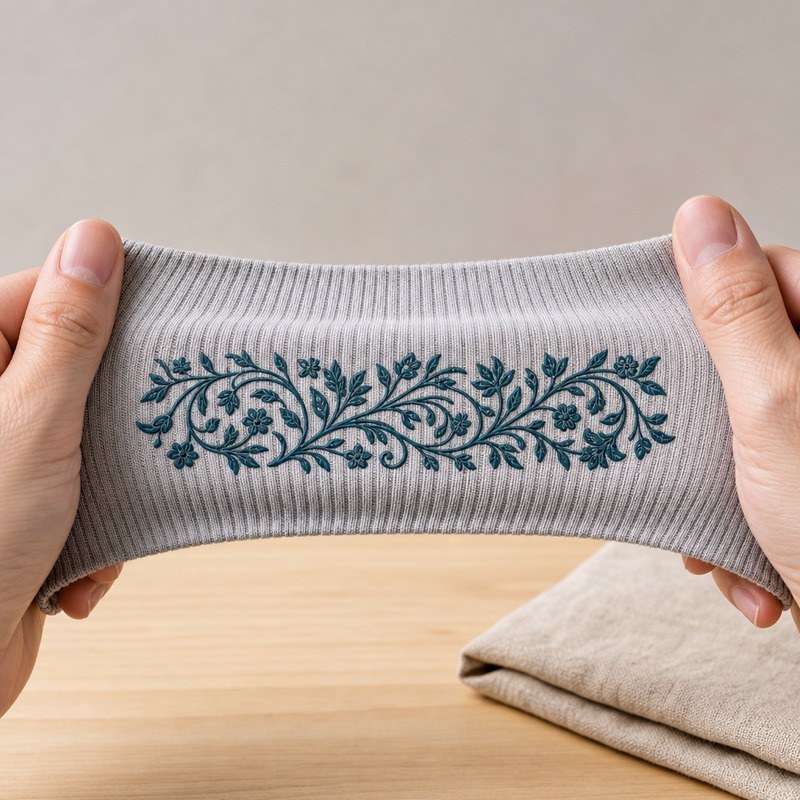
Every wear cycle applies and releases a load across the bond line, so the label has to survive the accumulation rather than a single event. Fabrics with high recovery pull back against a label that does not, and that mismatch is applied exactly where the bonded area ends.
Fabric behaviour under load is measured with tensile testing. ISO 13934-1 covers maximum force and elongation of woven and knitted fabrics (https://www.shimadzu.com/an/apl/16706/index.html), which is why two fabrics with the same fibre content can deform very differently and give different results for the same label.
Surface construction matters as much as fibre. A knit is a field of loops rather than a flat plane, so the bonding system only adheres where it actually contacts fibre. A dense flat knit presents a large contact area; an open or highly textured knit presents far less.
Curved and mobile areas raise the load further. A label on the flat of a back panel experiences a different loading history from one on a waistband, a cuff, a knee or an elbow, and the same label and process can pass in one location and fail in another.
That is why validation has to reproduce the load case rather than a flat adhesion check. If the test does not include a stretch-and-recover cycle on the production fabric, it is not testing the dominant failure mode for this garment type.
Matching the symptom to the cause
This table narrows the possibilities before any adjustment is made. It is a diagnostic starting point, not a substitute for controlled testing where the garment specification calls for it.
| Symptom | Most likely cause | How to confirm it |
|---|---|---|
| Corners lift straight after pressing | Uneven contact, pressure or dwell time | Review pressure distribution, platen condition, seams and folds in the pressing area |
| One area releases, the rest holds | Local contact loss from fabric thickness or a wrinkle | Compare the failed zone with a good sample and check the fabric surface underneath |
| Crack along a thin graphic feature | Label stiffness or geometry that cannot deform with the fabric | Flex a pressed sample by hand under raking light and look for stress whitening |
| Fails only after laundering | Durability was never validated, or the fabric finish degrades in wash | Run the laundering conditions defined in ISO 6330:2021 separately from the adhesion check (https://www.jamesheal.com/standards/iso-63302021) |
| Fails only in wear | Repeated stretch and recovery at a mobile garment location | Add a stretch-and-recover cycle on the production fabric to the release criteria |
| Whole label detaches | Bonding system incompatible with this textile | Inspect the separation interface before adjusting any process setting |
What raising the temperature will not fix
Extra heat is a common first response and often makes things worse. If the cause is an incompatible bonding system, uneven contact or a construction that cannot deform with the fabric, a higher setting will not correct it and may damage the garment or the label system itself. Published durability figures also depend on the test protocol rather than on the label alone: one peer construction is quoted with washing at 45 °C for 45 minutes across 10 cycles (https://www.dgtriangle.com/heat-transfer-silicone-material/customized-silicone-heat-transfer-labels/cmyk-silicone-heat-transfer-labels.html), while another is quoted at 40–60 washes of 30 minutes (https://www.aomingprinting.com/good-quality-heat-sublimation-printer-3d-silicone-heat-transfer-sticker-labels-for-clothing-aoming-product/). Those numbers are not interchangeable, and neither replaces a test on your own fabric.
Can silicone heat transfer labels be used on spandex fabrics?
They can, and suitability depends on the specific textile, the label system and the application method rather than on the fibre name alone. The combination has to be tested on the actual fabric.
Is the peeling caused by the silicone or by the adhesive layer?
The failure interface answers that question. A label that comes away cleanly with the fabric surface intact indicates a release at the interface, while fibre or finish pulling away with the label points to a failure inside the fabric or its treatment.
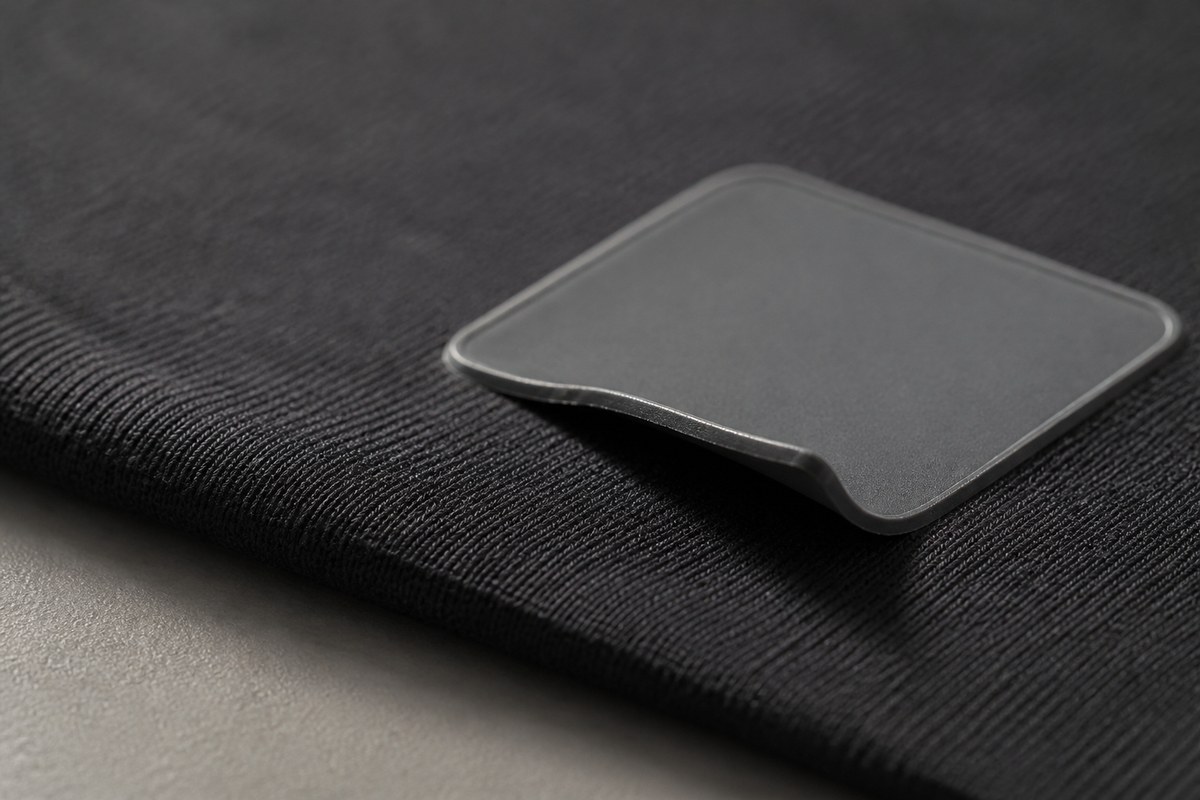
A definite perimeter failure looks like this: the label has lifted along one edge while the rest of the bonded area is still attached. That pattern points towards local stress concentration rather than a wholesale bonding failure.
Comparing the exposed fabric underneath with an unused sample is the next step. If fibre or finish has come away with the label, the interface has failed at or inside the fabric rather than at the label.
Reliable performance is a property of the whole system: textile, label construction, bonding system, application conditions and how the garment is used. Validate on the production fabric, with the production equipment, before bulk application.
Sources and further reading
- Tensile testing of fabrics — ISO 13934-1 strip method, covering maximum force and elongation. https://www.shimadzu.com/an/apl/16706/index.html
- ISO 6330:2021 — domestic washing and drying procedures for textile testing, used to define laundering conditions in durability protocols. https://www.jamesheal.com/standards/iso-63302021
- Silicone heat transfer application guidance, including the role of temperature, pressure and dwell time. https://www.visionsub.com/silicone-heat-transfer-application-tips/
- How silicone heat transfer labels differ from other labelling methods. https://www.colorpglobal.com/news/the-difference-between-silicone-heat-transfer-labels-other-labeling-methods/
- Peer-published wash durability for a silicone heat transfer construction: 45 °C, 45 minutes, 10 cycles. https://www.dgtriangle.com/heat-transfer-silicone-material/customized-silicone-heat-transfer-labels/cmyk-silicone-heat-transfer-labels.html
- Peer-published wash durability and transfer parameters for a 3D silicone heat transfer label. https://www.aomingprinting.com/good-quality-heat-sublimation-printer-3d-silicone-heat-transfer-sticker-labels-for-clothing-aoming-product/
About this answer
Prepared by the engineering team at FromRubber (Dongguan Bohao Electronic Technology Co., Ltd.), which develops custom silicone heat transfer labels and silicone patches for apparel. Sample evaluation is carried out on the customer's production fabric so that compatibility and deformation are assessed together rather than assumed.
Send the fabric composition, the elastane content, the garment location and photographs of the failure, and the label construction can be reviewed against the actual load case.
Review heat transfer patch options