Silicone Heat Transfer Label on Polyester: What Causes Peeling?
- Share
- Issue Time
- Oct 9,2026
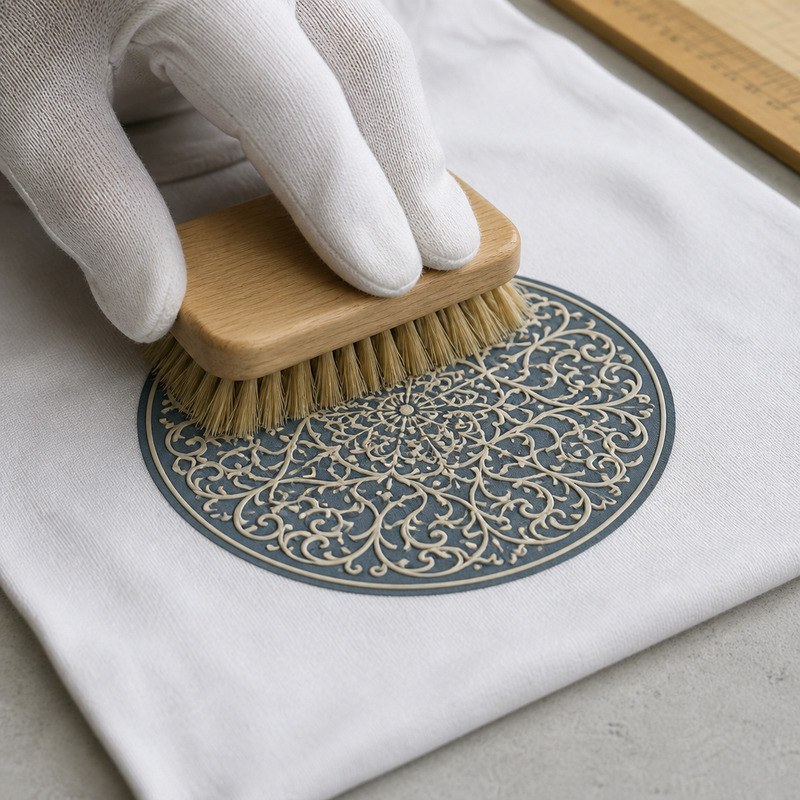
Peeling is a symptom, not a diagnosis. It tells you that something in the label system failed, not which part. On polyester that distinction matters more than usual, because polyester is not a single material: it is a fibre used in many constructions, dyed in different ways, with and without finishes, supplied by different mills. A label that peels from one polyester shirt may hold perfectly on the next polyester shirt from the same factory.
The cause has to be located by inspecting the separation interface, checking the actual fabric, reviewing the application conditions, and establishing whether the failure appeared immediately, after cooling, after washing, or only in wear.
What the peeling pattern tells you
- Edge peeling. Lifting along a corner or outer perimeter is the most common pattern. It shows where stress concentrates once the garment starts moving.
- Partial separation. Part of the label releasing while the rest stays bonded almost always points to uneven contact: a seam, a fold, a variation in fabric thickness, or a pressing surface applying inconsistent pressure.
- Complete detachment. The whole label coming away suggests a system-level problem rather than a local one, and the interface is worth inspecting carefully before any adjustment is made.
- Peeling after laundering. A label that survived the press and failed in the wash has usually been assessed against the wrong criterion. Initial adhesion and laundering durability are different measurements.
- Different results on apparently similar polyester. Two polyester fabrics with the same fibre content can differ in knit structure, surface texture, dye class and finishing, and those differences change how a bonding system behaves on them.
Surface resistance is part of the durability picture, but it is a different property from bond strength, and passing one does not demonstrate the other.
Test programmes frequently conflate the two and then cannot explain why a label that survived an abrasion check peeled in the wash. Running the two checks as separate tests with their own criteria removes that ambiguity.
Separating fabric, label and process
Working through this sequence usually shows which category applies before any change is made. Changing the whole process at once produces a result that cannot be interpreted.
- Inspect the separation interface. Determine whether the label came away cleanly from the fabric surface, or whether part of the bonding layer or fabric surface came with it. This single observation eliminates more possibilities than any other step.
- Check the polyester fabric. Confirm composition, construction and surface finish, and verify that the production fabric matches the fabric used for the approved sample. Batch and finish changes are easy to miss.
- Review the application parameters. Compare actual temperature, pressure, dwell time, equipment setup and post-application handling against the specified process.
- Compare multiple samples. Establish whether the problem appears on every sample or only on one fabric lot, one garment location or one production run.
- Reproduce the failure under control. Change one factor at a time so the result can be attributed to something specific.
- Separate initial adhesion from long-term durability. Evaluate immediate bonding, edge lifting and laundering as distinct tests with their own criteria.
Handling matters more than it looks. A transfer that has picked up contamination or been creased in storage can produce locally unbonded areas even when the process itself is correct, and those areas typically stay hidden until the first wash.
If failures cluster along a fold line or a handled edge rather than at random, the problem may have started before the garment reached the press.

Causes that actually apply to polyester
| Cause | What you would observe | What to check |
|---|---|---|
| Bonding system not matched to the fabric | Clean release with the fabric surface intact, across most samples | Whether the label system was ever qualified on this specific construction |
| Temperature outside the working window | Weak or inconsistent bonding that looks acceptable at first | The label supplier's specified window, confirmed on this fabric and press |
| Incorrect or uneven pressure and dwell time | Localised release, often along one edge or around a seam | Pressure distribution and platen condition across the whole pressing area |
| Water-repellent or other surface treatment | Poor bonding on treated fabric while untreated fabric of the same fibre bonds normally | Whether the patch is bonding to the finish rather than the fibre |
| Fabric construction and surface texture | Different results on two fabrics with identical fibre content | Real contact area on the actual knit or weave |
| Insufficient cooling or post-application handling | Failures that appear after the garment has left the line | Whether the specified cooling or waiting period was followed |
| Label geometry or stiffness | The label stays attached but deforms, or releases along thin sections | Size, thickness and edge design against how the garment moves |
Most peeling complaints resolve into one of three categories: an interface that never bonded properly, a construction that cannot deform with the garment, or a fabric surface that does not suit the bonding system. Published transfer parameters differ between suppliers — 160–170 °C for 15 seconds in one peer specification (https://www.dgtriangle.com/heat-transfer-silicone-material/customized-silicone-heat-transfer-labels/cmyk-silicone-heat-transfer-labels.html) and 150–160 °C for 15–20 seconds in another (https://www.aomingprinting.com/good-quality-heat-sublimation-printer-3d-silicone-heat-transfer-sticker-labels-for-clothing-aoming-product/) — which is why the correct window is the one confirmed on your own fabric and equipment.
What extra heat will not solve
Increasing temperature or pressure is not a universal fix. If the cause is an incompatible system, a treated surface or a construction that cannot deform, extra heat will not correct it and may damage the garment or the label. An initial adhesion check is also not a durability test: passing it says the label bonded today. Durability has to be tested on its own terms, using laundering conditions defined for the purpose such as those in ISO 6330:2021 (https://www.jamesheal.com/standards/iso-63302021).
Can silicone heat transfer labels be used on 100% polyester?
Yes, but suitability depends on the specific fabric and the label system rather than on the fibre percentage. A dense flat polyester knit and an open textured one are different substrates even though both are 100% polyester.
Can a water-repellent finish cause the label to peel?
Certain finishes and coatings can interfere with bonding, and treated fabrics should be evaluated through representative samples rather than assumed to behave like untreated ones.
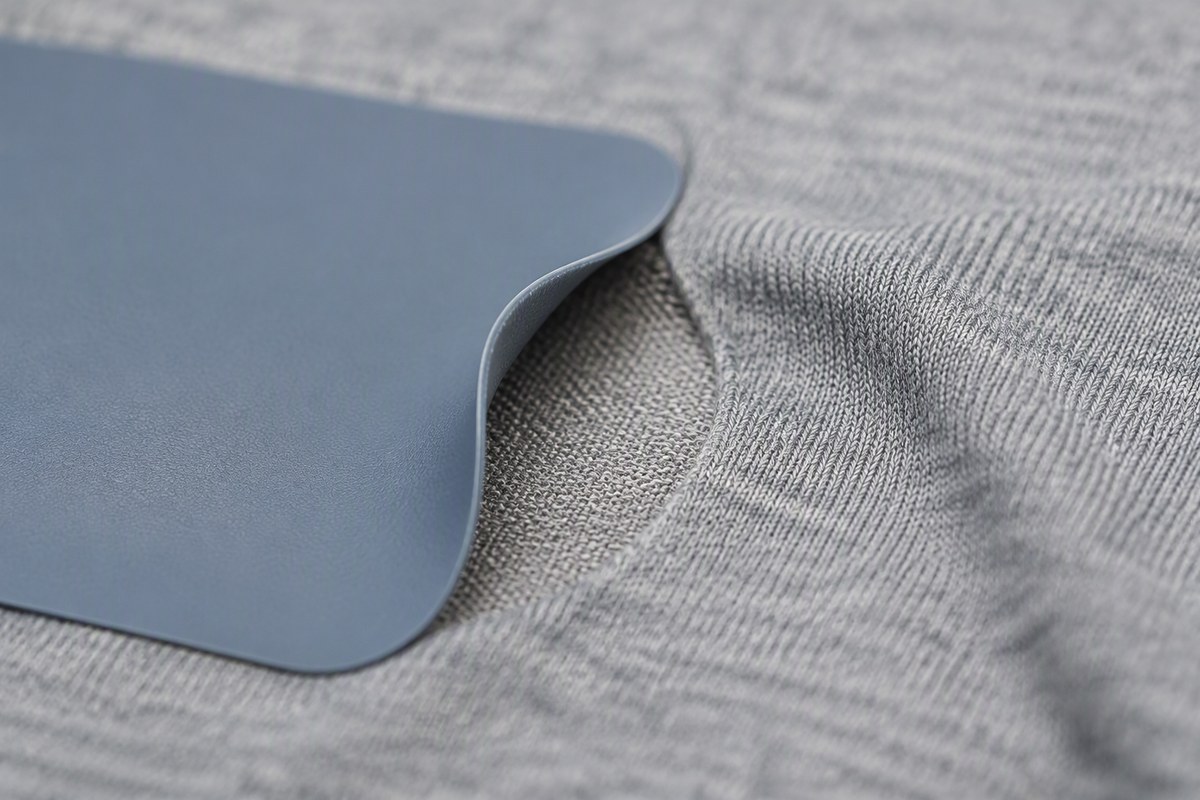
The pattern here is characteristic of an interface problem rather than a material failure: the label is intact, the bond line has released, and the fabric surface beneath is visible.
Three actions resolve most peeling investigations. Identify the failure interface, confirm compatibility using the actual polyester fabric, and validate the complete application process before bulk production. Everything else follows from those three.
Photographs of the failed label and of the exposed fabric surface are more useful to a supplier than a general description, because they show where the separation occurred.
Sources and further reading
- What you should know about dye migration: how heat, dye class and fabric chemistry interact on decorated polyester garments. https://www.extremescreenprints.com/post/what-you-should-know-about-dye-migration
- ISO 6330:2021 — domestic washing and drying procedures for textile testing. https://www.jamesheal.com/standards/iso-63302021
- Silicone heat transfer application guidance, including the role of temperature, pressure and dwell time on adhesion. https://www.visionsub.com/silicone-heat-transfer-application-tips/
- How silicone heat transfer labels differ from other labelling methods. https://www.colorpglobal.com/news/the-difference-between-silicone-heat-transfer-labels-other-labeling-methods/
- Peer-published transfer parameters for a silicone heat transfer construction: 160–170 °C for 15 s. https://www.dgtriangle.com/heat-transfer-silicone-material/customized-silicone-heat-transfer-labels/cmyk-silicone-heat-transfer-labels.html
- Peer-published transfer parameters for a 3D silicone heat transfer label: 150–160 °C for 15–20 s, film thickness 400–500 µm. https://www.aomingprinting.com/good-quality-heat-sublimation-printer-3d-silicone-heat-transfer-sticker-labels-for-clothing-aoming-product/
About this answer
Prepared by the engineering team at FromRubber (Dongguan Bohao Electronic Technology Co., Ltd.), which develops custom silicone heat transfer labels for apparel. Label construction and relevant fabric information are reviewed together during sample development, so a design question is not mistaken for an application problem.
Send the fabric construction, the finish, the label size, the process settings actually used and photographs of the failure, and the system can be assessed as a whole.
Review heat transfer patch options