silicone/rubber keyboard and parts custom process!!
- Share
- publisher
- karl
- Issue Time
- Jan 3,2024
Summary
The silicone keypad custom process is seven steps, each with one decision that cannot wait. Where projects actually stall, and how to tell where a programme is by which documents exist rather than what the supplier says.

Programme map / custom keypads - reviewed 11 November 2026
The silicone keypad custom process is seven steps from a drawing to a production lot, and each step has one decision that cannot be made later. Skipping any of them moves the decision to a point where it costs steel instead of time.
Written as a map rather than a description, the process is easy to audit: you can see where a project is by which documents exist, not by how long the supplier says it has been working.
Definitions. The custom process is the sequence from design input to mass production: design intake, prototype mould, sample delivery, confirmation, modification if required, production mould, and production. A prototype mould is a single-cavity tool for proving geometry; a production mould is a multi-cavity tool sized for volume.
Step one: what "design input" means
Three inputs cover most projects: an actual sample, a 3D file, or a PCB with its housing. Each answers a different question. The sample answers fit and feel, the 3D file answers geometry, and the PCB answers the contact layout. A project that supplies none of them is not yet at step one.
Steps two to four: prove it, ship it, check it
The prototype mould turns the design into a part, the sample travels to the customer, and confirmation is a measurement, not an impression. The check should cover fit in the housing, force at the keytop and contact resistance, because those three are what the production tool will reproduce.
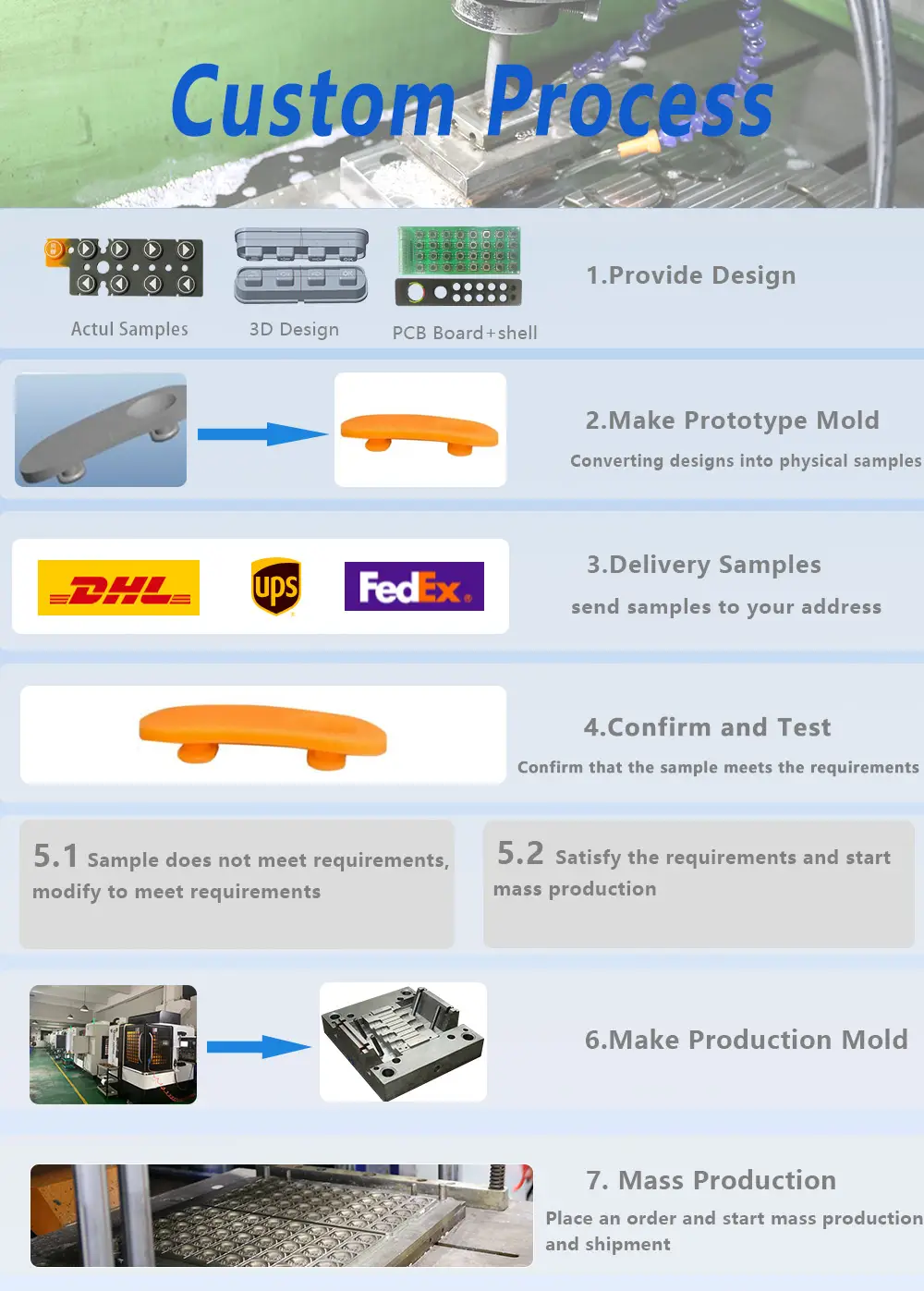
The seven steps of the silicone keypad custom process
| Step | Output | Decision that cannot wait |
|---|---|---|
| 1. Design input | Sample, 3D file or PCB plus housing | Which reference is authoritative |
| 2. Prototype mould | Trial part | Whether feel and fit are acceptable |
| 3. Sample delivery | Part at the customer | What will be measured, and how |
| 4. Confirm and test | Signed approval or a defect list | Whether to modify or proceed |
| 5. Modify if required | Revised tool or geometry | Which change is worth the cost |
| 6. Production mould | Multi-cavity tool | Cavity count and plate size |
| 7. Mass production | Lots with inspection records | Packing standard and AQL |
Step five is the one that gets skipped
When a sample is close but not right, the temptation is to accept it and fix the issue in production. That decision moves a tool change into the most expensive stage. A structured modification list, with the force, fit and cosmetic items separated, keeps the change small and the schedule honest.
Step seven is not the end of the process
A production lot generates a first-article record and an inspection plan that the re-order will depend on. A programme that ends at shipment without those documents starts again from a drawing when the buyer re-orders eighteen months later.
How to tell where a project actually is
Ask which documents exist rather than what stage the supplier says it is at. A project with a prototype report and a signed sample is further along than one with a promise and a photo, and the documents also tell you what was decided, which is what the re-order will need.
Commissioning a keypad programme
Start with the design input and ask for the seven steps to be mapped onto a schedule. The production process overview shows how the stages connect, and the silicone keypad manufacturing section covers the keypad-specific route.
How long does the custom process take?
It is the sum of seven intervals, and two of them belong to the customer: supplying the design input and approving the sample. Those two are usually what extend a schedule.
Can steps two to five be skipped?
They can be combined when the geometry is already proven in another material. For a new keypad with a force target, skipping them moves the risk into the production tool.
Stage names describe a typical programme. Specific suppliers may combine steps, but the decisions listed remain the customer's.
To start at step one, send the sample or file through the quotation file checklist.