How to find a Pos machine replace keypads?
- Share
- publisher
- Nani Gui
- Issue Time
- Mar 19,2024
Summary
A POS machine keypad replacement hinges on one question: is the keypad inside the terminal's security boundary? What can be remade, what must come from the terminal maker, and which dimensions a replacement has to match.

POS hardware / replacement keypads - reviewed 11 November 2026
Finding a POS machine keypad replacement starts with one question that decides everything else: is the keypad part of the terminal's security boundary? If it is, the part is controlled by the terminal maker and cannot be freely remade. If it is not, a replacement is an ordinary moulded keypad job with a short list of measurements.
The distinction matters because payment terminals are built to detect tampering, and a keypad is often part of that detection. Remaking one without authorisation is not a sourcing problem; it is a compliance problem.
Definitions. A POS machine keypad is the moulded input panel on a point-of-sale terminal, covering the numeric block, function keys and often the magnetic stripe or contactless area. A tamper-evident assembly is a housing designed to show or respond to intrusion, and its keypad may carry conductive traces tied to that circuit. A replacement part is either an authorised service component or a compatible non-secure moulding, and the two are not interchangeable.
What to identify first
The terminal model and revision, the key count and layout, the mounting method, and whether the keypad carries any conductive trace beyond the key contacts. A photograph of the underside is worth more than a photograph of the front, because the contact pattern and any shielding layer are what a replacement has to reproduce.
Where replacement is possible
Non-payment terminals, kiosks, ticketing machines, loyalty tablets and industrial controllers use silicone keypads that can be re-tooled or matched from an existing shape. For payment terminals, the practical route is the manufacturer's authorised service part; anything else puts the merchant's compliance at risk.
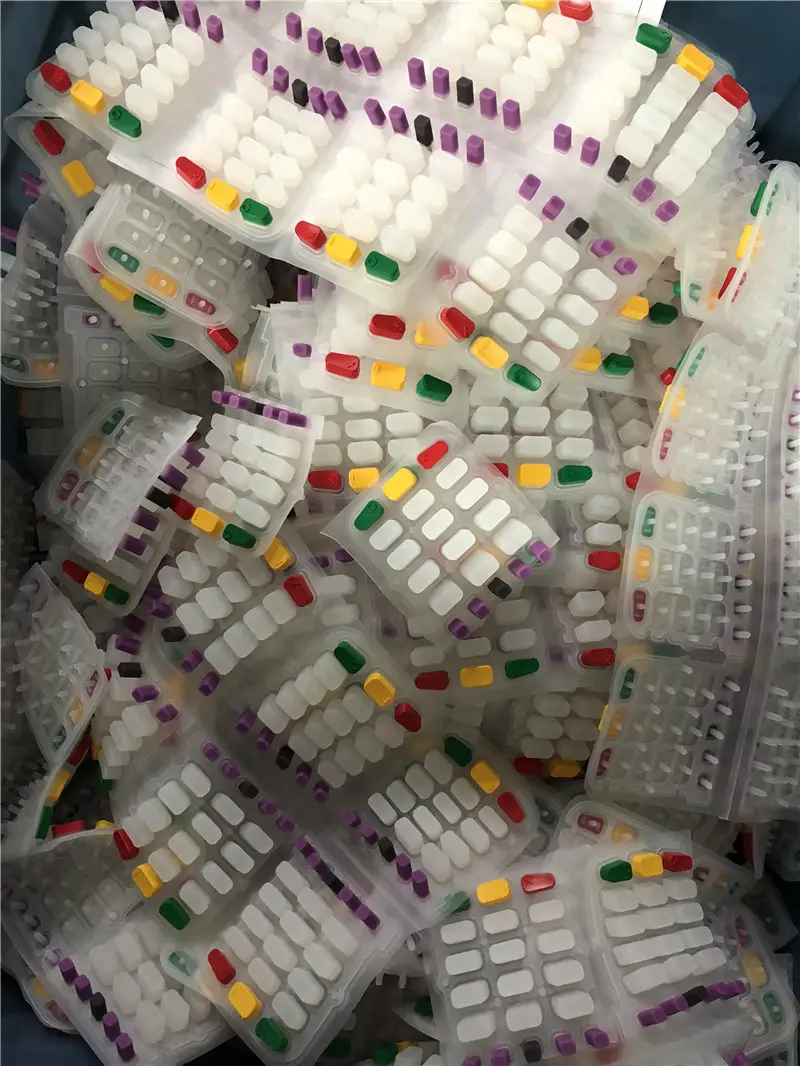
What a POS machine keypad replacement has to match
| Feature | Why it must match |
|---|---|
| Key pitch and outline | The housing opening and the bezel are fixed |
| Contact pattern | The PCB pads are already laid out |
| Travel and force | The user's habit and the bezel clearance |
| Legend layout | Mislabelled keys cause operator error, not just complaints |
| Mounting method | Adhesive, bezel clamp or captured flange |
| Materials and finish | Cleaning agents and the surrounding plastic colour |
Re-tool or match an existing shape
If the terminal is still supported, the fastest route is a moulding matched to an existing shape the factory already holds. If the shape is unique, a single-cavity tool is usually enough for a service-part volume, and it avoids paying for cavities the volume will never fill.
Service parts have their own economics
Replacement volumes are small and unpredictable, which makes a low-cavity tool the sensible choice and makes stock-holding more valuable than unit price. A supplier who can hold a small buffer of finished keypads is worth more here than one who quotes three percent less with a month of lead time.
Matching without a drawing
When no drawing exists, the practical route is a measured copy: the physical part is measured at the key pitch, the outline, the key height and the contact pattern, and a drawing is produced for approval before tooling. That step costs a day and prevents a tool cut to a part that was already worn or distorted.
Commissioning a replacement keypad
Send the terminal model, the physical part and the quantity. The silicone keypad manufacturing section covers the tooling route, and the custom silicone rubber keypad page shows a comparable construction.
Can a payment terminal keypad be remade by a third party?
Generally no. Keypads in tamper-evident terminals are part of a certified assembly, and replacement should go through the terminal manufacturer's authorised service channel.
What if the original drawing is lost?
The part can be measured and redrawn. That drawing should be approved before tooling, because a worn sample carries its own distortion.
Compliance for payment terminals rests with the terminal manufacturer and the acquirer. This article describes moulding practice, not authorisation to reproduce a certified security component.
For a service-part programme, send the physical part and quantity through the quotation file checklist.