Custom Button Pad Manufacturer: Your Partner for High-Quality Rubber and Conductive Buttons
- Share
- publisher
- karl
- Issue Time
- Oct 8,2024
Summary
A custom button pad manufacturer is being asked for a tool that holds a web profile, a legend that survives wear, and a stack that lines up with a PCB. What to measure on the first article, and why the housing belongs in the brief.

Keypad sourcing / supplier evaluation - reviewed 11 November 2026
A custom button pad manufacturer is being asked for three things at once: a tool that holds a web profile, a print or mould that carries the legend, and a stack that lines up with aPCB. Only the first is visible in a sample. The other two decide whether the pad works after assembly, which is why the evaluation should be about process rather than about the word "partner".
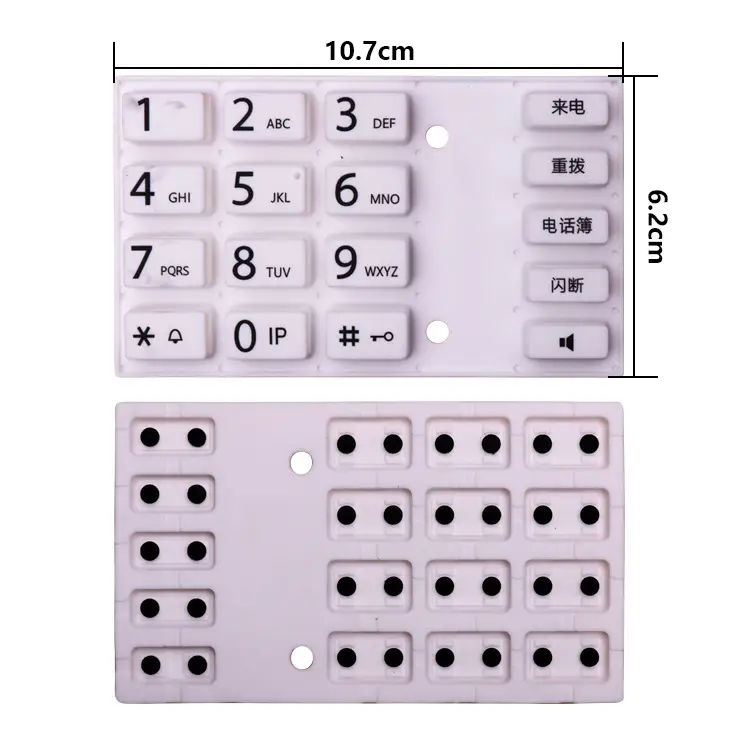
The pad itself is usually small, and small parts are where tolerance stacks hide. A pad of roughly 107 by 62 mm with a dozen keys has enough cumulative variation across its length to put the outer pills off their contacts if the tool and the housing are not designed together.
Definitions. A button pad is a moulded sheet carrying several keys on individual webs, usually with conductive contacts underneath. Web geometry is the profile of the thin membrane that returns each key, and it sets both force and snap. The pad footprint is the overall outline, and it matters because shrinkage and print registration both accumulate across the longest dimension.
What the pad drawing has to carry
Beyond the outline, a pad needs the key pitch, the travel, the force target, the web profile, the contact type and the location features. Without those, a supplier can only reproduce a shape, and a shape is not a keypad. The fastest way to see whether a manufacturer thinks this way is to send the outline alone and read the questions that come back.
Footprint drives the tool, not just the price
On a pad of this size, a single-cavity tool is normal, and the press plate has to accommodate the whole footprint with room for the flash line. That is why two factories can quote the same drawing very differently: one has a plate that fits, the other has to build a larger tool or nest the part in a way that changes the cycle.
What to evaluate in a custom button pad manufacturer
| Capability | Evidence | Question that exposes it |
|---|---|---|
| Web design | Force-travel curve from a comparable pad | What force did the last similar pad measure at the keytop? |
| Tool precision | Location features and pitch tolerance on the drawing | How is the tool located in the press, and how is that recorded? |
| Legend | Moulded, printed or laser, and the wear test used | What wipe or abrasion test does the legend pass? |
| Contact | Carbon pill geometry and end-of-life resistance | What is contact resistance after the rated cycles? |
| Assembly fit | Housing interface and clamp design | Is the pad tested mounted, or loose? |
The first article should be measured, not admired
Force and travel at four keys, contact resistance at the two extremes of the pad, and the pitch across the longest dimension. Those four measurements catch most of the problems that a visual check misses, and they catch them before assembly rather than after.
Why the housing belongs in the conversation
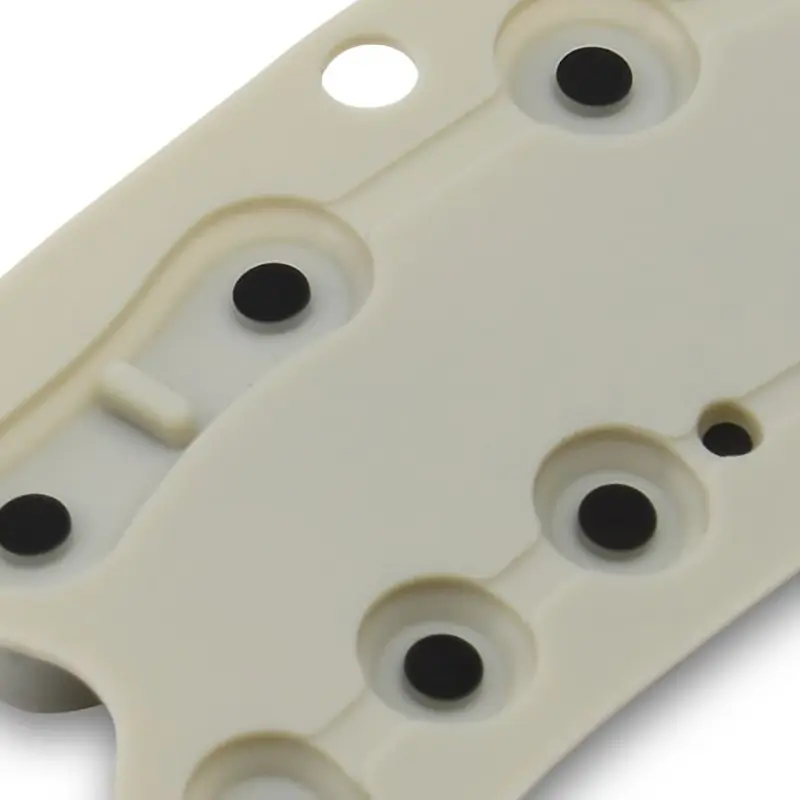
A pad clamped in a bezel behaves differently from a pad sitting on a bench: the perimeter is restrained, the base cannot bow, and the force rises. A supplier who asks for the housing drawing is a supplier who has seen a pad fail after installation.
Where the cost actually sits
For a pad of this size, tooling is the dominant one-off and the moulding cycle is the dominant recurring cost. Decoration adds a per-pass cost, and inspection adds a fixed element per lot. A quotation that does not separate those three cannot be compared with another, because the difference may simply be that one supplier assumed a printed legend and the other assumed a moulded one.
Commissioning a button pad
Send the outline, the PCB layout and the housing interface. The silicone keypad manufacturing section covers the tooling route, and the custom silicone rubber keypad page shows a comparable construction.
How do I compare two button pad quotes?
Ask both to state cavity count, web profile, decoration route and the inspection standard. A quote missing any of those is an assumption, not a price.
Can a pad be made without a housing drawing?
It can be made, but it cannot be validated. The clamp changes the force curve, so the pad should be tested in its bezel.
What pitch tolerance is realistic?
It depends on the footprint and the tool. The practical approach is to mark the pitch as a functional dimension and let the rest sit in a general class.
Force, pitch and resistance values depend on the design and the assembly. They should be recorded in a first-article report rather than inferred from a sample photograph.
For a pad programme, send the outline and PCB layout through the custom silicone quotation route.