Custom Gasket Ordering Guide | FromRubber
- Share
- publisher
- karl
- Issue Time
- Jun 27,2025
Summary
A custom gasket order goes wrong on two things: the drawing never said what the seal faces, or the tolerance was set tighter than the process holds. What to send, how to read the quote, and why compression ratio is always missing.

Sealing components / ordering - reviewed 11 November 2026
A custom gasket order goes wrong in one of two places: the drawing did not say what the gasket has to seal against, or the tolerance was written tighter than the process can hold. Both are cheap to fix before the tool and expensive after, and both are visible in the first page of a well-made enquiry.
Gaskets are the least glamorous moulded part and the easiest to under-specify, because the shape looks trivial. The shape is trivial. The compression, the medium and the flatness of the mating face are not.
Definitions. A custom gasket is a moulded or cut seal made to a specific joint rather than a standard size, so the section, the hardness and the flatness are all part of the design. Compression set is the permanent deformation remaining after a seal has been squeezed at temperature for a period, and it is what ends a gasket's life. Compression ratio is the percentage by which the section is squeezed in service, and it is the single number most often missing from a drawing.
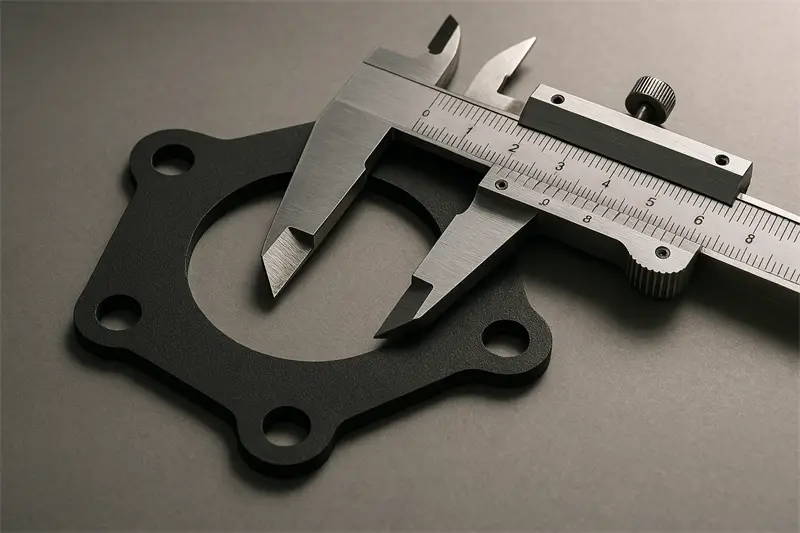
What a custom gasket enquiry should contain
| Input | Why it changes the part | Typical omission |
|---|---|---|
| Medium and concentration | Selects the compound, including fluorosilicone where hydrocarbons are present | "Water and oil" with no detail |
| Temperature, continuous and peak | Sets hardness and compression set limits | Ambient quoted instead of flange temperature |
| Compression ratio | Decides section thickness and groove depth | Section copied from an old drawing |
| Mating face flatness | Determines whether a soft gasket can conform | Assumed flat because the drawing is flat |
| Tolerance class | Sets the tool and the inspection plan | Two-decimal tolerances on every dimension |
| Annual and peak volume | Sets the cavity count and the process | A single annual figure with no seasonality |
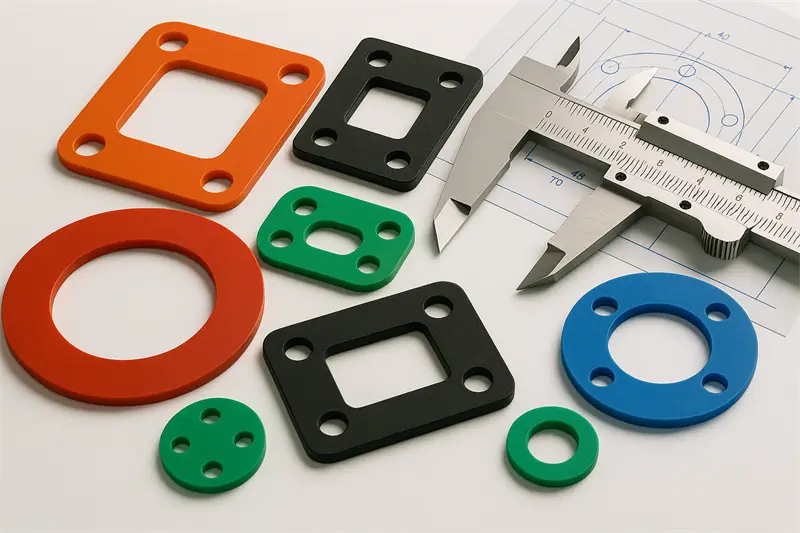
The tolerance conversation
Moulded rubber moves
Silicone shrinks during cure, and the amount depends on the section, the compound and the tool temperature. A drawing that specifies a tight tolerance on every dimension is asking the moulder to control shrinkage everywhere at once, which usually means a more expensive tool and a slower cycle for dimensions that do not matter. The practical approach is a general class, such as a moulded-rubber tolerance class, plus two or three dimensions marked as functional.
Cut versus moulded
A flat gasket with simple geometry can be cut from sheet, which avoids tooling and suits low volume. The moment the part needs a moulded bead, a non-uniform section or a 3D curvature, it becomes a moulded part with a tool and a cavity count. Sending a section drawing with the bead profile marked lets a supplier say which route you are actually asking for.
Reading the quotation
Three lines decide whether two gasket quotes are comparable: the compound grade, the cavity count, and the inspection standard. A quote that names only a hardness is not naming a material. A quote without a cavity count is not committing to a tool. A quote without an inspection standard is leaving the cosmetic acceptance to whoever packs the box.
Ask also whether post-cure is included. For a seal that will sit against a hot flange for years, volatiles are not cosmetic; they change compression set and, in a closed housing, they condense on whatever is coldest.
Sampling and first article
A prototype cavity proves the section, the hardness and the fit before a multi-cavity tool is cut. The first-article report should record the sealing dimensions, the hardness and the compression set of the trial lot, not only the outline. That record is what makes a re-order in eighteen months the same part rather than a similar one.
Commissioning a gasket
Send the section drawing with the joint it seals against, the medium list and the volume. The custom silicone rubber parts range covers the formats, and the moulded rubber gaskets for instrument sealing page shows a typical build.
What is the most common gasket ordering mistake?
Specifying the shape and leaving out the compression ratio and the mating face condition. Both decide whether the seal works, and neither is visible on a 2D drawing.
Should a gasket be cut or moulded?
Cut for flat, simple profiles at low volume; moulded when the part needs a bead, a varying section or a 3D form. The section drawing usually makes the answer obvious.
How tight should the tolerance be?
As loose as the function allows, with a published class as the default and two or three dimensions marked as functional. Tighter tolerances on a rubber part buy cost, not accuracy.
Sealing performance depends on the joint, the compression and the medium together. Values quoted by a supplier should be validated on the assembled hardware, not on a free sample.
For a gasket programme, send the section drawing and the medium list through the quotation file checklist.