Top 5 Applications for Silicone Thin-Film Switches in 2025
- Share
- publisher
- Suey
- Issue Time
- Jul 28,2025
Summary
Silicone thin-film switches are a layered stack, not a moulded part. Where the flat construction wins, where a moulded keypad is still the better buy, and the four failures worth designing against.

Interface construction / thin-film switches - reviewed 11 November 2026
A silicone thin-film switch is a stack of layers rather than a moulded part: graphic overlay, spacer, circuit, and a tail that carries the signal to the board. That construction buys a flat face, a low profile and a low unit price, and it costs the one thing a moulded keypad gives away for free: a seal that survives being washed.
The two technologies are often specified against each other, which is the wrong frame. They answer different questions, and the useful decision is which of the two questions the product is actually asking.
Definitions. A silicone thin-film switch is a membrane switch whose overlay is silicone rather than polyester, giving a softer touch and better temperature range while keeping the layered circuit underneath. The tail is the flexible extension that carries the circuit to a connector. Silver migration is the movement of silver ink between adjacent tracks under moisture and voltage, and it is the failure that ends most thin-film switch lives in humid environments.
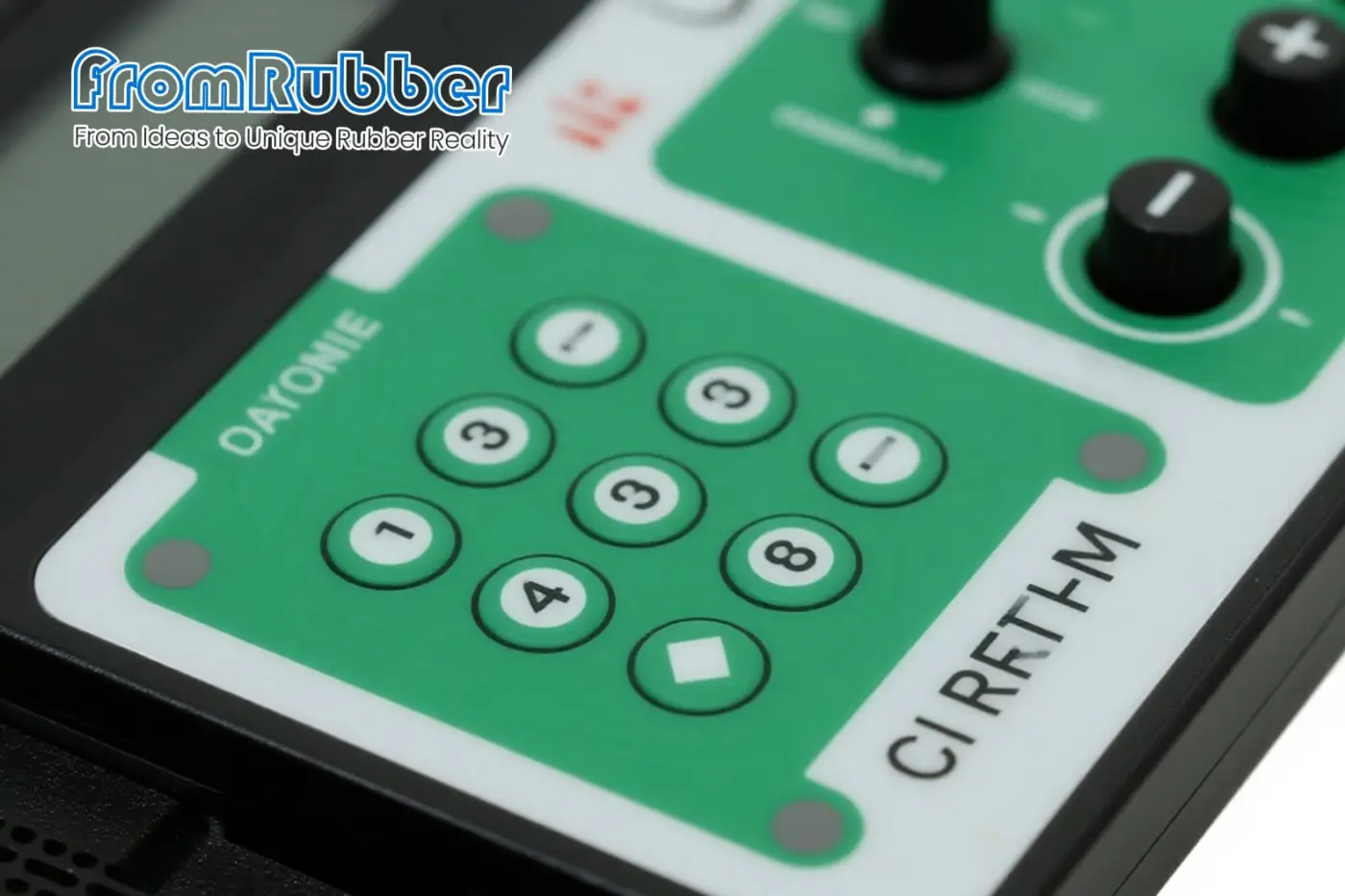
Where silicone thin-film switches win
| Requirement | Thin-film switch | Moulded silicone keypad |
|---|---|---|
| Flat, low-profile face | Best fit; stack can sit under 1 mm | Needs key travel, so a raised profile |
| Sealing against wash-down | Depends on the adhesive bond line | Moulded bead plus clamp is more robust |
| Cost at low volume | Lower tooling, faster to first article | Higher tool cost, longer sample cycle |
| Legend durability | Printed under the overlay, wears at the edge | Moulded legends cannot wear |
| Tactile feedback | Metal domes provide the snap | Web geometry provides the snap |
Five applications where the flat stack is the right answer
Handheld instruments with a sealed front
A meter or analyser usually has a display, four to eight keys and a housing that is already sealed elsewhere. A thin-film switch lets the whole front be one flat surface with no key openings, which is easier to wipe and cheaper to tool than a moulded panel with a bezel.
Appliance control panels
White goods and small appliances want a printed graphic with hidden-until-lit indicators. That is a print job, not a moulding job, and the volumes justify the tooling.
Medical disposables and bench equipment
Where the panel is replaced with the device or cleaned between patients, a flat overlay with a sealed tail entry removes the recess where contamination collects.
Failure modes worth designing against
Four failures account for most field returns. Silver migration between tracks under humidity, which is controlled by track spacing, encapsulant and a vented spacer. Tail fatigue where the tail exits the housing, which is controlled by a bend radius and a strain relief. Delamination at the overlay edge, which follows from adhesive choice and surface cleanliness. And dome wear, where a metal dome loses its snap after a few hundred thousand presses and the key stops confirming.
None of those are visible in a sample. They appear in a life test with humidity cycling, which is why the test plan matters more than the first article for this technology.
Deciding between the two
If the product needs a flat face, printed graphics and a low tooling cost, and the environment is dry, thin-film is usually correct. If it needs a seal that survives a jet, legends that cannot wear, or a tactile feel that works through gloves, a moulded keypad is the better buy even at higher tooling cost. When both are needed, the usual compromise is a moulded silicone keypad with a printed overlay bonded into it, which gives the seal of the first and the graphics of the second.
Commissioning a thin-film switch
Send the panel artwork, the circuit layout, the tail position and the environment. The silicone keypad manufacturing section covers the moulded alternative, and the waterproof membrane switch page shows a sealed appliance build.
Is a thin-film switch waterproof?
The overlay can be, but the seal depends on the adhesive bond line and the tail entry. A jet test is a different requirement from a splash test, and it should be stated.
How long do thin-film switches last?
Life is set by the dome and the circuit rather than the overlay. Silver ink circuits and metal domes are rated in cycles, and the number should be tested under humidity rather than at ambient.
Can thin-film switches have backlighting?
Yes, with a light guide layer or discrete LEDs. The layer adds thickness and changes the tactile feel, so it belongs in the stack drawing from the start.
Life and ingress figures depend on the full stack and the installation. They should be established by testing the assembled panel rather than the overlay alone.
For a switch construction review, send the artwork and the tail drawing through the custom silicone quotation route.