Global Trends: How Silicone Patches Are Influencing Fashion Worldwide
- Share
- publisher
- Suey
- Issue Time
- Aug 18,2025
Summary
Silicone patches work in fashion where embroidery cannot: hard edges, abrasion resistance and colour depth. How attachment changes between footwear, denim and headwear, and why the wash protocol belongs in the brief.

Apparel trim / fashion applications - reviewed 11 November 2026
Silicone patches moved from workwear to fashion because they solve a problem embroidery cannot: they hold a hard edge, they survive abrasion where a garment actually wears, and they can be moulded in a shape that reads at arm's length. The trend is real, but the products that last are the ones where the attachment method was chosen for the fabric rather than for the sample photo.
In footwear, denim and headwear the patch is usually doing two jobs at once, branding and reinforcement, which is why the same design that works on a cap front can fail on a stretch denim pocket.
Definitions. Silicone patches are moulded silicone labels applied to textile or footwear, either by a heat-transfer adhesive or by sewing through a moulded channel. Relief height is measured from the base plane to the top of the highest element; below roughly 1.5 mm the patch reads as a printed badge, above it the moulded wall and its shadow become the effect. A bar tack is a short, dense stitch used to anchor a corner that carries load.
Footwear: the patch is also a wear part
On a shoe, a silicone patch often sits where the upper creases. That makes adhesion harder than on a flat panel, because the bond line sees repeated flex and the patch has to move with the leather rather than resist it. A thinner base with a softer compound and a wider adhesive margin survives longer than a thick, stiff badge, even though the thick one photographs better.
Denim and heavy twill: sew, do not glue
Denim is stiff, heavy and washed hard. A heat-transfer patch on a denim pocket usually lifts at a corner after the first industrial wash, because the fabric does not compress evenly under the press. A moulded sew channel, stitched with a bar tack at each corner, is the durable answer and it also survives garment dyeing better than an adhesive.

Where silicone patches are being used now
| Placement | Why a patch | Attachment that works |
|---|---|---|
| Cap front and side | Crisp logo, no stitch holes | Heat transfer on structured panels; sew channel on unstructured crowns |
| Footwear upper and tongue | Abrasion resistance plus branding | Heat transfer with a flexible adhesive, or stitch through a channel |
| Denim pocket and waistband | Hard-wearing, colour depth | Sew channel with bar tacks; adhesive only on non-washed items |
| Sleeve and back panel | Large graphic without weight | Heat transfer, with a test on the actual fabric |
| Bag and accessory | Grip and reinforcement | Rivets or bar tacks where the load is concentrated |
Two colours, then print
Moulded colour cannot peel and survives abrasion, but the tool holds two colours per part. Fashion artwork usually wants four or five, which is why the practical construction is a two-colour moulded base with print for the fine detail, plus a protective coat if the patch will be washed. The print is the wear layer, so it should sit inside the relief rather than on the highest surface.
Testing belongs on the garment
A patch tested on a flat swatch tells you almost nothing about footwear, where the substrate flexes in two directions. The protocol should name the fabric, the wash temperature, the number of cycles, and whether tumble drying is included. Without those four, a durability figure is a marketing number.

Design details that separate a premium patch from a promotional one
Three details do most of the work. A consistent base flatness, because a patch that rocks on a curved panel lifts at the edge first. A defined edge treatment, either a clean chamfer or a deliberate step, because an undefined edge reads as flash. And a surface texture that matches the garment, matte on canvas and satin on leather, since a high-gloss patch on a matte fabric looks like an afterthought.
Commissioning a patch programme
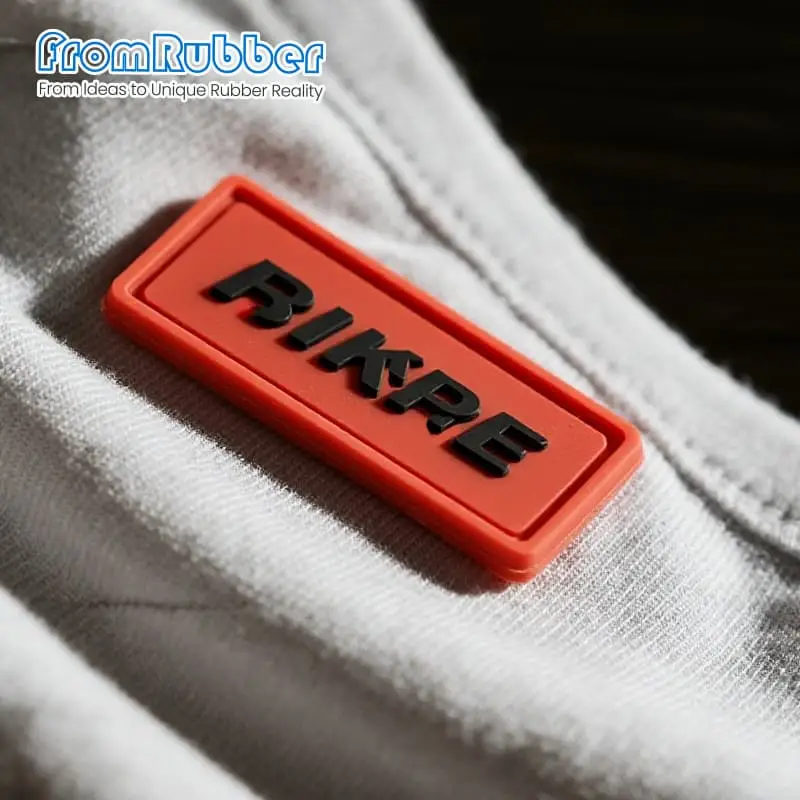
Send the artwork at final size with the substrate and the wash protocol. The custom rubber patches section covers construction options, and the heat transfer patches for clothing page shows a typical applied build.
Do silicone patches survive industrial washing?
The moulded part does; the adhesive and the print are the limits. A sew channel removes the adhesive question entirely, which is why denim programmes usually specify it.
Can a patch be curved to follow a shoe?
It can be moulded with a slight curvature, but a stiff patch on a creasing area will still lift. A thinner, softer base with a wider adhesive margin is usually the better answer.
How thick should a fashion patch be?
Around 1.5 mm of relief is where the moulded edge starts to read. Beyond 3 mm the patch behaves like a rigid tile on soft fabric and the attachment has to compensate.
Durability depends on fabric, adhesive, print system and wash protocol. Any figure quoted by a supplier should be validated on the actual garment before production tooling is released.
For a patch programme, send the artwork and the garment specification through the quotation file checklist.