Top 10 Silicone Keypad Manufacturers Worldwide in 2025
- Share
- publisher
- karl
- Issue Time
- Aug 18,2025
Summary
No public benchmark ranks silicone keypad manufacturers, so the useful comparison is evidence: process ownership, tooling, material range, measurement and programme control. How to shortlist three and quote the same drawing.

Sourcing / manufacturer comparison - reviewed 11 November 2026
There is no published benchmark that ranks silicone keypad manufacturers, and any list that claims to is describing an opinion, a search result or a paid placement. What a buyer can compare is evidence: who owns the process, how tools are maintained, what the measurement bench looks like, and whether the same drawing produces the same part twice. This article sets out that comparison, because it is the part of a "top ten" list that survives contact with a purchase order.
The category is genuinely fragmented. Keypads are made by large contract manufacturers, by small specialist moulders, and by factories that mostly make gaskets and take keypad work between contracts. All three can quote the same drawing, and none of them publishes numbers that make them comparable.
Definitions. A silicone keypad manufacturer moulds the key body, the web and usually the conductive contact in one part, which means the tool, the compound and the inspection plan are all customer-specific. Process ownership means those steps happen on the supplier's own site rather than being passed between subcontractors. A first-article report is the dimensional and force record of the first part from a tool, signed against the drawing.
Why a ranking of silicone keypad manufacturers misleads
Rankings reward size and visibility, and price a programme on neither. A factory with a thousand presses but no engineering time for a 5,000-piece programme is worse for that programme than a specialist with four presses and a force-test rig. The useful comparison is between suppliers matched to your volume, your actuation count and your documentation requirement, not between suppliers ordered by revenue.
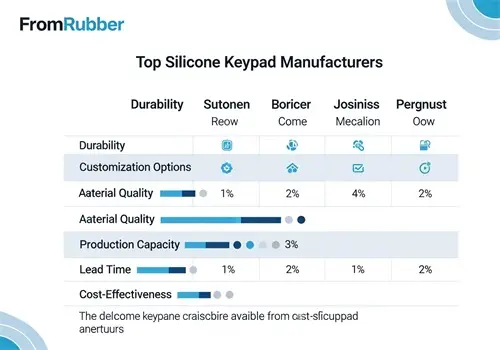

Five axes that actually separate suppliers
| Axis | Evidence to request | What a weak answer looks like |
|---|---|---|
| Process ownership | List of in-house steps, and which are subcontracted | "Everything in-house", with printing done elsewhere |
| Tooling capability | Mould register extract, tool life policy, repair turnaround | A verbal assurance that tools are maintained |
| Material range | Grades held in stock, conductive options, translucent and FR grades | A single general-purpose compound for every job |
| Measurement | Force-travel rig, calibrated instruments, sample first-article report | Inspection described as a visual check |
| Programme management | Named engineer, change-notification rule, response time | Contact only through a sales inbox |
Send the same drawing to two suppliers
The only fair comparison is a controlled one: the same drawing, the same volume, the same decoration sequence and the same cosmetic standard, sent to two or three suppliers. Differences in price then map to differences in assumption, and the assumptions can be discussed. A quote that arrives without a stated cavity count, decoration route and inspection standard cannot be compared with anything.
Ask for the force curve, not the datasheet
Actuation force and snap ratio are properties of the geometry and the compound together, so a datasheet cannot answer the question. A supplier that can produce a force-travel curve from a comparable part is showing you that it measures what it sells.
What a shortlist should contain
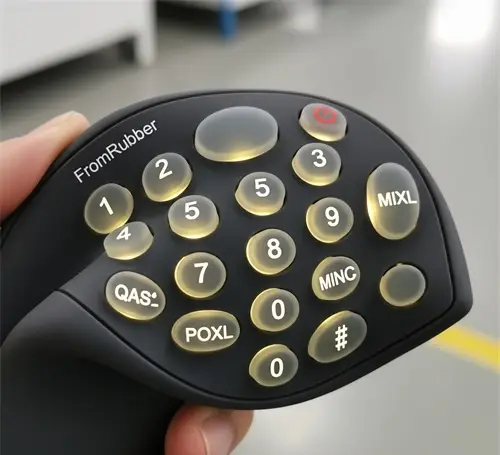
Three names is usually enough: one specialist in your product category, one mid-size factory that can scale, and one low-cost option to establish the floor. Beyond three, the comparison cost outweighs the information. Each should be asked the same five-axis questions in writing, and each should quote the same drawing with the cavity count stated.
Red flags worth acting on
A quote with no cavity count. A refusal to provide a first-article sample. A mould that is described as "ours" without a written ownership clause. A change of compound mentioned after the trial, rather than before. Any of these is cheaper to resolve before the tool is cut than after.
Where geography actually matters
Region affects lead time, freight and the ability to visit, not quality by itself. A supplier you can audit in a day is worth a premium when the part is safety-related; a supplier you can only reach through email needs a stronger documentary trail to compensate.
Commissioning the comparison
Start with the drawing and the volume, and ask for the five axes in writing. The silicone keypad manufacturing section describes one supplier's process, which is useful as a reference for the questions rather than as a ranking. The custom silicone rubber keypad page shows the standard construction a quote should be based on.
Is there a reliable list of top keypad manufacturers?
No public benchmark ranks them on comparable evidence. Lists reflect visibility or advertising. The workable approach is to shortlist three suppliers matched to your volume and compare the same drawing.
Should I choose the largest supplier I can find?
Only if your volume justifies the engineering attention. Large factories allocate engineering by programme value, so a small account can wait behind a large one.
How many suppliers should I sample?
Two or three. More than that multiplies the sampling cost without adding much information, provided all of them quote the same specification.
This article does not rank or endorse any manufacturer. Supplier claims should be verified against certificates, tool registers and first-article reports for the specific programme.
For a like-for-like keypad quotation, send the drawing and the volume through the custom silicone quotation route.