Benefits of Silicone Rubber Keypads for Industrial Applications
- Share
- publisher
- karl
- Issue Time
- Aug 19,2025
Summary
Silicone rubber keypads for industrial applications are specified by gloves, coolant and wash-down rather than by looks. How force, legend durability and perimeter sealing change when the operator wears nitrile for a shift.

Industrial interfaces / keypad selection - reviewed 11 November 2026
Industrial panels are specified by what is on the operator's hands, not by what is on the specification sheet. Coolant, cutting oil, flour dust, blood, disinfectant and a nitrile glove all change the same three numbers: the force needed to register a press, the force the seal has to hold against, and the life of the legend the operator reads without looking.
Silicone rubber keypads for industrial applications earn their place because they solve those three with one moulding. They lose that place when the panel is specified as a consumer keypad with a heavier wall, which is the most common failure in the category.
Definitions. A silicone rubber keypad for industrial applications is a moulded panel specified against a wash-down or chemical routine and a gloved actuation profile, rather than against a consumer press count. Actuation force is measured at the keytop with the panel mounted, not on a bare pad. Ingress protection is the IP two-digit rating that describes dust and water resistance in the installed condition.
Gloves set the force before the aesthetics do
A nitrile or leather glove spreads the load over a larger area and removes much of the tactile feedback a bare finger uses. The panel therefore needs a higher force and a longer travel than the same layout would use indoors, and the keys need enough separation that a gloved thumb cannot press two at once. Panels that feel crisp in the sample room often feel dead on the factory floor for exactly this reason.
Cleaning chemistry sets the surface
Alkaline wash-down, alcohol wipes, solvent and steam are four different attacks. Silicone tolerates all four better than most polymers; the printed legend and the adhesive backing often do not. If the panel will be wiped daily with a solvent, the legend should be moulded rather than printed, and the perimeter should be clamped rather than bonded.
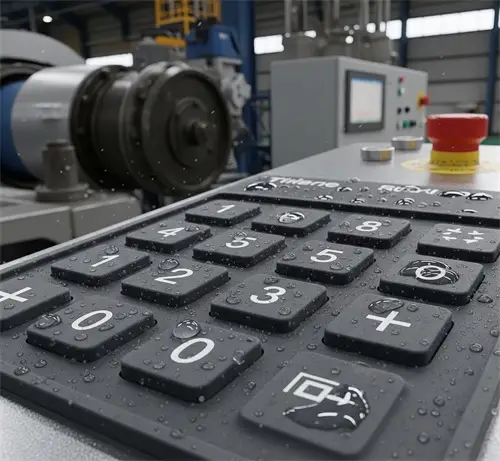
Specification by environment
| Environment | Design consequence | Test that proves it |
|---|---|---|
| Machine shop, coolant mist | Oil-resistant compound, clamped perimeter, moulded legends | Immersion in the coolant, then force and resistance re-measured |
| Food processing | Wash-down sealing, no recess that traps residue, light colours | Jet test plus a residue inspection after cleaning |
| Outdoor equipment | UV-stable compound, wide temperature range, drip path | Thermal cycling with the panel mounted |
| Medical or laboratory | Solvent wipe resistance, moulded legends, sealed edge | Wipe cycles with the actual disinfectant |
| Heavy vibration | Location pins, no adhesive-only fixing, damped base | Vibration soak, then contact resistance check |
Legend life is the first visible failure
Operators read industrial panels by position, so a worn legend is not immediately noticed; the wrong key is pressed instead. Printed legends wear at the edges first, which is exactly where a gloved thumb contacts. Moulded legends never wear, at the cost of the two-colour limit, and the trade is usually worth taking for any control that stops a machine.
Static and shielding in one panel
Panels near drives and inverters sometimes need a conductive or dissipative path, either through a conductive silicone layer or a shielding film behind the pad. That changes the stack height and the bonding method, so it belongs in the first conversation rather than in a late revision.

Why the assembly, not the pad, is tested
A pad on a bench has no bezel load, no adhesive and no housing tolerance. Mounting it changes the force curve, because the perimeter is now restrained and the base cannot bow. That is why industrial panels are approved on the assembled unit, with the force measured at the keytop and the contact resistance measured at the PCB. A test that skips the assembly reports a number that will not survive installation.
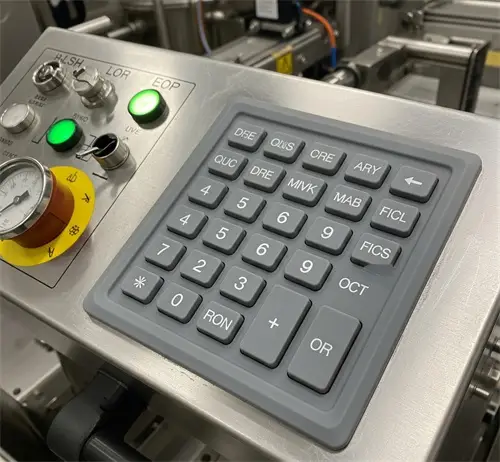
Commissioning silicone rubber keypads for industrial applications
Send the layout, the glove profile, the cleaning routine and the actuation count. The silicone keypad manufacturing section covers the tooling, and the IP67 waterproof membrane keypad page shows a sealed construction for wash-down environments.
Can a silicone keypad survive daily wash-down?
Yes, with a clamped or bonded perimeter that stays loaded and a legend that is moulded rather than printed. The seal is a geometry decision, not a property of the material.
Why do industrial panels need more force than consumer ones?
Gloves reduce feedback and spread the load. Without a higher force and a longer travel, the operator cannot tell whether the press registered.
Do industrial keypads need shielding?
Only where the panel sits next to drives, inverters or radios. It adds a conductive layer and changes the stack, so it should be raised at the start of the project.
Force, ingress and resistance values apply to the assembled panel in its housing. They should be established on a mounted sample rather than on a loose pad.
For an industrial panel programme, send the layout and the cleaning routine through the quotation file checklist.