Customer Favorites: The Most Loved Silicone Baby Bath Toys
- Share
- publisher
- Suey
- Issue Time
- Aug 26,2025
Summary
Silicone baby bath toys fail on water traps, not on material. How closed moulding, drainable vents, one-piece construction and colour fastness decide whether a bath toy survives a year in a bathroom.

Infant products / moulded toy design - reviewed 11 November 2026
Silicone baby bath toys look like the simplest product in the catalogue and behave like the hardest. The material has to be safe enough to go in a mouth, the shape has to be safe enough to fall on, and the moulding has to be closed enough to stop bath water sitting inside it for a week. Most of the products that fail at least one of those fail on the third.
The category has moved from rigid plastic ducks to soft silicone shapes because silicone does not crack, does not hold odour and can be squeezed by a small hand. The advantage only holds if the design respects what a bathroom does to a hollow moulding.
Definitions. Silicone baby bath toys are moulded silicone play pieces intended for use in water by infants, which puts them in a different compliance class from a general household item. A water trap is any cavity that can take in bath water and cannot drain or dry, and it is the main reason soft squeeze toys develop visible mould inside. Platinum cure is the addition-cure silicone system used where low volatiles and consistent skin contact behaviour matter.
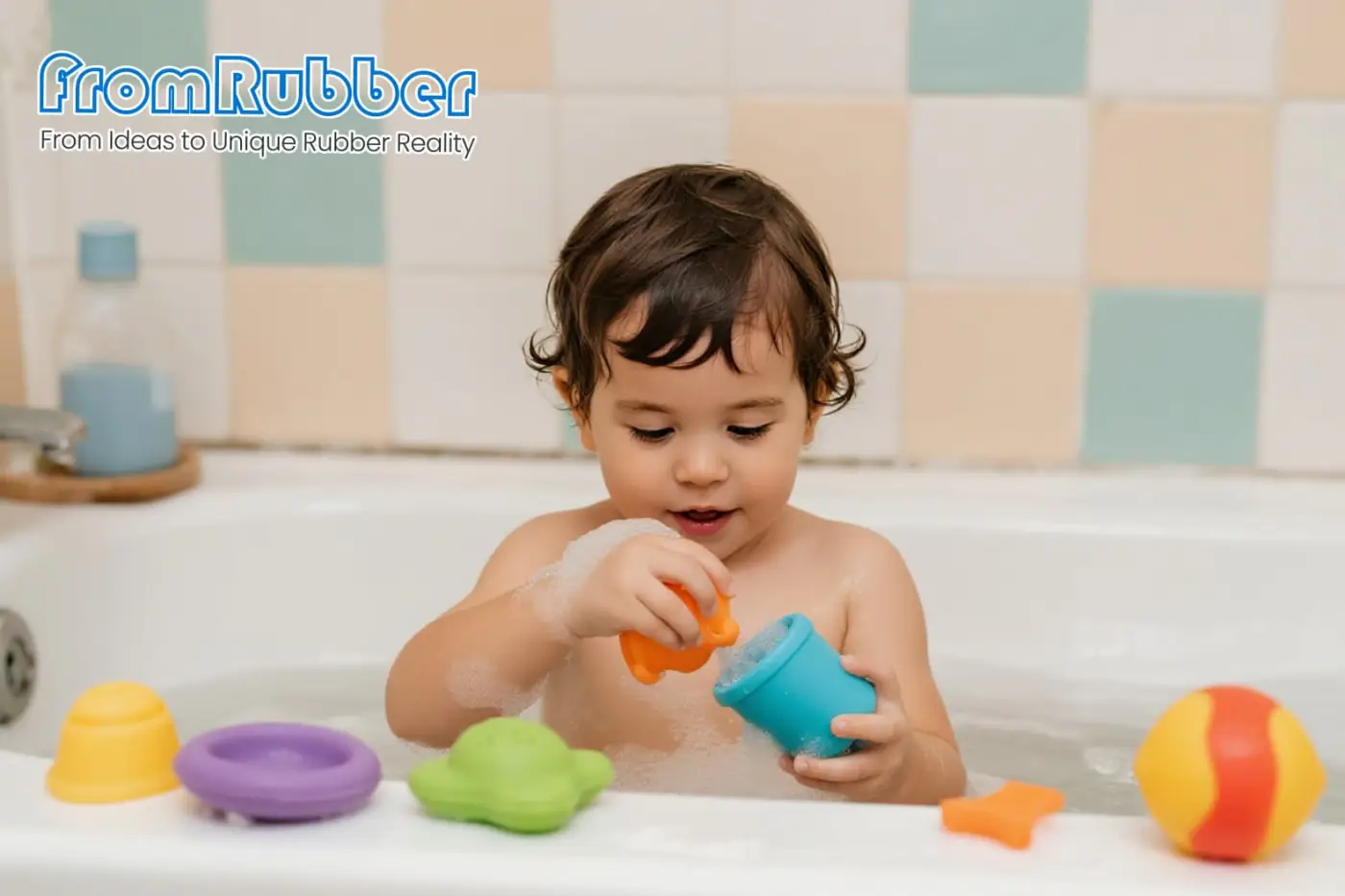
How silicone baby bath toys trap water
A squeeze toy with a small hole behaves as a pump: the child squeezes air out in the bath and water in, and the water stays because the hole is too small to drain and too deep to dry. Black spots appear inside within weeks, and the product is thrown away long before the silicone wears out. There are only three honest answers. Mould the toy closed, with no hole at all, and accept that it does not squirt. Mould it open, with a vent large enough to drain and to let air circulate, and accept that it fills and empties quickly. Or design it as a solid piece with no cavity, which is the most common answer for bath shapes.
The dishonest answer is a small hole plus a marketing line about hygiene. It is also the most common answer in the category, which is why the design decision is worth taking deliberately rather than inheriting from a plastic predecessor.
Material: platinum cure, no plasticiser
Soft PVC toys were the original bath category and the reason plasticiser migration became a consumer issue. Silicone avoids that mechanism entirely: it contains no plasticiser to migrate, so it does not go tacky or leach into bath water. Platinum-cured compound is the usual specification, and the compound should meet the food-contact or toy-safety references for the market it will be sold in.
Shape rules that come from mouths, not from art
Any element small enough to separate has to be impossible to separate, which means moulded as one piece rather than assembled. Thin fins and sharp edges are out, not only for safety but because they tear first. Rounded forms with a wall thick enough to resist a bite are the practical target, and the shape should sit above the small-parts gauge used in the target market.
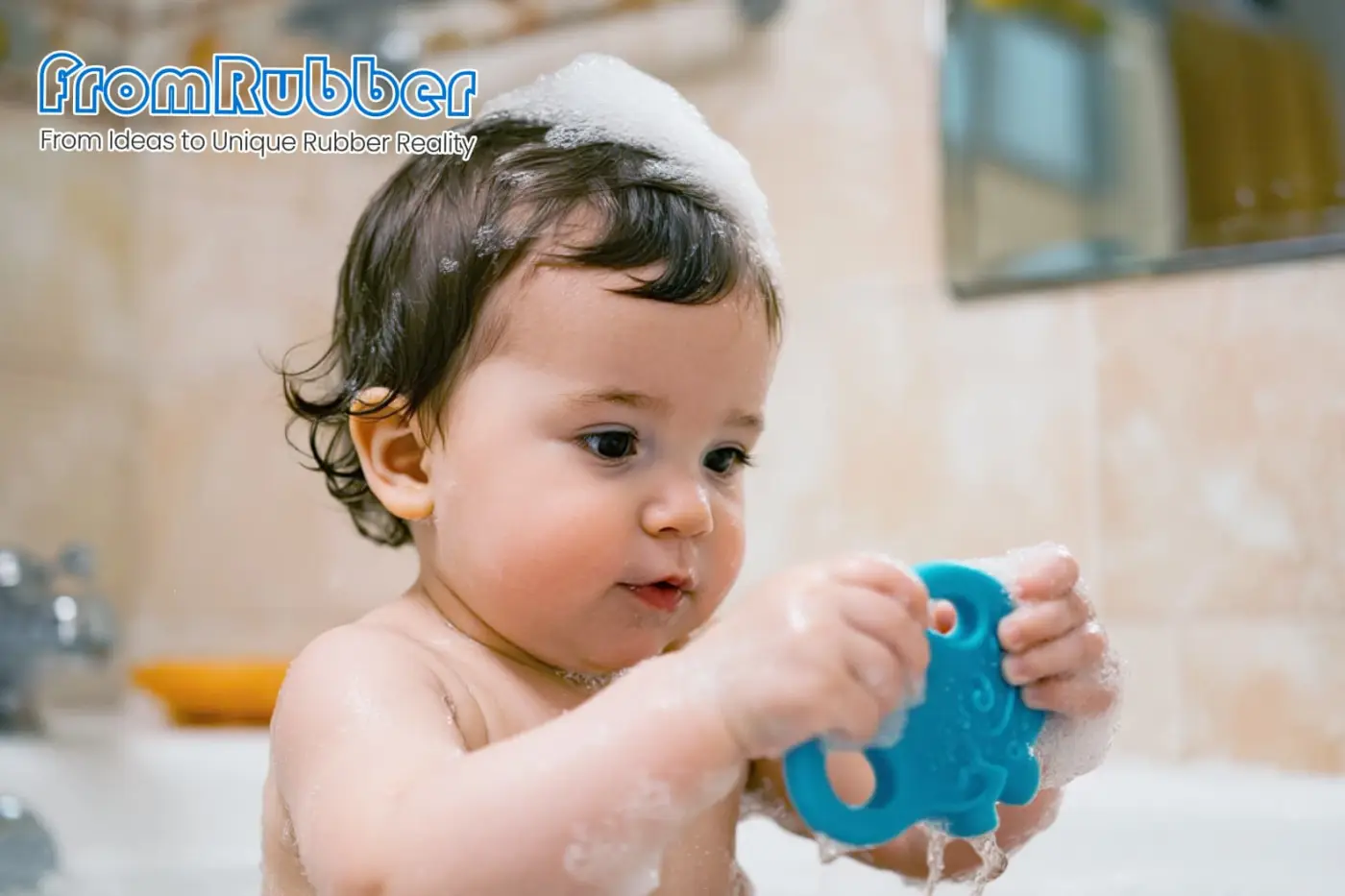
What to test before a tool is cut
Three tests answer most of the risk. A bite and tear test on the actual wall section shows whether a determined child can puncture the part. A warm-water soak with the intended cleaning routine shows colour bleed and surface change. A drying test, where the toy is emptied and left for a day, shows whether the design drains or traps water.
Odour belongs with the drying test. An under-cured part smells, and a toy that smells after a week in a bathroom will be returned regardless of how well it floats.
Commissioning a silicone baby bath toy range
A range is usually four to six shapes sharing one compound and one colour system, with the artwork doing the differentiation. That keeps tooling to one cavity per shape and keeps the palette consistent, which matters when the set is sold as a gift. The mother and baby section covers adjacent products, and the silicone baby bath toy set page shows a typical range.
Are silicone bath toys safe for babies?
Silicone itself is a suitable material, being plasticiser-free and stable in warm water. Safety then depends on shape, on whether parts can detach, and on the specific compound and its declarations for the target market.
Why do bath toys go black inside?
Water trapped in a cavity. A small hole lets water in and prevents drying, so mould grows inside. A closed moulding or a large drainable vent removes the mechanism.
Can silicone bath toys go in a dishwasher?
Usually yes on a top rack, and that is worth printing on the pack. The parts that fail are the ones with trapped water or with a coating, not the moulded silicone itself.
Toy safety requirements differ by market and by age grading. This article describes design considerations; compliance must be confirmed against the applicable regulation and the specific compound declarations.
For an infant product programme, send the shape concepts and the age grade through the custom silicone quotation route.