P+R Keypad Plastic Rubber Hybrid Keypads Benefits and Features
- Share
- Issue Time
- Sep 22,2025
Summary
A P+R keypad pairs rigid plastic caps with a silicone dome sheet. The assembly route, the tolerance stack that decides key feel, and when a one-piece silicone panel is still the stronger answer.

Keypad construction / hybrid design - reviewed 11 November 2026
A P+R keypad is two parts pretending to be one: a moulded plastic key cap set and a silicone dome sheet underneath it. The plastic gives the crisp edge, the hard legend surface and the colour depth; the silicone gives the snap and the seal. The failure modes live in the joint between them, which is why the assembly method, not the material, decides whether the panel survives a production run.
Hybrid panels are usually chosen when a design needs sharper key edges and a flatter face than a one-piece silicone panel can produce, without giving up tactile feedback. That trade is real, and it comes with a tolerance stack that has to be managed from the first drawing.
Definitions. A P+R keypad combines a plastic key set (P) with a rubber or silicone dome sheet (R) so that the visible key is rigid and the actuation is elastic. The key cap is the plastic part the finger touches; the dome sheet carries the collapsing web and, usually, the conductive contact. Actuation travel is the distance the cap moves before the dome collapses, and it is set by the gap between cap and dome rather than by the dome alone.
Construction reference points
- Caps are commonly moulded in ABS for cost and finish, PC where heat or clarity is needed, and POM where a low-friction sliding surface is required.
- Dome sheets are compression moulded or liquid silicone moulded, with carbon pills or printed conductive ink on the underside.
- The cap-to-dome interface is either a mechanical location or a bonded joint; each has a different tolerance and service story.
- Two moulded colours per part is the limit on the silicone side, while the plastic cap can carry a separate moulded or printed colour.
What a P+R keypad changes compared with an all-silicone panel
The edge becomes crisp, the face becomes flat
A one-piece silicone key has a soft edge because the material has to release from the cavity and because a sharp silicone edge wears. A plastic cap can hold a hard corner and a flat top, which is what gives a premium appliance or an automotive console its machined look. The cost is a second part, a second tool and an assembly step.
The tolerance stack moves to the gap
In a one-piece panel, travel is set by the web. In a hybrid, travel is set by the gap between the cap skirt and the dome, plus the height of the cap above the bezel. Three parts now contribute to one dimension, so the drawing has to nominate which one absorbs the variation. If nobody does, the assembly absorbs it, and some keys feel dead while others bottom out.
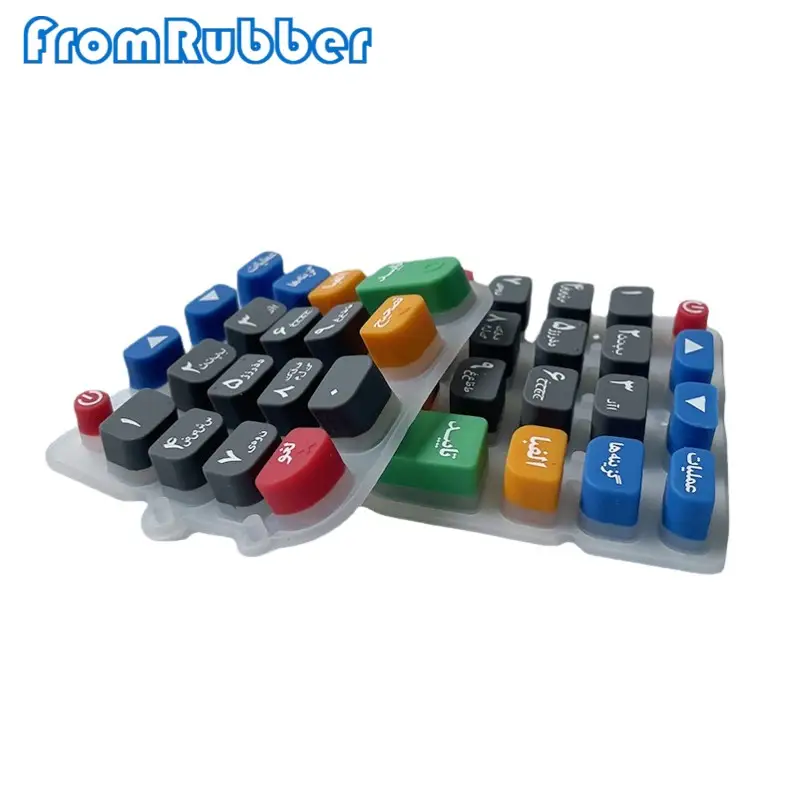
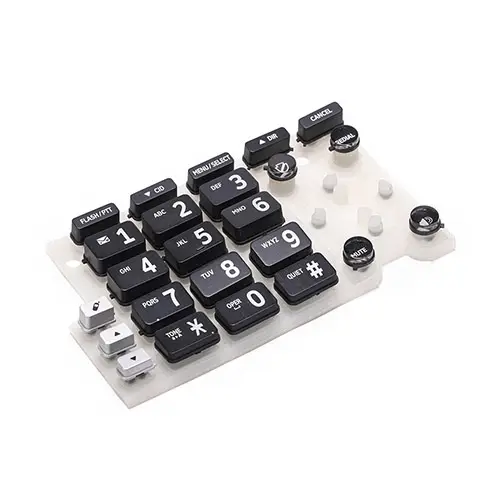
Assembly routes and what each one costs
| Route | Best for | What to watch |
|---|---|---|
| Mechanical location, no adhesive | Serviceable panels, large keys, low volume | Rattle and cap loss if the retention is under-specified |
| Pressure-sensitive adhesive | Flat bezels, high volume, thin stacks | Bond strength on textured or contaminated surfaces |
| Ultrasonic or heat staking | Permanent assemblies, appliance fronts | Distortion near the stake, and no service path |
| Overmoulded silicone onto plastic | Sealed panels, harsh cleaning | Bond line quality and cycle time; hardest to rework |
Backlighting is where hybrid panels earn their price
A plastic cap can be moulded in translucent material and masked, so the legend lights evenly while the surrounding face stays opaque. That is difficult to achieve in one-piece silicone at the same crispness. The light path still has to be designed: an LED per key, a light guide film, or a diffuser sheet, each with its own thickness and its own effect on travel.
Sealing is a decision, not an assumption
A hybrid panel is not automatically sealed. If the caps are separate parts sitting in a bezel, water reaches the dome sheet through the gaps. Sealing requires either an overmoulded silicone skirt or a gasket around the whole key field, and that requirement has to be stated before the tool is designed rather than after the first ingress test.
When a one-piece silicone panel is still the better answer
If the product is cleaned aggressively, if it must survive a pressure wash, or if the volume does not justify two tools, a one-piece silicone keypad is usually the stronger choice: one part, one seal, one tool, and legends that are moulded into the surface. The hybrid wins where the visible key has to look machined, where the legend has to be backlit with sharp masking, or where the plastic cap carries a brand detail that silicone cannot hold.
Commissioning a P+R panel
The brief needs the bezel drawing, the cap finish, the travel and force target at the cap, and the sealing requirement. The silicone keypad manufacturing section covers the dome sheet side, and the plastic rubber keypad page shows the hybrid construction. The injection moulded parts section covers the cap set.
Is a P+R keypad more durable than silicone alone?
The cap is more resistant to surface wear and legend abrasion; the dome sheet still sets the cycle life. Durability is therefore a property of the pair, not of the plastic.
Can a P+R keypad be sealed to IP67?
Yes, with an overmoulded skirt or a perimeter gasket. Separate caps in a bezel without a seal will pass a splash test and fail an immersion test.
Why do some keys feel different from others on the same panel?
Usually because the cap-to-dome gap varies across the part. The drawing should nominate which component absorbs that variation, and the first article should measure travel at several keys, not one.
Force and travel values are set by the assembled stack, not by either component alone. First-article measurement should be taken at the cap with the panel mounted in its bezel.
For a hybrid keypad review, send the bezel drawing and the force target through the quotation file checklist.