Go Green in Your Beauty Routine: The Eco-Friendly Benefits of Reusable Silicone Makeup Brush Applicators
- Share
- publisher
- Suey
- Issue Time
- Mar 13,2026
Summary
A reusable silicone makeup applicator is only reusable if it can be cleaned back to a neutral surface. Formula compatibility, closed geometry, hardness at the neck and an honest use-cycle assumption decide the claim.

Beauty tools / material honesty - reviewed 11 November 2026
A reusable silicone makeup applicator earns the word reusable only if it can be cleaned back to a neutral surface after every use. That sounds trivial and is not: silicone attracts silicone-based formulas, pigment settles into texture, and a shape with a tight inside corner is impossible to clean with a wipe. The sustainability argument follows from the cleaning performance, not the other way round.
Beauty brands are moving toward refillable and reusable formats, and silicone is the usual material for the applicator. The material choice is sound, but the claims around it often run ahead of the engineering. This article sets out what decides whether a silicone applicator is genuinely reusable, and how to describe the environmental case without overstating it.
Definitions. A reusable silicone makeup applicator is a moulded silicone tool used to pick up and place product, then washed and used again rather than discarded. Surface energy is the property that decides whether a formula wets the surface or beads on it. A closed geometry is a shape with no narrow internal corner or blind recess, so that a wipe reaches every surface.
Design values used in this article
- Applicators are moulded in platinum-cured silicone, free of plasticiser, which is why they do not go tacky after repeated washing.
- Shore A hardness is selected by function: softer for a cushion that blends, firmer for a paddle that spreads.
- Surface finish is matte to semi-gloss; a high gloss shows smears, while a deep texture holds pigment.
- Take-back of worn tools is offered so the material re-enters a technical stream rather than landfill.
What makes a reusable silicone makeup applicator actually reusable
Formulation compatibility decides the cleaning routine
Silicone-based foundations wet a silicone surface readily, and some pigment dispersions leave a film that water alone will not lift. An applicator designed for those formulas needs either a formulation-specific cleanser recommendation or a surface that releases the film mechanically. Either way, the cleaning instruction belongs in the product design brief, not in a customer service script written after launch.
Geometry beats material every time
A single-piece paddle with one continuous surface cleans in a swipe. The same material moulded with a seam, a groove or an internal step will hold residue no matter how good the compound is. If the design needs a handle-to-head transition, it should be a smooth radius rather than a joint, because every joint is a place where product accumulates.
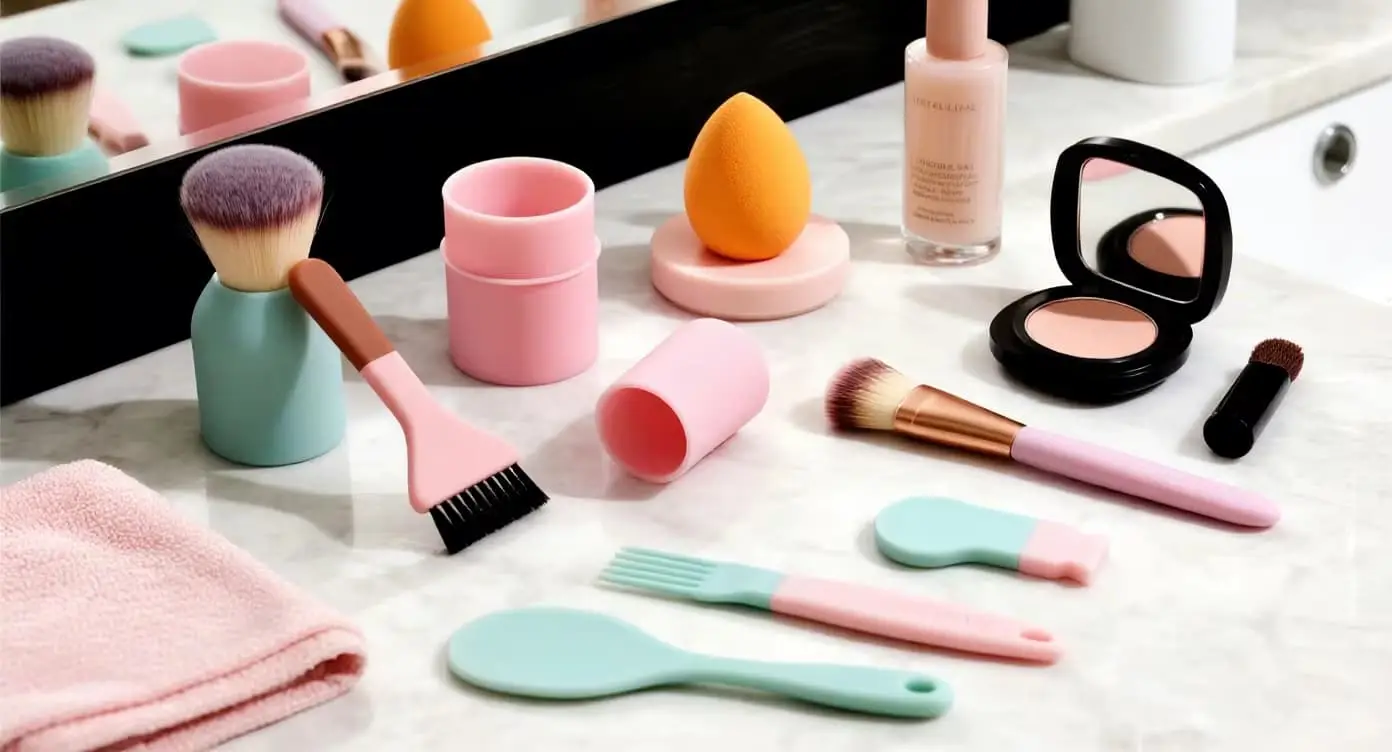
Design choices and what each one costs
| Choice | Benefit | Cost or risk |
|---|---|---|
| Single-piece paddle | Cleanable, no joint to trap product | Limited shape freedom; grip must be moulded into the form |
| Soft cushion tip | Blends without dragging | Softer wall can tear at the neck if the radius is tight |
| Textured surface | Holds product during transfer | Texture depth is where pigment survives washing |
| Two-material handle | Comfort and grip | A bond line that can separate and cannot be recycled as one material |
| Moulded colour | Survives washing and solvents | Two colours per part in practice; print wears first |
The environmental case is a use-cycle argument
Silicone carries a higher production impact than a disposable sponge, so the case for it depends on how many uses replace how many disposables. That number is a property of the product and the user, not of the material. A tool used three times and thrown away is worse than the disposable it replaced; the same tool used for two years is clearly better. Brands should publish the use assumption rather than a single headline percentage.
What can be claimed honestly
Reusable, washable, plasticiser-free, and recyclable through a take-back route are all defensible if they are designed in. Degradable, compostable and carbon-neutral are not, and a silicone part that makes those claims invites a challenge it cannot answer.
Material, cure and the smell test
An applicator sits close to the face and is used with products that contain solvents and oils. The compound should be fully cured and free of low-molecular residue, because an under-cured part smells and can mark the formula it touches. A simple check before production is to seal a sample in a bag for a day and smell it on opening; a silicone odour at that point is a cure problem, not a packaging problem.
Commissioning a reusable applicator
The brief needs the formula family it will be used with, the cleaning method the brand will recommend, the hardness and the shape family, plus the packaging story. The wider custom silicone rubber parts range covers adjacent beauty tools such as masks, brushes and cases, and the production process overview sets out the tooling sequence.
Is silicone good for a reusable makeup applicator?
It is good for the body: it does not plasticise, it tolerates washing and solvents, and it can be moulded as one piece. The limit is geometry, since any deep texture or joint will hold pigment.
How should a silicone applicator be cleaned?
With a cleanser matched to the formula, then warm water and a soft cloth, and air dried. Abrasive scrubbers dull the surface and can leave a finish that grips pigment.
Is a silicone applicator better for the environment than a disposable sponge?
Only across enough use cycles. Silicone has a higher production impact per unit, so the benefit depends on how many disposables one tool replaces. That assumption should be stated, not implied.
This article does not publish a lifecycle comparison. Environmental claims should be based on the brand's own use assumption and on the specific material and packaging chosen.
For a reusable beauty tool programme, send the formula family and the cleaning method through the quotation file checklist.