From Boring to Cute: How Custom Talking Pen Cartoon Silicone Covers Boost Pen Sales for Educational Brands
- Share
- publisher
- Suey
- Issue Time
- Apr 7,2026
Summary
A talking pen silicone cover fails when it muffles the speaker, covers the reading tip or fattens the barrel beyond a child's grip. How acoustic clearance, nose geometry, button access and insert-based tooling decide a character range.

Educational products / accessory design - reviewed 11 November 2026
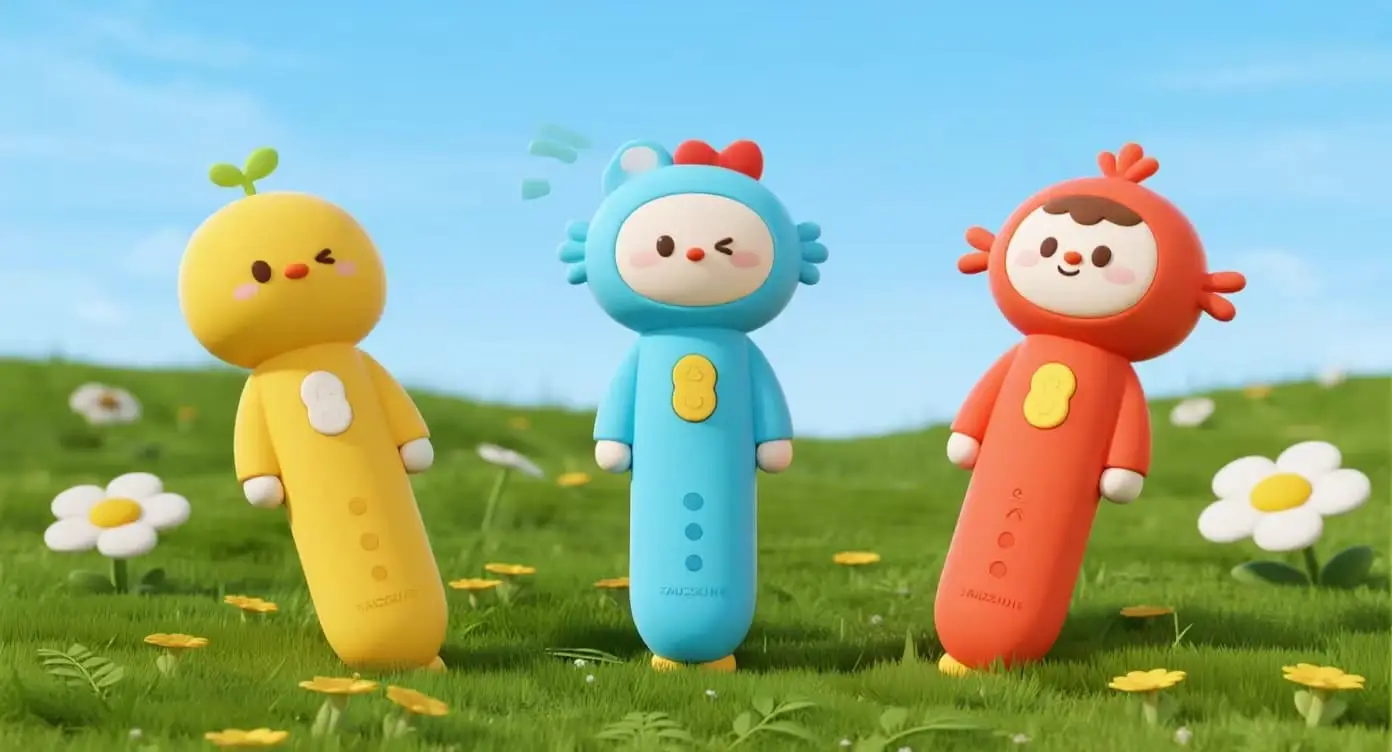
A talking pen silicone cover is a shell around a device that reads aloud, and it fails in three predictable ways: it muffles the speaker, it covers the optical tip that reads the printed code, or it makes the pen too fat for a five-year-old to hold. Get those three right and the character becomes the reason a child picks the pen up. Get them wrong and the cover is removed within a week.
Educational brands use character covers for a commercial reason that is easy to state and hard to execute: the pen is the same device across a whole catalogue, so the cover is the cheapest way to create a new SKU and a collectible line. That only works when the cover respects the device functions underneath it.
Definitions. A talking pen silicone cover is a moulded sleeve that wraps the barrel of a reading pen while leaving the speaker, the optical reading tip and the control buttons exposed. The reading tip is the small camera or sensor at the nose that decodes printed patterns. Acoustic clearance is the open area above the speaker grille that lets sound out without forcing it through a narrow channel.
Design values used in this article
- Covers are moulded in food-contact-grade silicone, which matters for a product handled by young children and occasionally mouthed.
- The speaker opening is kept clear and, where possible, enlarged rather than covered by a thin wall.
- The nose of the pen is left open, because the optical tip needs a fixed reading distance to the paper.
- Starter programmes can run from about 1,000 pieces, with sketch-to-shelf quoted in the region of 25 days.
What a talking pen silicone cover has to leave alone
The speaker is not a decorative hole
A cover that puts a 1 mm wall over the speaker grille turns a clear voice into a muffled one, and children respond by holding the pen closer to their ear, which moves the reading tip off the page. The opening should be cut to at least the grille area, with a chamfer that does not create a whistle at high volume. If the design wants a character mouth over the speaker, the mouth has to be a genuine aperture, not a shallow dimple.
The nose has to stay at the same height
Reading pens are focused at a fixed distance from the paper. A cover that adds 2 mm at the nose changes that distance and the pen starts missing codes. The sleeve should end behind the tip cone, and any character feature at the front should sit on the sides rather than under the nose.
Grip, weight and the hand that holds it
A silicone sleeve adds volume, and volume is the difference between a pen a child holds comfortably and one they grip with a fist. Two measurements decide it: the barrel diameter after the sleeve is fitted, and the balance point once the character mass is added at the top. A top-heavy character makes the pen rotate forward in small hands, which is exactly when the reading tip lifts off the page.
| Requirement | Design response | Failure if ignored |
|---|---|---|
| Speaker clarity | Aperture at least the size of the grille, with a chamfered edge | Child holds the pen closer, reading distance changes, codes miss |
| Reading tip | Sleeve ends behind the nose cone | Focal distance shifts and recognition rate falls |
| Button access | Raised pads over the keys, or open cutouts | Child cannot start playback without removing the cover |
| Balance | Character mass kept rearward or low | Pen tips forward in the hand |
| Hygiene | Smooth external surface, drainage at the base | Residue collects in textured recesses |
Insert changes, not new tools
A four-character range should share one barrel sleeve and change only the character insert. That keeps the fit identical across the range, which matters when a school buys a mixed set, and it keeps tooling cost close to a single design. The characters can be as different as the licence allows; the interface to the pen cannot.
Collectibility is a packaging decision as much as a design decision
Interchangeable covers create a series only if the packaging makes the series visible: a numbered set, a consistent window, a colour system. Brands that treat each cover as an independent SKU lose the repeat purchase that makes the category worthwhile.
Material and cleaning in a classroom
Classroom cleaning is harsher than a home routine: wipes, sprays and shared handling. A fully cured food-contact silicone survives that without crazing, and it does not develop the tacky surface that plasticised materials do. The specification that matters is cure completeness, because an under-cured part will smell and will hold residue in the texture.
Commissioning a talking pen silicone cover
Start with the pen, not the character: cross-sections, speaker opening, tip distance and button map. The character follows the mechanical envelope. Adjacent formats and the wider programme are covered under custom silicone rubber parts, with the tooling sequence in the production process overview.
Will a silicone cover affect the pen's reading accuracy?
Only if it changes the nose geometry. Keep the sleeve behind the tip cone and the focal distance stays as designed. Covers that wrap the nose are the usual cause of missed codes.
Can the speaker be covered by a character mouth?
Yes, if the mouth is a real aperture sized to the grille. A moulded dimple over the speaker muffles output and pushes children to hold the pen closer than the reading distance allows.
What order quantity makes a character range viable?
Around 1,000 pieces per design is a common entry point on an existing barrel sleeve, with the character insert changed per design. A new barrel geometry needs its own tool.
This article describes mechanical design requirements for pen covers. It makes no claim about learning outcomes, which depend on content, teaching and use rather than on an accessory.
For an educational accessory programme, send the pen cross-sections and the character set through the quotation file checklist.