Reliable Detector Plastic Enclosures Deployed in Gas Detection and Environmental Monitoring Systems
- Share
- publisher
- Suey
- Issue Time
- May 4,2026
Summary
A detector plastic enclosure is judged by what happens after two summers and one service visit, not by its datasheet. Gas compatibility, weld line placement, seal path and venting decide whether a gas or air monitoring housing keeps its ingress rating.

Industrial enclosures / gas and air monitoring - reviewed 11 November 2026
A detector plastic enclosure fails for reasons that are rarely visible in a datasheet: a weld line that opens under thermal cycling, a gasket that takes a permanent set, a polycarbonate that goes brittle after two summers of UV, or a cable gland that passes the spray test and fails the pressure wash. The material and the sealing path have to be chosen against the gas, the weather and the maintenance routine, in that order.
Gas detection and environmental monitoring housings are a narrow, unforgiving segment of injection moulding. The enclosure is also the mounting frame, the light pipe, the antenna window and the thermal path, and every one of those roles competes with the seal.
Definitions. A detector plastic enclosure is the moulded housing that carries a sensing element, its electronics and its cable entry, and that holds a defined ingress protection rating in the installed position. Ingress protection is stated as IP followed by two digits, where the first covers solids and the second covers water; IP67 means dust-tight and protected against temporary immersion. A weld line is the seam where two melt fronts meet inside the cavity, and it is the weakest plane in any moulded housing.
Reference points used in this article
- Fixed gas detectors in petrochemical service are commonly specified with flame-retardant polycarbonate at UL 94 V-0.
- Portable multi-gas monitors usually combine glass-filled nylon with an overmoulded TPE grip to survive drop and chemical exposure.
- Outdoor air-quality stations need UV-stabilised material, because unstabilised ABS yellows and embrittles under direct sun.
- Industrial detector housings are typically qualified across about -40 degrees Celsius to 85 degrees Celsius, with the seal assessed after cycling.
- Electrostatic-discharge grades for explosive atmospheres are quoted by surface resistivity, commonly in the 10^6 to 10^9 ohm per square band.
What a detector plastic enclosure has to survive
Gas compatibility is a material question
Hydrogen sulphide, chlorine and ammonia attack different polymers at different rates, and the attack is usually accelerated by humidity. A resin that performs in a methane detector may craze in a chlorine environment. The material should be chosen against the gas list and the concentration excursions the instrument is rated for, not against a generic industrial specification.
The seal path is a geometry question
Two housings in the same resin can differ by an order of magnitude in water ingress because of where the gasket sits relative to the screws. A seal that runs inside the fastener circle compresses evenly; a seal that runs outside it depends on the lid stiffness. The gland entry deserves the same attention, since most field leaks start at the cable, not at the lid joint.
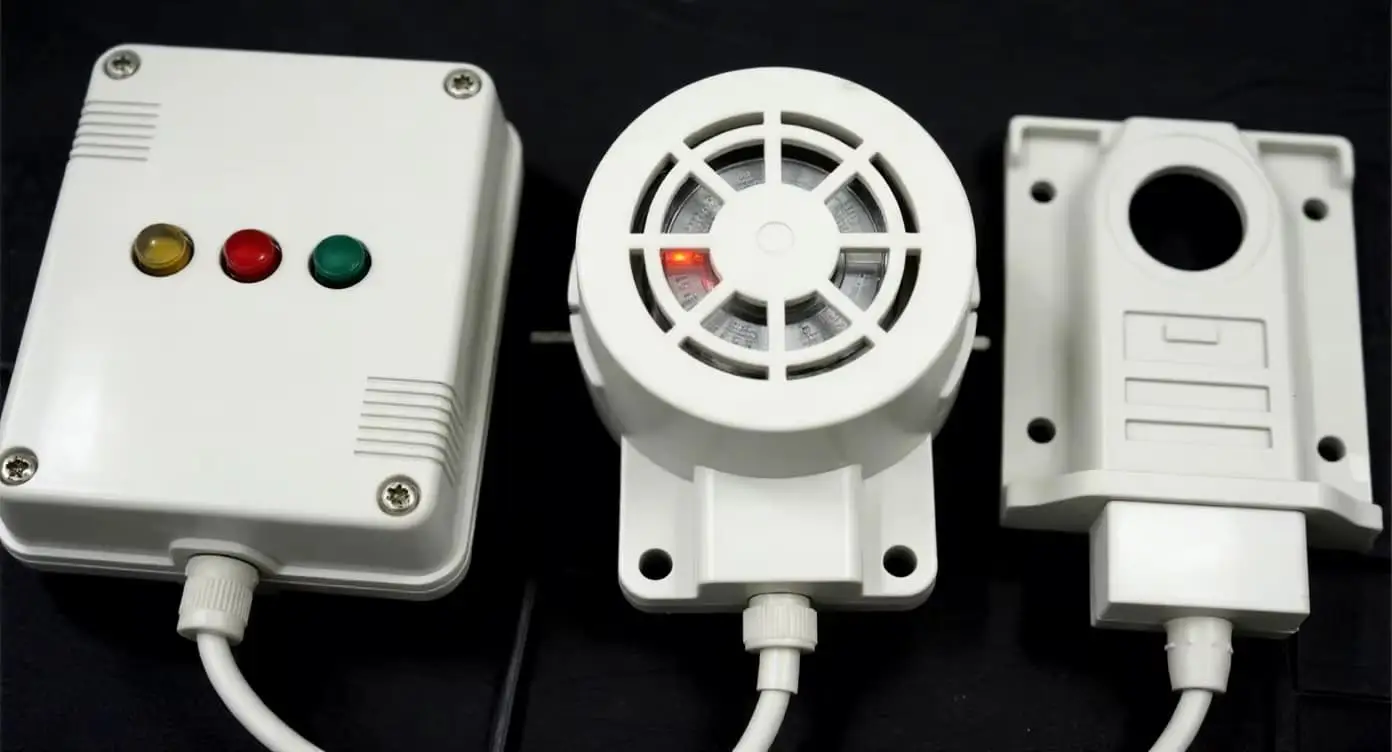
Material selection by application
| Application | Common material route | What drives the choice |
|---|---|---|
| Fixed detector, petrochemical | Flame-retardant polycarbonate, UL 94 V-0 | Ignition risk, impact strength, dimensional stability at high ambient |
| Portable multi-gas monitor | Glass-filled nylon with TPE overmould | Drop resistance, grip, resistance to mine water and cleaning agents |
| Outdoor air-quality station | UV-stabilised ASA or PC | Colour retention and impact strength after long sun exposure |
| Indoor air sensor | ABS with thin walls | RF transparency for Wi-Fi and Zigbee, low cost, cosmetic finish |
| Explosive atmosphere | ESD-modified ABS or PC | Surface resistivity in the dissipative band, plus flame retardancy |
Where detector housings actually fail
The failures that reach a warranty desk cluster in four places: a weld line running through a sealing groove, a metal insert that corrodes and splits the boss, a gasket compressed beyond recovery so the lid no longer seals after service, and condensation inside a housing that passed its factory ingress test. None of these are resin problems. All four are decided at the design review.
Condensation is not an ingress failure
A sealed housing that cycles between a cold night and a warm day will pull moisture out of the air inside it. That is why detector enclosures often carry a breathable membrane vent: it equalises pressure without letting liquid water through. Omitting the vent because the housing is "sealed" is a common cause of fogged optics and drifting sensors.
Prototype, then tool, then qualify
Enclosure programmes move faster when the prototype is used for the qualification that matters: fit of the PCB, cable routing, gland torque, and a thermal cycle with the seal in place. A prototype tool in the region of a week, followed by production in the region of three to four weeks, is the usual rhythm quoted for this product family, and it only holds if the design review is finished before the cavity is cut.
Traceability matters as much as the test itself. A detector housing should be linkable from resin batch to moulding lot to inspection record, because a field return with no batch trail cannot be closed.
Commissioning a detector enclosure
Useful briefs include the PCB outline with connector positions, the gas list and concentration range, the ingress target and the cleaning method, the mounting interface, and the certification route the instrument is aiming for. The custom plastic enclosure format covers the housing family, and the custom injection moulded parts section covers the adjacent components such as glands, bezels and clips.
What does IP67 mean for a detector enclosure?
Dust-tight, and protected against temporary immersion under defined test conditions. It does not mean the housing survives pressure washing, and it says nothing about resistance to the gas being measured.
Can a polycarbonate housing be used outdoors?
Yes, with a UV-stabilised grade and a colour that does not depend on surface paint. Unstabilised grades yellow and lose impact strength, which shows up as cracked corners after a couple of seasons.
Do detector housings need a vent?
Often, yes. A breathable membrane equalises pressure and limits condensation without admitting liquid water. Sealed housings without a vent tend to fog internally when the temperature drops.
Standard references in this article are named for orientation only. Material grades, ingress ratings and approvals must be confirmed against the instrument's certification file and the resin supplier's data for the specific grade.
For a detector housing review, send the PCB outline, the gas list and the ingress target through the quotation file checklist.