Boosting Thermal Mug Merchandise Sales with Custom Cartoon Animal Silicone Mug Lids
- Share
- publisher
- Suey
- Issue Time
- May 5,2026
Summary
A cartoon animal silicone mug lid sells as a series, not a single SKU. How body moulds, character inserts, colour standards, mug-fit ranges and minimum order quantities decide whether a range survives its second season.

Drinkware merchandising / series planning - reviewed 11 November 2026
A cartoon animal silicone mug lid is usually bought as one lid and reordered as a series. That second order is where the money is, and it is also where most programmes break: the second character does not match the first, the colour drifts between lots, or the new face needs a new tool because nobody designed the body as a family. Planning the family before the first face is the difference between a collectible range and a one-off.
This article looks at a lid range the way a merchandising team has to: one body, several faces, a fixed mug interface, and a colour standard that survives a repeat order across seasons.
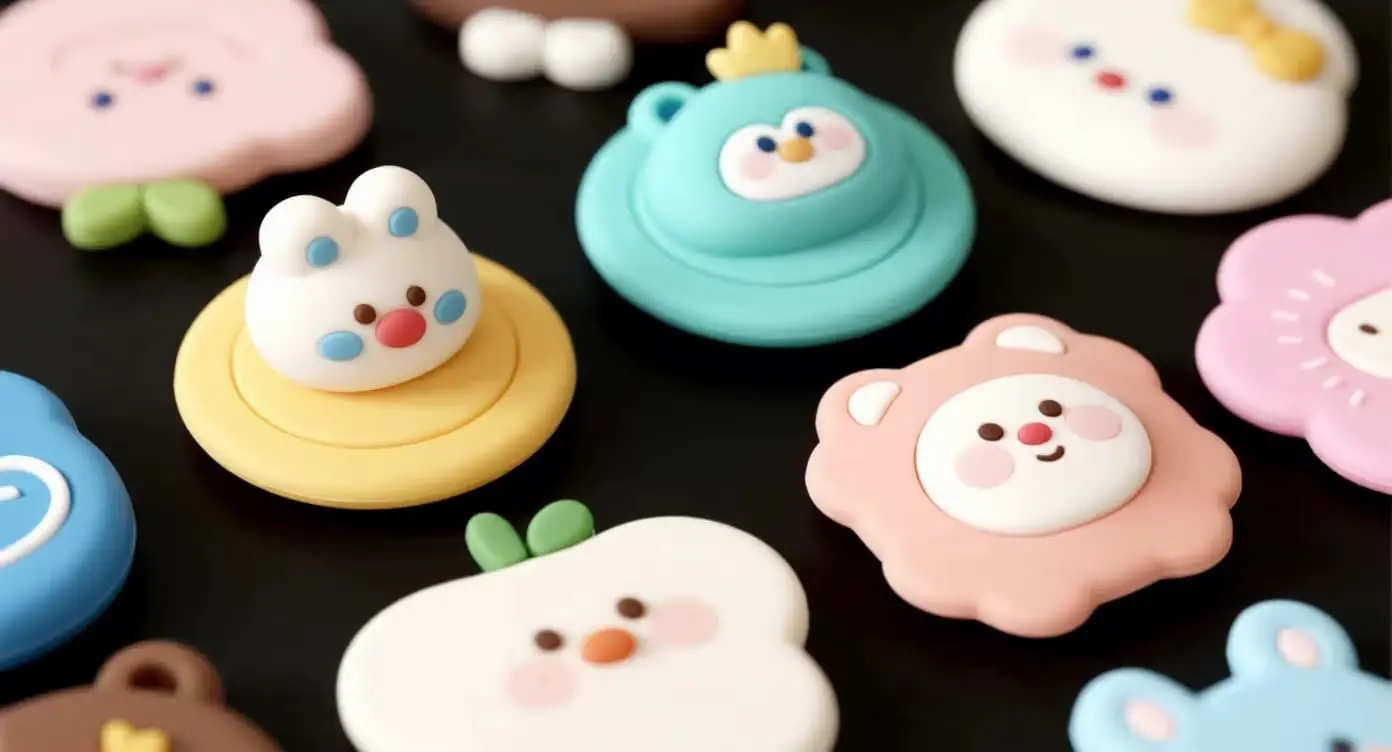
Definitions. A cartoon animal silicone mug lid is a moulded LSR lid whose decorative character sits on top of a functional sealing ring. A body mould is the tool that forms the sealing ring, the sip hole and the recess into which a character insert or a character detail is moulded. A series is a set of SKUs that share that body and differ only in the character and the colourway.
Design values used in this article
- The lid family is sized for mug openings of about 78 mm to 88 mm, covering most 12 oz to 20 oz thermal mugs.
- Material is liquid silicone rubber at Shore A 50 to 70, with a working range of about -40 degrees Celsius to 230 degrees Celsius.
- Food-contact references for the compound are 21 CFR 177.2600, LFGB and REACH.
- New character designs typically start at 2,000 to 3,000 pieces; private labelling on the existing 50-plus animal lid templates runs lower.
- Sample tooling for a new character runs about 10 to 14 days, with production at 20 to 25 days.
What a cartoon animal silicone mug lid programme actually buys
One body mould, several faces
The sealing ring, the sip hole and the underside geometry are the expensive part of the tool. The character is comparatively cheap to change if the design keeps the face on a flat pad above the ring, because that pad can be cut as an insert. A series built this way pays for the body once and then pays for inserts, which is why the fourth character costs a fraction of the first.
The lid is a SKU, not a product
Each character is a separate SKU with its own barcode, carton and colour standard, even though the body is shared. Retail buyers treat the range as one listing with variants, so the series has to be planned with the packaging and the variant naming from the start. Retrofitting a series structure after four characters exist is a repackaging project, not a design project.
Match the lid to the mug before the character
The most expensive mistake in this category is designing a character for a mug family that was never measured. Silicone stretches, but a lid seals on the rim diameter and the wall angle, not on good intentions.
| Parameter | Working range | Why it matters |
|---|---|---|
| Mug opening | 78 mm to 88 mm | Sets the inner sealing ring diameter; a lid outside this band needs its own tool |
| Capacity class | 12 oz to 20 oz | Correlates with rim diameter in most retail ranges, but should be measured, not assumed |
| Rim wall angle | Recorded per mug family | A straight wall and a tapered wall need different lip compression |
| Seal compression | About 1 mm on the nominal diameter | Too little leaks; too much makes the lid hard to seat and to remove |
Colour consistency is a tool decision as much as a pigment decision
Two characters in the same range that read as slightly different pinks will look like a mistake on a shelf. The control is a retained colour standard held against the approved sample, plus a pigment lot record for each production run. Silicone pigments shift slightly with cure and with wall thickness, so the standard has to be a moulded plaque from the same compound, not a Pantone chip on paper.
Sampling order that avoids retooling
Sample the body first, confirm the seal on the actual mug, then sample the character. Reversing that order is common and expensive: a beautiful character attached to a ring that leaks will send the whole tool back for modification, and the character tool usually has to be re-cut with it.
Where the margin sits in a character lid range
The economics are driven by three numbers: the tool amortisation per character, the minimum order per design, and the sell-through per season. A range of four characters at a modest order each usually beats one character at a large order, because the range is what drives the collector behaviour. That only works if the body is shared, since four separate bodies means four times the tooling.
Existing animal templates are the fastest route to a first season: a private-label run on a proven shape tests the market before any new character is cut. Production capacity in the region of 500,000 lids a month, as the factory quotes for this product family, is what makes a short seasonal window feasible at all.
Commissioning a character lid range
The brief that gets a fast, accurate quotation contains the mug drawing, the number of characters planned for the first season, the target retail price, the packaging format and the colour references. Brands that intend to extend the range should say so at the first meeting, because the body design changes if three characters are planned instead of one. Adjacent formats and the silicone case family are listed under custom silicone rubber parts, and the tooling-to-shipment sequence is described in the production process overview.
How many characters should a first range include?
Three to four is the common starting point: enough for a collector display, few enough to keep the order per design above the minimum. The body should be designed for the full planned range, not only for the first drop.
Can an existing animal lid be private labelled?
Yes, on the shapes the factory already holds. That route avoids character tooling and is the fastest way to test a market, but the shape is shared with other brands, so it does not create exclusivity.
Is a silicone lid safe for hot drinks?
The compound is specified for food contact and for temperatures well above boiling. The practical limits are the sealing ring, which must stay seated, and the sip hole, which should be closed when the mug is carried.
Values quoted here are the manufacturer's standard figures for this product family and will shift with character complexity, colour count and volume. They should be confirmed in the quotation rather than treated as a specification.
For a lid range review, send the mug drawing, the character concepts and the season plan through the custom silicone quotation route.