Even colleagues are impressed! Visiting FromRubber: 100% Internet customer acquisition, the "powerful" custom logic behind 8,000+ molds
- Share
- publisher
- Suey
- Issue Time
- Jun 25,2026
Summary
A custom silicone keypad manufacturer with 2,336 clients and more than 8,000 mould projects is a useful test case for supplier due diligence. What a mould store, an in-house process claim and a peer factory order can prove, and what none of them can.

Factory visit / supplier due diligence - reviewed 11 November 2026
A tour of a silicone plant is a poor test of quality and a good test of organisation. The useful question is not whether the machines look new, but whether the factory can show you where a mould lives, who can move it, and what the last first-article report for it said. This visit to a custom silicone keypad manufacturer with 2,336 clients and more than 8,000 completed mould projects is a case study in what those answers look like.
FromRubber has been moulding silicone keypads for sixteen years in Dongguan. Every order it holds arrived through an online channel rather than a trade fair or a referral network, which is unusual in a segment where buyers normally meet suppliers through agents. The company also counts other silicone manufacturers among its customers, including a factory from Qingdao that placed a keypad order after failing to meet its own specification in-house.
Definitions. A custom silicone keypad manufacturer produces keypads to a customer drawing rather than from a catalogue, which means the tool, the legend artwork and the actuation force are all customer-specific. A mould register is the numbered inventory of those tools, with the location, the cavity count, the last service date and the owner of each one. In-house means the process steps happen on the supplier's own site under its own supervision, not that the supplier owns every machine in the chain.
Facts this article is built on
- Sixteen years of silicone keypad production, with 2,336 customers served and more than 8,000 mould projects completed.
- All orders are acquired online; there is no agent or exhibition channel feeding the order book.
- Prototyping, precision machining, moulding and final inspection are performed on one site.
- A silicone manufacturer from Qingdao placed a custom keypad order after its own attempt did not meet specification.
What a mould store tells you about a custom silicone keypad manufacturer
A numbered mould is a record, not a trophy
The first thing visible in the store is that every tool carries a plate with a number, and that the racks are laid out by size rather than by customer. That sounds like housekeeping. It is actually the difference between a factory that can find a mould in an hour and one that can find it in a week, and it decides how quickly a repeat order can be quoted against the original tool rather than a new one.
The racks are the capacity statement
Eight thousand mould projects is a claim about breadth, not about size. A store of that kind contains a lot of small, awkward tools built for one product generation, and the practical value is pattern recognition: the supplier has already met the housing tolerance, the legend density and the undercut that a new drawing is about to introduce. A buyer should read the store as a library of solved problems, then ask which of those problems resemble their own.
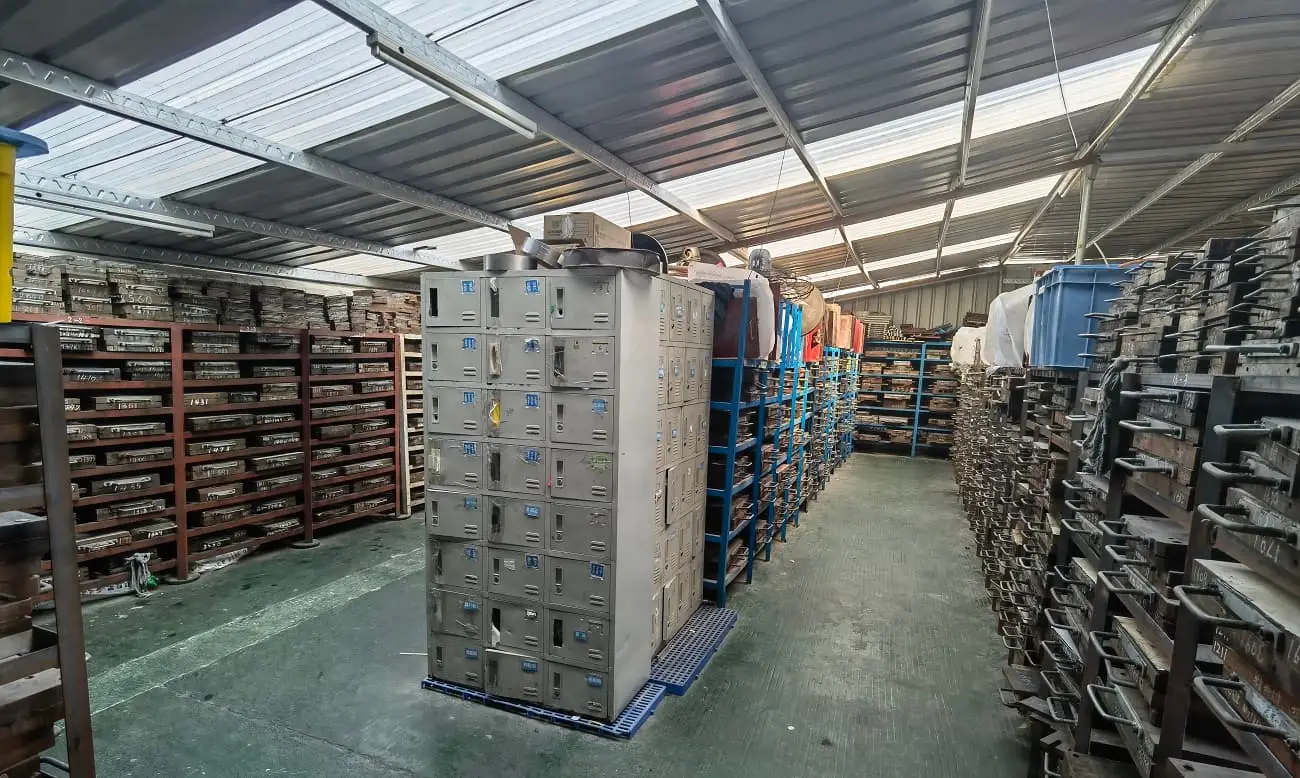
The visit is also a reminder of what a photograph cannot show. A tidy store proves the factory can keep an inventory. It does not prove that the tool inside the frame was maintained, that the last shot was dimensionally checked, or that the customer who paid for it still controls it. Those three questions have to be asked directly, and the answers should appear in the tooling agreement.
Three numbers on the wall, and what each one does not prove
| Number | What it supports | What it does not prove |
|---|---|---|
| 2,336 customers | Repeatable onboarding across many small accounts | That any single account is large or demanding |
| 8,000+ mould projects | Breadth of geometry and materials already tooled | That the tools are maintained, or that yields are stable |
| 100 percent online acquisition | A documented, traceable sales history and public reputation | That engineering support scales with account size |
None of the three is a quality certificate. Together they describe a factory that has chosen volume through reach rather than through a handful of large accounts, and that choice has consequences a buyer should price in: quoting is fast because the process is standardised, and engineering time is allocated by project rather than by account size.
A peer factory is the harder customer
The Qingdao order is the most useful data point in the visit, because a competing manufacturer reads a drawing differently. It knows where a supplier is likely to take a shortcut, it measures actuation force rather than pressing a sample by hand, and it has its own cost model for every step in the quotation. Winning that order does not prove the factory is the best in the region. It does prove the process survived a review by someone who could have made the part themselves.
For a brand owner, the transferable lesson is to borrow that posture. Ask for the first-article report, ask which dimensions are checked on every lot rather than on the first lot, and ask what the rejection rate was on the last three production runs of a comparable part.
Reading an in-house process claim without a tour
Ask which steps leave the building
Almost every supplier describes itself as fully integrated. The precise question is narrower: which operations are subcontracted, and who approves a change of subcontractor. A factory that moulds, prints and coats on site but sends laser engraving out is still a credible supplier, provided the handover is documented and the engraving parameters are fixed by the same engineering team.
Ask what happens to a failed lot
The answer separates a factory with a quality system from one with a quality poster. A usable answer names the containment step, the person who signs the disposition, and the record that survives the shipment. A vague answer usually means the customer becomes the inspection station.
Commissioning a custom silicone keypad project
Keypad projects move fastest when the drawing arrives with the actuation force, the travel, the legend artwork and the housing tolerance. The factory's process chain, from tooling through printing and finishing, is described in the silicone production process overview, and the keypad formats themselves are set out on the custom silicone keypad page. Buyers comparing factories can use the quotation file checklist as a common brief.
How do you verify a custom silicone keypad manufacturer before ordering?
Ask for the mould register extract for comparable tools, a first-article report, the inspection plan used in production, and two customer references in the same equipment category. A plant visit then confirms the organisation behind those documents.
Does a large mould count mean better quality?
No. It means broader geometry experience and a faster quotation for a familiar shape. Quality depends on tool maintenance, process control and inspection discipline, which are separate evidence.
Is an online-only supplier a risk?
It is a different risk profile. There is usually a longer public record of transactions and reviews, and less reliance on a single agent, but engineering depth has to be verified through documents rather than through a relationship history.
This article is based on an on-site visit and an interview with the supplier's sales and engineering team. Customer counts and mould totals are the company's own figures as provided during the visit.
For a keypad programme review, send the drawing, the actuation target and the annual volume through the custom silicone quotation route.