Cordless Screwdriver Silicone Keypad Applications Expand Beyond Basic Start and Stop Controls
- Share
- publisher
- FromRubber Application Engineering
- Issue Time
- Sep 15,2026
Summary
Cordless screwdriver handles now carry soft start, direction and lockout, and the keypad has to encode which state is active without a display. The layout, hardness and ESD decisions that follow.
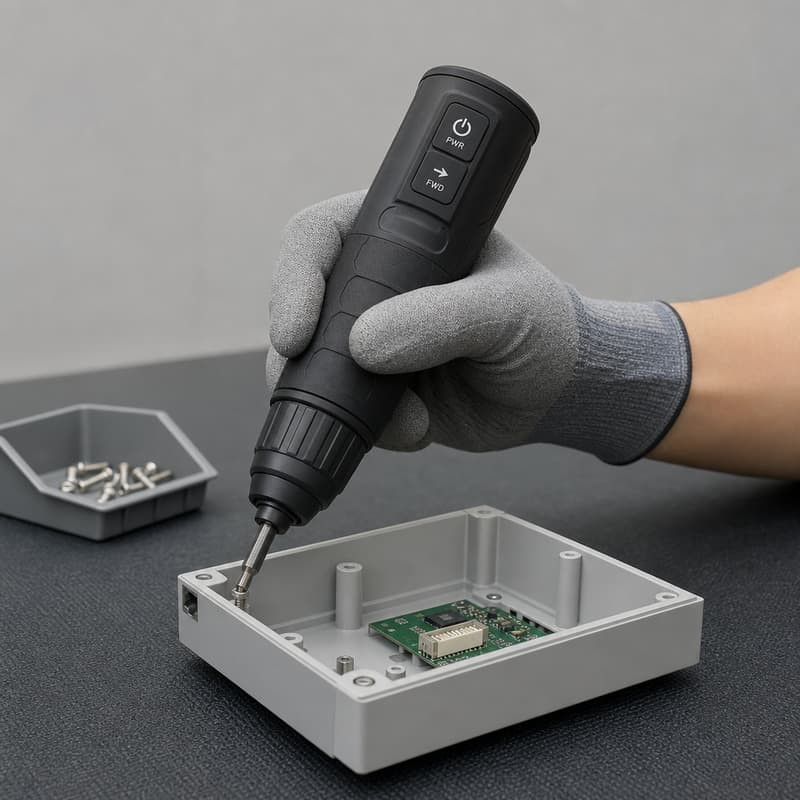
A cordless screwdriver used to have a trigger, a forward-reverse collar and nothing else on the handle. On the tools reaching electronics benches and light assembly cells this year, that handle panel is expected to carry power, direction, soft start and a lockout, and to tell the operator which of those states is active without adding a display. Covering two buttons and encoding four states are different jobs for the same silicone part, and they pull the tooling drawing in different directions.
Key facts
- IEC 62841-2-2:2014 covers hand-held screwdrivers and impact wrenches rated not more than 250 V single-phase and 3,700 W input.
- IEC 61058-1:2026 applies to appliance switches up to 600 V and 63 A and adds a DC arc extinction test.
- IEC 60073:2002 supplies the coding principles that give visual and tactile indications their assigned meaning.
- JEDEC JESD625C.01 addresses devices susceptible to damage from discharges above 100 V HBM and 200 V CDM.
- Two published liquid silicone rubber grades used for this class of part sit at 31 plus or minus 3 Shore A and at 50 Shore A.
Start and stop was never the hard part
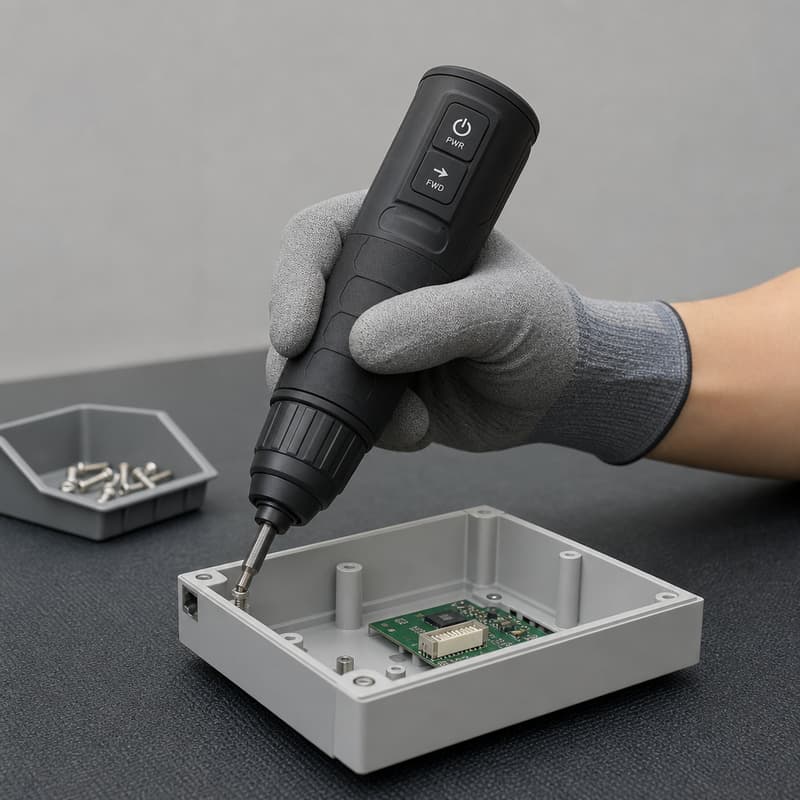
The operator in the sequence below is driving a screw into a small enclosure that already holds a populated board. Two things have to be true for that operation to go quickly. The tool must be pointing the right way, and the driver must not spin up hard enough to strip a thread in a plastic boss. Neither requirement is about the trigger. Both end up expressed on the handle panel, and both have to be readable by someone whose eyes are on the screw head, not on the tool.
A display would answer the second requirement directly, and that is exactly why it rarely appears on a tool at this price. Adding a display means a window in the housing, a lens, another sealing problem, another flex connection and another line of firmware. A keypad with a shaped dome and a defined legend delivers part of the same information through the thumb, at a fraction of that cost, and it can be sealed as one flat area.
What the keypad cannot do is invent the information. It can only carry a state the controller already tracks, and make that state distinguishable by touch and by glance.
Three keys, and which one moves
The two images below show the same panel size carrying a different function set. That difference is the whole story of the shift.
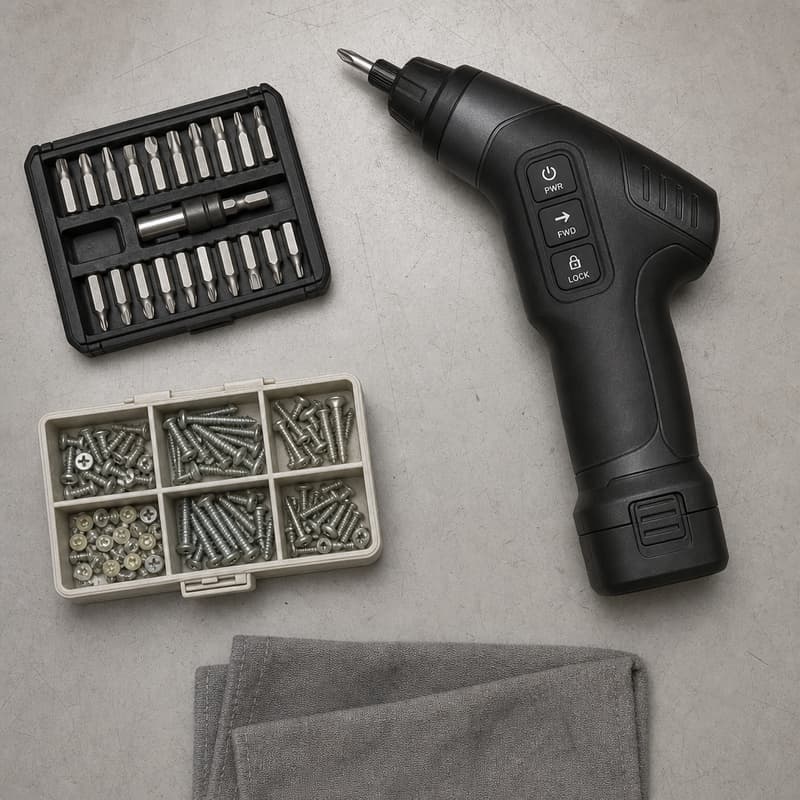
Here the panel carries power, forward direction and lockout. Direction is a two-state choice that used to live on a mechanical collar, and lockout is a safety function that used to be a physical slide on the trigger. Both are on the membrane, and the panel still holds three keys.
Lockout is the interesting one. It is a state the operator must be able to verify without pressing anything, because the whole point is that the tool will not run. A raised dome with a padlock legend, sitting proud of a flat web, gives that verification through a finger. A printed symbol on a flush surface does not.
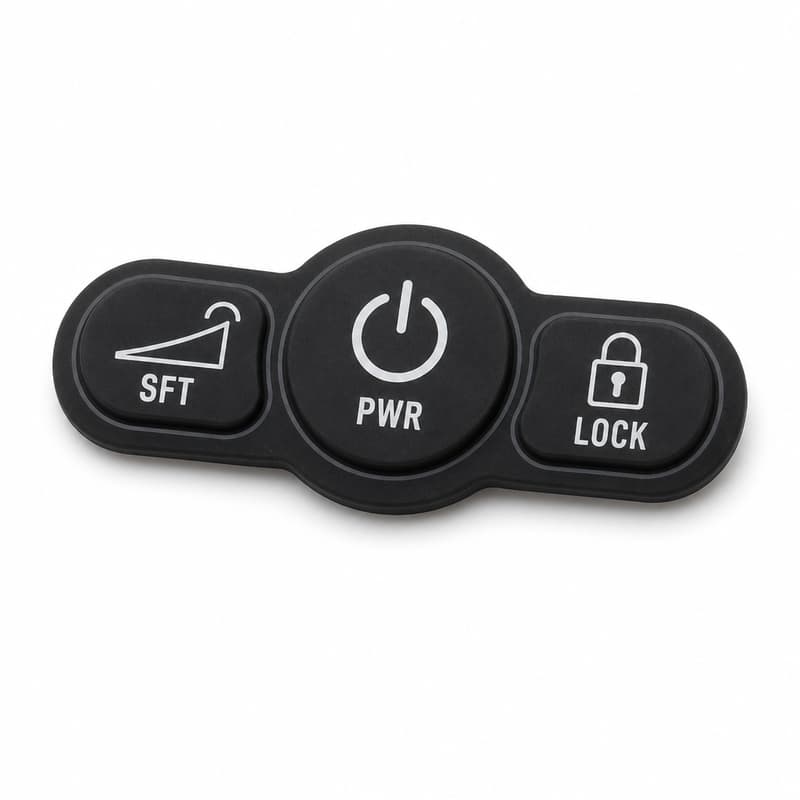
The second panel swaps the middle function. Soft start takes the place of direction, and the centre key grows into a larger circle than either neighbour. That is the layout consequence of the change. Soft start is not a selection the operator makes once, the way a direction choice is; it is a ramp state the tool enters on every trigger pull, so a percentage of presses land on that key during setup and troubleshooting. A larger top surface means the thumb finds it without looking down, and the deeper boss gives a longer travel that can be felt through a glove.
Add a fourth function, such as torque stage, and the three-key outline runs out of room. Either every key shrinks below the size a gloved thumb can find, or the panel moves to a two-row arrangement and the seal path around it doubles. There is no third option that keeps the tool's handle height.
Hardness shows up as a feel problem, not a data sheet problem
Two published liquid silicone rubber grades used for parts of this type show the width of the choice. One is rated at 31 plus or minus 3 Shore A with low compression set and no post-cure required, serviceable from minus 55 to 210 degrees Celsius. The other is a 50 Shore A grade, self-lubricating, mixed 1:1, likewise with low compression set and no post cure.
The softer grade gives longer travel and a lighter actuation force, which is what an operator doing two hundred fastenings an hour wants. It also lets the web deform sideways when a thumb pushes at an angle rather than straight down, and a web that deforms sideways can drag against the housing wall on the return stroke. The harder grade holds its geometry and the self-lubricating surface keeps that drag low, at the cost of a firmer press.
Neither number is wrong. The point is that the two grades are not interchangeable at the drawing stage, and the choice is usually made on feel in a sample review rather than on a table. Compression set enters here as well. ISO 815-1 measures it at a constant 25 percent strain, and a key that has taken set stops returning fully. On a panel where lockout is verified by the height of a dome, a lost fraction of a millimetre is not a cosmetic change; the operator can no longer confirm the state by touch.
ESD on an assembly bench changes the specification
While the panel itself is an input device, the surface the operator touches during board handling is not electrically neutral. ANSI/ESD S20.20 sets the administrative and technical requirements for an electrostatic discharge control program, and JEDEC JESD625C.01 addresses devices that can be damaged by discharges above 100 volts human body model and 200 volts charged device model. An assembly house working to those documents will ask for a surface resistivity figure for anything near an exposed board, and a silicone keypad web is an insulating material.
The answer is not one number, and this is where a keypad drawing is often ambiguous. A keypad with conductive pills contains two different materials: the pill, loaded with carbon so that it can bridge the contact pads, and the web, which is ordinary insulating silicone. A specification that quotes resistivity without naming the surface is quoting half a part. The same ambiguity applies to the membrane circuit and the switch board, which are separate items with their own material declarations.
What none of this changes is the switch rating. IEC 61058-1:2026 covers appliance switches up to 600 volts and 63 amps and adds a DC arc extinction test, which matters because a cordless tool switches direct current. The keypad sits in front of that switch, not in place of it, and the switch remains the component with the rating.
What the keypad is not
A cordless screwdriver keypad from a silicone moulder is a mechanical part. It does not include the switch board, the motor controller, the membrane circuit, the battery pack or the torque control firmware. On a recent electronics assembly screwdriver programme, FromRubber tooled the three-key SFT, PWR and LOCK web shown above, while the customer kept the board, the controller and the torque strategy in house. The populated green board visible inside the enclosure in the first photograph is the customer's assembly and sits outside the keypad scope entirely.
Keeping that boundary explicit saves arguments later. The values the two drawings share are contact pad positions, available travel, actuation force and the flatness the web can hold against the housing. A keypad drawing that does not state them is asking the moulder to guess at the customer's board, and a board drawing that does not state them is doing the same thing in reverse.
This is the same pattern seen on other hand tools. Our notes on electric screwdriver silicone keypad durability in dusty workshop conditions cover the wear side of the same part, and the surface printing article on angle grinder keypads explains what happens to a legend before the material fails. Smaller format keypads that sit behind a housing aperture rather than on its outer face are covered by the custom silicone rubber inner keypad format.
What the next handle panel has to settle
Two values deserve to be fixed before tooling, and both concern the operator's hand rather than the firmware. The first is the minimum key size at the button that will be found without looking, measured with the thickest glove the tool is sold to be used in. The second is the dome height that lets the operator confirm a latched state, such as lockout, by touch alone, with enough margin that ordinary compression set over the tool's life does not erase it.
Everything else follows. The function list on a cordless screwdriver panel is still growing, and the limiting factor is no longer how many states the controller can track. It is how many of those states a thumb can distinguish in one flat rectangle of silicone.
Related reading
The same squeeze is happening on the drill side of the tool box, where mode selection and battery status have moved onto the panel as well; that shift is covered in electric drill silicone keypad design changes as tool interfaces become more compact. Further technical notes on this class of part: electric screwdriver silicone keypad durability in dusty workshop conditions, surface printing wear and identification problems on tool keypads, and the custom silicone rubber inner keypad format. More industry articles are collected under Industry News & Insights.
Sources and references
- [1]IEC 62841-2-2:2014, Electric motor-operated hand-held tools, transportable tools and lawn and garden machinery - Safety - Part 2-2: Particular requirements for hand-held screwdrivers and impact wrenches. https://webstore.iec.ch/en/publication/7450/
- [2]IEC 61058-1:2026, Switches for appliances - Part 1: General requirements. Scope to 600 V and 63 A; listed technical changes include a DC arc extinction test. https://webstore.iec.ch/en/publication/85002
- [3]IEC 60073:2002, Basic and safety principles for man-machine interface, marking and identification - Coding principles for indicators and actuators. https://webstore.iec.ch/en/publication/587
- [4]ANSI/ESD S20.20-2021, Protection of Electrical and Electronic Parts, Assemblies and Equipment. Requirements for establishing, implementing and maintaining an ESD control program. https://www.esda.org/store/standards/product/314/ansiesd-s20-20-2021/
- [5]JEDEC JESD625C.01, Requirements for Handling Electrostatic-Discharge-Sensitive (ESDS) Devices. https://www.jedec.org/standards-documents/docs/jesd-625
- [6]ISO 815-1:2019, Rubber, vulcanized or thermoplastic - Determination of compression set - Part 1: At ambient or elevated temperatures. https://www.iso.org/standard/74943.html
- [7]Wacker Chemie AG, ELASTOSIL LR 3005/30 A/B liquid silicone rubber technical data sheet. Shore hardness 31 plus or minus 3 Shore A, low compression set without post-cure, minus 55 to 210 degrees Celsius. https://www.wacker.com/h/en-us/silicone-rubber/liquid-silicone-rubber-lsr/elastosil-lr-300530-ab/p/000014167
- [8]Dow Inc., SILASTIC 9212-50 Liquid Silicone Rubber A&B Kit. 50 Shore A, self-lubricating, 1:1 mix, low compression set, no post cure required. https://www.dow.com/en-us/pdp.silastic-9212-50-liquid-silicone-rubber-ab-kit.537781z.html