Portable Silicone Sunglasses Cases Shift the Design Argument to the Opening
- Share
- publisher
- FromRubber
- Issue Time
- Oct 27,2026
Summary
Soft eyewear cases are judged on looks, but the specification that decides performance sits at the opening: folded frame measurements, insertion against retention, wall recovery, colour boundaries and the tooling that fixes them.
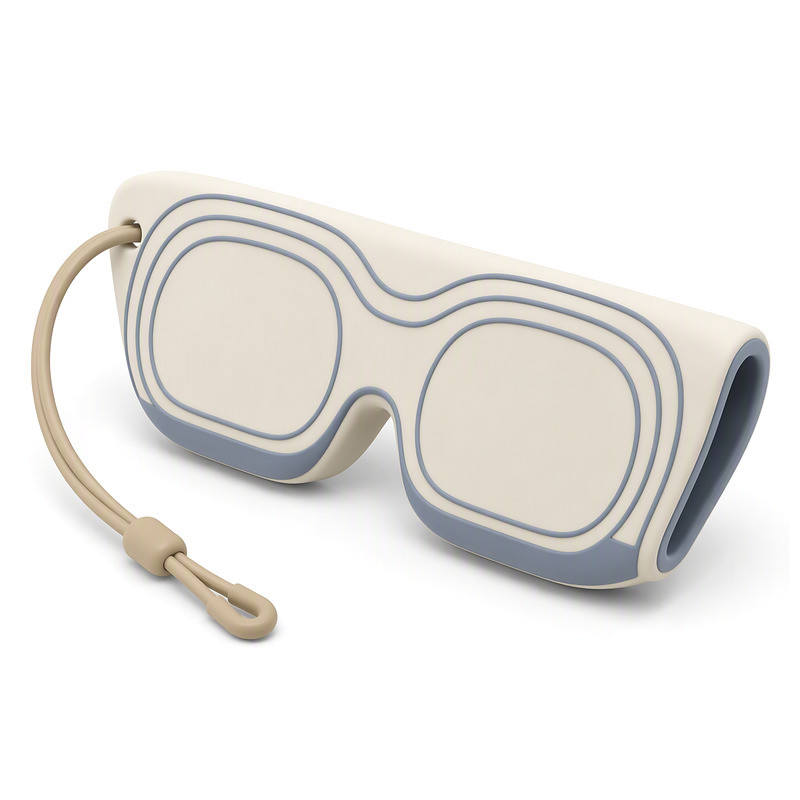
A folded pair of sunglasses is safest in the bag and most exposed on the way into it: temple tips first, one hand, a phone or a car door in the other. Hard clamshells answer that moment with a hinge and a fixed volume; fabric pouches answer it with softness and nothing else. Portable silicone sunglasses cases sit between the two, soft enough to squash into a tote and shaped enough at the opening to load one-handed.
No standard covers the case. ISO 12312-1:2022 governs non-prescription sunglasses, ISO 12870:2024 governs frames, and neither sets requirements for the object the glasses live in. The specification comes from the buyer, and it usually reduces to one detail: what happens at the mouth.
How Silicone Sunglasses Cases Differ From Traditional Eyewear Cases
A hard case protects by holding its shape; a silicone case protects by giving way and coming back. Flexibility lets a designer wrap a curved front and keep the part inside a coat-pocket profile, but it confers no crush resistance: a soft wall passes load to the frame beneath, so the question is what it presses against when it bends. Thin walls save weight and remove the spring that reopens a mouth. Colour behaves differently too, because pigment in the compound runs through the wall, and a scuff takes material without taking colour.
Flexible construction, with one condition
The contoured line on this sleeve is not only styling. It stiffens the wall at the grip, helps the mouth return to shape between insertions, and fixes where the second colour has to stop. What flexibility cannot provide is a hinge: a closure is a separate part, and that part fails first.
What Eyewear Brands Should Consider When Developing a Portable Silicone Case
Fit is usually checked against lens width, the least useful dimension in the brief. The controlling measurement is the widest cross-section of the closed frame, normally at the endpiece and hinge, so a sleeve built to a catalogue lens width can look right and still be a millimetre short. Access pulls against retention: a mouth tight enough to hold the frame is tight enough to drag on it. The fix is rarely a softer compound but a flare at the rim and a thinner section behind it. Support is the third question, and current briefs cluster into three answers.
| Construction | How the frame is held | What to review first |
|---|---|---|
| End-load sleeve | Closed tube, one open end | Rim roll, mouth fatigue, retention when a bag is tipped |
| Diagonal channel holder | Temples ride in an external slot | Slot width against temple thickness, edge wear |
| Hanging carrier | Body hangs from a strap or bead chain | Attachment strength, creep, swing against a hard surface |
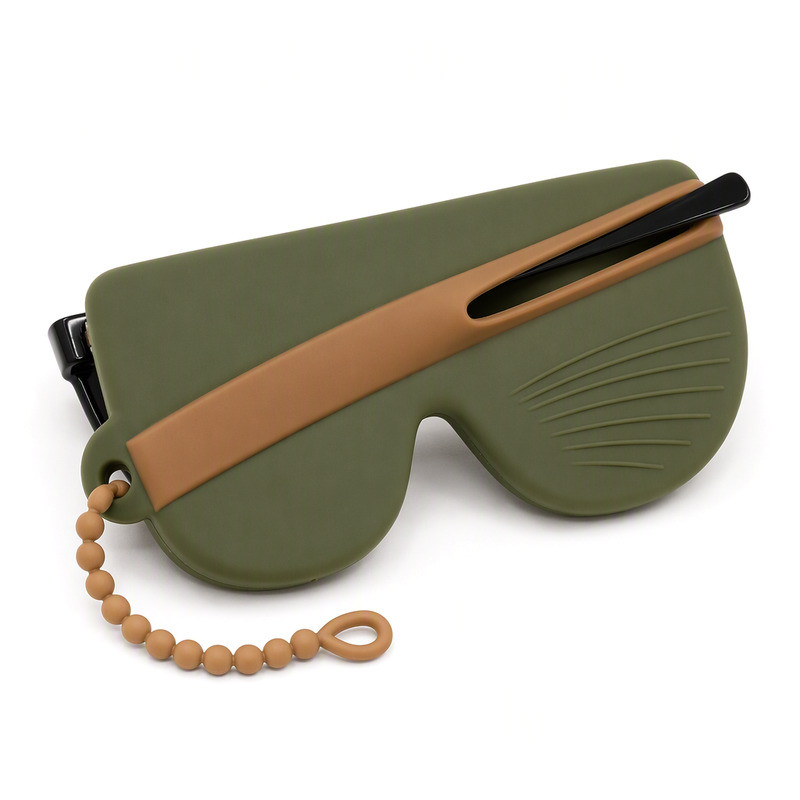
Why a channel changes the brief
A slot holds the frame by the temples, so insertion becomes a straight push instead of a squeeze. The mouth problem disappears and a width problem arrives: a channel that grips a chunky acetate arm will mark a thin metal one. Flash shows on the channel edge first, where it scratches a temple on every insertion.
Material and Manufacturing Decisions Can Affect the Finished Product
Shore A is an indentation reading, not a stiffness rating. ASTM D2240 presses a specified indentor into the surface for a defined time, and the number says how far it penetrates, so two compounds at the same hardness can feel different under a sliding load.
That matters at the mouth, because a softer wall increases contact area and therefore drag. A case can feel gentle in the hand and still be hard to load, and the trade-off between grip and insertion load is covered in this note on silicone case hardness.
Recovery is the property buyers rarely ask about. Compression set is the permanent deformation left in a rubber part after it has been held under compression, and ASTM D395 is the method normally used to measure it. For a case that spends hours at the bottom of a bag, how much shape returns matters more than the number on the datasheet.
Wall uniformity sits underneath both, because a section that thins near the rim stretches and whitens first, as this review of uneven walls in moulded silicone cases sets out.
Customization Creates More Options for Eyewear Accessory Brands
Two-colour silicone is a tooling decision in a design costume. Each boundary needs a shut-off sharp enough to stop one compound entering the other's territory, and a boundary across the mouth sits in the highest-flow region of the cavity, where it distorts first. The interface is also a line of different shrinkage, so running it across a flexing zone turns it into a crack starter. Moulded marks age with the material; printed ones depend on adhesion, and below roughly half a millimetre of line width, contrast does more work than artwork.
Tooling follows the same logic. A prototype mould answers whether shape and fit are right; a production mould answers whether the part can be made at volume, and the two are rarely the same tool, a distinction worth settling early (see this comparison of prototype and production moulds). FromRubber, the brand of Dongguan Bohao Electronic Technology Co., Ltd., has moulded silicone in Dongguan since 2010 and runs its own tool shop beside 32 compression presses in two plants, so colour layout and shut-off design are reviewed by the people who cut the tool. A worked example for this product family is published as a multicolour silicone sunglasses sleeve guide, with the wider process under multi-colour silicone moulding.
What Buyers Should Check Before Moving From Samples to Mass Production
Most of these cost an afternoon and prevent a tooling revision.
- Fold the frame and measure it at the hinge on three pairs, then put the range on the drawing.
- Insert and remove the sunglasses one-handed, cold, in the gloves the user will wear.
- Tip the loaded case and shake it; note whether the frame moves before it falls.
- Load the assembled product by its strap, not the body, and leave it warm.
- Agree written limits for flash, weld line, colour bleed and rim height before sampling.
Where Portable Silicone Sunglasses Cases May Fit Into an Accessory Range
The three formats point to different buyers rather than one market. A private-label brand tends toward the sleeve, which can carry the frame's colours and ship inside the box. Travel and promotional ranges lean to the channel holder, which packs flat and offers a readable logo surface. The hanging carrier serves the owner who wants the glasses off the seat. For buyers comparing constructions, the custom multi-colour silicone case range shows the sleeve format produced in two-colour layouts.
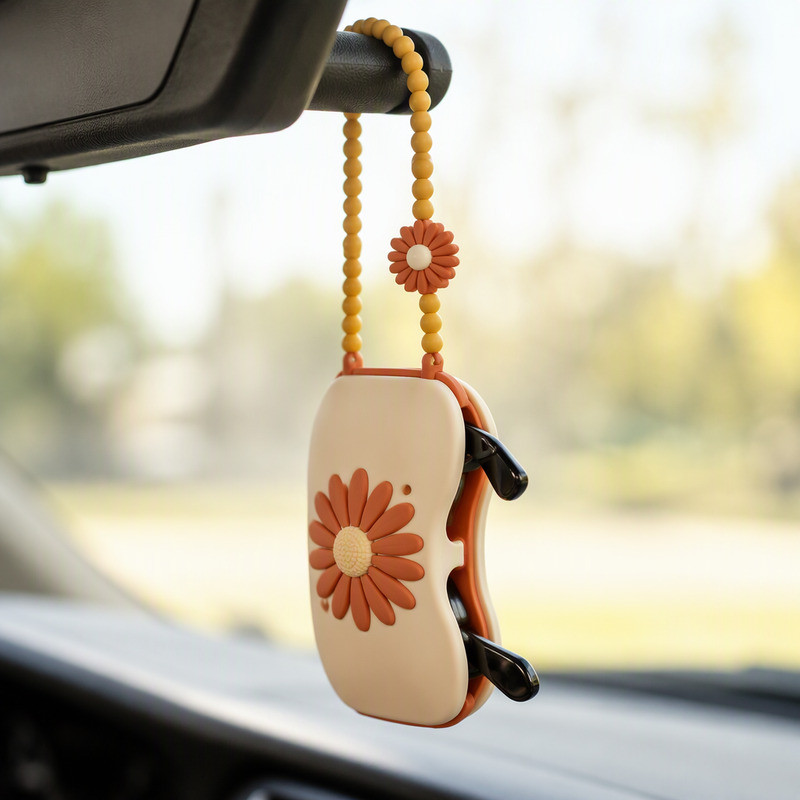
The visor is a harder test than the beach bag
A visor mount keeps the part in tension for hours, in direct sun, with the frame swinging. Heat ageing is assessed with the air-oven methods in ISO 188, and it exposes drift rather than melting: the attachment stretches, the mouth loses spring, printed motifs dull. Bead chains concentrate load at every bead, and the first bead behind the lug is usually where a hanging carrier gives way.
Working With a Silicone Manufacturer on a Custom Sunglasses Case
The process is short when the inputs are complete: folded frame dimensions, a reference photo, the colour map, logo artwork, quantity and storage position. That is enough to judge whether the opening can be moulded at the proposed wall thickness and where boundaries will move. A measured pair of sunglasses often answers more than a CAD file without tolerances. Write the hardness target as a Shore A range with a tolerance rather than a single figure, state both the nominal and the minimum wall, and give the load and duration behind any compression set requirement; those three lines are what make two quotations comparable.
The Opening Tells You Most of What the Product Will Be
Portability, frame compatibility, wall recovery and mouldability converge on one small area, which is the easiest to leave until after sampling. A case that loads cleanly and still holds the frame is not a compromise between soft and rigid; it is a shape where mouth, wall and compound were decided together. FromRubber reviews drawings, folded dimensions and colour maps before tooling for daily-goods silicone projects; samples and questions can go to nani@fromrubber.com or karl@fromrubber.com, or by WeChat and WhatsApp on +86 18676210913.
Frequently Asked Questions
What are the advantages of a silicone sunglasses case?
Low weight, a soft contact surface, colour carried through the material and freedom in shape. Protection still depends on wall thickness and construction.
Can a silicone case carry a brand logo?
Yes, moulded, debossed or printed. Line width, contrast and the curvature under the mark decide which route reads at final size.
How is the right silicone hardness chosen?
From the intended handling: how far the mouth must flex, how much grip the frame needs, and how thick the wall can be.
Can one case fit different frame sizes?
Only within a measured range, set by internal dimensions, opening length and temple thickness.
What should be sent with a development request?
Folded frame dimensions, reference images, target colours, logo artwork, quantity and storage position.
Sources
- International Organization for Standardization. ISO 12312-1:2022, Eye and face protection — Sunglasses and related eyewear — Part 1: Sunglasses for general use.
- International Organization for Standardization. ISO 12870:2024, Ophthalmic optics — Spectacle frames — Requirements and test methods.
- ASTM International. ASTM D2240-15(2021), Standard Test Method for Rubber Property — Durometer Hardness.
- ASTM International. ASTM D395-18, Standard Test Methods for Rubber Property — Compression Set.
- International Organization for Standardization. ISO 188:2023, Rubber, vulcanized or thermoplastic — Accelerated ageing and heat resistance tests.