Silicone Pet Boots: Fit, Sole Load and Mould Release
- Share
- publisher
- FromRubber
- Issue Time
- Oct 27,2026
Summary
Silicone pet boots are being specified like moulded parts rather than accessories. A look at load path, cuff memory, tread geometry and the three dimensions that decide fit, cleaning and mould release.
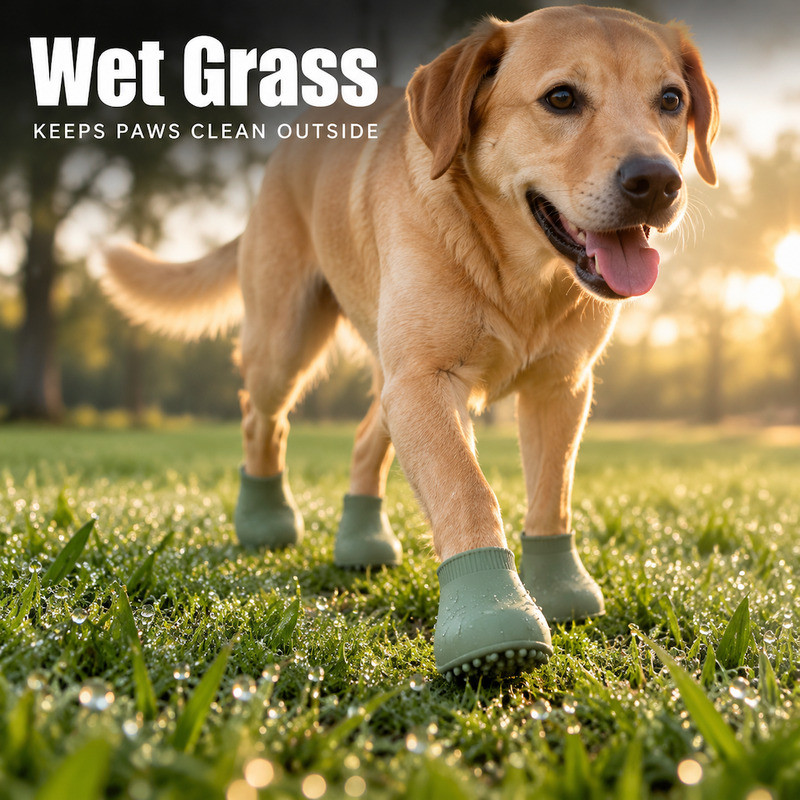
Industry analysis / silicone pet product manufacturing - reviewed 27 October 2026
Silicone pet boots are moving out of the seasonal accessory aisle and into the same specification process as any other moulded part. That shift is the development worth watching, because it changes what a drawing has to survive: a paw silhouette is no longer enough, and fit, sole load and mould release now decide whether a programme ships or stalls.
Ask five factories for a silicone dog boot and you get five drawings that look almost the same. Then the first sample arrives, and the boot turns on the paw at a trot, the cuff needs two hands to get over the toes, or the sole feels reassuring on a tiled hallway and useless on wet grass. None of those are cosmetic. Each one comes from a decision locked in before a cavity is cut: the load path through the sole, the spring behaviour of the cuff, and the stretch the part must survive as it leaves the mould.
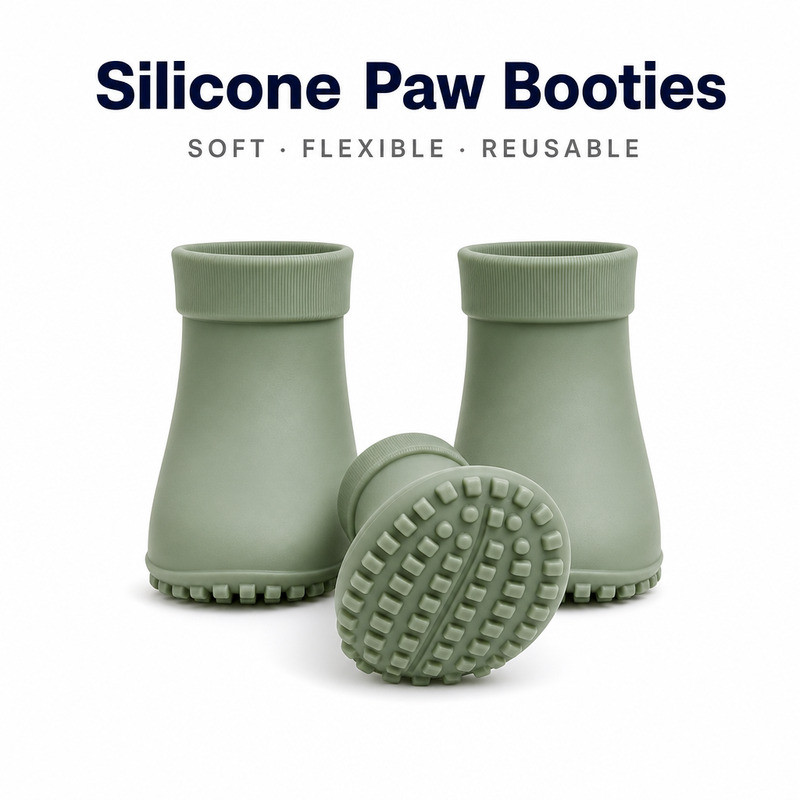
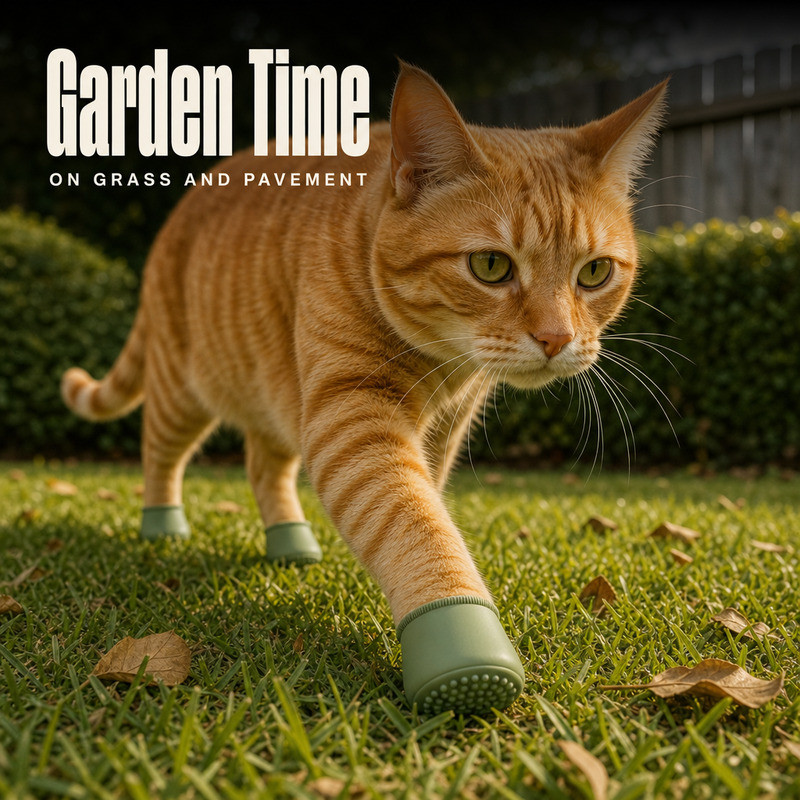
Definitions. A silicone pet boot is a one-piece moulded silicone cover that fits over a dog's or a cat's paw and is held in place by the elasticity of its own cuff. Load path means the route the animal's weight takes from the pad, through the boot wall, into the sole and into the ground. The centre of pressure is the single point where that load acts at any instant, which is why a boot can change how a paw is loaded without changing how the dog walks.
Facts this article is built on
- Bieber et al. (2022), a pressure-plate study of five Labrador Retrievers, found that one boot on a front limb reduced peak vertical force on that limb at the trot and raised it on the opposite hind limb, while stride length and speed stayed the same.
- The same study recorded a larger centre-of-pressure area at one front paw in every boot condition during walking, so the boot moved where the load sat inside the footprint, not only how much load there was.
- ISO 815-1:2019 measures compression set at a constant strain that is normally 25 percent, and separates short tests of about a day from long tests of about 1,000 hours because they answer different questions.
- ASTM D2240-15(2021) states that indentation hardness is an empirical measurement with no simple relationship between durometer scales, or between hardness and any fundamental property of the material.
A boot changes the load path before it changes anything else
The pad already solves its own contact problem
Paw pads are hairless, heavily keratinised and backed by fat. On a rough path they spread over the high points, on a smooth floor they flatten, and on wet grass they wrap the blades before they slide. The pad is a contact surface that re-solves its shape every step, and a moulded sole interrupts that. Whatever sits between the pad and the ground becomes the new contact surface, and it does not negotiate.
Uniform thickness moves the load somewhere else
Put a sole of even thickness under the paw and the weight stops distributing itself. It collects where the sole is stiffest or lowest, which is usually under the heel of the boot rather than the centre of the paw. That is the practical reading of Bieber et al. (2022): nothing about the walk looked different, but the pressure inside the footprint had shifted.
The design rule that follows is simple and easy to ignore: keep the stiffest region under the main pad, where body weight lands, and leave the toe region compliant enough that the dog can still read the ground.
Consistency inside a pair beats a perfect prototype
The largest load change in Bieber et al. (2022) appeared when a single boot was worn on one front limb. That is not an argument against boots; it is a warning about variation across a set. If four boots from one carton differ in height or cuff tension, the dog is wearing four different devices and will compensate accordingly.
A sample that feels right on the bench but sits a fraction taller than its partner will be re-measured by a limping dog, not by a calliper.
Fit is decided by three dimensions that rarely reach the first drawing
Opening circumference, not opening diameter
A hole in a flexible sheet has no diameter, only a circumference that stretches. Two boots can share a nominal opening and behave differently because one cuff is thin and tall and the other is thick and short: the first passes the toes and recovers, the second resists and then folds. Specify the opening as a circumference at a stated stretch.
Depth from the pad, not from the claw
Paw length is popular because it is easy to measure on a cooperative dog, and it is the least useful number for a boot. The claw overhangs; the pad carries the load. Set depth from the back of the main pad to the front of the toe, then check it with the paw bearing weight rather than lifted.
Toe spread changes once the dog moves
Toes sit close at rest and splay at a trot, so the paw widens by a few millimetres mid-stride. A boot cut to the resting width pinches, and pinching is what produces the rotation owners describe as the boot walking off. A tape measure taken before and after five minutes of walking tells you the clearance the interior actually needs.
The cuff behaves like a spring, and springs relax
A rolled rim is doing two jobs
The cuff has to open far enough for the toes and close hard enough to stay. In silicone that is done with geometry: the roll stores strain like a spring clip and the wall below transfers it into grip. A thick, short roll is a stiff spring with little travel; it grips hard on the first wear and fades early. A thinner, taller roll travels further, so the grip curve is flatter and lasts longer.
Compression set belongs on the drawing
ISO 815-1 exists because rubber held under compression does not fully return. The cuff sits at partial compression for a whole walk and at full stretch every time it comes off, so both conditions age the material. If compression set is not specified, the retention approved in the sample room is a temporary condition.
Silicone still allows different structures
Flexible bodies, shaped openings, wrapped toe caps, textured soles and moulded branding can all be made in one piece. The constraint is release, not imagination: every added feature has to leave the tool without tearing. Why a silicone dog paw product loses its shape after repeated use covers the same recovery problem in another product.
The sole is where grip and gait disagree
Tread depth is not traction
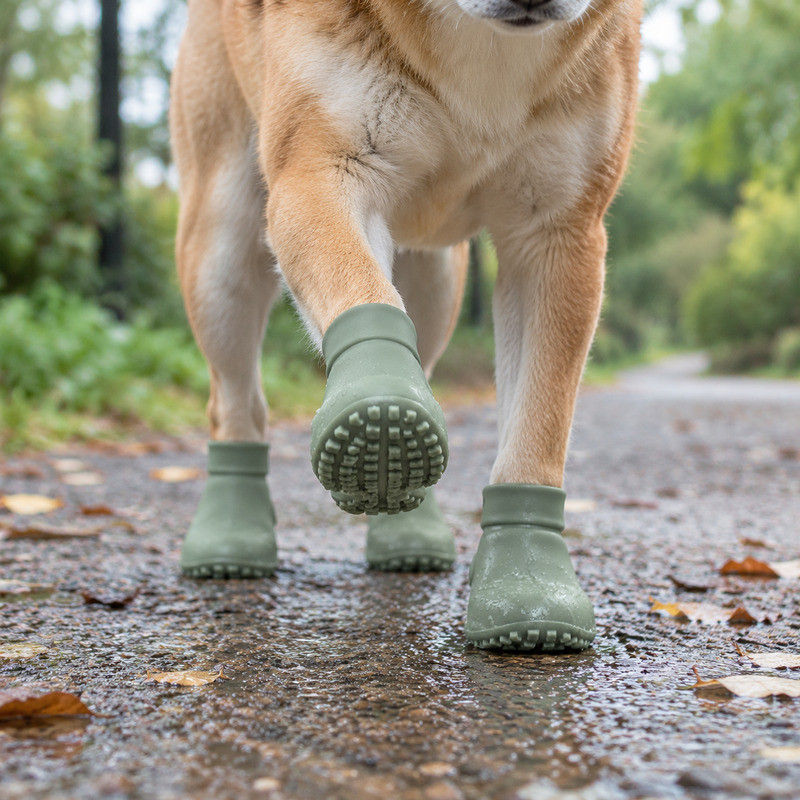
Deeper lugs help on grass, soil and mud, where something has to bite into a surface that yields. On wet paving, a smooth indoor floor or a boat deck the opposite happens: lugs cut the real contact area, and a smaller patch slides earlier. Wet friction on a hard surface comes mostly from the rubber conforming and from hysteresis as it deforms, which is why a slick beats a mud tyre in the dry and loses in a field.
One sole cannot serve every surface
A low-profile boot with a shallow, wide-spaced pattern suits floors and pavement; a taller version with deeper lugs suits wet grass and trails. Selling one geometry to both customers is how a brand ends up with reviews that contradict each other.
Deep grooves cost money twice
Narrow grooves collect dirt on the dog, and in the tool they become thin steel fins that must be vented and polished and that resist release. Shallow, wide, rounded valleys clean under a tap and grip as well on the surfaces most owners actually walk on.
A cheap test for any sole
Make one sample and walk it on wet grass, wet paving and a smooth indoor floor. If the ranking of grip is identical on all three, the pattern is doing very little and the compound is doing all the work.
Wall thickness should change on purpose
Four jobs, four different walls
The sole resists abrasion and spreads load. The sidewall holds shape without stiffening the paw. The toe area folds as the paw flexes. The cuff acts as a spring. One wall thickness cannot do all four, so it usually does the easiest one: staying mouldable. A deliberate gradient, thick where load lands and thin where the paw articulates, uses less material and feels better.
Abrupt transitions surface later
Where thick meets thin, cure arrives at different times and shrinkage resolves differently, leaving a witness line, a slight sink or a soft spot that appears after a few hundred cycles. Cheap to remove on a section drawing, expensive to chase in a cut tool.
Height is a fit decision, not a style decision
A low boot is easier to put on and easier to lose. A taller cuff covers more of the pastern and holds better, at the cost of more material, a harder release and a greater chance of rubbing at the top edge. Neither is universally better; the intended coverage decides.
Mould geometry decides whether the design survives production
The cuff is an undercut
A boot is moulded with an opening smaller than the paw it will accept, so the part can only leave the core by stretching over that lip. Silicone is forgiving enough that this usually works, but the stretch has to stay well inside the elongation at break, and every internal corner at the cuff needs a radius, because a sharp corner at a stretch point is a tear waiting to happen.
This is the same conversation as mould design for a silicone dog paw cup, where release direction decides the whole tool. On a boot, the release is decided at the cuff.
Where the parting line lands matters more than usual
Flash is unavoidable; its position is a choice. Sole-edge flash hides in use but can lift the contact patch off the ground, and cuff flash is felt by the paw and seen by anyone who turns the boot inside out. A split on the outer wall below the roll is the compromise most buyers accept.
Integrated features have to earn their complexity
A moulded logo on the sole, a reinforced toe or a raised grip band can replace a later process step and reduce cost. The same features can add a parting line, a thin steel detail or an air trap, so each one should answer a question the user asks rather than a question the catalogue asks.
Hardness needs the same discipline. Two compounds reading 50 Shore A can differ in tear strength and compression set, which decide whether a boot survives a winter, which is why ASTM D2240-15(2021) treats indentation hardness as an empirical measurement rather than a material specification on its own. See how to choose the hardness of silicone parts.
What to send, and what to check on the sample
Most of the cost of a boot programme is settled before a tool is ordered, and almost all of it is settled by information the buyer already has: a drawing, a reference product, the size range, the surfaces the product will meet, and the quantity per size. A photo alone is not enough.
| Check | What it catches | How to test it |
|---|---|---|
| Donning force | Cuff too stiff for the buyer | Ten on-and-off cycles with the intended paw size, timed |
| Rotation at a trot | Opening too wide, wall too soft, toe box too short | Trot and turn on a hard surface, watch for twist over 50 strides |
| Cuff memory | Compression set in the compound or the roll | Leave fitted 24 hours, remove, measure recovery after 30 minutes |
| Contact patch | Concave base, sole-edge flash, uneven wall | Ink the sole, walk on paper, compare left and right prints |
| Groove cleaning | Lug depth that cannot be rinsed | Pack with wet soil, rinse under a tap, count what stays |
Two of these, cuff memory and rotation, cannot be judged on a static sample, and they generate most field complaints. A drawing review before tooling is cheaper than a revision after it.
Questions that come up before a boot project starts
Can a silicone pet boot be developed as a full size run?
Yes, and it should be. Opening circumference and pad depth change at different rates across sizes, so each size needs its own numbers rather than one tool scaled by eye.
Does a thicker sole make the boot safer?
Not by itself. Extra thickness moves the load path and reduces the feedback a dog uses to place its foot. The cross-section should follow the surfaces the product is sold for.
How tight should the opening be?
Tight enough to resist rotation at a trot, loose enough to remove without a struggle. Write that band into the specification and check it on a moving dog.
What is the hardest part to tool?
The inward-facing cuff, the varying wall and the lug field pull in different directions. A split core solves the cuff and raises cost; a simpler cuff with a radiused lip often solves it for less.
Resolve the stretch before you commit to steel
A silicone pet boot fails in three quiet ways: the sole moves the load where the paw did not expect it, the cuff relaxes faster than the owner expects, and the shape cannot leave the tool without being stretched past what the material will forgive. All three are settled on paper, and none is visible in a product photo.
FromRubber is the export brand of Dongguan Bohao Electronic Technology Co., Ltd., moulding silicone in Dongguan since 2010 with its own tool shop, so a change found at trial stage is a drawing change rather than a conversation with a third party. Work runs under ISO 9001:2015, ISO 14001:2015 and IATF 16949:2016, and a pet boot project is reviewed against the section drawing, the size family and the release direction before any tool is quoted. This note was prepared by the FromRubber mould engineering team in Dongguan, where those reviews take place. Project enquiries, drawings and reference samples can be addressed to nani@fromrubber.com or karl@fromrubber.com; WeChat and WhatsApp +86 18676210913.
Sources and further reading
- Bieber B, Reicher B, Tichy A, Bockstahler B. Changes in Ground Reaction Forces and Center of Pressure Parameters of Paws When Wearing Dog Boots in Dogs. Frontiers in Veterinary Science, 2022;9:906277.
- ASTM D2240-15(2021), Standard Test Method for Rubber Property - Durometer Hardness.
- ISO 815-1:2019, Rubber, vulcanized or thermoplastic - Determination of compression set - Part 1: At ambient or elevated temperatures.