Electric Screwdriver Silicone Keypad Durability Issues in Dusty Workshop Conditions
- Share
- publisher
- FromRubber
- Issue Time
- Sep 15,2026
Summary
Dust does not pass through moulded silicone; it travels around it, and a keypad strokes its own cavity on every press. That pumping action, rather than abrasive wear, is what changes how a screwdriver keypad feels after two years in a workshop.
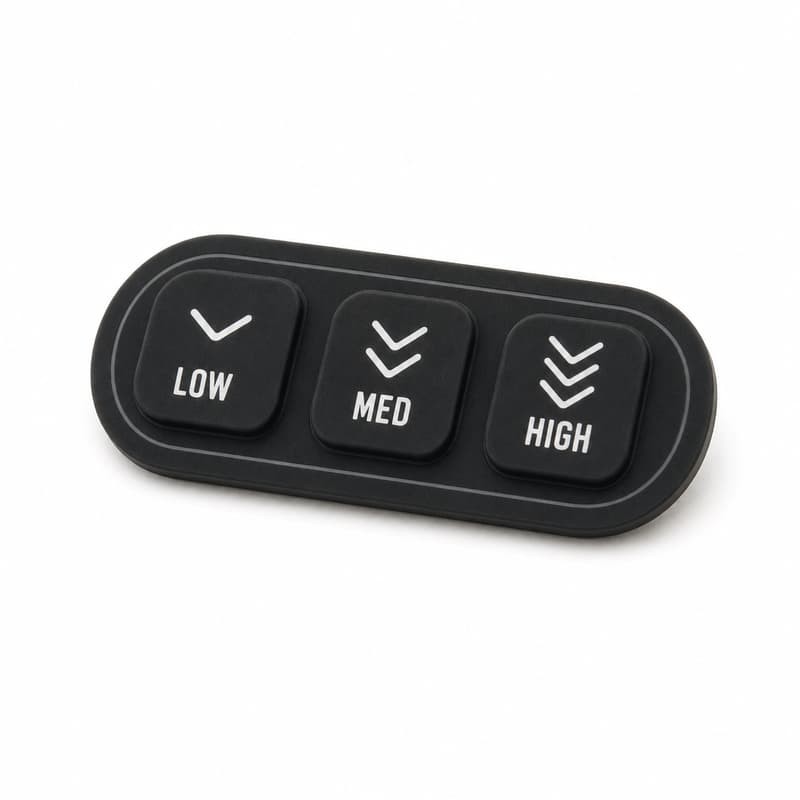
The complaint arrives about two years in, and it is almost never phrased as a dust problem. The LOW key now feels like the MED key. The trigger-mode key needs two presses to register. The tool still assembles, the print is intact, and nothing looks broken. What has changed is that the keypad has been slowly filling with workshop dust since the day it was fitted, and nobody designed a way for that dust to leave.
Dust does not pass through silicone. It travels around it
Silicone rubber is not porous in any way that matters here. Fine abrasive dust does not migrate through a moulded key wall. It moves along interfaces instead: the flange against the housing, the key wall against the aperture edge, the screw boss next to the switch cavity, the unsealed gap between a flexible keypad and a rigid plastic bezel. Every one of those paths is a gap that opens and closes slightly as the tool is used, and every opening cycle is an opportunity.
This is why a screwdriver keypad can look perfect and still fail. Inspection photographs of a worn panel show dust on the contact pads and around the web root, inside the assembly, while the exterior of the keypad is clean. The material did its job. The interface did not.
A keypad is a small pump, and it strokes on every press
Pressing a key displaces the web, which reduces the volume of the cavity behind it. Releasing the key restores that volume. Air leaves and then has to come back. If the easiest path for that return air happens to be the aperture gap rather than a filtered path, the panel draws in whatever is suspended around the tool at chest height, which in a workshop is exactly the fraction of dust that is fine enough to stay airborne and abrasive enough to matter.
The same pumping happens thermally. A tool that heats up during use and cools on the bench cycles its internal pressure every working day. IEC 60529 addresses this directly in its dust test method: the standard reproduces the breathing effect by testing the enclosure under reduced pressure, drawing in a volume of air around eighty times the enclosure volume without exceeding a depression of about 2 kPa. If a test house has to simulate breathing to be fair to an enclosure, a designer should assume the real enclosure breathes too.
Why year two is worse than year one
Dust that enters once does not necessarily leave. It settles on the contact pad, in the groove around the key shoulder and at the root of the web where the material is thinnest. Every subsequent press grinds those particles against the silicone and against the switching surface. The dust is no longer just contamination; it has become a lapping compound with a fresh load applied several thousand times a day. Abrasion of the web root, glazing of the contact pad and a slow drift in actuation force all follow from that same mechanism rather than from three separate causes.
What makes a workshop worse than a test bench
Dust concentration is not the only variable, and it is often not the most important one. Air-tool exhaust near the bench keeps fine particles suspended instead of letting them settle. A screwdriver used in the same bay as a grinder is breathing a steady supply of material that has just been cut from metal or concrete. Without local extraction, the dust that settles on a work surface is available to be stirred up again by the next tool the operator picks up.
Storage matters as much as use. A tool laid down keys-up on a dusty bench collects a shallow layer in the groove around every key and along the flange edge. The next press pushes part of that layer inward. A tool stored keys-down or in a holster collects far less, which is one reason two identical tools in the same workshop can age very differently.
The dust that a power tool itself emits is a measured quantity in Europe. EN 50632 sets out the dust measurement procedure for electric motor-operated tools, part by part, and exists precisely because the dust a tool generates around itself is a workplace exposure issue rather than a manufacturing detail. For a screwdriver keypad, the practical reading is that the panel lives in a dust field that it helps to create.
Sealing and force are two jobs, and a harder compound solves neither
The usual first instinct is to raise the hardness of the silicone. It rarely helps. A harder web raises the actuation force, which conflicts with a tool that has to be usable one-handed, and it does not close the interface gap that the dust is using. It also usually increases compression set, so the flange relaxes faster and the gap gets slightly larger over time, which is the opposite of the intended effect.
What does work on a drawing tends to be unglamorous. Move the keypad into a recess so the flange sits below the surrounding surface and dust has to climb to reach the seam. Slope the flange edge rather than leaving it flat, so particles shed instead of collecting. Pre-load the sealing lip so that it stays in contact over the whole service temperature range, and check that pre-load against compression set rather than against a room-temperature measurement. Finish the key face matte so the surface does not polish to a smooth, easily wetted glaze. And decide deliberately whether the panel is targeting IP5X dust-protected or IP6X dust-tight in the terms defined by IEC 60529, because those two acceptance rules lead to different lip geometry.
Give the dust somewhere to go
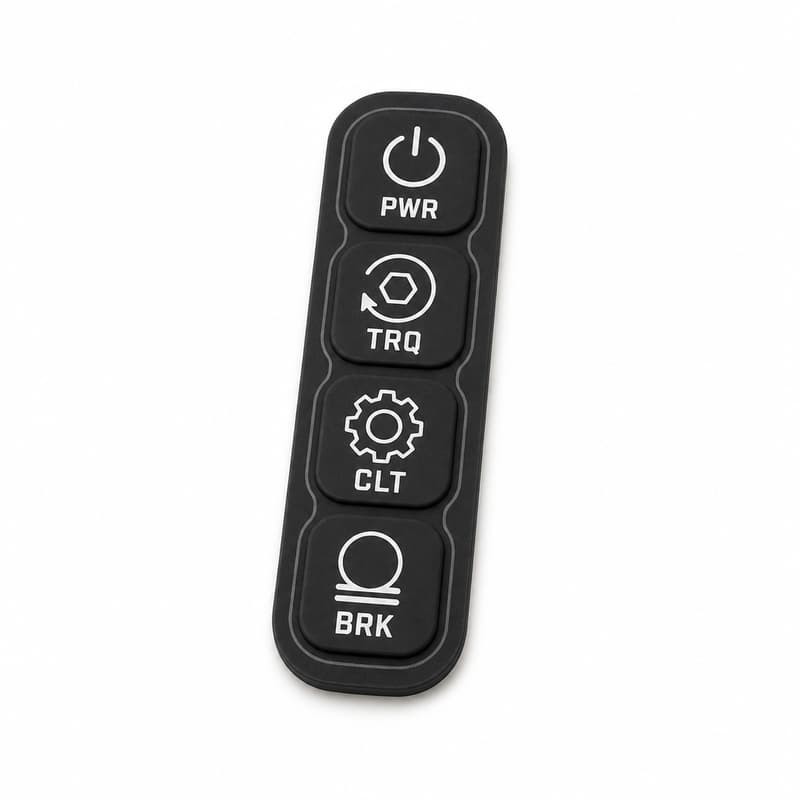
Keeping dust out completely is expensive. Giving it a defined route out is cheap and usually more reliable. A shallow channel at the low edge of the keypad recess, clear of the contact area, lets settled material migrate away from the web instead of accumulating under the key. On a screwdriver that is often hung or stood on its battery, the low edge is easy to identify, and the channel costs nothing in tooling if it is included in the first cut. Designing the exit after the tool is made means a second mould.
Contact element choice changes how much a particle matters
Not all switching methods react the same way to a particle sitting on the contact. A metal dome closes over a small area, so a single hard particle can hold the dome fractionally off the pad and produce an intermittent rather than a failed contact. A conductive carbon pill presents a wider contact area, which spreads the effect of one particle but comes with higher contact resistance to begin with. Conductive ink printed pads sit somewhere between the two.
The selection criterion is not which one has the lowest resistance in a clean test. It is which one still closes reliably when the surface has a layer of fine dust on it and the operator is pressing with a gloved thumb in the cold. That question is answered by testing in the contaminated condition, not by comparing datasheet figures taken in a laboratory.
The test that predicts field behaviour is not the standard dust test
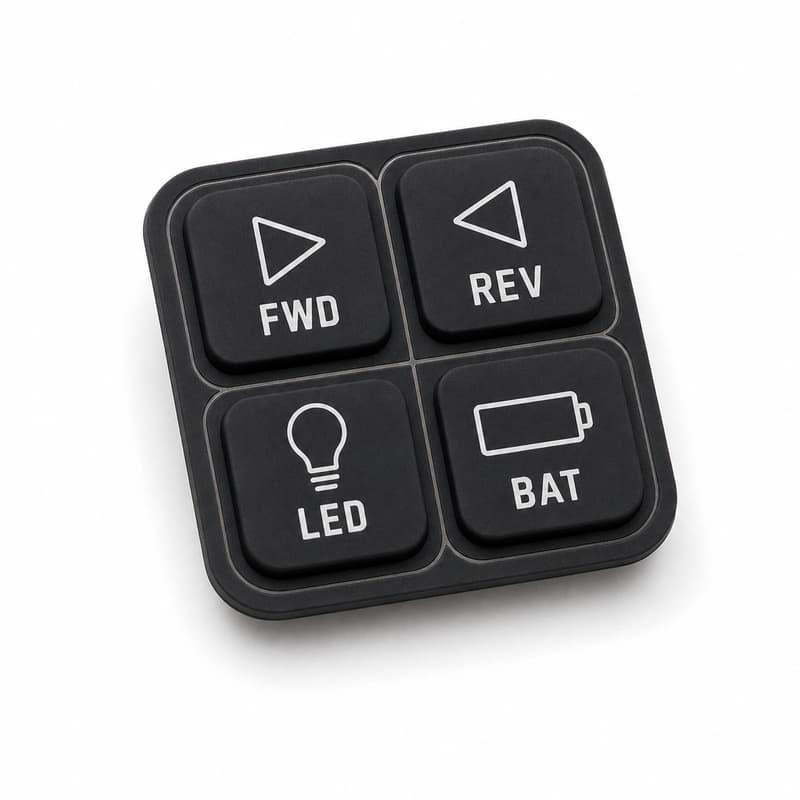
A conventional IEC 60529 dust test puts the enclosure in a chamber with the enclosure at rest or with the sample simply powered. It tells you whether dust entered in a quantity that interferes with operation. It does not tell you what a workshop does to the part over two years, because it does not reproduce the pumping. A more useful internal test cycles the keys while the sample is in the dust chamber, so that every press draws air through the same path it will use in service. Running the same sample with keys cycled and keys static, on the same day, in the same chamber, produces a comparison that a bench test cannot.
Test dust selection matters for the same reason. ISO 12103-1 defines the particle size distribution and chemical content of Arizona test dust across several grades, from fine to coarse. Abrasive material from metal cutting and concrete work is not evenly distributed, and running only one grade can make a design look acceptable when it is only tolerant of one particle size.
What to put on the drawing for a dusty installation
- Ingress target stated as IP5X or IP6X to IEC 60529, and applied to the assembled tool rather than to the keypad alone.
- Recess depth that puts the flange below the surrounding surface, with a sloped rather than flat outer edge.
- Sealing lip pre-load stated at the lowest service temperature, checked against compression set measured to ISO 815-1 or ASTM D395.
- Surface finish specified as matte, with the mould texture called out so it does not polish out over life.
- A defined dust exit path, clear of the contact pads and the web root.
- Contact element type selected on contaminated-state test results, not clean-state resistance figures.
- A dust chamber test that cycles the keys, using at least one coarse and one fine grade of test dust to ISO 12103-1.
How this reads on a real screwdriver panel
A tool that comes in for review after a field complaint normally follows one of two paths. In the first, the keypad is removed and the contact pads are found dirty while the exterior is clean, which points at the interface and the pumping path. In the second, the exterior of the keypad shows a polished, dust-collecting band around the keys, and the flange has visibly relaxed into the recess, which points at surface finish and compression set.
The two paths call for different work, and it is worth separating them before changing anything. The first responds to geometry: moving the flange into a deeper recess, adding a shed edge, and giving settled material a route away from the web. The second responds to compound and process: a matte mould finish, a hardness band that stays stable in service, and a cure schedule that leaves the compression set low enough for the lip to stay pre-loaded.
On one screwdriver programme the change that mattered was none of those. The contact pads were fine and the seal was fine, but the aperture in the housing had a square internal corner that trapped dust directly above the switch cavity, so the pump drew from a reservoir that never emptied. Rounding that corner and shifting it a few tenths away from the key line solved a problem that had already been through two compound changes without effect. That is a housing drawing change, not a silicone change, and it is the reason a keypad review is worth doing with the housing in front of you.
The division of work is straightforward. The silicone keypad carries the contact element and the sealing geometry, and it has to match the board underneath. The board itself, its pad layout and its switch design, is the customer's electronics design. FromRubber works to that drawing.
Questions that come up when a screwdriver keypad starts to feel different
Can dust really get in if the keypad passes an IP dust test?
Yes, and the reason is that the test and the service condition are not identical. IEC 60529 dust testing is usually run with the sample at rest or powered but not worked. A keypad that strokes its cavity several thousand times a day pulls air in along the same path it uses to push air out. Testing with the keys cycled inside the chamber is a closer model of the field.
Would a softer compound seal better against dust?
A softer compound conforms more easily to a housing surface, which helps static sealing, but it deforms more under press load and can extrude into gaps over time. The useful lever is usually lip geometry and pre-load rather than hardness alone. Once the lip is shaped so that press load does not act on the sealing line, hardness has much less influence on seal quality.
Why does the print survive while the key feels different?
Because they are worn by different mechanisms. Legend wear is driven by friction across the key face, so it tracks glove contact and surface finish. The change in feel is driven by material accumulating inside the assembly and by compression set relaxing the panel. A keypad can therefore look convincing and behave incorrectly at the same time, which is why visual inspection alone is a weak acceptance method.
FromRubber (Dongguan Bohao Electronic Technology Co., Ltd.) moulds custom silicone keypads for hand-held power tools and reviews sealing, contact element selection and dust path design against the housing they will be assembled into. The technical points above come from that review work and from the standards and references listed below.
Related reading
Sources
- [1] Castle Compliance, IEC 60529 ingress protection testing: definitions of IP5X dust-protected and IP6X dust-tight, and the reduced-pressure dust chamber method drawing in about eighty times the enclosure volume without exceeding 2 kPa. https://castle-compliance.com/iec-60529-testing/
- [2] IEC 60529 dust test guide for IP5X and IP6X, including talcum powder test media and the acceptance criteria that separate the two ratings. https://www.dgkingpo.com/iec-standard-60529-dust-test-ip5x-ip6x-explained/
- [3] ISO 12103-1:2016, Road vehicles - Test contaminants for filter evaluation - Part 1: Arizona test dust, defining particle size distribution and chemical content limits across graded test dusts. https://www.iso.org/standard/63386.html
- [4] ISO 12103-1:2024, current edition of the Arizona test dust standard covering five grades of test dust made from Arizona desert sand. https://www.iso.org/standard/85949.html
- [5] EN 50632 series, Electric motor-operated tools - Dust measurement procedure, assessing the dust emitted by hand-held and transportable tools. https://www.sis.se/en/produkter/environment-health-protection-safety/air-quality/stationary-source-emissions/ssen5063225/
- [6] IEC 62841-2-2:2014, Electric motor-operated hand-held tools, transportable tools and lawn and garden machinery - Safety - Part 2-2: Particular requirements for hand-held screwdrivers and impact wrenches. https://webstore.iec.ch/en/publication/7450
- [7] ISO 815-1:2014, Rubber, vulcanized or thermoplastic - Determination of compression set - Part 1: At ambient or elevated temperatures. https://www.iso.org/standard/61761.html
- [8] ScienceDirect topic overview, Compression set: definition as a percentage of unrecovered deformation, and the difference between physical and chemical set in elastomers. https://www.sciencedirect.com/topics/engineering/compression-set
- [9] SItech, The pros and cons of metal domes vs conductive carbon inserts in silicone rubber keypads: relative contact resistance and tolerance to contamination. https://www.sitech-corp.com/blog/the-pros-and-cons-of-metal-domes-vs-conductive-carbon-inserts-in-silicone-rubber-keypads/
- [10] Epec Engineered Technologies, comparison of conductive and non-conductive rubber keypads covering contact element options and design features. https://www.epectec.com/articles/conductive-and-non-conductive-rubber-keypad-comparison.html
- [11] Jasper Electronics, silicone keypad carbon pill resistance guide, including the point that carbon pill specifications should control the closed switch system rather than the raw material. https://www.jasperele.com/blog/silicone-keypad-carbon-pill-resistance/
- [12] Protective coatings for silicone keypads, a durability guide covering legend protection, matte and smooth top coats, and the observation that laser-etched surfaces attract dirt more readily. https://siliconekeypadfactory.com/blog/protective-coated-keypad-guide/