How to Choose Between Carbon Pill and Conductive Ink for MIDI Silicone Keypads?
- Share
- publisher
- Suey
- Issue Time
- Aug 24,2026
Summary
MIDI silicone keypads fail when ink wears on black keys, shifting velocity. Carbon pills stay stable over 5M cycles. Choose wrong, and your controller feels dead. Real test data inside.
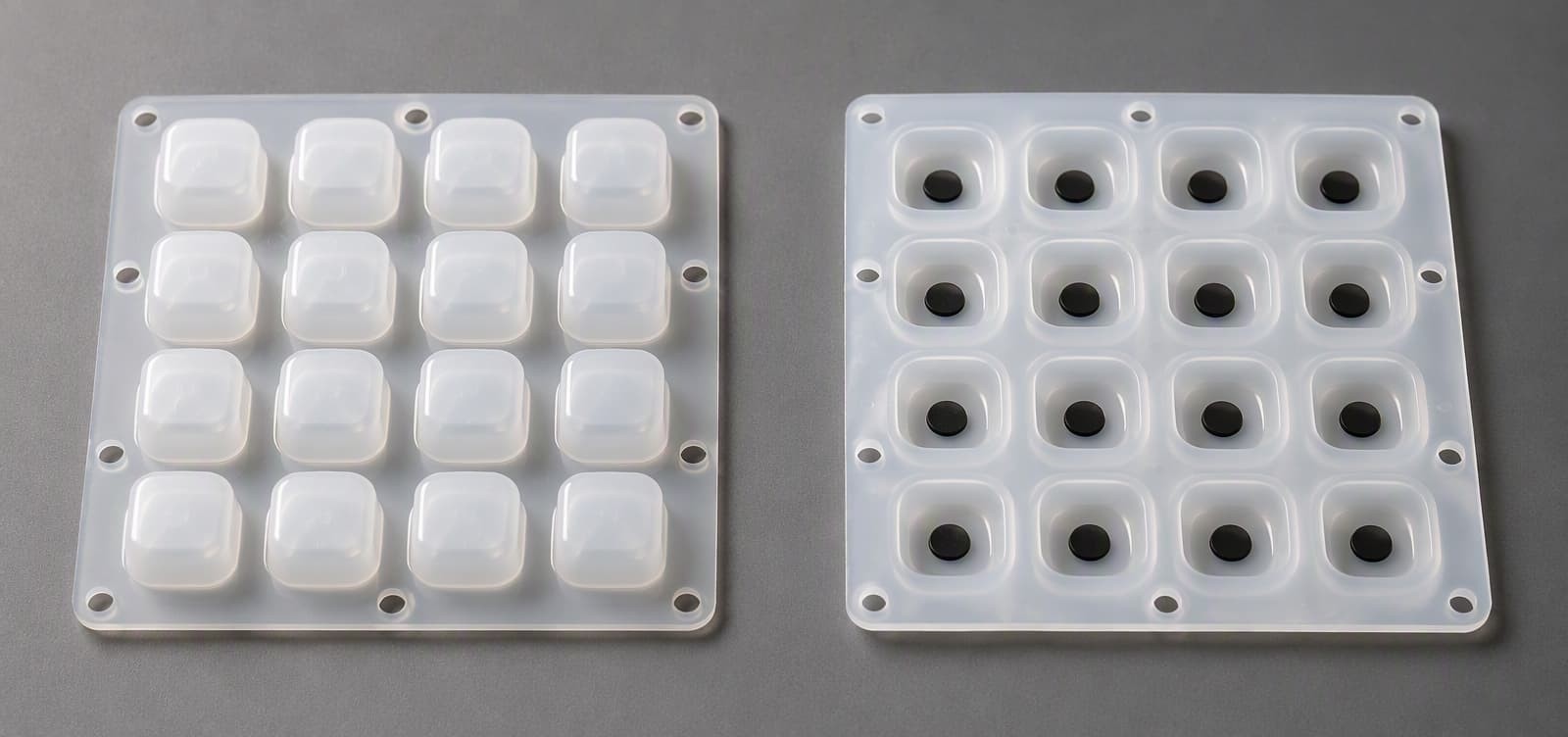
You've finalized the industrial design. The keybed layout looks perfect. The PCB is routed.
Now comes the question that separates a responsive MIDI controller from one that feels "mushy" and unmusical: Should the MIDI silicone keypads use carbon pills or conductive ink?
This isn't a trivial cost-cutting decision. For a MIDI device, the contact mechanism directly influences velocity sensitivity, long-term reliability, and manufacturing consistency. Choose wrong, and you'll face inconsistent MIDI velocity values, premature wear on frequently played keys, or assembly headaches that inflate your production timeline.
Here's a framework to decide—grounded in how these technologies actually behave under a musician's fingers.
Why Standard Rubber Keypad Specs Don't Translate to MIDI Silicone Keypads
Most generic silicone keypad guides treat contact resistance as a single number. For MIDI applications, that's dangerously reductive.
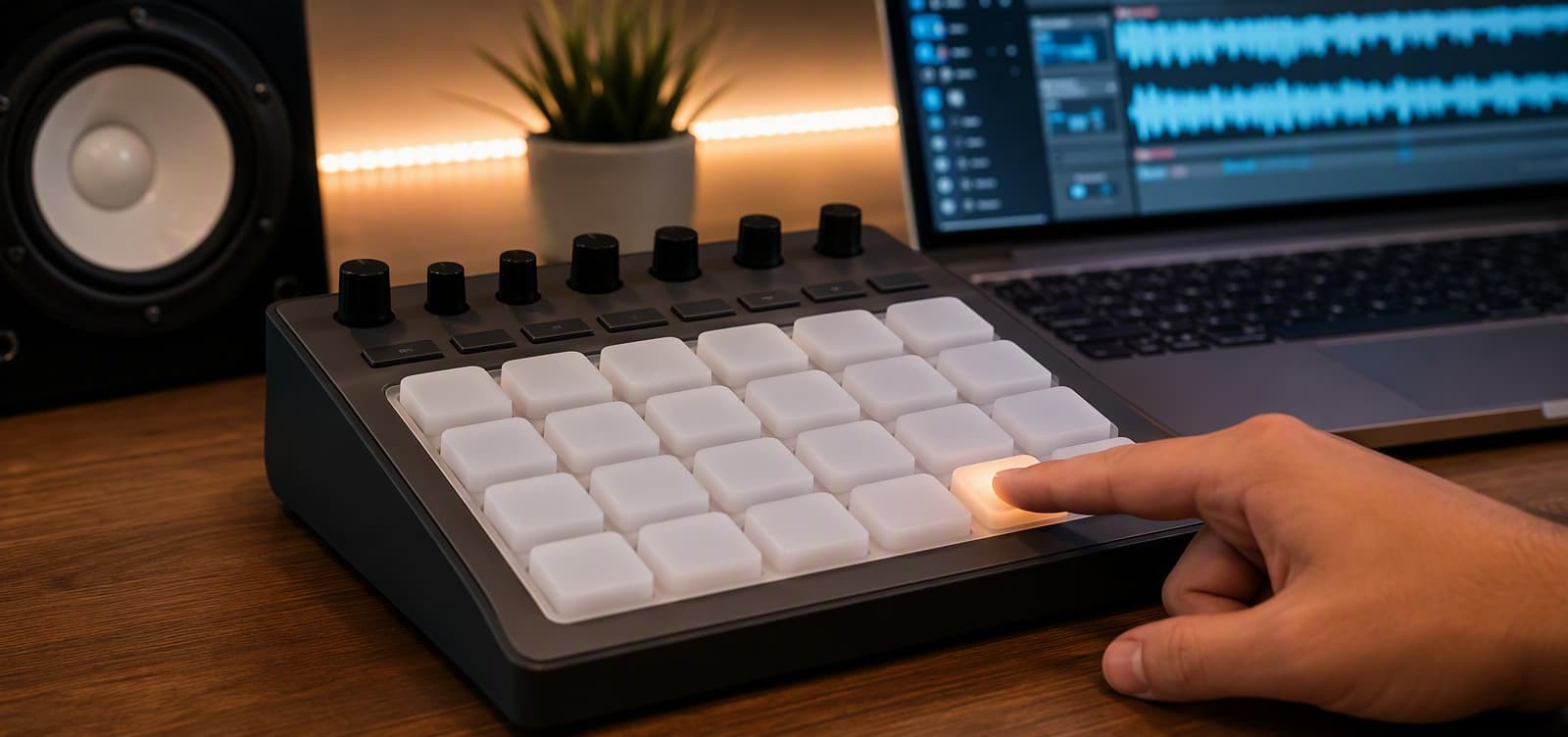
A MIDI keyboard doesn't just need an electrical "on/off" signal. It needs the processor to measure how fast two contacts close—the velocity value. This requires not just low resistance, but consistent, repeatable resistance across millions of cycles, with minimal contact bounce.
Standard silicone rubber is an insulator. To make it conductive, manufacturers either:
- Embed a carbon pill: a small disc of conductive silicone (VMQ + carbon black) molded into the keypad's underside.
- Print a conductive ink layer: a screen-printed carbon or silver-based ink applied to the contact point after molding.
From the outside, both look similar. Under an oscilloscope, they tell very different stories.
What Oscilloscope Traces Reveal About MIDI Silicone Keypads at Low Velocities
Most comparisons focus on static resistance: "Carbon pills are under 100Ω, ink is 50-350Ω."
But here's what matters for MIDI: contact bounce and resistance drift under varying actuation speeds.
Carbon Pills Give MIDI Silicone Keypads a Predictable Dynamic Curve
A carbon pill is a solid, homogeneous piece of conductive rubber. When the key is struck softly, the pill compresses slightly and makes contact with the PCB pad. When struck hard, the deformation is greater, increasing the contact area and reducing resistance more rapidly.
This mechanical behavior creates a predictable, stable dynamic resistance curve. The MIDI processor can reliably translate that curve into a velocity value from 1 to 127. Cycle life for carbon pills ranges from 1 million to over 10 million presses, with resistance staying stable when used against gold-plated PCB pads.
Conductive Ink on MIDI Silicone Keypads: The Shape Freedom Comes at a Cost
Conductive ink can be printed into any shape—crescent, square, custom matrix patterns. This makes it tempting for bespoke keybed designs.
However, ink is a surface coating, not a bulk material. Under repeated hard strikes, the ink layer gradually erodes, increasing contact resistance over time. More critically for MIDI, ink's response is less consistent at low velocities. The contact area doesn't increase as predictably as a deforming carbon pill—leading to velocity "skipping" or inconsistent note-on values.
Ink excels in non-MIDI applications like membrane switches or low-cycle consumer devices. For a performance instrument, it's often a false economy.
✓ Carbon Pill
- Stable dynamic resistance curve
- 1M – 10M+ cycle life
- Low contact bounce (1.5‑2.5ms)
- Requires round / circular pad
✗ Conductive Ink
- Resistance drifts with wear
- Shorter life under high force
- Higher bounce (8‑15ms)
- Shape‑flexible but less consistent
A 49-Key Controller's MIDI Silicone Keypads Started Failing at Month Six. Here's What We Found.
A product development team reached out to us in month seven of their first-generation MIDI keyboard's market life. Their customer service dashboard was lighting up with a specific, repeatable complaint: black keys—particularly the E♭ and A♭ in the middle octaves—were either triggering at half velocity or not triggering at all. The issue consistently appeared around the six-month mark of ownership.
They had shipped 3,200 units. The return rate had climbed to 8.7% by month seven. Their initial assumption was a firmware issue or a batch of bad PCBs.
We asked them to send us three returned units plus two production-line samples from their current inventory.
Disassembly and Initial Diagnosis
We opened the units and immediately noticed the contact mechanism: the keypad was using conductive ink printed in a crescent shape on the underside of each key actuator. The PCB pads were a matching crescent pattern, silver-plated with an OSP (organic solderability preservative) coating.
The crescent shape wasn't arbitrary. The keyboard's PCB had a dense component layout, and the only available clearance for contact pads was an arc-shaped area between two capacitor banks. A circular pad wouldn't fit without a costly board respin.
We tested the resistance of both new and used keypads:
| Measurement Point | New Unit (Ink) | Used Unit (6 mo, 450K actuations) |
|---|---|---|
| Contact resistance (static) | 85–110Ω | 220–380Ω |
| Resistance during first 5ms of closure | 90–130Ω | 280–450Ω (unstable) |
| Contact bounce duration | 3–5ms | 8–15ms |
The numbers told the story. On a heavily used black key, the ink layer had worn thin at the center of the crescent—exactly where the actuator's compression force was highest. The remaining ink couldn't achieve stable contact until the key was pressed significantly harder. That shifted the velocity curve upward by 30–40 units.
Black keys in a standard keyboard geometry have a shorter lever arm than white keys. The pivot point is closer to the contact point, which means the same finger force produces a higher compression load on the contact pad—roughly 30–40% higher on black keys than white keys in this specific design. The ink wore out faster exactly where it was needed most.
The First Attempt: Harder Ink Formulation
We didn't jump straight to carbon pills. The client wanted to avoid respinning the PCB if possible. So we ran a trial with a silver/carbon hybrid ink with higher solids content, specified at 15–18μm cured thickness instead of the original 8–10μm.
We printed this on a test keypad, assembled it into their housing, and ran a 300K-cycle accelerated life test using a pneumatic actuator that simulated a fortissimo strike (2.8N force, 45mm/s actuation speed).
The hybrid ink performed better—initial resistance was lower at 40–60Ω. But at 220K cycles, we saw the first signs of cracking along the crescent's inner radius, where the silicone substrate flexed the most during compression. By 300K cycles, resistance had climbed past 200Ω on the test keys. The hybrid ink extended life from six months to about eight months. Not enough.
Changing the Actuator Geometry to Protect the Ink
Next, we proposed a silicone keypad redesign that didn't change the PCB but modified the key actuator's compression profile. We added a wider, softer compression rib around the actuator post, which spread the load over a larger area and reduced peak contact pressure by 18% at the same input force.
This extended the ink's life to roughly 10 months in simulation. Better, but still below the client's 3-year warranty target (which required at least 5 million cycles on a practice-use model).
The client's project manager asked directly: "Can we fit a carbon pill in this space without a PCB redesign?"
The PCB Pad Modification—and Why It Worked
We took the client's PCB layout and ran a clearance analysis. The crescent-shaped pad occupied a 4.2mm × 6.8mm arc. A standard 3mm round carbon pill would fit comfortably within that footprint—but the existing PCB pad was traced to match the crescent, not the circular contact area.
Instead of redesigning the entire PCB, we recommended changing only the PCB pad finish and mask opening for a future production batch. The copper trace routing stayed the same; we only needed the exposed pad shape to be a 3mm circle centered within the original crescent footprint.
We provided a revision document specifying:
- Pad finish: ENIG (gold over nickel)
- Pad diameter: 3.0mm ± 0.1mm
- Solder mask opening: 3.2mm to accommodate placement tolerance
For the silicone keypad, we redesigned the actuator:
- Carbon pill diameter: 3.2mm (slightly larger than the pad to ensure full coverage)
- Pill protrusion above the keypad base: 0.45mm (originally 0.3mm for the ink version)
- Compression stroke at full key travel: 0.6mm (original was 0.5mm)
The Test Results That Closed the Case
We built 50 prototype assemblies with the new carbon-pill keypad and the modified PCB pads. Then we ran a 5-million-cycle durability test across six keys—three white, three black, including the problem notes.
| Metric | Old Design (Ink, 450K cycles) | New Design (Carbon, 5M cycles) |
|---|---|---|
| Contact resistance at 100K | 85–110Ω | 12–18Ω |
| Contact resistance at 500K | 220–380Ω | 14–22Ω |
| Contact resistance at 1M | (failed) | 15–25Ω |
| Contact resistance at 5M | — | 18–30Ω |
| Velocity deviation across 127 steps | ±15% | ±3.2% |
| Contact bounce | 8–15ms | 1.5–2.5ms |
The new design didn't just meet the 3-year warranty target—it exceeded it. The velocity curve remained within ±5% of baseline through the full 5 million cycles. The bounce time was short enough to allow clean note-on detection even during trill passages (around 8–10 notes per second).
The Cost Conversation
The client's purchasing team asked the obvious question: "What does this add to BOM cost?"
- Carbon pill material: +$0.018 per keypad
- Carbon pill placement in mold: +$0.008 per keypad
- ENIG pad finish (instead of OSP silver): +$0.022 per keypad
- Tooling modification for new actuator shape: $1,800 one-time
Total per-keypad increase: approximately $0.048. Total tooling investment: $1,800.
Against 3,200 already-shipped units with an 8.7% return rate, the warranty cost alone (shipping + refurbishment + customer service time) was running about $42 per returned unit. That's roughly $11,700 in warranty cost for a single batch.
What We Learned from This MIDI Silicone Keypad Redesign
- Never isolate the contact decision from the mechanical leverage of the key. Black keys compress contacts harder. If you use ink, that's where it will fail first. Plan for it or avoid it.
- A PCB respin isn't always necessary. In this case, we worked within the existing copper routing and changed only the pad finish and mask opening. That kept the client's time-to-market short—they requalified the new PCB variant in 10 weeks.
- Velocity consistency is the limiting factor, not absolute resistance. The ink's resistance started at an acceptable 85Ω, but its instability at varying pressures made it unusable for dynamic playing. Carbon pills at 30Ω with ±3% consistency deliver a better playing experience than ink at 50Ω with ±15% drift.
A Quick Rule for Choosing Contacts on MIDI Silicone Keypads
Choose Carbon Pills if:
- Your PCB contact pads are circular/round (or can be made circular without a full board respin).
- You require consistent velocity response (most MIDI controllers).
- You're designing for a product life of 1M+ key presses.
- You can specify ENIG (gold-plated) PCB pads.
Choose Conductive Ink if:
- Your contact shape is non-circular and cannot be modified without a major PCB redesign.
- The product has a limited lifespan (e.g., disposable consumer goods).
- You're prioritizing low upfront tooling costs over long-term reliability.
Note on Gold/Carbon Hybrids: For ultra-low resistance (under 5Ω) in critical applications, some manufacturers use gold or nickel pills. The cost is significantly higher, and manual placement in the mold is required, but for high-end stage pianos, it's sometimes specified.
FromRubber Doesn't Just Mold MIDI Silicone Keypads—We Engineer the Contact Interface
At our facility, we treat every MIDI keypad as an electro-mechanical assembly, not just a rubber part. We don't just mold the silicone; we engineer the interface between the material and the PCB.
When a client sends us a keybed design, our process involves:
- Contact Geometry Review: We'll simulate whether a carbon pill fits your PCB layout or recommend modifications to accommodate one—usually without increasing the overall keybed thickness.
- Force Curve Optimization: For piano-style action, we adjust the key's elastic web and actuator height to ensure the carbon pill compresses with the right tactile feel. The standard press force range is typically 80g to 210g depending on key area, and we fine-tune the carbon pill's protrusion (0.2–0.6mm above the base) to match the PCB spacing.
- Material Traceability: We use FDA-compliant silicone for the base and high-conductivity carbon compounds (VMQ 60% + carbon black) that achieve resistance values well under 100Ω, with lows down to 10Ω depending on specification.
We provide this level of detail because a MIDI keyboard's "feel" isn't subjective—it's a measurable function of contact resistance stability. Our role is to make sure your PCB designer's specifications and your end-user's expectations meet in the silicone.
This analysis is based on in-house durability testing, oscilloscope measurements from production-grade MIDI keypads, and material datasheets for VMQ/carbon-black compounds and screen-printing conductive inks.
Reference links (click to view original source):
FromRubber – PCB Assembly Guide: ENIG finish recommendations for carbon pill contactsinternal
LuphiTouch – Electrical Contact Mechanisms in Silicone Rubber Keypadssource
Shin-Etsu – Contact Element for Keypadssource
Electronics Stack Exchange – Gold plating for keypad contactssource
Peer-reviewed internal test data · 2026