Silicone Keypad for Water Quality Meter: How to Design Keypads for Field Water Testing?
- Share
- publisher
- FromRubber
- Issue Time
- Sep 10,2026
Summary
A water quality meter gets splashed, rinsed and pressed with gloved hands - and its keypad has to seal the housing, switch the circuit and keep its feel. This article looks at the documented rubber keypad of the Hanna HI98195, the force-travel geometry behind tactile feedback, and what to specify when sourcing a custom silicone keypad for a water quality meter.
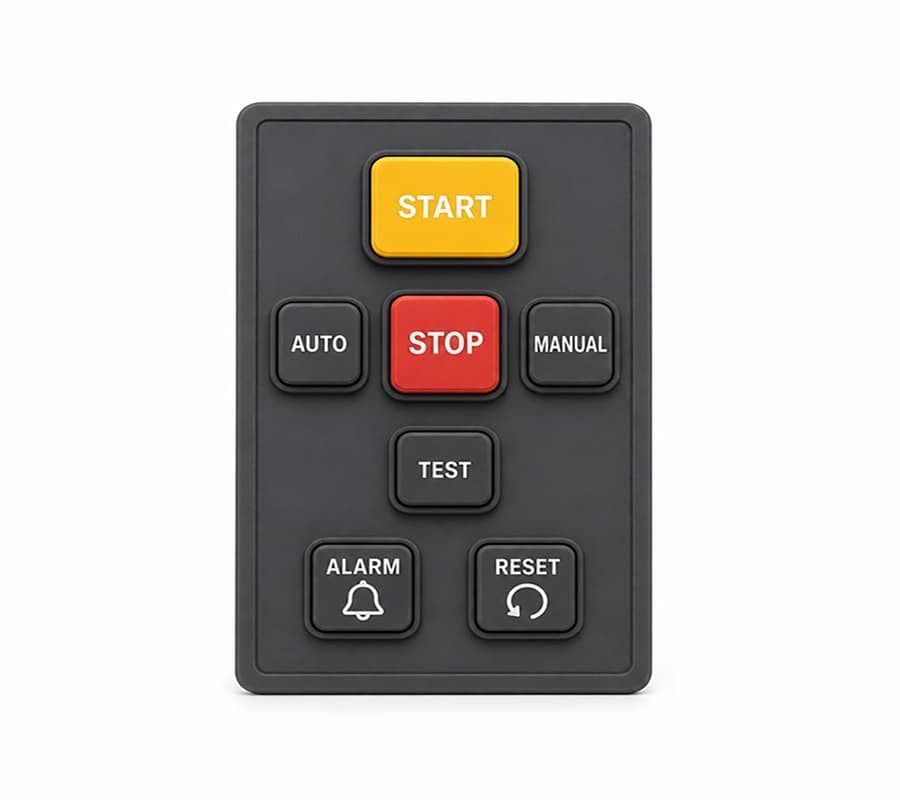
A water quality meter lives in the splash zone. It gets dipped in the river, rinsed under a tap, used with gloves and set down on a wet gangway, and the silicone keypad for water quality meter projects sits directly in that environment. When the pad is not sealed, the first rinse becomes a service call; when the keys feel vague through a glove, every menu step becomes a guess. The keypad is the one moving, flexible part on the front of the meter, and it has to seal the housing, switch the circuit and still feel predictable after years of wet, repeated pressing.
Why Do Portable Water Quality Meters Still Use Physical Keypads?
Field meters have had touchscreens as an option for years, yet most portable water quality instruments still ship with physical buttons. The reasons are practical rather than nostalgic. Physical keys give tactile recognition — an operator can find the right key without taking eyes off the measurement, the probe or the sample bottle. They work with wet hands and gloves, where capacitive touch screens become unreliable. They offer clear button differentiation: a power key, a backlight key and a help key can be given different positions, sizes and even surface textures, so the finger finds them by feel.
Physical buttons also give predictable mechanical feedback. A press that clicks tells the operator the input was registered, which matters during calibration routines where a missed keystroke corrupts a buffer sequence. None of this means physical buttons are universally superior to touch interfaces; it means that for a meter used outdoors, in wet conditions, by operators whose attention is split, a well-designed keypad is still the lower-risk input method.
The keypad does not exist for its own sake. It is one element of the instrument interface, and the instrument defines the constraints: the housing opening, the PCB contact positions, the button count and the environment the meter must survive.
Why the button count matters before the material does
In our shop, the first question about a water quality meter keypad is never the durometer. It is the key layout: how many keys, which roles, and how much skirt area remains around them for sealing. A meter driven by four dedicated keys and a help key seals differently from a meter with a full alphanumeric block. The layout decision comes first because it fixes the space available for the sealing skirt, the web geometry and the PCB contact pattern.
What Can the Hanna HI98195 Teach Us About Water Quality Meter Keypad Design?
The Hanna Instruments HI98195 is a useful reference because its interface is documented in public materials — and the documentation is careful with its wording. What the sources actually say, without interpretation: the meter has a "rubber keypad" that includes dedicated keys for power, backlight, navigation (up/down arrows), help and alphanumeric input, plus two virtual soft keys that guide the user through configuration [1]. Another distributor describes the same interface as a "low-profile vulcanized rubber keypad" used together with virtual keys for entering passwords, user IDs and sample site data [2]. Hanna's German product literature describes a specially fitted rubber keypad (Gummitastatur) with dedicated keys for on/off, backlight, arrow up/down, escape and help, plus an alphanumeric keypad and up to two context-dependent virtual keys [3]. The meter itself is documented as IP67 waterproof, with an IP68-rated probe [1][4].
Note the terminology: Hanna says "rubber keypad," not "silicone keypad." Rubber and silicone are related but not interchangeable words, and a manufacturer should quote the terminology the brand itself uses. From a keypad engineering perspective, the documented HI98195 interface is still a clear example of a multi-function physical keypad: a small cluster of dedicated keys, a navigation pair, a help key and an alphanumeric block, all on one molded pad under a graphic display. That combination — dedicated keys plus alphanumeric entry plus soft keys on the display — is exactly the pattern we see when an OEM needs both quick field operation and structured data entry (site IDs, user IDs, passwords).
What the product photos do not tell you, and what an OEM has to specify, is how those keys are built: key size, spacing, actuation force, travel, graphics and the membrane that connects them. The documentation describes the user experience; the engineering underneath is where a custom silicone keypad manufacturer works.
What Are the Key Requirements for a Silicone Keypad for Water Quality Meter?
The requirements divide into four groups, and each group maps to a different part of the pad.
- Mechanical — fit in the housing opening, actuation force per key, key travel, and durability for repeated operation. The pad has to seat consistently and press consistently, from the first sample to the thousandth.
- Electrical — reliable contact between the conductive pill under each key and the PCB pads, with stable contact resistance and enough overtravel to close the switch over the full tolerance range.
- Environmental — water exposure, cleaning routines, operating temperature range, and chemical compatibility per the OEM's specification. Silicone is documented as water- and contamination-proof by keypad manufacturers, with a broad service temperature window [5], but the compound still has to be selected for the specific cleaning agents and temperatures the meter sees.
- User interface — graphics contrast, key differentiation, surface finish and glove compatibility. The operator reads the meter through these keys, so legends have to stay legible and the keys have to remain distinguishable in low light and with wet hands.
These four groups interact. A softer compound may improve sealing but worsen tactile feedback; a thicker web may extend life but raise actuation force. The design task is balancing them against the meter's actual use, not optimizing any single parameter.
Why Is a Soft Silicone Keypad Not Necessarily a Better Keypad?
There is a persistent assumption that a softer keypad feels better because it feels gentler. On a water quality meter, softness without geometry control does the opposite. Tactile feedback is not a material property; it is the shape of the force-travel curve, which is set mostly by the web geometry — the thin wall that lets the key collapse and return.
A pad that is simply soft tends to show four failure patterns. Vague actuation, where the press slides into the switch with no clear step, so the operator cannot tell whether the input registered. Poor feedback, where the return force is so low the key feels dead after release. Accidental activation, where keys trigger under the weight of a hand resting on the panel. And slow return, where the key does not snap back before the next press, which causes missed or doubled keystrokes during rapid menu navigation.
The hardness of the compound and the geometry of the web have to work together. The design guides define the force curve with three numbers: the actuation force F1 at which the web collapses, the contact force F2 at which the conductive pill touches the PCB, and the snap ratio (F1 − F2) / F1, which measures how pronounced the click is [5]. A sensible target for instrument keypads is a snap ratio in the rough 40–60% range: enough of a step to feel through a glove, not so much that the return force drops and the key jams. Hardness matters, but it is measured per ASTM D2240 [6] and describes the compound; the curve is what the operator feels.
When "soft feel" turns into field complaints
We once quoted a keypad for a handheld analyzer where the original drawing specified a very soft compound "for comfortable pressing." Before tooling, we flagged that the proposed web geometry would produce a snap ratio below 20% — a mushy press with weak return. We kept the soft compound but changed the web thickness and added a return rib, and the prototype came back with a clear step at roughly the same peak force. The customer's operator feedback after the trial run was that the meter finally "clicked like a real instrument." The lesson is routine for us: the operator feels the curve, not the durometer.
How Should Different Keys Be Designed on a Water Quality Meter Keypad?
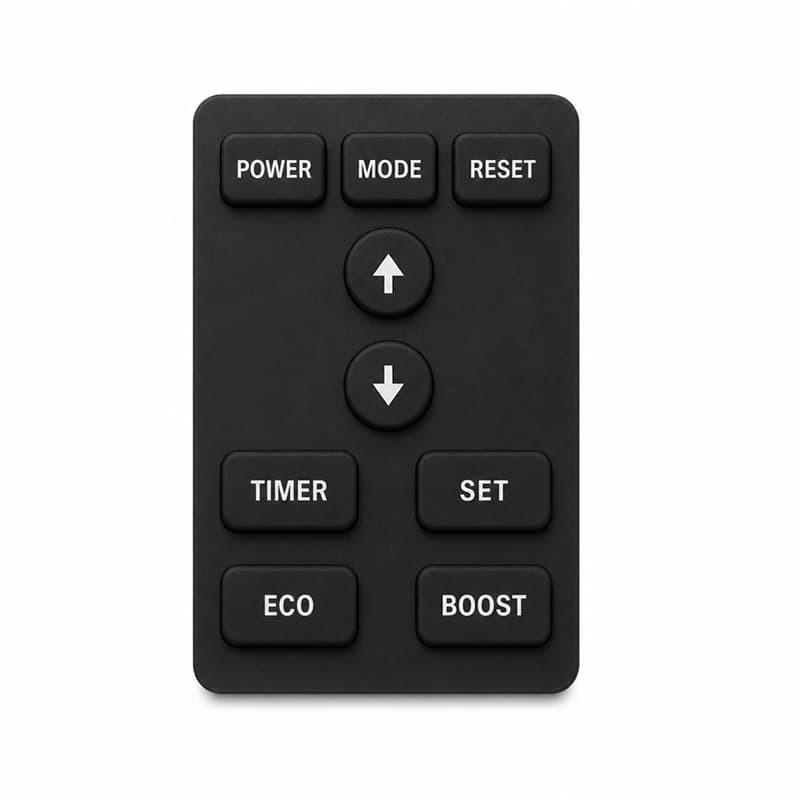
A field meter keypad usually mixes several key roles on one pad: power, navigation, function, and sometimes numeric or alphanumeric entry. Each role earns its own design treatment.
- Power and backlight keys — usually the largest or most distinct keys, often given a different graphic treatment so they are found by touch in the dark.
- Navigation keys — arrow pairs or a small cluster. They are pressed repeatedly during menu scrolling, so they need a force and travel that suit rapid, light presses rather than a single firm jab.
- Function keys — CAL, LOG, HELP and similar. The HI98195 documents a dedicated HELP key that calls up contextual on-screen guidance [1]; on the pad, that key needs graphic differentiation so the operator finds it without reading the legend.
- Numeric/alphanumeric keys — used for site IDs, passwords and calibration buffers. These are smaller keys on the same pad, which means the web geometry has to be sized per key area; a single force target for the whole pad usually fails the small keys.
- Soft-key regions — keys aligned with on-screen labels. Their position on the pad has to match the display layout, which makes the PCB-to-keypad alignment part of the design rather than an afterthought.
The underlying rule is differentiation: key size, force, graphics and spacing should let the operator identify each key by feel and by glance. A pad where every key feels identical forces the operator to read every legend — which is exactly what a field user does not want to do.
Graphics and texture are part of the design
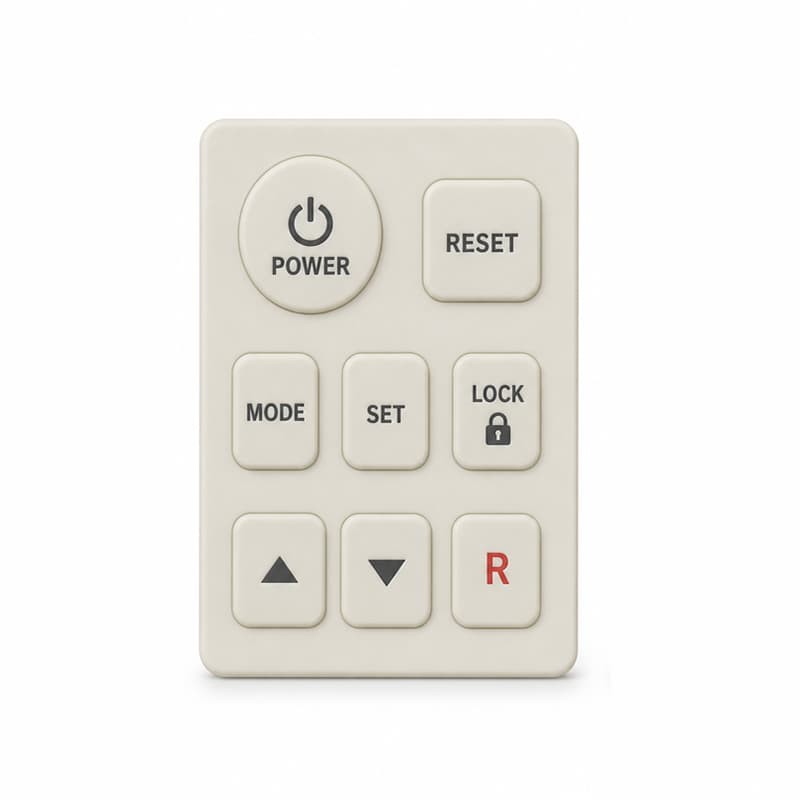
Key differentiation does not stop at geometry. Legend contrast, symbol style and surface texture all tell the operator which key is which. On a water quality meter, where the eyes are often on the probe or the sample, the difference between a matte power key and a smooth function key is a usability decision, not a cosmetic one.
How Does a Silicone Keypad Connect to the Electronics?
Most custom silicone keypads switch the circuit with conductive carbon pills molded onto the underside of each key. When the key travels down, the pill bridges the two contact pads on the PCB. Three parameters dominate the electrical design: contact resistance, alignment and compression.
Carbon-pill contacts are documented with contact resistance well below the design limits for the switching circuits inside a meter — keypad manufacturers specify maximum contact resistance in the order of a few hundred to a couple of thousand ohms at low voltage and current [5]. That is ample for digital control circuitry. The real failure mode is not resistance magnitude but intermittent contact: a pill that lands off-center, or a key with too little travel to compress the pill firmly, gives a switch that opens and closes unreliably. Alignment is set by the mold and the pad's locating features; compression is set by the travel budget and the PCB height. Both are measured on a sample, not assumed.
Electrical testing on our floor covers continuity per key, contact resistance at rated force, and switch actuation over repeated cycles. The keypad is a control interface, not a measurement path, so the specification that matters is reliable switching over the meter's life — not chasing the lowest possible resistance.
How Should a Custom Silicone Keypad Be Designed Around the Instrument Housing?
The pad does not end at the keys. Around them is the skirt — the flat silicone that sits against the housing — and that skirt is where sealing is won or lost. For a meter documented as IP67 [1], the keypad has to be designed and assembled so the instrument can hold that rating: the skirt is compressed between the housing halves or into a groove, and the compression has to be specified, not approximated.
Housing curvature is the first thing we check in a 3D model. If the front face of the meter is curved, the pad has to follow that curvature without wrinkling, which changes the skirt layout and the web geometry. Locating features — alignment holes, ribs, or a molded lip — keep the pad in position during assembly, and the keypad design guide notes that alignment holes are typically needed when the overall pad size exceeds roughly 75 mm in either direction [5]. Mounting and sealing also set the cosmetic surface: the visible area of the pad must sit flush with the housing, with even gaps, which comes down to tolerance stack-up between the molded pad, the housing and the PCB.
From a tolerance standpoint, the pad is the flexible member that has to absorb the stack-up of three rigid parts. If the drawing sets the pad to nominal dimensions without allowance for housing and PCB tolerances, the first assembly trial is where the problem shows up — as a key that works in one corner and not the other.
Rubber Keypad vs. Silicone Keypad for Water Quality Meters
The terms "rubber keypad" and "silicone keypad" are often used interchangeably, but they are not synonyms, and the distinction matters when an OEM writes a specification.
- Terminology — "Rubber keypad" is the broader term; it can mean natural rubber, EPDM or other elastomers. "Silicone keypad" names the material family specifically. A brand that documents a "rubber keypad," as Hanna does for the HI98195 [1][3], may be describing a silicone pad under a generic name — but an OEM should not assume that, and a supplier should not claim it as fact.
- Material family — Silicone is a synthetic elastomer with a siloxane backbone, documented for resistance to heat, low temperature and contamination, with a typical service range of roughly −55 °C to 250 °C [5].
- Tactile performance — Both families can be molded with webs and pills; the feel is set by geometry and compound, not by the family name.
- Durability and customization — Silicone keypads are routinely molded with multi-color graphics, translucent areas for backlighting, and carbon pills in the same shot [5].
- Environmental requirements — The right choice depends on the OEM's specified temperature, chemical and cleaning regime; the specification should name the compound, not just the word "rubber."
The practical point: when an OEM asks for "a rubber keypad for a water quality meter," the useful follow-up question is which elastomer family and what environmental requirements. The answer drives compound selection, tooling and test conditions.
What Should Water Quality Meter Manufacturers Provide to a Silicone Keypad Supplier?
The fewer design loops a project needs, the more information arrives with the first inquiry. For a water quality meter keypad, a workable starting package contains:
- 3D housing — the front opening, the sealing groove or boss, and the wall that traps the pad.
- PCB — contact pad positions, heights and tolerances, so the pills can be aligned to them.
- Button layout — number of keys, positions, sizes and pitch, including the skirt area.
- Key functions — which keys do what, which are pressed most, which need differentiation.
- Force target — desired actuation force and snap ratio, and the temperature at which they must hold.
- Travel — target key travel and overtravel above the contact point.
- Graphics — legends, symbols, colors, and any translucent or backlit areas.
- Environmental requirements — target IP class, cleaning agents, temperature range, chemical exposure.
- Expected production volume — it determines tooling strategy and molding approach.
If some items are still open, write them as assumptions on the quote. A quote with stated assumptions is useful; a quote that silently guesses produces the wrong part.
How Can a Silicone Keypad Manufacturer Improve OEM Development Efficiency?
Most development time in keypad projects is lost to late discoveries, and the fixes are procedural. A DFM review before any tooling catches sealing and geometry issues while they are still cheap to change. Early coordination between the PCB layout and the pad geometry prevents the classic failure where the pill lands beside the pad. Prototype testing should include force measurement on a load-cell rig and electrical continuity per key, not a thumb test. Design revisions should be closed before production tooling is cut — a change after tooling multiplies cost and schedule by a factor that no discount on the unit price recovers.
For a field meter that has to seal and click for years, the efficiency gain is not speed for its own sake. It is the difference between a pad that works on the first production batch and a pad that consumes several rounds of engineering rework.
Common Problems in Water Quality Meter Keypad Projects
Across the instrument keypad projects we review, the same patterns recur:
- Keypad too soft — vague actuation and accidental presses because softness was chosen without geometry control.
- Keypad too hard — operator fatigue and glove-damped presses that no longer register.
- Inconsistent tactile feel — keys on the same pad that feel different because each key area has its own web geometry but one force target.
- Poor PCB contact — the pill misses the pad or lacks overtravel once housing and PCB tolerances stack up.
- Graphics wear — legends that fade under repeated cleaning with aggressive agents.
- Poor housing fit — the skirt wrinkles on a curved face, or the pad sits proud of the housing.
- Excessive flash — molding flash at the skirt edge that interferes with the seal or assembly.
- Key interference — adjacent keys touching under off-angle presses because spacing was too tight.
None of these are exotic. They are the ordinary failure modes of a molded interface part, and they are all addressable in the drawing and the DFM review before steel is cut.
Conclusion
The silicone keypad for a water quality meter is best understood as one continuous engineered interface connecting the operator's finger, the instrument housing and the PCB. It has to seal against water that the meter is explicitly rated to survive, switch the circuit reliably for years of field use, and give tactile feedback that works through gloves and wet hands. The HI98195's documented rubber keypad — dedicated keys, alphanumeric entry, soft-key support, inside an IP67 instrument — shows what a mature physical interface looks like from the outside. The engineering underneath is where a custom silicone keypad manufacturer earns its place. If you are developing a portable water quality meter, a 3D housing, PCB layout and a preliminary button plan are usually enough for a silicone rubber keypad manufacturer to begin a DFM review.
This article was written by the molding engineering team at FromRubber, a custom silicone keypad manufacturer in Dongguan, China. We mold instrument keypads for portable analyzers and field meters, and the checks described here are the ones we run on our own shop floor before a pad is approved for production.
Related reading
Sources
- [1] Neonics Co., Ltd., "Hanna Instruments HI98195 Multiparameter Waterproof Meter — Specifications and Features". https://manuals.plus/m/a0002b173b993075f72efed23c9092e0e5f5c312acc086ebca0ffeb79792345e
- [2] Geneq, "pH Conductivity and dissolved oxygen waterproof meter — HI98194 / HI98195". https://geneqonline.com/product/multiparameter-portable-ph-ec-do-waterproof-meter/
- [3] Hanna Instruments Deutschland, "Outdoor Messtechnik — HI98195". https://hannainst.de/shop/multiparameter-messgeraete/outdoor-messtechnik/
- [4] Hanna Instruments (China), "HI98195 多参数水质分析测定仪". http://www.hannachina.cn/Product-162.html
- [5] Diamond HMI Ltd, "Rubber Keypad Design Guide". https://www.diamondhmi.co.uk/wp-content/uploads/2020/02/Diamond-HMI-Rubber-Keypad-Design-Guide.pdf
- [6] ASTM International, "Standard Test Method for Rubber Property — Durometer Hardness", ASTM D2240-15(2021). https://www.astm.org/d2240-15r21.html