The Real Cost of Cheap Industrial Controls Panel Silicone Keypad
- Share
- Issue Time
- Sep 7,2026
Summary
Cheap silicone keypads fail as legends wear, carbon pill contacts drift, and geometry changes. A worked cost model shows the higher-priced part can be three times cheaper per unit.
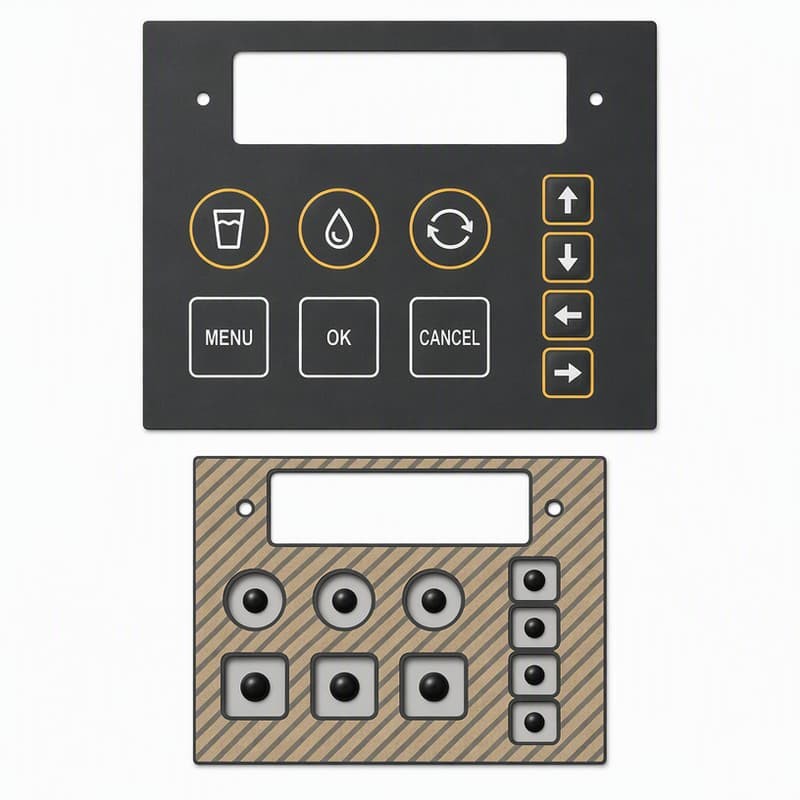
The cheapest quote wins the purchase order. Nine months later the controller is back on the bench with a key that double-fires, a legend that has rubbed off, and a service ticket that costs more than the entire lot of keypads. This is not a quality rant. It is arithmetic, and the arithmetic rarely gets written down before the PO goes out.
What the unit price does not include
A silicone keypad for an industrial control panel is a small molded part, and small parts invite the cheapest-bid reflex. But an industrial panel keypad does not fail like a toy button. It fails between the operator's finger and the machine's logic: intermittent contact, missed actuations, legends that become unreadable, keys that stop returning. Each failure mode has a different root cause, a different test, and a different cost to the field. The unit price only buys the part. The failure rate buys the aftermath.
The useful way to compare two quotes is expected cost per unit over the product's life, which is roughly: part price + (field failure rate × cost per field failure). A $0.85 keypad with a 3% field failure rate and a $180 service call costs $0.85 + 0.03 × 180 = $6.25 per unit. A $1.60 keypad with a 0.3% failure rate costs $1.60 + 0.003 × 180 = $2.14. The more expensive part is cheaper by a factor of three, before downtime and reputation are counted. The gap widens the moment the panel is inside a machine that stops production when it misbehaves.
Where the cheap parts actually fail
The common failure modes on industrial panels are specific and testable. They are not vague "quality differences."
Legends that wear off the button
Silk-screen printing on silicone is the low-cost default, and its durability is bounded. Industry practice for screen-printed legends is to survive a 1,000-cycle alcohol rub with a 500 g load and a 10,000+ stroke abrasion test while staying legible [1]. Cheap parts get there by using ink without a protective topcoat, which passes incoming inspection and fails in the second year of daily wiping. On an industrial panel, an unreadable STOP button is not a cosmetic issue. Laser-etched legends, by contrast, are ablated through the topcoat into the silicone itself and last as long as the part [1]. The price difference is a few cents; the safety difference is not.
Carbon pill contacts that drift
The conductive pill under each key is carbon-loaded silicone with volume resistivity typically in the 10²–10⁵ Ω·cm range [2]. Contact resistance between the pill and the PCB pad is the number that matters, commonly specified below 500 Ω initially and below 1,000 Ω after a million actuations [2]. Cheap suppliers often skip the batch resistance check entirely. The symptom in the field is a key that works when pressed hard and misses when pressed normally — an intermittent contact that is almost impossible to reproduce on a service call.
Compression set that turns clicks into mush
Actuation force on a silicone keypad carries a tolerance of roughly ±25 g around the design target, and the snap ratio that makes a key feel like a switch sits between 40% and 60% [3]. Compression set (ASTM D395 / ISO 815) measures how much of that geometry is lost over time. Low-cost compounds and short cure cycles push set numbers up; the result is a panel that clicks on the bench and mushes in the field.
Batch-to-batch force drift
When the process is not controlled, the same drawing produces different-feeling keypads across batches, because durometer drifts with material lot and cure conditions. Durometer itself should be verified per ISO 7619-1 on a molded test slab, not on the finished keypad wall [4]. A supplier that cannot show batch force-travel data is selling you a lottery ticket with a mold number on it.
The geometry failures nobody photographs
Two more failure modes show up mainly on price-driven tooling. First, flash and edge thinning: when the mold steel is cheap or the cavity is worn, the web edge thins or flashes, and a 22% failure rate from edge thinning is not hypothetical — we have documented it on a conductive keypad project (write-up here). Second, trapped air: poor venting leaves bubbles under printed legends, which later look like pinholes on a backlit panel. Neither shows on a drawing review; both show on the first winter or the first backlit batch.
Compliance paperwork is part of the part
Industrial panels routinely land in equipment that must meet UL 94 for flammability and RoHS/REACH for restricted substances. UL 94 V-0 requires a specimen to self-extinguish within 10 s of a test flame and to produce no flaming drips [5]. RoHS (Directive 2011/65/EU) and REACH (Regulation EC 1907/2006) restrict substances that are easy to slip into a cheap compound [6]. A low price with a missing or recycled test certificate is not a saving; it is a liability that surfaces at your customer's audit, not at the supplier's factory.
The case that changed how one buyer bought
A manufacturer of food-processing control panels bought keypads for two years on price. Their field failure rate on the keypad was running around 2.8%, split between worn legends, intermittent contacts, and one recurring "no click" key. Each failure cost a service visit plus the panel's downtime in a production line, which their service manager priced at roughly $180 per incident.
We re-specified the part with them: laser-etched legends, batch carbon-pill resistance checks, durometer verified on a molded slab per ISO 7619-1, force-travel-snap data on finished parts, and UL 94 V-0 / RoHS / REACH documentation on every lot. The piece price went up about 80%. The measured field failure rate dropped to below 0.3% in the first year. Their purchasing system still flags the higher unit price; their service manager no longer reads it.
What to check before you order, not after
- Durometer data measured per ISO 7619-1 / ASTM D2240 on a molded slab of the same lot, with the compound identified by grade, not just "silicone."
- Contact resistance data for the carbon pills, and the test method (volume resistivity per ISO 1853 and a finished-pill contact check).
- Force-travel-snap curves on finished parts, not only on paper, with the tolerance stated (±25 g is a normal working band).
- Legend durability: ask how many alcohol-rub cycles and abrasion strokes the legend spec requires, and get the test report.
- Compliance files: UL 94 rating, RoHS and REACH declarations tied to the actual material lot, with a certificate you can hand to your customer.
- Mold steel grade and a flash spec. Cheap molds wear and start flashing at exactly the part edge that changes the feel.
Cheap silicone keypads are not a bargain; they are a deferred cost with interest. The parts that look identical on a photo are not identical on a force curve, and the force curve is where industrial panels live.
FromRubber is a full-process custom silicone keypad manufacturer: we compound the material, build the tooling, mold the parts, and test every lot on finished parts — durometer on the batch slab, contact resistance on the pills, force-travel-snap on the molded keypad, with UL 94, RoHS and REACH documentation on request. If you are comparing quotes for an industrial control panel keypad, send us your drawing and your failure history; we will quote against a written spec instead of against a photo.
Sources and test references used in this article:
- Screen-print legend durability practice for silicone keypads: alcohol rub test (1,000+ rubs at 500 g) and abrasion test (10,000+ strokes) per industry test protocols for silicone keypad printing; laser-etched legends ablated through the topcoat remain legible for the life of the part (keypad surface treatment and quality inspection references, 2025–2026).
- Conductive silicone keypad electrical data: carbon-loaded silicone volume resistivity 10²–10⁵ Ω·cm; contact resistance typically specified <500 Ω initial and <1,000 Ω after 1,000,000 actuations (silicone keypad materials reference). Volume resistivity measurement per ISO 1853.
- Diamond HMI, Rubber Keypad Design Guide: actuation force 125–150 g, snap ratio 40–60%, typical force tolerance ±25 g.
- ISO 7619-1, Rubber, vulcanized or thermoplastic — Determination of indentation hardness — Part 1: Durometer method (Shore hardness); ASTM D2240 assumes specimen thickness of at least about 6 mm, which finished keypad walls rarely have.
- UL 94, Standard for Safety of Flammability of Plastic Materials for Parts in Devices and Appliances: V-0 requires self-extinguishing within 10 s and no flaming drips (UL Solutions and independent test references).
- Directive 2011/65/EU (RoHS) on the restriction of the use of certain hazardous substances in electrical and electronic equipment; Regulation (EC) No 1907/2006 (REACH).