Angle Grinder Silicone Keypad Surface Printing Wear and Identification Problems
- Share
- publisher
- FromRubber
- Issue Time
- Sep 15,2026
Summary
Legend failure on a grinder keypad is three mechanisms wearing one label: friction, chemical attack and adhesion loss. They need different fixes, and identification should never depend on any of them.
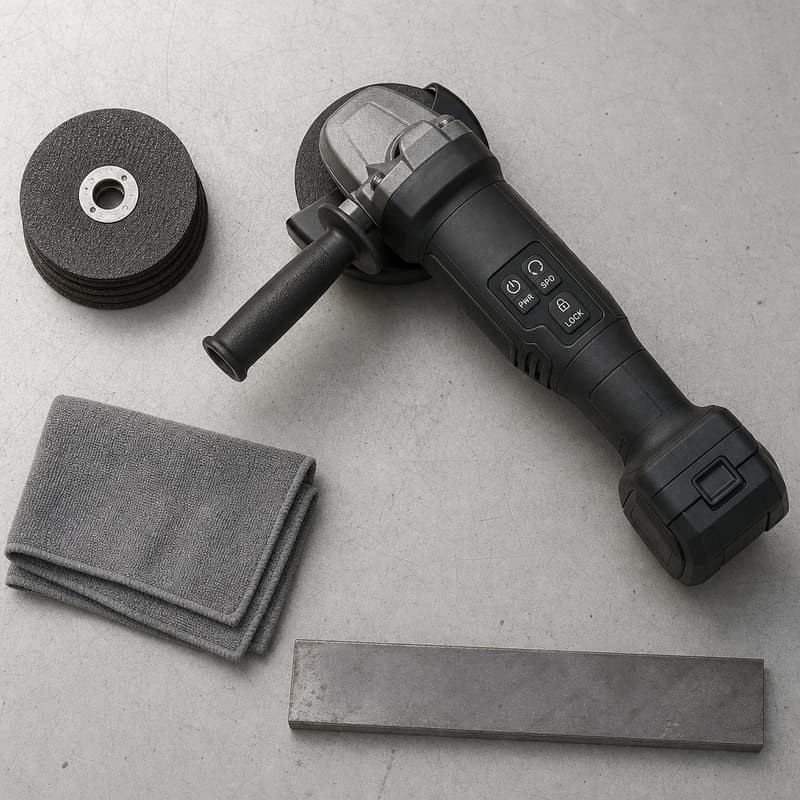
A grinder keypad hardly ever fails all at once. It fails one letter at a time. The first sign is not a fault report but a question from the shop floor: what does the third key from the left do now? By the time someone asks, the panel has already stopped being a control interface and become a set of positions that only experienced operators remember.
On a grinder, a worn legend is not a cosmetic issue
Panel markings on this class of tool are not decoration. The keys that lose readability first are usually the ones that change how the tool behaves rather than how fast it spins: lock, brake, overload reset, mode. If those become ambiguous, three things happen in sequence. Operators press by position from habit. A replacement tool with a slightly different layout breaks that habit. And the function that nobody is sure about gets avoided until it is needed.
That is why identification has to be treated as a functional requirement with an acceptance test, in the same way as force or travel, rather than as a finish decision made at the end of the programme. It also means the design question is not only how to make the print last longer. It is how to keep the panel identifiable on the day the print finally goes.
Three wear mechanisms that get treated as one
Legend failures on silicone keypads arrive under a single heading, but they are three separate mechanisms, and a fix aimed at the wrong one will not move the result.
Abrasion removes ink by friction across the face. On a grinder the counter-face is a glove, a rag, a sleeve, or dust sitting on the surface while any of those slide over it. The standard method for this is ASTM D5264, which determines the abrasion resistance of printed materials using the Sutherland rub tester, applying a controlled load and a set number of strokes against a specified counter-face.
Chemical attack softens, swells or lifts the ink rather than grinding it away. Solvent wipes, hand cleaners, degreasers, hydraulic oil and even some barrier creams attack different ink systems differently. ISO 2836 specifies methods for assessing the resistance of printed materials to liquid and solid agents, solvents, varnishes and acids, which is the right framework when the actual cleaning agent is known.
Adhesion loss is the print detaching from the silicone rather than wearing through. It almost always starts at the perimeter of a printed feature, where a tiny edge is available for a fingernail, a cloth fibre or a particle to get underneath. Adhesion is measured by ASTM D3359, the tape test methods for rating adhesion, and by the cross-cut method described in ISO 2409.
Small features fail first, and there is a geometric reason
Every printed feature has a perimeter, and the ratio of perimeter to area grows quickly as the feature gets smaller. Delamination and edge undercutting both start at that perimeter, so a panel covered in small symbols and short abbreviations has far more potential failure initiation points than one with a few large marks. This is the mechanism that makes a five-key strip with icon and text on every key age faster than a two-key panel with large markings, even when the ink, the coating and the substrate are identical. It is a layout consequence, and layout is decided long before the ink is chosen.
Choosing between screen printing and laser etching is a durability decision
Screen printing lays ink on the surface of the keypad. It supports multiple colours, gradients and fine detail, and it registers against a moulded feature. Its durability comes from the ink system and from whatever protective top coat sits over it, and its characteristic failure modes are the three above, in the order they are likely to appear on a grinder: abrasion first, chemical second, edge lifting whenever the surface preparation is weak.
Laser etching works the other way. It removes a top layer of coating or a moulded surface layer to reveal a different colour underneath, so the legend is defined by the material rather than by an ink layer sitting on top of it. There is no printed layer to abrade away, which is why etched legends resist friction wear well. The trade-offs are also real: etching is generally a single-colour-per-process technique that produces no gradients, and the etched texture is rougher than a printed surface, which holds dust more readily and can polish over time as that dust is worked against it.
Where a panel has keys with very different duty cycles, the two processes can be combined on one part. A high-traffic key can carry an etched legend while low-traffic keys carry printed ones, provided the finish difference is acceptable visually. That is a layout and process decision rather than a coating decision, and it is worth raising before the printing artwork is finalised.
The cleaning agent on site matters more than the datasheet
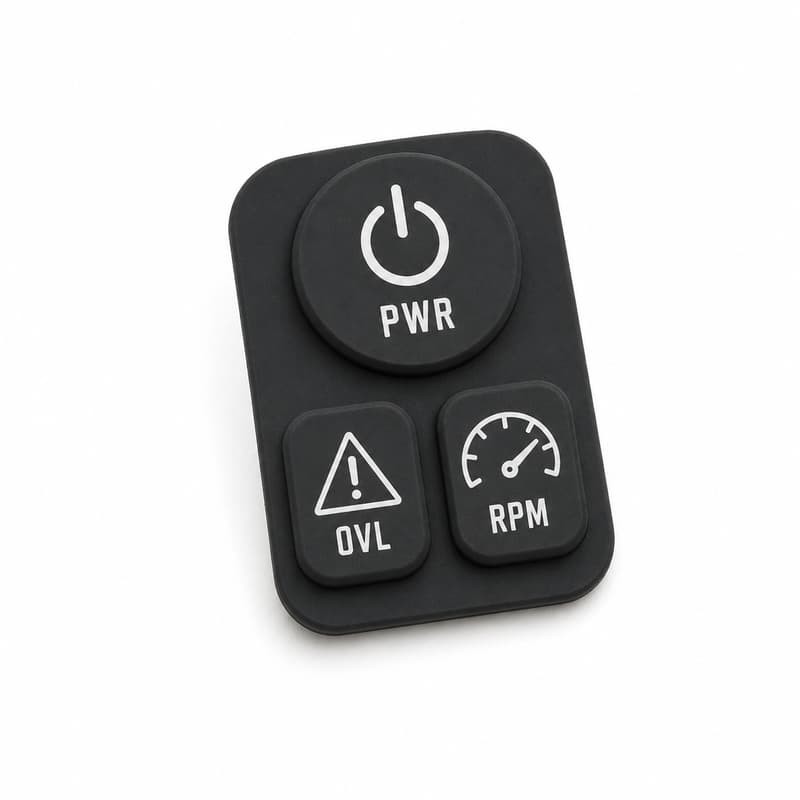
Chemical resistance is usually specified against a generic list, then invalidated in the field by whatever wipe the maintenance team actually uses. The most reliable route is to ask the customer to name the exact product they clean with, and then test the finished legend against that product using the ISO 2836 framework. Solvent-based wipes are the common culprit, and alcohol-based wipes have their own habit of attacking legends that survive everything else. If the answer changes, the ink system or the top coat has to change with it, and that is a different fix from improving abrasion resistance.
Design so the panel still works on the day the print goes
The most useful thing a designer can do about legend wear is to stop depending on the legend alone. Identification can be carried on three independent channels, and a panel that uses all three keeps working when the least durable one fails.
Position is the channel operators already use, and it is reliable only while the tool layout is stable. It carries no information to a new user or to someone picking up a different tool.
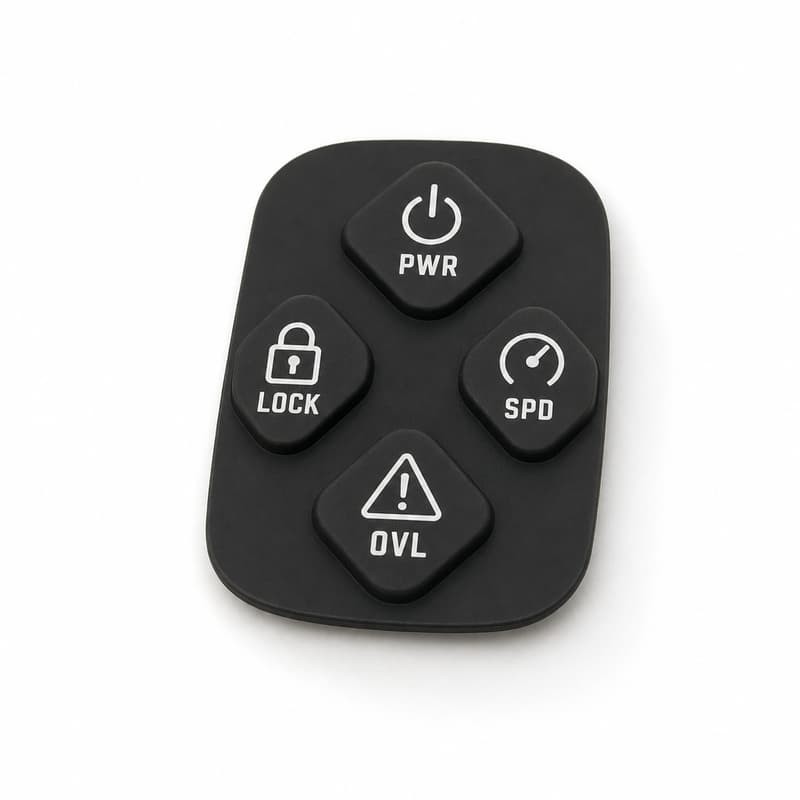
Outline and shape is the strongest channel available to a moulded keypad, because it is generated by the mould rather than by a print, so it does not wear. A key with its own silhouette is identifiable by touch through a glove as well as by sight, which matters on a tool that is often operated without looking at the panel.
Symbol is faster to read than an abbreviation and occupies less area, so it survives being printed smaller and survives partial wear better than a word does.
Colour is a fourth channel, but it is the weakest of the four on this type of product. Contrast drops as the panel gets dirty, and colour alone excludes operators with colour vision deficiency. It is worth using, but not worth relying on.
The practical rule that follows is short. Any key that changes the behaviour of the tool rather than its speed should be identifiable by shape alone. If a legend disappears entirely, the operator should still be able to reach the right key without reading anything.
What to write into the print specification
A legend requirement that can be accepted objectively names the process, the ink system, the surface preparation, the top coat and the test. It also names the test conditions, because a Sutherland rub result means nothing without the load and the stroke count, and an adhesion result means nothing without the tape grade and the timing between coating and test. Where the customer's cleaning routine is known, that agent belongs in the specification as a test medium rather than as a note in a document nobody reads.
What belongs on the keypad drawing for the printed legend
- Legend process named explicitly, screen printing, laser etching or a combination, with the reason for the choice recorded.
- Surface preparation method stated, so adhesion does not depend on whether the operator that day degreased the parts.
- Ink system and top coat named, with the cure schedule, since under-cured coatings pass a fresh test and fail in service.
- Abrasion acceptance by ASTM D5264, with sample load, stroke count and counter-face defined.
- Adhesion acceptance by ASTM D3359 or ISO 2409, tested after the abrasion and after the chemical exposure rather than instead of them.
- Chemical resistance assessed by the ISO 2836 approach against the cleaning agent actually used on site.
- Shape coding on any key that changes tool behaviour, so identification survives total legend loss.
Two panels, one ink system, opposite results
Two grinder panels built to the same print specification reached service within a few months of each other. One came back with legends that had worn thin at the centre of the most-used keys. The other came back with whole legends missing from three keys, with clean silicone underneath, which is the signature of adhesion loss rather than abrasion.
The difference was not the ink. It was the parts. Comparing production records, the second batch had been printed after a longer interval from moulding, and the surface preparation step had been shortened on the assumption that a cleaned part stays clean. Silicone surfaces are not inert to their environment, and the interval between moulding, preparation and printing turned out to be a processing variable nobody had written down. The abrasion failure in the first panel was a separate matter and was addressed by the top coat, but the second panel would never have been fixed by changing ink.
What the comparison produced was a written process window: a maximum interval between moulding and printing, an explicit preparation step, and a tape adhesion check on the first articles of every print run rather than on the first run of the year. None of that is a material change. It is the difference between a print specification and a print process.
The keypad supplies the moulded key shapes, the surface and the legend, and it has to match the board it closes against. The circuit layout and the switch design stay with the customer's electronics team, and FromRubber works to that drawing.
Questions that come up about silicone keypad legends on tools
Is laser etching always more durable than screen printing?
For friction wear, usually, because there is no applied ink layer to abrade. For chemical exposure and for multi-colour designs, not necessarily. Etched surfaces also hold dust more readily and can polish under repeated contact, so the appearance can degrade through a different route. The right comparison is against the specific wear mechanism that the tool actually experiences.
Why do small symbols disappear before large ones?
Because failure starts at the perimeter of a printed feature, and small features have a much higher perimeter to area ratio. A short abbreviation or a small icon offers many more edges where lifting can begin. Enlarging a symbol or replacing a word with a symbol both reduce the number of edges for a given amount of information.
Can a worn legend be repaired?
Not in a way that restores the original adhesion and appearance, because a repair sits on top of aged, contaminated material rather than on prepared silicone. On a tool where identification is safety-relevant, replacing the keypad is the reliable route. That is one more reason to design the panel so identification does not depend on the print alone.
FromRubber (Dongguan Bohao Electronic Technology Co., Ltd.) moulds custom silicone keypads, control panels and keypad strips, and reviews legend process selection, surface preparation and acceptance testing against the environment the panel will be used in. The technical notes above come from that review work and from the standards listed below.
Related reading
Sources
- [1] ASTM D5264-98(2019), Standard Practice for Abrasion Resistance of Printed Materials by the Sutherland Rub Tester. https://store.astm.org/d5264-98r19.html
- [2] Packaging Compliance Labs, the Sutherland rub test to ASTM D5264, used to evaluate how printed labels resist scuffing and smearing under controlled conditions. https://pkgcompliance.com/test/sutherland-rub/
- [3] Rycobel, abrasion resistance of printed materials to ASTM D5264 using the Sutherland or ink rub tester. https://www.rycobel.com/measure/standards/test-the-abrasion-resistance-of-printed-materials-astm-d5264
- [4] Industrial Physics, ASTM D3359 test methods for measuring adhesion by tape test, together with the ISO 2409 and GOST 15140 cross-cut equivalents. https://industrialphysics.com/standards/astm-d3359/
- [5] Micom Laboratories, ASTM D3359 tape adhesion testing and the related DIN EN ISO 2409 paints and varnishes cross-cut test. https://www.micomlab.com/micom-testing/astm-d3359/
- [6] ISO 2836:2021, Graphic technology - Prints and printing inks - Assessment of resistance of prints to various agents, covering liquid and solid agents, solvents, varnishes and acids. https://www.iso.org/standard/76452.html
- [7] Protective coatings for silicone keypads, a durability guide covering PU, matte and smooth top coats, their effect on legend clarity and readability, and the tendency of laser-etched surfaces to attract dirt. https://siliconekeypadfactory.com/blog/protective-coated-keypad-guide/
- [8] Comparison of silkscreen printing and laser etching for rubber keypads, covering legend methods, conductive options and available surface protective coatings including PU and matte finishes. https://www.rubber-keypad.com/silkscreen-laser-etching-rubber-keyboard.html
- [9] Laser etching versus screen printing for silicone keypads, including the point that screen printing is compatible with UV and PU protective coatings to increase abrasion resistance, while laser etching reveals a base layer for sharp, wear-resistant markings. https://www.silicone.com.hk/industry-news/silicone-keypad-laser-etching-silkscreen-printing/
- [10] Coating technologies for silicone rubber keypads, covering abrasion resistance, chemical resistance, UV stability and tactile performance in demanding environments. https://siliconekeypadfactory.com/coating/
- [11] Custom silicone keypad engineering guide covering actuation force, conductive contact selection and surface coatings for industrial applications. https://www.siliconefactories.com/custom-silicone-keypads-engineering-guide/
- [12] ASTM D2240-15(2021), Standard Test Method for Rubber Property - Durometer Hardness, referenced when the coated or etched legend is specified together with a hardness band. https://www.astm.org/d2240-15r21.html